
In 1885, my Great Grandfather, Stephanus Jaráb, was baptized in the Catholic Church in the village of Domanyóc, then located in the Kingdom of Hungary. The village is now known as Domaňovce and located in Slovakia (officially, the Slovak Republic). My Great Grandfather emigrated to the United States in December 1901 and changed the spelling of his surname to Yarab circa 1920.
Yarab is an Anglicized spelling of the Slovak surname Jaráb.[1] Jaráb is akin to the Czech word jeřáb, which has a primary definition meaning crane.[2] As such, Jaráb is a zoonym (which means that it is a name for a species of animal).[3]
Historically, zoonyms often were given originally to an individual as a nickname to reflect a trait associated with both the animal and the individual. For instance, when giving an individual the nickname crane, the trait could be very straight forward and prosaic, such as tall, loud, or noisy or more abstract and poetic, such as long-lived, merciful, or vigilant. These latter traits, and other similar intangible traits, and how they came to be associated with cranes, are discussed in greater detail below after a few more words about the cranes likely to be encountered in Slovakia.
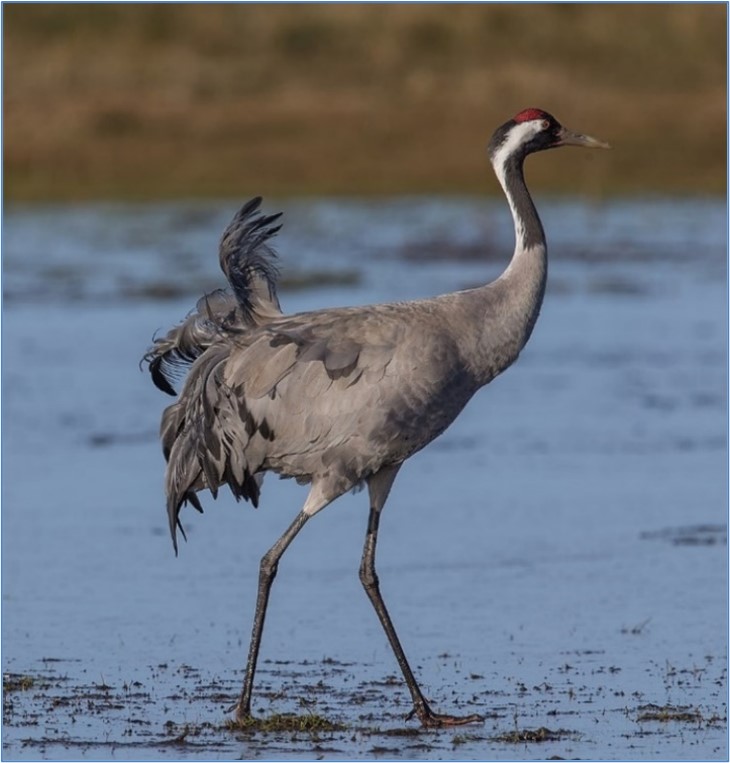
Any Slovak receiving Jaráb as a nickname or a surname was most likely named after the Eurasian crane, the only crane generally found in Slovakia and Central Europe. The Eurasian crane, also known as the common crane, was first formally described in 1758 by the Swedish naturalist Carl Linnaeus under the binomial taxonomic name Ardea grus.[4] Grus is the Latin word for crane. Ardea grus translates as “soaring crane.” Today, its taxonomic name is simply grus grus. In Czech, the Eurasian crane is called the jeřáb popelavý, which translates as ash crane.[5]
The Eurasian crane is a large, stately bird. It is 39–51 inches long with a wingspan of 71–94 inches. Its body weight ranges from 6.6 to 13.4 pounds. Males are slightly heavier and larger than females. The species is slate-grey overall. The forehead and lores are blackish with a bare red crown and a white streak extending from behind the eyes to the upper back. The overall color is darkest on the back and rump and palest on the breast and wings. The primaries, the tips of secondaries, the alula, the tip of the tail, and the edges of upper tail coverts are all black and the greater coverts droop into explosive plumes. This combination of coloration distinguishes it from similar species in Asia. The juvenile has yellowish-brown tips to its body feathers and lacks the drooping wing feathers and the bright neck pattern of the adult and has a fully feathered crown. Every two years, before migration, the adult common crane undergoes a complete molt, remaining flightless for six weeks, until its new feathers grow. It has a loud trumpeting call, given in flight and display. The call is piercing and can be heard from a considerable distance. It has a dancing display, leaping with wings uplifted.[6]
The loud, trumpeting call, described above as piercing, immediately calls to mind the reputation of the crane among the tenth century Bāshghirds, a Turkic people, who were encountered by Ahmad ibn Faḍlān ibn al-ʿAbbās ibn Rāšid ibn Ḥammād, a tenth century envoy to the king of the Volga Bulgars (whom he identified as king of the Saqaliba, or Slavs) for the Abbasid Caliph al-Muqtadir bi-llāh (reigned 908-932 AD). Ibn Faḍlān left a famous account of his embassy and the peoples he encountered on his journey, including the Bāshghirds. He recorded crane worship by one of the clans of the Bāshghirds:
We saw a clan that … worships cranes. These told me that one day, while they were fighting some of their enemies and were on the point of being defeated, the cranes began to give their call behind their opponents. Their enemy was frightened and turned and fled. This is why they worship cranes.[7]
So, perhaps a trait of the cranes that can be associated with the name Jaráb could be cunning or ferocity in conflict. Or, perhaps, just the propensity to make loud, piercing noises.
Interestingly, divinity was also associated with cranes by the Arabs in pre-Islamic southern Arabia. Specifically, the three chief goddesses of Mecca in the pre-Islamic era were Allāt, Uzza, and Manāt. In the Book of Idols these goddesses were identified as “three exalted cranes” and the Quraysh, the powerful mercantile tribe that dominated Mecca, were to chant the following verses as they circumambulated the Kaaba (the then pagan shrine in the center of Mecca):
By al-Lat and al-‘Uzza,
And Manat, the third idol besides.
Verily they are the Numidean cranes,
Whose intercession is to be sought.[8]
An extraordinary anecdote related to these “three exalted cranes,” regarded as having historical foundation, is recorded in the Satanic Verses regarding Mohammed’s momentary approval of these divinities as intercessors in the interests of the advancement of his cause makes for fascinating reading.[9]
Christianity has long held cranes in high esteem. Isidore of Seville (d. 636 AD), Bishop and prolific author, wrote of cranes (grues) the following:
[they] take their name from the murmuring sound they make. When they are travelling somewhere they follow the letters of the alphabet. They fly at great altitude so they can see the lands they seek. The leader in flight maintains the line of birds with its voice; when it grows hoarse another bird takes its place. At night they take turns acting as guard; the one on duty holds a small stone in its claws to hold off sleep and cries out at anything to be feared. Their age is revealed by their color, because the darken as they grow old (Etymologies, Book 12, 7:14-15).
The ever-venerated Saint Anthony of Padua (d. 1231 AD), Doctor of the Church, preached in his Sermons: Merciful Men Compared to Cranes:
Let us, therefore, be merciful, and imitate the cranes, who, when they set off for their appointed place, fly up to some lofty eminence, in order that they may obtain a view of the lands which they are going to pass. The leader of the band goes before them, chastises those that fly too slowly, and keeps together the troop by his cry. As soon as he becomes hoarse, another takes his place; and all have the same care for those that are weary; so that if anyone is unable to fly, the rest gather together, and bear him up till he recovers his strength. Nor do they take less care of each other when they are on the ground. They divide the night into watches, so that there may be a diligent care overall. Those that watch hold a weight in one of their claws, so that, if they happen to sleep, it falls on the ground and makes a noise, and thus convicts them of somnolency. Let us, therefore, be merciful as the cranes; that, placing ourselves on a lofty watchtower in this life, we may look out both for ourselves and for others, may lead those that are ignorant of the way, and may chastise the slothful and negligent by our exhortations. Let us succeed alternately to labour. Let us carry the weak and infirm, that they faint not in the way. In the watches of the night, let us keep vigil to the Lord, by prayer and contemplation.[10]
Other cultures have found the beauty and traits of the cranes to be equally enticing. Myths, stories, poetry, and sermons about the birds abound in many cultures with records dating back to antiquity in areas as geographically diverse as India, the Aegean, China, Korea, Japan, and North America.

In northern Hokkaidō, the women of the Ainu people performed a crane dance that was captured in 1908 in a photograph by Arnold Genthe.[11] In Korea, a crane dance has been performed in the courtyard of the Tongdosa Temple since the Silla Dynasty (646 AD).
The Sanskrit epic poet Valmiki was inspired to write the first śloka couplet by the pathos of seeing a male sarus crane shot by a hunter while dancing with its mate. Valmiki, greatly moved by the piteous cries of the slain crane’s mate, cursed the hunter with the following verse:
No fame is thine for endless time,
Because, base outcast, of thy crime,
Whose cruel hand was fain to slay,
One of this gentle pair at play![12]
In China, several styles of kung fu take inspiration from the movements of cranes in the wild, the most famous of these styles being Wing Chun, Hung Gar (tiger crane), and the Shaolin Five Animals style of fighting.  Crane movements are well known for their fluidity and grace.
The ancient Greeks, ever capable of transforming the most humble of creatures into the most virtuous of beings, recount the tale of Ibycus, a 6th century BC Greek poet, and the cranes. In one version of the tale, a thief attacked Ibycus and left him for dead. Thereupon, as Ibycus lay dying, he called upon a sedge of passing cranes to avenge him. The cranes, in conformity with the charge impressed upon them by Ibycus, followed the attacker to a theater and hovered over him until, stricken with guilt, the attacker confessed to the crime. The cranes thus became the avengers of Ibycus. In another telling of the tale by the second century BC Greek poet Antipater of Sidon, the story is told thusly:
Ibycus, robbers murdered you when one day you came from the ship to a desolate trackless beach, but only after you had cried out to a cloud of cranes which came as witnesses to your grievous death. Nor did you shout in vain, for thanks to their screams an avenging Fury exacted the penalty for your killing in the land of Sisyphus. O greedy robber-bands, why do you not fear the anger of the gods? Even Aegisthus who in olden days murdered the bard did not escape the eye of the black-robed Eumenides.[13]
The Greeks were enamored of the tale and had yet another version in which robbers betray themselves not through guilt, but through careless mocking of the “avenging” cranes:
Ibycus: son of Phytius; but some say son of the historian Polyzelus of Messana, others son of Cerdas; of Rhegium by birth. From there he went to Samos when it was ruled by the father of the tyrant Polycrates. This was in the time of Croesus, in the 54th Olympiad (564/560 BC). He was completely crazed with love for boys, and he was the inventor of the so-called sambyke, a kind of triangular cithara. His works are in seven books in the Doric dialect. Captured by bandits in a deserted place he declared that the cranes which happened to be flying overhead would be his avengers; he was murdered, but afterwards one of the bandits saw some cranes in the city and exclaimed, ‘Look, the avengers of Ibycus!’ Someone overheard and followed up his words: the crime was confessed, and the bandits paid the penalty; whence the proverbial expression, ‘the cranes of Ibycus.’[14]
Plutarch, the famous Greek philosopher, historian, and essayist, was quick to draw moral instruction from this latter version of the tale in his essay “Concerning Talkativeness.” He attributed the lesson to be gained from the story not to the avenging nature of the cranes, but to the misfortune that comes from an unguarded tongue:
Were not the murderers of Ibycus caught in the same way? They were sitting in a theatre, and when the cranes came in sight, they laughed and whispered to each other that the avengers of Ibycus were come. Persons sitting near overheard them, and since Ibycus had disappeared and now for a long time had been sought, they caught at this remark and reported it to the magistrates. And thus the slayers were convicted and led off to prison, not punished by the cranes, but compelled to confess the murder by the infirmity of their own tongues, as it were some Fury or spirit of vengeance.[15]
The tale also compelled no less than that most extraordinary German poet, playwright, and philosopher Friedrich Schiller (most famous to Americans, no doubt, for penning the poem “Ode to Joy,” which Ludwig van Beethoven used in the fourth movement of his Ninth Symphony) to put ink to manuscript in 1797 to compose a beautiful ballad based on the murder of Ibycus and the avenging cranes. In it, a dying Ibycus calls upon the cranes to avenge his death in beautiful melodious prose:
“Ye cranes, that sweep through upper air,
Though hushed be every human breath,
The tidings of my murder bear,”
He cried, and closed his lips in death.[16]
Pliny the Elder wrote that cranes would appoint one of their number to stand guard while they slept. The sentry would hold a stone in its claw, so that if it fell asleep, it would drop the stone and awaken.[17] Recall that Saint Anthony made the same observation about the utility of the stone in the crane’s claw in the sermon discussed above.
 A crane holding a stone in its claw is a well-known symbol in heraldry, and is known as a crane in its vigilance.
Greek and Roman myths often portrayed the dance of cranes as a love of joy and a celebration of life. The crane was associated, for instance, with Hephaistos, the Olympian god of fire, smiths, craftsmen, metalworking and stone masonry, for the god was said to have dwelt on the shores of the earth-encircling River Okeanos in his early days, the wintering grounds of the migrating crane and his donkey-saddle or chariot was often depicted decorated with crane-heads.
Similarly, Apollo, the Olympian god of prophecy and oracles, music, song and poetry, archery, healing, plague and disease, and the protection of the young, often disguised himself as a crane when visiting the mortal world. Additionally, the crane was viewed to be a bird of Apollo as a herald of spring and light.  Finally, Greek for crane is Γερανος (geranos), which gives us the hardy geranium, also known as the cranesbill after the beaklike fruit that follows the flowers.
In pre-modern Ottoman Empire, sultans would sometimes present a piece of crane feather [Turkish: turna teli] to soldiers of any group in the army (janissaries, sipahis etc.) who performed heroically during a battle. Soldiers would attach this feather to their caps or headgears which would give them some sort of a rank among their peers.
Throughout Asia, the crane is a symbol of happiness and eternal youth. In Japan, the crane is one of the mystical or holy creatures, along with the dragon and the tortoise, and symbolizes good fortune and longevity because of its fabled life span of a thousand years.  The crane is one of the subjects in the tradition of origami, or paper folding. An ancient Japanese legend promises that anyone who folds a thousand origami cranes will be granted a wish by a crane.
Thus, traits traditionally associated with the crane, and thus with the surname Yarab, are merciful, vigilant, cunning, graceful, joyful, happy, long-lived, and fierce.
According to the U.S. Census bureau, the Yarab surname, spelled as such, was counted less than one hundred times when it tabulated the 2010 U.S. Census. Similarly, the original Slovak surname Jaráb or Jarab, and the other Anglicized spelling of the surname, Yarb, was counted less than one hundred times during the 2010 U.S. Census.[18] Accordingly, the Yarab surname and its variations are very uncommon names in the United States.
Today, we find that, though an uncommon surname, Yarabs of Slovak heritage are spread throughout the United States. A survey readily finds that, in 2021, individuals with the surname Yarab are resident in states as diverse as Ohio, Pennsylvania, Georgia, Florida, Arizona, Washington, Michigan, Alabama, South Carolina, and North Carolina.
The Yarabs of the Mahoning Valley in north-eastern Ohio are originally from the Spiš region in north-eastern Slovakia. The original Jaráb surname can still be encountered in the Spiš region, especially in the small villages from which our family emigrated or were associated with over one hundred years ago, including the village of Bijacovce.
[1] Though Yarab can be an Arabic surname, for those of us descended from Stefan Jaráb, it is not – it is a Slovak surname in origin. I mention this as on many occasions throughout my life I have been advised by new acquaintances that my surname is a venerable name carrying significant historical and cultural meaning in Arabic; yet, in truth, I have just as often encountered bigots who assumed it was an Arabic name who immediately behaved in an uncivil, uncouth manner towards me on that account alone.
For those who are curious, in Arabic, Yarab may be a transliteration of the Arabic يا رب [Ya Rabb, Ya Rab], which translates to the traditional Arab invocation or blessing (and occasionally expression of frustration), “O Lord” or “O God.” Alternatively, it may be a transliteration of يعرب [Ya’rub, Yarob, Ya’rob, Yarrob, Yarab, or Yaarub], which means “he expresses” or “he articulates” in English, and, more importantly, is an ancient Arabic personal name of some significance. Specifically, Ya’rub was the name of the grandson of Abir, being the son of Qahtan, and the ancestor of the Himyarite and Sabaean kings of Yemen. Another account places Ya’rub as Qahtan’s grandson (Ya’rub bin Yashjub bin Qahtan) and holds that he is the forefather of al-‘Arab al-‘Ariba (“the pure Arabs”). Some legendary accounts suggest that Ya’rub was the first to speak Arabic, and that the language was named after him. Shams-i Qais Razi, writing in the 12th-13th century AD, traced the origins of Arabic poetry to Ya’rub and credited him with creating the Kufic script. In Arabian folklore, Ya’rub is considered one of the greatest Arab kings and the first to rule the lands of Yemen in southwestern Arabia. His grandson, King Sheba (known in Arabic as Saba’), founded the Sabaean Kingdom, which is also mentioned in the Qur’an.
Therefore, while Yarab may indeed be a venerable name in Arabic, as I have often been advised by those inquiring about the origin of my surname, in our lineage, it connects to our Slovak heritage.
[2] Kott, František Štěpán. 1878. Česko-německý Slovník zvláště Grammaticko-fraseologický. Prague: J. Kolář. p. 601. Modern Czech dictionaries generally provide three definitions for Jeřáb: crane (as in the bird); crane/derrick; and rowan (as in European Mountain Ash/Sorbus aucuparia). The modern Slovak word for a feathered crane, retrieved from proto-slavic roots, is žeriav, see https://slovnik.juls.savba.sk/?w=žeriav and for the ash crane (that is the Eurasian crane) is Žeriav popolavý.
An early alternative spelling for crane in Slovak was Garáb (Bernolák, Antonio. 1825-1827. Slowár slowenskí česko-latinsko-ňemecko-uherskí: seu, Lexicon slavicum bohemico-latino-germanico-ungaricum. Buda: Typis et Sumtibus Typogr. Reg. Univ. Hungaricae. p. 613). This dictionary noted the primary definition for Garáb as crane (i.e., Ardea Grus (the Eurasian crane)) and a secondary definition as Strom (tree): sorbus (i.e., Sorbus aucuparia (European Mountain Ash)).
Bernolák’s dictionary was published after his death by his admirer Juraj Palkovič. Tomasz Kamusella stated that “Bernolák himself called this new written language, ‘Pannonian Slavic,’ the ‘Slavic language in Hungary,’ or simply ‘the Slavic language.'” Kamusella said that “with his dictionary Bernolák did not wish to codify a Slovak language but compiled it for the sake of spreading the knowledge of Magyar among the Slavophone inhabitants of Upper Hungary. He recognized Slovak as the mother tongue of this population and appealed for its use in books and education. However, Bernolák continued to see Hungary as the patria of all who lived in the country, whatever languages they might happen to speak. He never proposed that there existed some separate ‘natio slovaca,’ let alone a ‘Slovak nation.” Finally, Kamusella noted that Palkovič opposed attempts, which occurred c. 1830, at replacing [g] with [j], [w] with [v], etc., in the spelling of words that occurred in Bernolák’s system. Kamusella, Tomasz. 2012. The Politics of Language and Nationalism in Modern Central Europe. New York: Palgrave MacMillan. pp. 530-537. In any event, the Jarábs of Spiš were attested as using the J rather than the G for their surname in baptismal records as early as the 1780s and never spelled their surname with a G.
[3] Room, Adrian. 1996. An Alphabetical Guide to the Language of Name Studies. Lanham and London: The Scarecrow Pressoom. p. 106.
[4] Linnæus , Carl. 1758. Systema naturæ per regn a tria naturæ, secundum classes, ordines, genera, species, cum characteribus, differentiis, synonymis, locis. Tomus I. Editio decima, reformata. Stockholm: Salvius. pp. 141-142.
[5]It is not at all surprising that it is known as the ash crane as even the ancient Greeks were quick to note, as a distinguishing characteristic, the ashen-color of the crane. The famous Greek philosopher and polymath Aristotle himself wrote the following: “With regard to feathered animals, such as birds, none undergoes a change [of color] through age except the crane, which begins as ashen-colored and as it grows old its feathers get blacker.” See p. 209. Aristotle. History of Animals, Volume I: Books 1-3. Translated by A. L. Peck. Loeb Classical Library 437. Cambridge, MA: Harvard University Press, 1965.
[6] https://en.wikipedia.org/wiki/Common_crane
[7] Paul, Lunde, and Caroline Stone. 2012. Ibn Faḍlān and the Land of Darkness: Arab Travellers in the Far North. New York: Penguin Classics. p. 24.
[8] Ibn al-Kalbi, Hashim, and Nabith Amin translated by Faris. 2015. The Book of Idols: Being a Translation from the Arabic The Kitab Al-Asnam. Princeton: Princeton University Press. p. 17.
[9] “Now the apostle was anxious for the welfare of his people [the Quraysh], wishing to attract them as far as he could. It has been mentioned that he longed for a way to attract them, and the method he adopted is what Ibn Hamid told me that Salama said M. b. Ishaq told him from Yazid b. Ziyad of Medina from M. b. Ka`b al-Qurazi: When the apostle saw that his people turned their backs on him and he was pained by their estrangement from what he brought them from God he longed that there should come to him from God a message that would reconcile his people to him. Because of his love for his people and his anxiety over them it would delight him if the obstacle that made his task so difficult could be removed; so that he meditated on the project and longed for it, and it was dear to him. Then God sent down “By the star when it sets your comrade errs not and is not deceived, he speaks not from his own desire,”[Q. 53:1-3] and when he reached His words “Have you thought of al-Lat and al-`Uzza and Manat the third, the others”[Q. 53:19-20], Satan, when he was meditating upon it, and desiring to bring it (sc. reconciliation) to his people, put upon his tongue “these are the exalted Gharaniq [high flying cranes] whose intercession is approved”. When the Quraysh heard that, they were delighted and greatly pleased at the way in which he spoke of their gods and they listened to him; while the believers were holding that what their prophet brought from their Lord was true, not suspecting a mistake or a vain desire or slip, and when he reached the prostration and the end of the Sura in which he prostrated himself the Muslims prostrated themselves when their prophet prostrated confirming what he brought and obeying his command, and the polytheists of the Quraysh and others who were in the mosque prostrated when they heard the mention of their gods, so that everyone in the mosque believer and unbeliever prostrated, except al-Walid b. al-Mughira who was an old man who could not do so, so he took a handful of dirt from the valley and bent over it. Then the people dispersed, and the Quraysh went out, delighted at what had been said about their gods, saying, “Muhammad has spoken of our gods in splendid fashion. He alleged in what he read that they are the exalted Gharaniq whose intercession is approved”.
The news reached the prophet’s companions who were in Abyssinia, it being reported that the Quraysh had accepted Islam, so some men started to return while others remained behind. Then [the angel] Gabriel came to the apostle and said, “What have you done, Muhammad? You have read to these people something I did not bring you from God and you have said what He did not say to you.” The apostle was bitterly grieved and was greatly in fear of God. So, God sent down (a revelation), for he was merciful to him comforting him and making light of the affair and telling him that every prophet and apostle before him desired as he desired and wanted what he wanted, and Satan interjected something into his desires as he had on his tongue. So, God annulled what Satan had suggested and God established His verses i.e., you are just like the prophets and apostles. Then God sent down: “We have not sent a prophet or apostle before you but when he longed Satan cast suggestions into his longing. But God will annul what Satan has suggested. Then God will establish his verses, God being knowing and wise”[Q. 22:52]. Thus, God relieved his prophet’s grief, and made him feel safe from his fears and annulled what Satan had suggested in the words used above about their gods by his revelation “Are yours the males and His the females? That were indeed an unfair division” (i.e., most unjust); “they are nothing by names which your fathers gave them” as far as the words “to whom he pleases and accepts”[Q. 53:21-26], i.e., how can the intercession of their gods avail with Him? When the annulment of what Satan had put upon the prophet’s tongue came from God, Quraysh said: “Muhammad has repented of what he said about the position of your gods with Allah, altered it and brought something else.” Now those two words which Satan had put upon the apostle’s tongue were in the mouth of every polytheist and they became more violently hostile to the Muslims and the apostle’s followers. Meanwhile those of his companions who had left Abyssinia when they heard that the people of Mecca had accepted Islam when they prostrated themselves with the apostle, heard when they approached Mecca that the report was false, and none came into the town without the promise of protection or secretly.” Guillaume, Alfred. 1998. The Life of Muhammad: A translation of Ishaq’s Sirat Rasul Allah. Karachi: Oxford University Press. pp. 165-167.
[10] Neale, John Mason. 1856. Mediæval Preachers and Mediæval Preaching, A Series of Extracts, Translated from the Sermons of the Middle Ages, Chronologically Arranged; with Notes and an Introduction . London: J & C Mozley. pp. 245-246.
[11] See figure 2. Genthe, A., photographer. (1908) Crane dance of the Ainu women. 1908 Retrieved from the Library of Congress, https://loc.gov/item/2018720053/.
[12] https://www.baps.org/EnlighteningEssays/2013/Valmiki—The-First-Poet-(Part-2)-4552.aspx
[13] Stesichorus, Ibycus, Simonides. Edited and translated by David A. Campbell. 1991. Greek Lyric, Volume III: Stesichorus, Ibycus, Simonides, and Others. Cambridge: Harvard University Press. p. 213
[14] Stesichorus 1991. pp. 209-211.
[15] Plutarch, and W. C. Translated by Hembold. 1939. Moralia, Volume VI: Can Virtue Be Taught? On Moral Virtue. On the Control of Anger. On Tranquility of Mind. On Brotherly Love. On Affection for Offspring. Whether Vice Be Sufficient to Cause Unhappiness. Cambridge: Harvard University Press. p. 439.
[16] See https://de.wikisource.org/wiki/Die_Kraniche_des_Ibycus for the original German version of Die Kraniche des Ibycus as well as an audio file which provides a dramatic recitation of the ballad in German and http://www.poetryatlas.com/poetry/poem/3114/the-cranes-of-ibycus.html for a fine English translation of the ballad by C. T. Brooks.
[17] “By the departure of the cranes, which, as we have already stated, were in the habit of waging war with them, the nation of the Pygmies now enjoys a respite. The tracts over which they travel must be immense, if we only consider that they come all the way from the Eastern Sea. These birds agree by common consent at what moment they shall set out, fly aloft to look out afar, select a leader for them to follow, and have sentinels duly posted in the rear, which relieve each other by turns, utter loud cries, and with their voice keep the whole flight in proper array. During the night, also, they place sentinels on guard, each of which holds a little stone in its claw: if the bird should happen to fall asleep, the claw becomes relaxed, and the stone falls to the ground, and so convicts it of neglect. The rest sleep in the meanwhile, with the head beneath the wing, standing first on one leg and then on the other: the leader looks out, with neck erect, and gives warning when required. These birds, when tamed, are very frolicsome, and even when alone will describe a sort of circle, as they move along, with their clumsy gait.” Bostock, John (1855). The Natural History of Pliny, (London) Book X, Chapter 30. See: http://data.perseus.org/citations/urn:cts:latinLit:phi0978.phi001.perseus-eng1:10.30








 Northcoast Antiquarian