
Here at the end of all my winding days,
behind me look I shall not, lest I see
what well I know, yet shrink to look upon:
one set of prints, and none beside my own.
Yet worse, and past all bearing of the heart,
to turn, and find the green grass ris’n again
where I had passed, and not a print of me,
no sign whatever that I once had been.

A Bolognino of Charles III di Durazzo
From Ovid’s Sulmona to Benedict’s Rome
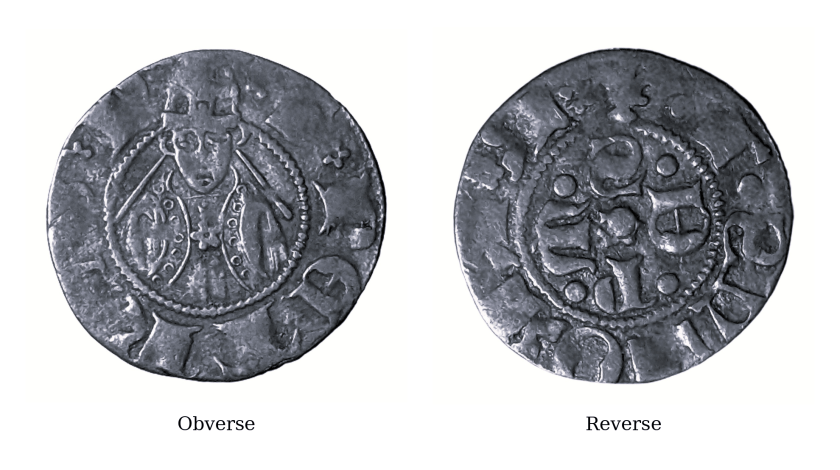
Charles III of Durazzo, King of Sicily, 1381-1386,
King of Hungary, 1385-1386.
AR Bolognino of Sulmona,
.82 g., struck 1382-1385.
Obverse: Bust of St. Peter Celestine
with S PETRVS P inscription around.
Reverse: R•KROLVS•T• inscription around
with •S•M•P•E in center around pelleted cross saltire.
Reference: MEC 14, 727 variant.
Recently, I spent time attributing various coins from a small assemblage of medieval coins I purchased a decade or two ago that were either wholly unattributed or erroneously attributed by their previous owner. After all this time, I have finally turned my attention to cataloguing the coins properly. One of the coins was previously grossly misidentified as an obol from Bergamo when, in fact, I found that it was a bolognino minted in Sulmona, a much more interesting attribution, as will be discussed below. The coin is illustrated above.
The general type is familiar, and common, enough. Two examples are illustrated below. The similarities with my coin will be obvious, as will be the dissimilarities.
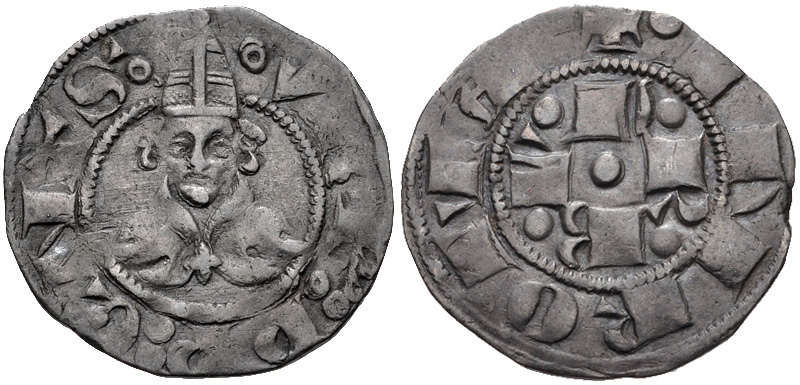
AR Bolognino, 18mm, 1.33 g. Rome mint.
Obverse: · VRB’ : P P : QNTS’ · (annulet and double annulet stops throughout), mitred bust facing
Reverse: + · IN ROMЯ · inscription around, •V•R•B•I as central device within beaded circle.
References: CNI XV 8; Muntoni 3; Berman 198.
Source: CNG: The Coin Shop, 933495.
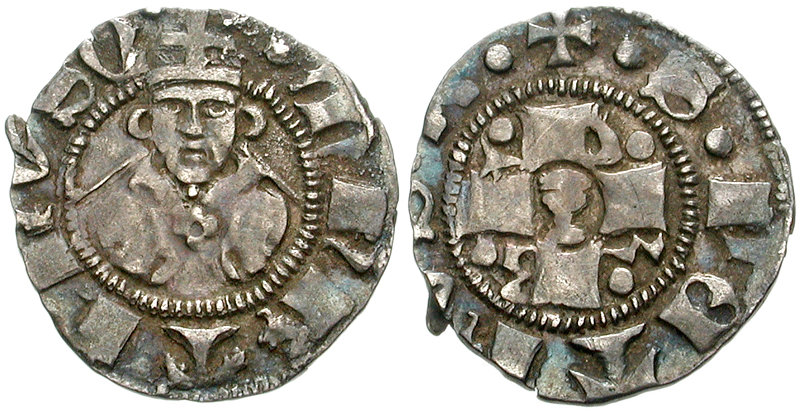
AR Bolognino (15mm, 0.82 g, 6h). Rome mint.
Obverse: + mARTInVS Q, mitred bust facing
Reverse: +•S•PЄTRVS• inscription around, •V•R•B•I as central device within beaded circle
References: CNI XV 61; Muntoni 21; Berman 274.
Source: CNG, The Coin Shop, 820494. Ex Luparello Collection.
The similarities between my coin’s obverse and the general type are obvious and immediate. All three obverses present a mitred, front-facing papal bust within a beaded border, identified by encircling legends: VRB PP on the Urban piece, mARTInVS on the Martin piece, and S. PETRVS on mine. The reverses, too, share marked similarities: four rather heavy-looking letters are set as a central device in a cross-like pattern at the cardinal points, with pellets placed in the four diagonal angles and at the center, forming a saltire cross, all enclosed within a beaded border. Each coin’s outer legend, too, lends further identification of its origin: for Urban’s coin, an inscription declaring origin, IN ROMЯ; for Martin’s, one naming the see, S PЄTRVS; and for mine, one naming the sovereign who issued the coin, R KROLVS T (Rex Karolus Tertius).
The dissimilarities are subtle but significant. Urban’s and Martin’s obverse legends name a reigning pope in each instance, making it easy to identify the authority issuing the coins. Mine names, on its face, only S. PETRVS P and at first blush one would identify this as Saint Peter the Apostle, the first pope, making identification of the issuer difficult as the coin is not of such antiquity (but for the identification of Rex Karolus Tertius on the reverse). But we shall return to the true identity of this Saint Peter momentarily. The reverses have marked dissimilarities also. The center lettering on Urban’s and Martin’s coins spells VRBI, an unambiguous declaration that these coins are products of the City, that is, Rome. My coin’s central letters, S M P E, are cryptic by comparison, revelatory only to a those familiar with Ovid’s Tristia, specifically 4.10.1–4:
Ovid, Tristia 4.10.1–4:
Ille ego qui fuerim, tenerorum lusor amorum,
quem legis, ut noris, accipe posteritas.
Sulmo mihi patria est, gelidis uberrimus undis,
milia qui nouiens distat ab urbe decem.That man I was, you know him from these lines,
the playful poet once of tender loves
receive this, posterity, and learn his name.
Sulmo is my homeland, rich in ice-cold springs,
ninety miles distant from the city’s gates.
The four letters S M P E reflect the initial letters of four words from the poem: Sulmo Mihi Patria Est — the opening words of the couplet’s third line. Ovid, writing the autobiographical Tristia from exile on the Black Sea around AD 12, gives his birthplace before he gives almost anything else about himself. Whoever cut the die for this coin took that line and folded its initials into the same cross-and-saltire device that, on other bolognini, named nothing more than the City, Rome. These letters on this bolognino therefore tell us that the coin was struck at Sulmona.
The choice of these letters on the reverse also reveals the identity of the S. PETRVS on the obverse. He is Sulmona’s own Saint Peter, Pietro da Morrone, born Pietro Angelerio, hermit of Monte Morrone a few miles outside the city walls, elected and crowned Pope Celestine V in 1294, canonized in 1313 as San Pietro Celestino, and venerated ever since as the town’s own adopted son raised to the papacy. Thus, the coin’s obverse names its saint; the reverse names its town; and the coin’s issuing authority, the Rex Karolus Tertius identified on the reverse, turns out to be Charles III di Durazzo, who is almost incidental to the coin as it is a coin about Sulmona, not the king who issued it.
Celestine V, as noted above born Pietro Angelerio and known from his hermitage on Monte Morrone as Pietro da Morrone, was, prior to being elected and serving as Catholic pontiff for five months in 1294 AD, a monk and a hermit who founded the Celestines, a branch of the Benedictine Order that survived until the 18th century. He was elected pontiff in the Catholic Church’s last non-conclave election after a two-year impasse without a pope. Though his reign was short, and many of his acts were canceled by his successor, two extraordinary edicts survived from his reign: his confirmation of the right of a pope to abdicate and his reinstatement of conclave regulations established by Gregory X’s bull Ubi periculum.
On December 13, 1294, a week after confirming that pontiffs could abdicate, Celestine V himself resigned, stating that he desired to return voluntarily to his monastic, pre-papal life. Unfortunately, his successor, Boniface VIII, fearing that the former Celestine V would be installed as an antipope against him, imprisoned his predecessor in the castle of Fumone, where he died on May 19, 1296. Pietro Angelerio, the man who had been pontiff Celestine V, was canonized by Pope Clement V on May 5, 1313.
It cannot go unnoticed that Pope Benedict XVI proclaimed a Celestine Year in 2009–2010 to mark the eight-hundredth anniversary of Pope Celestine V’s birth, and in July 2010 knelt before Celestine’s relics in Sulmona’s own cathedral. Whether those gestures were, in retrospect, unwitting rehearsal for his own resignation in 2013 — using the very mechanism of abdication Celestine had established seven centuries earlier — is a question the record does not settle. But the resonance, once noticed, is difficult to set aside.
Thus, the coin I have attributed to Sulmona becomes, in the end, a hinge between two distant moments: Ovid’s line, composed around 12 AD, cast in cipher on the coin’s reverse; and the papal practice of resignation formalized by the man on the coin’s obverse, invoked, seven centuries later, by the next pope to resign, Benedict XVI, in AD 2013. This humble bolognino, struck sometime between 1382 and 1385 AD, stands as a hinge across a resonance spanning, in the end, two thousand and one years, from Ovid’s Sulmona to Benedict’s Rome.
Share this:

Uncut
Before the word, the light stood whole—
no edge to catch it, no angle
to prove it was there at all.
Then the word came, a shadow
thrown backward across the light,
trying to give an edge to what
threw no shadow of its own.
This is the failure built into naming:
the stone is cut so it can shine,
and cutting is a kind of loss—
a wound the light forgives
by entering it anyway.
So the word is not the thing.
It is the facet, not the fire.
Hold it still and it goes dark;
turn it, and for one breath
it remembers what it came from.
That breath is the poem.
Not the gem. The glimmer.
Share this:

The Cusan Sky
When color fails and sepia ascends,
it is not a lesser kingdom taking the throne—
it is the throne admitting
it was always borrowed light.
Blue steps down first,
humblest of the courtiers,
having pretended sky long enough.
Then green,
then every noon-loud hue,
filing out like a court dismissed
from a kingdom never theirs.
What ascends is not a color at all
but the confession beneath color—
the brown of old earth,
old paper,
old bone,
the ground from which all colors briefly rose,
waiting
the way silence waits
under every word
that thought itself necessary.
This is not dusk.
Dusk still bargains with the sun.
This is the sky
relinquishing every borrowed name,
becoming itself
by what it is no longer—
not red,
not gold,
not the day you expected,
but the day before adjectives.
Share this:

AUSTERE HOUSE
Beginnings stretch outward.
A trembling breath lingers.
Silence gestates
before the word is spoken.
The air holds still,
struck through with sensation,
as the unseen gathers
toward its trembling.
What do I see?
A shadow
escorted like a cenotaph,
a face dissolved
through clouds of doctrine.
What do I hear?
The long decay
of a voice grown old,
a quarrel flowering again
in the rooms of forgetting;
names abandoned,
a litany of the missing,
whose silence now
cuts more savagely
than their speech ever did.
What do I know?
I carry
the weight of not-knowing,
and raise from absence
its austere house.
Less than I imagine,
less than I understand.
Yet more
than I dare remember,
I hold.


