

The decrees of the Eternal One, to which I have always rendered a blind obedience and a perfect resignation, being beyond all fathoming, I do not know the term of my detention.
But judging that the time has come when you must go and see foreign lands, I write to my brother, His Excellency the Palatine of Łęczyca, that he may regulate your departure and your route.
With regard to your conduct, I prescribe to you certain articles which will serve you as light and guide in your travels, and will guard you, if you follow them, against every false step.
The most essential thing, and the first that I most earnestly recommend to you, is the Christian, Catholic, and Roman Religion, in whose bosom you were born and which you have professed since your childhood.
I protest to you by all that is most sacred that it is the best of all those that exist in the world.
It formerly united all others, but the world having inclined toward change, and men, through the weakness of their nature, being more inclined to evil than to good, the age has produced strong spirits who revolted against our Holy Mother the Church and went astray. Your age permits you to judge the danger of such errors.
Love, then, this holy Religion as your mother; respect her as your sovereign; and support her on every occasion.
Among so many people whom you will see, know, and frequent — even in Catholic countries — you will find monsters of abomination who will have no religion, or who, after the example of the Pharisees, will possess only its appearance. It is against such persons that you must be most on your guard, and you must support your Religion with all your strength, even to the shedding of the last drop of your blood, when the case demands it.
Religion, in its purity, being the source of all good, you cannot preserve it except by opposing the spirit of faith to those innovations that tend to weaken and destroy a Religion which cannot subsist without faith.
You must always be entirely convinced that you can succeed in nothing without the assistance of God. It is He who must guide you in your travels, in your studies, in your conduct, in your advancement, in all your progress, in your destiny in this world — and in what is of still greater importance, in the career which must lead you to eternity.
You cannot flatter yourself that you will obtain this assistance except by meriting His grace; and you can never promise yourself this grace without an entire confidence in God, without an irreproachable conscience, and without having a soul without stain. To this end I conjure you to choose one day in each month to make your Confession and to receive Holy Communion.
You will carefully observe hearing Mass every Sunday and on the Feast Days prescribed by the Church. You will take care to avoid the hours when certain churches are frequented only to put oneself on display, and you will choose those where you may attend Divine Service with the recollection that the sanctity of the place demands.
When you enjoy good health, observe religiously Lent and the other fast days. The perversity of the Age will perhaps attempt to cast ridicule on your conduct in this regard; but when one has done one’s duty, they can only wound those who, through a spirit of intellectual libertinage, seek something to censure. Such remarks, which can only be uttered by scatterbrains, must not turn you away from what the Church commands.
If illness requires that you renounce fasting, then follow the physician’s prescription, with the permission of the local Bishop or Curé, and preserve the sentiments of a good Christian.
True Piety is solid; it disowns hypocrisy; uprightness is its domain; it alone will inspire your duties, provide for your needs, and lead you to your end.
All your talents without it will become useless; and they will bear fruit without limit from the moment she accompanies them.
You will attend Sermons to perfect yourself in the ways of Salvation and to instruct yourself in the matters of holy doctrine.
It is not too much to ask of you a quarter of an hour morning and evening for meditation. Self-knowledge is the most instructive book we can consult; but who are those who truly wish to study themselves?
One seeks out all the works that appear, to charm one’s boredom, to flatter one’s self-love, or to satisfy one’s curiosity, and one neglects the examination of the Heart and the Soul, which can furnish us with far more useful instruction.
Nothing is rarer among men than knowledge of oneself; all other study is preferred to that of one’s own heart.
You have reason enough to understand how necessary this is for every Christian, and that it detracts in nothing from the estate of a man destined to live in the great world.
Flee absolutely from the wicked, and from those who make a way of being without character, without morals, without Religion, and without conscience; their feigned probity must be suspect to you.
As there will be some of this kind even among the honest persons you frequent, it is of the utmost importance to learn to discern them, in order to be able to avoid them.
You will succeed in this by informing yourself carefully, before committing yourself to any Society, of those who compose it, and by judging from the morals and character of those with whom you may bind yourself in friendship.
Would you cease to be good because the world abounds in the wicked? If you have ridicule to fear, it can only come from imitating bad originals. You will never run such risks by imitating the good actions of those who have one and the same Religion and virtue for their guide.
Guard yourself from reading bad Books as from a dangerous poison. Besides being condemned by the Head of our Church, you will draw no utility from them and will place yourself in danger of being perverted. There remain so many excellent books in all the sciences to which you may apply yourself that it is superfluous to seek out bad ones. Every obstacle that could oppose itself to the fruit you must gather from your education must be removed.
In the different countries you will see in your travels, you will observe the different forms of government — such as the Despotic, the Monarchical, the Aristocratic, the Democratic, and the Anarchical. You will combine their strengths and weaknesses in order to learn and appreciate that of your own Fatherland.
Far, then, from bringing back upon your return maxims injurious to the constitution of our State, you will strengthen more and more both mind and heart in the sentiments of the love you owe to your Nation.
You who would gamble away your money at play lose a precious time that you could employ to far better purpose. One makes enemies thereby, draws troublesome affairs upon oneself, inflames the blood, and risks verifying the Proverb that places on the same level the Gambler, the Dupe, and the Knave.
I do not forbid you games of commerce; I desire only that you not attach yourself to them with passion, and that you engage in them only out of complaisance when Society demands it, or as a relaxation after your studies. But my affection for you obliges me to use my authority to forbid you absolutely every game of chance.
Strive to cultivate a fund of gaiety of spirit; it suits young Gentlemen well, renders them agreeable in Society, contributes to their health, and seems to establish a certain harmony between mind and heart. But it must have nothing in common with coarse pleasantries, nor with a dissolute and indecent mirth; in a word, it must be rather the laughter of the soul than of the senses.
You will draw further instructions from His Excellency the Palatine of Łęczyca, my brother and your uncle. He has for you the very bowels of a father’s love, and his wisdom will supply what concerns the circumstances of your departure.
It is he who will choose for you a Governor, who will serve as friend and companion.
It is for you to observe strictly all that I prescribe here, all that Monsignor the Palatine will suggest to you, and all that your Mentor will counsel.
I have arranged your allowance; you will lack nothing. But as you are not yet of age to bear the burden of expenditure, the money will be placed in the hands of your Governor. He will spare nothing for what your needs require, and you will not demand of him any superfluity you could do without — since it is necessary that you learn in your youth to be generous without prodigality, and economical without avarice.
I flatter myself that the length of this writing will cause you no tedium, and that you will take it on the contrary as an evident mark of my tenderness, which interests itself in your glory, your honor, your reputation, your prosperity, your health, and the salvation of your Soul.
Count upon my affection as upon the thing in the world most assured to you — all the more since you are not unaware that I intend the succession of my estate to you after my death, if you render yourself worthy of it.
I also wish to persuade myself that you bear me friendship and gratitude; I ask of you a proof thereof that will cost you no more than half an hour each month, which you will employ in rereading this writing with attention.
You would afflict me deeply if you regarded these reflections as simple moral maxims uttered by a Bishop, or as a piece composed to display eloquence or erudition. I desire on the contrary to see you fully persuaded that it is a friend of the heart who speaks to you, who finds in it no other interest than your own.
I finish by embracing you tenderly and giving you my Benediction. I pray God and address to Him my most ardent vows, that He may assist you in your travels, your return, and shower you with His Benedictions.
CAJETAN SOŁTYK, PRINCE-BISHOP OF KRAKÓW, DUKE OF SIEWIERZ.
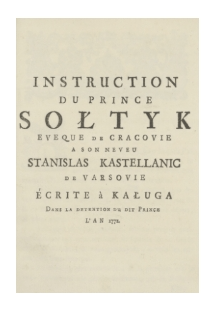
A Note on the “Instruction of Prince Sołtyk”
On the night of 13 October 1767, Russian troops, acting under the orders of Ambassador Nikolai Repnin, seized Kajetan Sołtyk, Bishop of Kraków, together with three other senators who had opposed Russian interference in the affairs of the Polish-Lithuanian Commonwealth. Without trial, charge, or any form of legal process, Sołtyk was carried across the border into Russia and confined at Kaługa, a provincial city some 150 miles southwest of Moscow, where he remained for five years.
At the time of his abduction, he was the most prominent Catholic bishop in Poland, occupying the see of Kraków, first among the dioceses of the realm. His seizure was immediately understood, both within Poland and across Catholic Europe, as an act of sovereign violation: the forcible removal of a senator and a bishop by a foreign power for actions taken in the course of a deliberative assembly.
It was in this captivity that Sołtyk composed the present Instruction, a letter of moral and practical counsel addressed to his nephew Stanisław, Castellan of Warsaw, who was preparing to undertake the customary tour of foreign countries expected of a young nobleman. The document is dated 1771, in the fourth year of his detention. Writing in French, the common language of Polish aristocratic culture, Sołtyk ranges across religion, self-knowledge, conduct in society, the dangers of bad company and bad books, the comparative observation of governments, and the prudent management of money and leisure. These themes are framed throughout by the unmistakable tenderness of a man who, though deprived of his liberty and removed from the exercise of his offices, retained undiminished his sense of episcopal authority, patrician dignity, and familial obligation.
The Instruction was subsequently published and circulated both as a personal document and as a form of political testimony: evidence that the captive bishop remained in full possession of his faculties and steadfast in his convictions. It stands as one of the more intimate texts to survive from Sołtyk’s long captivity, and among the more revealing—not as the rhetoric of martyrdom, but as the record of a great nobleman’s mind at work in confinement, attending, as best he could, to those he loved and to the reputation he intended to preserve.

 Northcoast Antiquarian