

Leonard Colton Hanna was a summer resident of the Edgewater neighborhood from 1890 until shortly before he sold the property in 1911.
We mentioned him briefly in discussing his more famous brother, Senator Marcus Alonzo Hanna, and Senator Hanna’s Glenmere estate, in several previously published Beacon articles. In this brief article, we will give L.C. Hanna and his estate, Urncliff, their due.

L.C. Hanna was born in New Lisbon, Ohio on November 30, 1850, the son of Dr. Leonard Hanna (1806-1862) and Samantha Maria (nee Converse) Hanna (1813-1897). His siblings included Helen G. Hubbell (1836-1891); Marcus A. Hanna (1837-1904); Howard M. Hanna (1840-1921); Salome M. Chapin (1844-1907); Seville S. Morse (1846-1927); and Lilian C. Baldwin (1852-1948). The family moved to Cleveland in 1851.
Once in Cleveland, L.C. Hanna attended the public schools. His family then sent him to Doctor Holbrook’s Military School, a military academy and boarding school for boys located in the town of Ossining, New York. He reportedly attended Doctor Holbrook’s Military School until June 1867.
When he returned to Cleveland, he was briefly associated with Hanna, Doherty & Company, a firm established by his brother, Marcus A. Hanna, for the purpose of refining petroleum. His brother Howard later purchased Marcus’ interest in the firm.
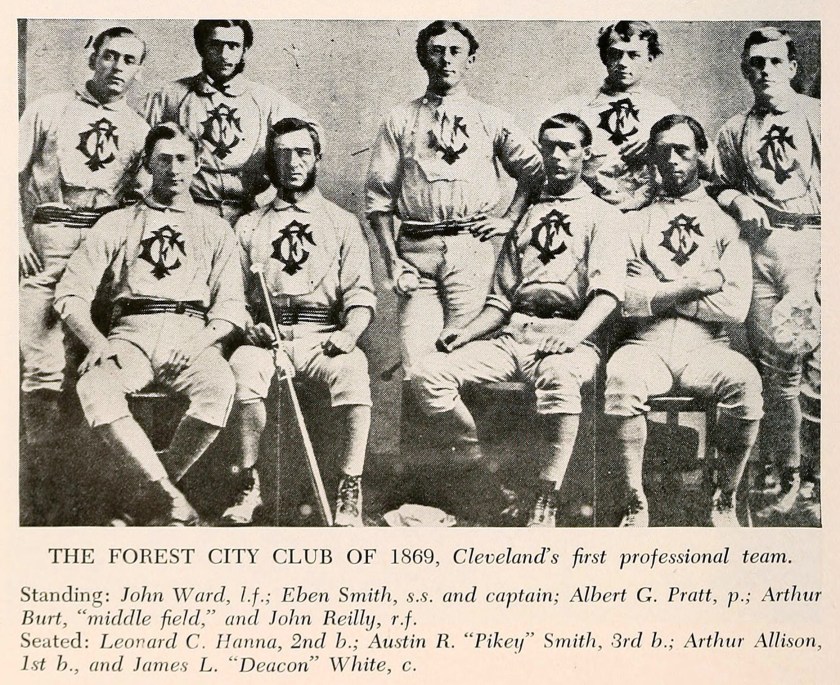
In 1869, L.C. Hanna became associated with Cleveland’s first professional baseball team, the Forest City Club, as its second baseman. The team included pros who were paid, such as Arthur Allison, outfielder and first baseman, Albert G. “Uncle Al” Pratt, pitcher, and James L. “Deacon” White, each of whom remained with the team until its demise in 1872, and amateurs such as L.C. Hanna, who remained “pure” and refused payment. On June 2, 1869, the Forest City Club played, and lost, 25-6, the first pro baseball game in Cleveland against the professional Cincinnati Red Stockings. The game was played in front of 2,000 spectators at Case Commons at Putnam Ave. (E. 38th St.) between Scovill Avenue and Central Avenue. On March 17, 1871, the Forest City Club became a charter member of the National Association of Professional Baseball Players.
By 1871, L.C. Hanna left behind his baseball career and sailed on the steamer Northern Light for one season. In January 1872, he left for St. Paul, Minnesota, where he resided until November 1874. In 1874 he returned to Cleveland to begin his lengthy career with the firm of M. A. Hanna & Company, which at the time was one of the largest and most important firms in the country handling coal, coke, iron ore and pig iron. M. A. Hanna survived into the modern era, merging in 2000 with The Geon Company, to become The PolyOne Corporation, a company whose 2016 revenues exceeded $3.3 billion dollars. L.C. Hanna was also affiliated with the Superior Savings & Trust Company, the Guardian Savings & Trust Company and the Union National Bank of Cleveland. His memberships included the Tavern Club, the Union Club, the Roadside Club, the Country Club of Cleveland, and the Chagrin Valley Hunt Club at Gates Mill, Ohio.
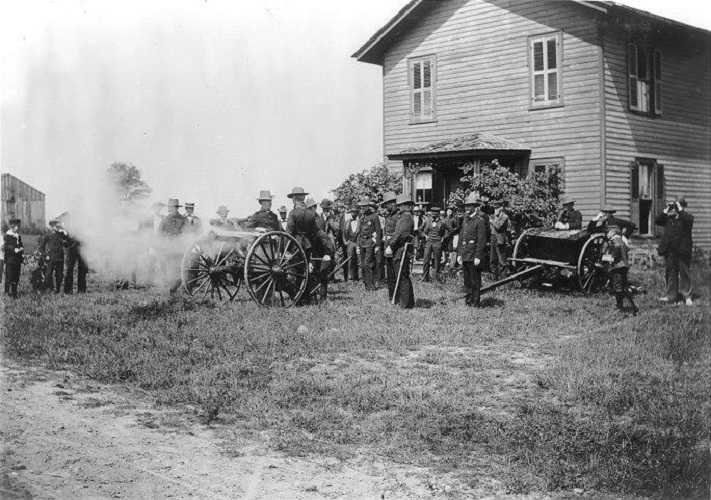
L.C. Hanna also “commanded” the Cleveland Gatling Gun Battery as “captain” from 1892-1893. This para-military organization was formed in June 1878 by reactionary Clevelanders concerned about “the maintenance of law and order” after the Great Railroad Strike of 1877, which was discussed in a Beacon article that sketched the life of Edgewater resident Daniel W. Caldwell, who was President of the Lake Shore and Michigan Southern Railway Company and who obtained the title “General” from the governor of Ohio during the “Great Railroad Strike.”
The Encyclopedia of Cleveland History states the following regarding the Cleveland Gatling Gun Battery:
“Using contributions, the committee purchased 2 Gatling guns and then issued a call for volunteers. At a meeting in the mayor’s office, the Cleveland Gatling Gun Battery was established with 25 charter members, including Major Wilbur F. Goodspeed, elected captain; 1st Sgt. Thomas Goodwillie; 2d Sgt. Leonard C. Hanna (captain, 1882-93); 3d Sgt. John R. Ranney; and Quartermaster J. Ford Evans. On 6 Mar. 1880 the Ohio legislature enacted a bill authorizing Cleveland citizens to establish a Gatling gun battery, placed it under control of the mayor in emergencies, and made it subject to the regulations governing Ohio National Guard units. The unit was incorporated on 17 May 1880. An armory was constructed at E. Prospect and Sibley (3433 Carnegie). In 1885 the battery had 2 guns, 80 sabers, and 1 revolver. It billed the city $242 for the services of its members on guard during the iron workers’ strike at Newburgh, 8-13 and 17-21 July 1885. The majority of the unit’s activities were social events; its annual target practice, for example, included dances and was held at such resorts as St. Clair Springs, MI, and Chautauqua Lake, NY.”
L.C. Hanna was married twice. He married his first wife, Fannie Wilson Mann (1852-1885) in Buffalo, New York. He married his second wife, Coralie Walker (1852-1936) on October 17, 1888, in Richmond, Kentucky.
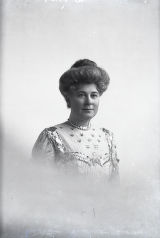
He had three children: Jean Claire Hanna (1880-1930), Fanny Hanna Moore (1884-1980) and Leonard C. Hanna, Jr. (1889-1957). He died on March 23, 1919, and is buried in Lake View Cemetery.

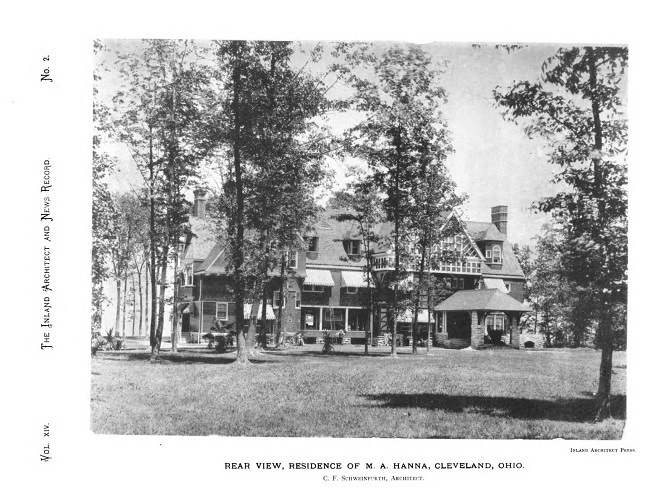
L.C. Hanna’s Edgewater estate was named Urncliff, Erncliff, or Erncliffe (depending on the written source) and was located on the northside of Lake Avenue at roughly West 104th Street. The home and barn located on the estate were designed by the famed architect Charles Frederick Schweinfurth. It is likely that L.C. Hanna commissioned Schweinfurth to build his summer residence and barn in the Edgewater neighborhood shortly after his brother Marcus did and that residence and barn were complete by 1890.
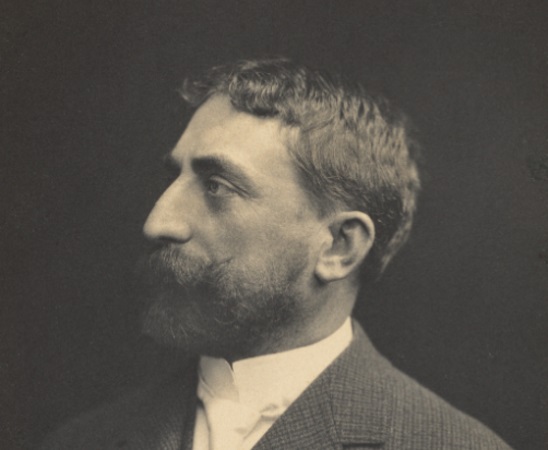
In The Life and Work of Charles Frederick Schweinfurth, Cleveland Architect, (1967), author R.A. Perry stated the following regarding the Urncliff residence of L.C. Hanna:
“The residence built for Captain Leonard C. Hanna was contemporary with “Glenmere.” The L.C. Hanna design was a simpler conception than the adjacent “Glenmere.” The carriage porch of the long, low design was a wider and simplified version of the one at “Glenmere.” The lake or north façade of the L.C. Hanna residence displayed a dramatic chimney-gable interpenetration on the northeast corner of the house. Pseudo-buttresses constructed of brick with limestone ashlar trim were located on the east side of a wide brick chimney which pierced a boldly projecting gabled area which cantilevered into space. The cantilevered effect and the piling up of buttresses which sloped offsets at the base of the chimney in the L.C. Hanna design represented the most striking of all Schweinfurth’s gabled interpenetrations and appears to have been an original feature of that design.”
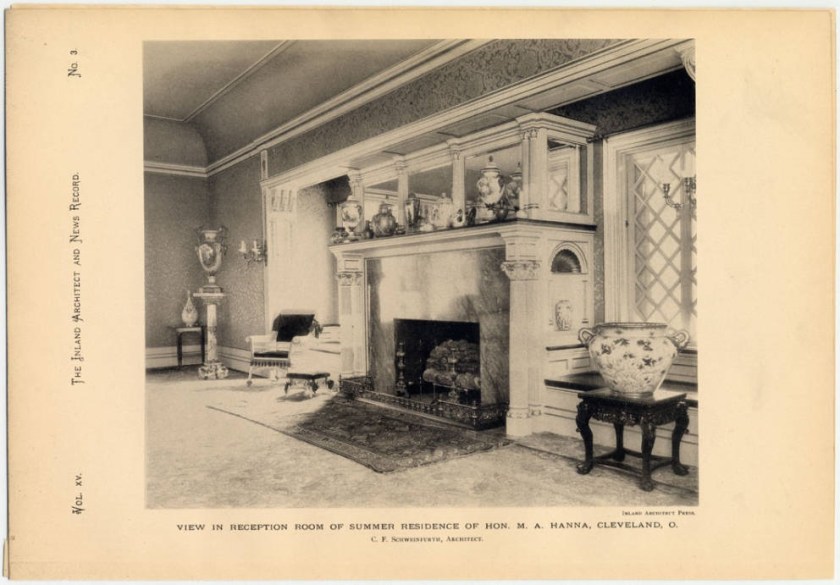
The interior of the L.C. Hanna residence was also simpler than that of “Glenmere” as is revealed in a comparison of the reception halls in the two residences. The L.C. Hanna barn which faced the north façade closely related to the main dwelling in the exterior sheathing and in its bold geometric arrangements. Schweinfurth’s skillful massing of bold, unadorned projecting surfaces created a feeling of movement and an interesting play of light and shade in the low, sprawling design. The L.C. Hanna house and barn were a handsome compliment to each other, and the two houses were remarkable examples of Schweinfurth’s most original productions in the “Shingle Style.” [pp. 100-101]
We are fortunate that several striking pictures of the residence and barn survive to illustrate Schweinfurth’s mastery of the Shingle Style.
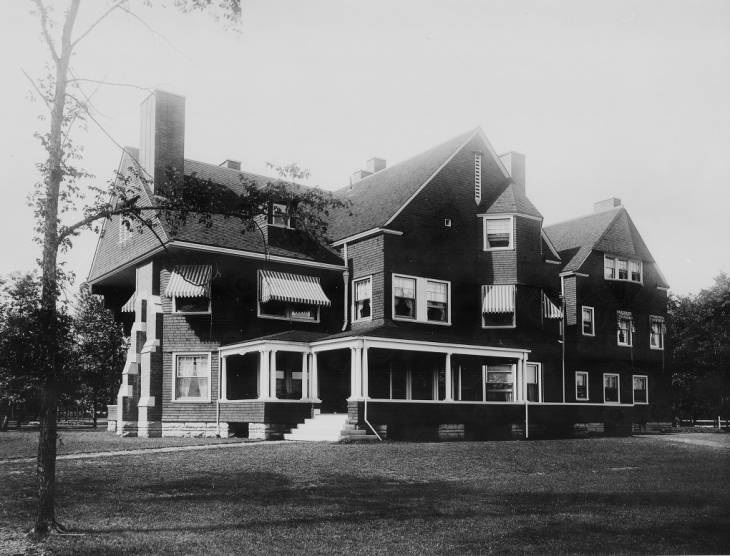


The Cleveland Blue Book 1891 indicates that Mr. and Mrs. L.C. Hanna considered “Erncliff” their summer residence, while their permanent residence was at 736 Prospect. The Cleveland Blue Book 1900 again indicated that “Erncliffe” was their summer residence while changing their permanent residence to 667 Euclid Avenue. In The Cleveland Blue Book 1904, Mr. and Mrs. L.C. Hanna only list 737 Euclid as their residence and no longer list Urncliff as a summer residence.
Sadly, like Senator Hanna’s Glenmere residence, the Urncliff residence was also demolished shortly after the turn of the 20th century.








 Northcoast Antiquarian