

In an earlier post I noted that the surname Yarab was an Anglicized spelling of the Slovak surname Jaráb and that it was akin to the Czech word jeřáb, which means crane. Since I have updated that original post with some additional information but do not anticipate that anyone would go back to read that lengthy post just for that information, I am providing the new information regarding alternative spellings and meanings here.
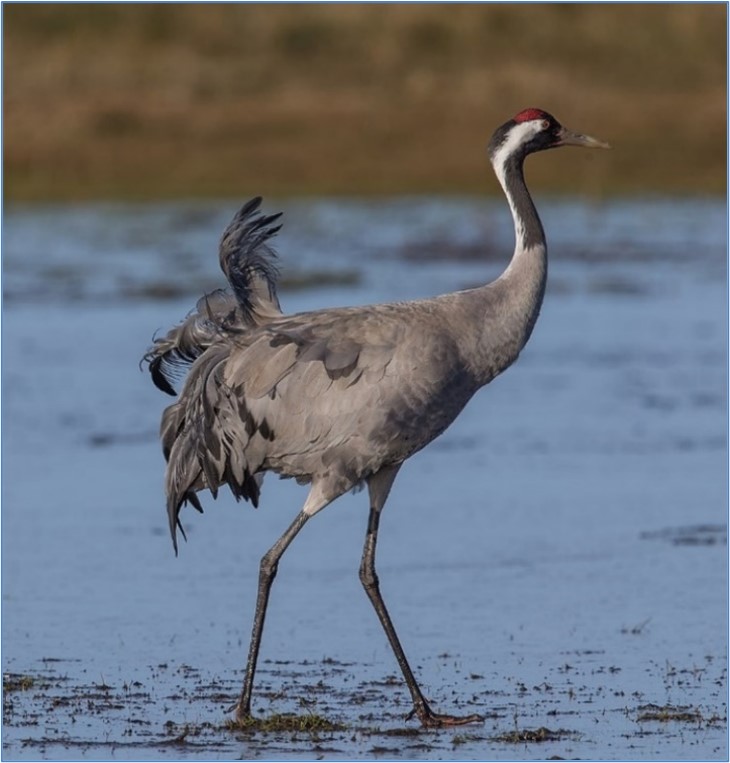
Modern Czech dictionaries generally provide three definitions for Jeřáb: crane (as in the feathered crane); crane/derrick; and rowan (as in European Mountain Ash/Sorbus aucuparia). Accordingly, I sought to determine what the earliest Slovak dictionary may have recorded as definitions for Jaráb. However, the search was not so straightforward as the earliest dictionary attempting to capture spoken Slovak had an alternative spelling for crane.

The earliest spelling for crane in a Slovak “dictionary” was Garáb (Bernolák, Antonio. 1825-1827. Slowár slowenskí česko-latinsko-ňemecko-uherskí: seu, Lexicon slavicum bohemico-latino-germanico-ungaricum. Buda: Typis et Sumtibus Typogr. Reg. Univ. Hungaricae. p. 613). This dictionary noted the primary definition for Garáb as crane (i.e., Ardea Grus (the Eurasian crane)) and a secondary definition as Strom (tree): sorbus (i.e., Sorbus aucuparia (European Mountain Ash)). Thus, there was a potential alternative spelling for Jaráb in circulation when Slovak was being codified as a written language. The issue of whether the letter G or J should be used for the sound represented in our surname and similar words was apparently in contention for some time.

Bernolák’s dictionary was published after his death by his admirer Juraj Palkovič. Tomasz Kamusella stated that “Bernolák himself called this new written language, ‘Pannonian Slavic,’ the ‘Slavic language in Hungary,’ or simply ‘the Slavic language.'”

Kamusella said that “with his dictionary Bernolák did not wish to codify a Slovak language but compiled it for the sake of spreading the knowledge of Magyar among the Slavophone inhabitants of Upper Hungary. He recognized Slovak as the mother tongue of this population and appealed for its use in books and education. However, Bernolák continued to see Hungary as the patria of all who lived in the country, whatever languages they might happen to speak. He never proposed that there existed some separate ‘natio slovaca,’ let alone a ‘Slovak nation.” Finally, Kamusella noted that Palkovič opposed attempts, which occurred c. 1830, at replacing the letter [g] with [j] in the spelling of words that occurred in Bernolák’s system. (see Kamusella, Tomasz. 2012. The Politics of Language and Nationalism in Modern Central Europe. New York: Palgrave MacMillan. pp. 530-537.)
In any event, the Jarábs of Spiš were attested as using the J rather than the G for their surname in baptismal records as early as the 1780s and never spelled their surname with a G.

 Northcoast Antiquarian