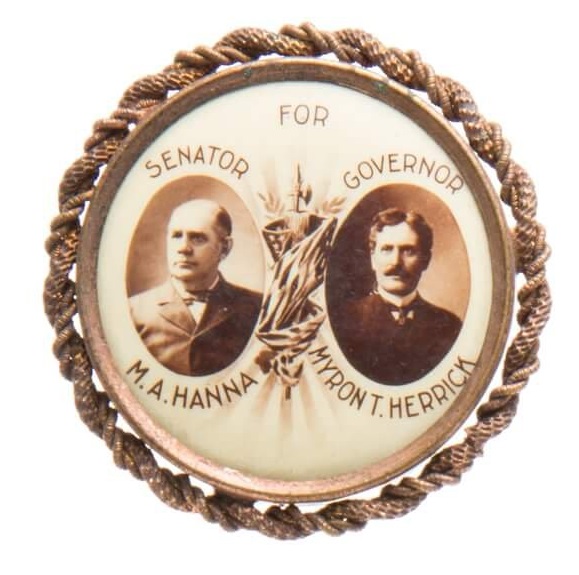

U.S. Senator M.A. Hanna: Part I

“Senator Hanna bought part of Twin Elms and made it famous. The McKinley election was planned in the famous summer house which finally fell over into the lake. Leonard C. Hanna built next door and we all became intimate friends.” – Jacob Bishop Perkins

In the late nineteenth century, Jacob Bishop Perkins (1854-1936) owned most of the land that is now the Edgewater Neighborhood and Edgewater Park. His holdings in Edgewater were known prosaically as Perkins’ Farm even though farming was never undertaken on the land. More poetically, his estate in Edgewater was known as Twin Elms. However, this article is not about Mr. Perkins or Twin Elms, rather, it is about the most famous resident of Edgewater, Marcus Alonzo Hanna, and his then equally famous estate, Glenmere.

Marcus Alonzo Hanna (1837-1904) was an extraordinary man who features prominently in Cleveland, Ohio, and American history. His careers were multiple, and his successes far outshone his failures. He was an industrialist, owner of the Westside Railway and its successors, publisher of the Cleveland Herald, Republican Party eminence, President William McKinley’s campaign manager, and twice elected U.S. Senator. He even, for a time, owned and operated the Euclid Avenue Opera House. His legacy was broad as he had a major role in the economic prosperity of Cleveland as a businessman, the election of President McKinley as a “political boss,” and the building of the Panama Canal as a senator.

Mr. Hanna was born on September 24, 1837, in Lisbon, Ohio. He moved to Cleveland in 1852, where he attended high school with John D. Rockefeller. On September 27, 1864, he married Charlotte Augusta Rhodes, in spite of the spirited disapproval of her father, prominent west side community leader, Democrat, and businessman Daniel Rhodes.

Originally, the couple resided with Mr. Rhodes in his Franklin Boulevard mansion, later moving to a small home on Prospect Street. After a series of unfortunate business setbacks left Mr. Hanna financially exhausted, he and his wife returned to Mr. Rhodes’ Franklin mansion and Mr. Hanna was brought into Mr. Rhodes’ business as a principal. Once Mr. Hanna became a principal in Mr. Rhodes’ company, he and the company prospered.

Jacob Bishop Perkins sold Mark and Charlotte Hanna a portion of Twin Elms on which they built a residence in 1889. They called their estate “Glenmere.” It is at Glenmere that they raised their daughter Ruth Hanna, who married Joseph Medill McCormick, owner of the Chicago Tribune and later a U.S. Senator. After Senator McCormick’s death, Ruth went on to marry U.S. Representative Albert Gallatin Sims. But Ruth Hanna, not one to merely be associated with politicians, was an able politician in her own right, having served as a U.S. Representative in Congress and being the first woman to be the nominee of the Republic Party for a U.S. Senate seat.

The Glenmere Estate

Charles Frederick Schweinfurth was the leading residential architect in Cleveland during the last quarter of the nineteenth century, responsible for more homes on Cleveland Millionaire Row on Euclid Avenue than any other architect. Naturally,

Mark Hanna engaged Mr. Schweinfurth to design and build Glenmere when he came to the Edgewater neighborhood at the invitation of Mr. Perkins.

In The Life and Works of Charles Frederick Schweinfurth – Cleveland Architect, R.A. Perry records the following about Glenmere:

“The most original “Shingle Style” residences of Schweinfurth’s early period were two summer homes designed for United States Senator Marcus A. Hanna and his brother Leonard. Both of the Hanna houses were completed in or around 1889 and were located … near the shores of Lake Erie. The Hanna designs reflected a horizontal emphasis which was new in Schweinfurth’s work, and both designs had two facades.”

“Glenmere,” the summer residence of Marcus A. Hanna, was probably the earlier of the two designs and was the more elaborate. On the south façade of “Glenmere” was a projecting carriage porch below an enlarged version of the “Shingle Style” Siamese gable, but decorated with contrasting stripes in imitation of English half-timber construction. The hexagonal cupola which had been used earlier on the Dellenbaugh and Nye designs also could be seen on the roof at “Glenmere.” At the south west end of the façade was a double tower motif which penetrated a boldly projecting gable in an unusually dramatic manner. It has not been possible to locate any prototypes for that feature which was apparently original.

The lake façade of “Glenmere” reflected a different character from the entrance façade. The main features of the lake or north façade were a wide porch supported on Tuscan columns, a second story loggia, and a number of gables, circular towers, and clustered chimneys which projected from the steep pitched roof.
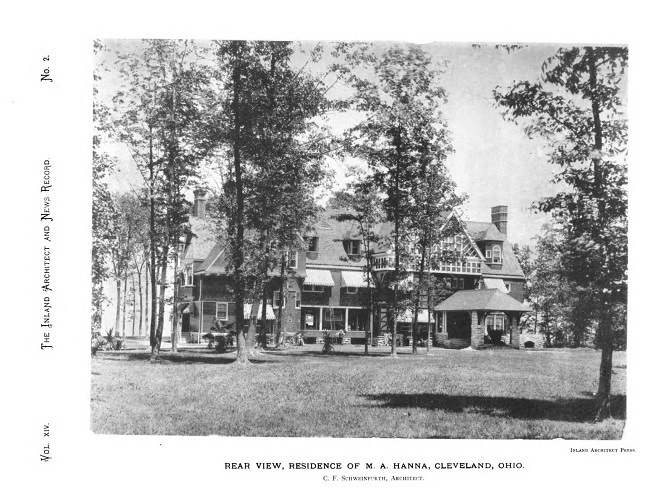
“Glenmere” was the scene of many splendid parties and other social events in Cleveland, and its owner was an important figure in American history. The plan for “Glenmere” included a spacious entrance hall with a baluster screen pierced by an oval opening located in front of the staircase.

The dining room contained an elaborate mantel with a veined marble fireplace and the dining room included a classical-inspired mantle finished in white and gold which links Schweinfurth with the Colonial Revival style.

The interior decorations at “Glenmere” were the most elaborate since the Everett mansion of 1883. The Marcus Hanna residence was Schweinfurth’s largest “Shingle Style “design. The decidedly horizontal emphasis of the design and the use of decorative half-timber framing were the closest Schweinfurth ever came to the design of a Shavian manor house.
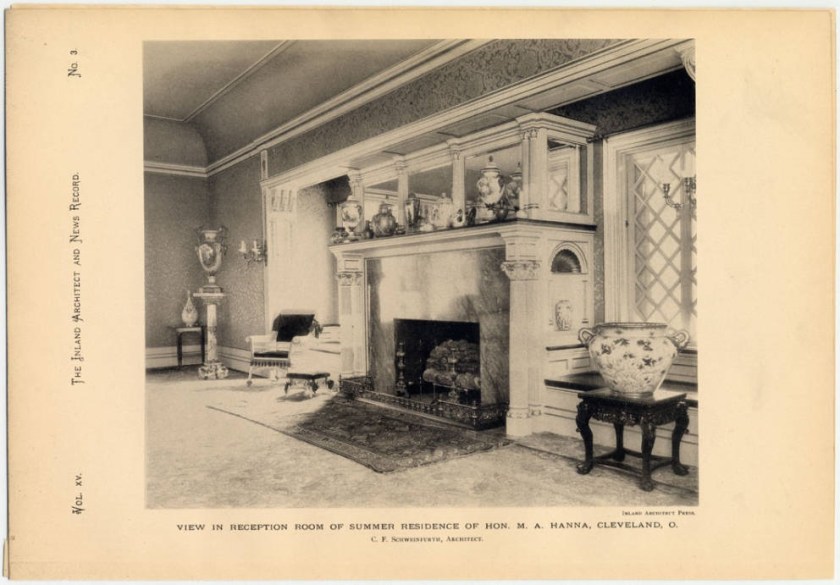
Sadly, Glenmere was demolished in the early 20th century. Fortunately, Glenmere was sufficiently famous that pictures of it appeared on contemporary postcards and it was featured in heavily photographed publications, including Inland Architect and News Record.

In the next article, we will talk about the campaign which won William McKinley the presidency of the United States, which was planned and largely executed at Glenmere, and Ruth Hanna’s “Wedding of the Century,” which was hosted at the Glenmere Estate and brought, among others, President Theodore Roosevelt to the Edgewater neighborhood on a sunny June day in 1903.

U.S. Senator M.A. Hanna: Part II

Previously, when discussing Edgewater’s most famous resident, U.S. Senator Marcus Alonzo Hanna (1837-1904), I briefly noted that the Senator was, among other things, a Republican Party eminence and President William McKinley’s campaign manager. These abbreviated characterizations do not adequately capture the extraordinary role he played in both shaping modern American political campaigns and the critical role he played in securing William McKinley the presidency, which roles he played, in large part, from his Lake Avenue estate, Glenmere, during the summers and from his rented home in Thomasville, Georgia, during the winters.

Hanna’s first foray into national Republican politics occurred in 1880, when he created a businessman’s club that successfully raised money to cover Ohioan James A. Garfield’s personal expenses during the presidential campaign of 1880. In the next two presidential elections, Hanna actively supported Ohio Senator John Sherman’s attempts to win the Republican Party presidential nomination.

Finally, by 1896, Hanna retired from his business interests to dedicate himself to the election of Ohio Governor William McKinley to the presidency. Hanna’s affection and support for McKinley was reportedly related to Hanna’s admiration for McKinley’s integrity, loyalty, and scruples although McKinley’s opponents, including the newspapers owned by William Randolph Hearst, fostered a narrative in which Hanna supported McKinley because McKinley was Hanna’s pliable puppet.

Hearst’s editorials often related a true story that hoped to firmly fix the narrative that Hanna had untoward influence over McKinley. The story ran thusly: “During the Panic of 1893, McKinley was presented with a bill for $100,000 to cover bad loans he had co-signed for a friend in Youngstown. Lacking anything near that kind of cash, McKinley planned to resign as governor and return to his law practice to pay the debt. When he informed Hanna, the Clevelander would have none of it. He quickly assembled a group of wealthy friends who retired the notes. McKinley and his wife put property in a trust to repay their benefactors, but no claims were ever filed.”

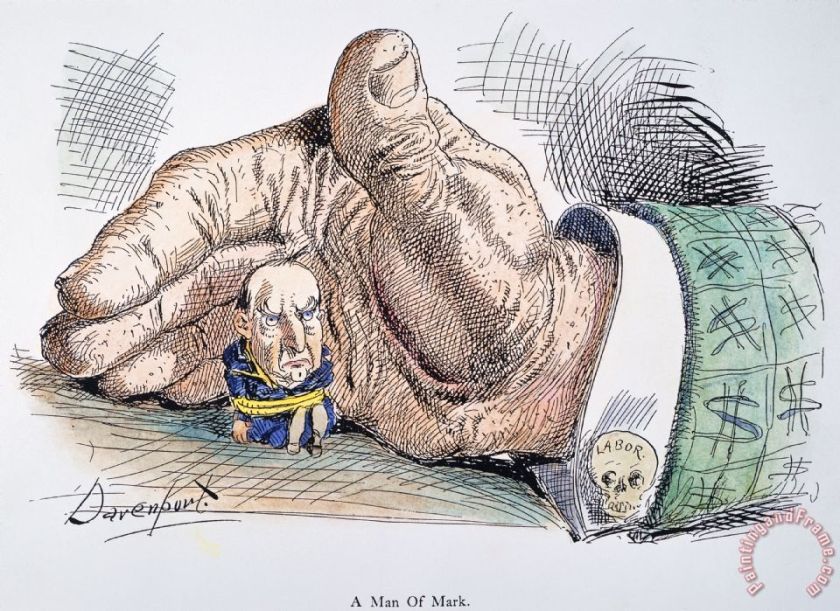
The image of Hanna as financier and McKinley as beholden beneficiary was driven home by in the Hearst newspapers by political cartoonist Homer Davenport, who depicted Hanna as “Dollar Mark,” a bloated character dressed in a suit covered with dollar signs. McKinley was usually drawn as a smaller child accompanying Dollar Mark. The attacks accusing McKinley of being a puppet of Hanna did not prevent McKinley from winning the White House in 1896.

Hanna, as noted earlier, often directed McKinley’s campaign from his “lake house” on Lake Avenue, a campaign which some have labeled the first modern American presidential campaign. Joseph Frolik, in writing about Hanna’s impact on American presidential campaigns, summarized the campaign thusly:

“Hanna worked his campaign magic without the aid of computers or the Internet or broadcast media, of course. Yet many of the practices that still define campaigning in the age of social media and micro-targeting were introduced or refined by Hanna during his political tour de force: the 1896 campaign to put William McKinley, his friend and fellow Ohioan, in the White House.”

He used polling techniques, albeit primitive ones, to monitor the pulse of the campaign, especially in states he thought could swing either way. He ordered the production of 200 million pamphlets, newspaper inserts and other pieces of literature – at a time when there were barely 14 million voters in the United States. Much of it was issue-oriented and targeted particular market segments such as German-Americans or “colored” voters. He dispatched 1,400 surrogate speakers to spread a unified GOP message, some of them toting newfangled devices to enthrall audiences with grainy moving pictures of McKinley. And, as Frolik further observed:

All of this innovation required boatloads of cash, and Hanna excelled at raising it. Before 1896, most presidential campaigns were run through the political parties and relied on tithes from patronage workers. Hanna had broken into politics in Cleveland by raising cash from his fellow businessmen to help elect President James Garfield in 1880, and 16 years later, he took the art of the ask national. He tapped not just the railroaders, but tycoons of every stripe, by stoking their fears of financial catastrophe if Bryan and his “free silver” platform prevailed. The result was a war chest that has been estimated at between $3.5 million and $10 million, in an era when newspapers sold for a penny. One of Hanna’s Cleveland Central High School classmates — a rather successful oilman named John D. Rockefeller – reportedly kicked in $250,000.

It was Hanna’s ability at raising, and agility at spending, campaign funds, in ways not heretofore seen, that caused Theodore Roosevelt to exclaim, in both astonishment and condemnation: “He has advertised McKinley as if he were a patent medicine!” Thomas Beer, in his analysis of the offense that Hanna had given to Roosevelt and many others, said the following: “He had made a President, and he had done it visibly. It is hard to forgive such realism.”

After McKinley was elected president, Hanna declined to seek a position in the President’s cabinet. Instead, consistent with Hanna’s wishes, the President appointed Senator John Sherman of Ohio as Secretary of State, which allowed Ohio’s governor to 

appoint Hanna as U.S. Senator for the remainder of Sherman’s Senate term. Hanna subsequently secured his election to a full-term in the U.S. Senate by the Ohio legislature in 1898. Hanna was re-elected to another term (1905-1911) in January 1904 by a legislative vote of 115–25. Unfortunately, Senator Hanna died on February 15, 1904 before that term commenced.

McKinley often visited Hanna in Cleveland and Cleveland has been characterized by some as the secondary center of McKinley’s presidency.

Those who want to know more about Hanna’s outsized impact on American political history can profitably consult any of a number of readily available sources. For instance, Joe Frolik, The Cleveland Plain Dealer’s former chief editorial writer, prepared a masterful account of the outsized role of Marcus Alonzo Hanna in both Republican party politics and the election campaigns of President William McKinley in his article, How Ohio made a president: Mark Hanna of Cleveland created modern politics in 1896 (October 16,2012). This article is online at http://www.cleveland.com/obituaries/index.ssf/2011/10/george_e_condon_chronicled_cle.html

Books which discuss Senator Hanna and his legacy, which are readily available and commended to your attention, include West of the Cuyahoga and Cleveland: the best kept secret. These works were written by George E. Condon (1916-2011), a reporter and columnist for the Cleveland Plain Dealer for over 40 years. Mr. Condon’s authorial style is highly engaging, reflecting both the depth of his knowledge of Cleveland’s history and his passion for that history. Another recommended work, perhaps less readily available, is Hanna, which was written by Thomas Beer (1889-1940), a highly reputed biographer, novelist, essayist, satirist, and author of short fiction.