
U.S. Senator M.A. Hanna: Part I

“Senator Hanna bought part of Twin Elms and made it famous. The McKinley election was planned in the famous summer house which finally fell over into the lake. Leonard C. Hanna built next door and we all became intimate friends.” – Jacob Bishop Perkins

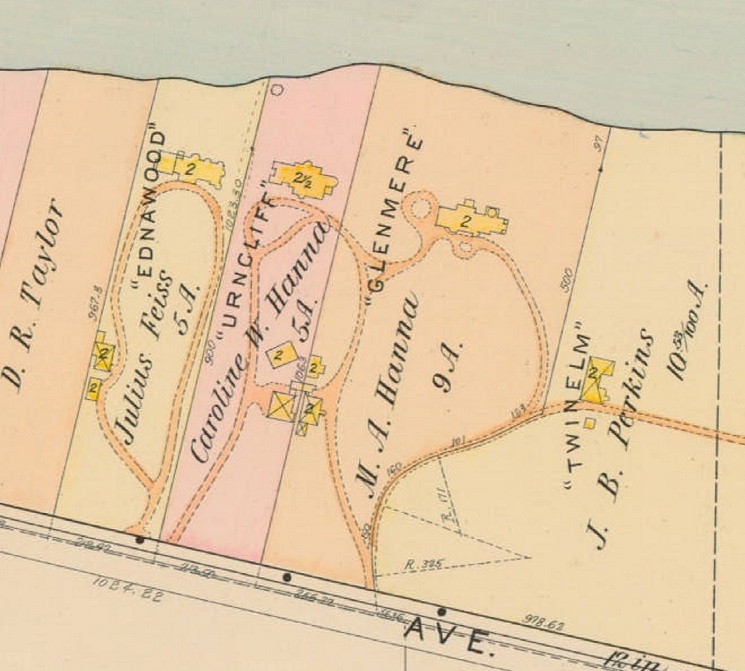
In the late nineteenth century, Jacob Bishop Perkins (1854-1936) owned most of the land that is now the Edgewater Neighborhood and Edgewater Park. His holdings in Edgewater were known prosaically as Perkins’ Farm even though farming was never undertaken on the land. More poetically, his estate in Edgewater was known as Twin Elms. However, this article is not about Mr. Perkins or Twin Elms, rather, it is about the most famous resident of Edgewater, Marcus Alonzo Hanna, and his then equally famous estate, Glenmere.

Marcus Alonzo Hanna (1837-1904) was an extraordinary man who features prominently in Cleveland, Ohio, and American history. His careers were multiple, and his successes far outshone his failures. He was an industrialist, owner of the Westside Railway and its successors, publisher of the Cleveland Herald, Republican Party eminence, President William McKinley’s campaign manager, and twice elected U.S. Senator. He even, for a time, owned and operated the Euclid Avenue Opera House. His legacy was broad as he had a major role in the economic prosperity of Cleveland as a businessman, the election of President McKinley as a “political boss,” and the building of the Panama Canal as a senator.

Mr. Hanna was born on September 24, 1837, in Lisbon, Ohio. He moved to Cleveland in 1852, where he attended high school with John D. Rockefeller. On September 27, 1864, he married Charlotte Augusta Rhodes, in spite of the spirited disapproval of her father, prominent west side community leader, Democrat, and businessman Daniel Rhodes.

Originally, the couple resided with Mr. Rhodes in his Franklin Boulevard mansion, later moving to a small home on Prospect Street. After a series of unfortunate business setbacks left Mr. Hanna financially exhausted, he and his wife returned to Mr. Rhodes’ Franklin mansion and Mr. Hanna was brought into Mr. Rhodes’ business as a principal. Once Mr. Hanna became a principal in Mr. Rhodes’ company, he and the company prospered.

Jacob Bishop Perkins sold Mark and Charlotte Hanna a portion of Twin Elms on which they built a residence in 1889. They called their estate “Glenmere.” It is at Glenmere that they raised their daughter Ruth Hanna, who married Joseph Medill McCormick, owner of the Chicago Tribune and later a U.S. Senator. After Senator McCormick’s death, Ruth went on to marry U.S. Representative Albert Gallatin Sims. But Ruth Hanna, not one to merely be associated with politicians, was an able politician in her own right, having served as a U.S. Representative in Congress and being the first woman to be the nominee of the Republic Party for a U.S. Senate seat.

The Glenmere Estate

Charles Frederick Schweinfurth was the leading residential architect in Cleveland during the last quarter of the nineteenth century, responsible for more homes on Cleveland Millionaire Row on Euclid Avenue than any other architect. Naturally,

Mark Hanna engaged Mr. Schweinfurth to design and build Glenmere when he came to the Edgewater neighborhood at the invitation of Mr. Perkins.

In The Life and Works of Charles Frederick Schweinfurth – Cleveland Architect, R.A. Perry records the following about Glenmere:

“The most original “Shingle Style” residences of Schweinfurth’s early period were two summer homes designed for United States Senator Marcus A. Hanna and his brother Leonard. Both of the Hanna houses were completed in or around 1889 and were located … near the shores of Lake Erie. The Hanna designs reflected a horizontal emphasis which was new in Schweinfurth’s work, and both designs had two facades.”

“Glenmere,” the summer residence of Marcus A. Hanna, was probably the earlier of the two designs and was the more elaborate. On the south façade of “Glenmere” was a projecting carriage porch below an enlarged version of the “Shingle Style” Siamese gable, but decorated with contrasting stripes in imitation of English half-timber construction. The hexagonal cupola which had been used earlier on the Dellenbaugh and Nye designs also could be seen on the roof at “Glenmere.” At the south west end of the façade was a double tower motif which penetrated a boldly projecting gable in an unusually dramatic manner. It has not been possible to locate any prototypes for that feature which was apparently original.

The lake façade of “Glenmere” reflected a different character from the entrance façade. The main features of the lake or north façade were a wide porch supported on Tuscan columns, a second story loggia, and a number of gables, circular towers, and clustered chimneys which projected from the steep pitched roof.
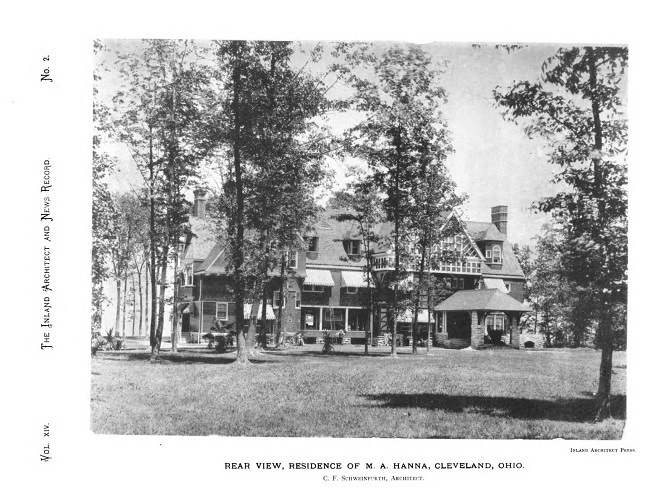
“Glenmere” was the scene of many splendid parties and other social events in Cleveland, and its owner was an important figure in American history. The plan for “Glenmere” included a spacious entrance hall with a baluster screen pierced by an oval opening located in front of the staircase.

The dining room contained an elaborate mantel with a veined marble fireplace and the dining room included a classical-inspired mantle finished in white and gold which links Schweinfurth with the Colonial Revival style.

The interior decorations at “Glenmere” were the most elaborate since the Everett mansion of 1883. The Marcus Hanna residence was Schweinfurth’s largest “Shingle Style “design. The decidedly horizontal emphasis of the design and the use of decorative half-timber framing were the closest Schweinfurth ever came to the design of a Shavian manor house.
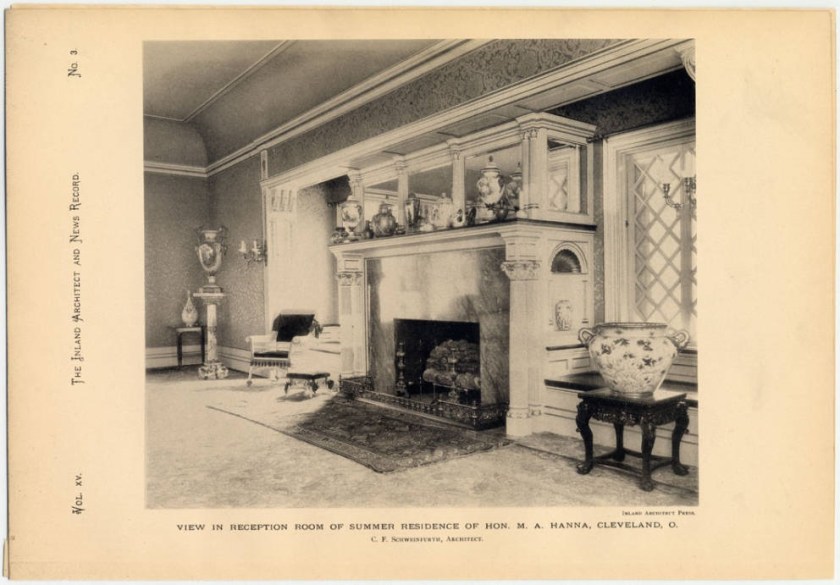
Sadly, Glenmere was demolished in the early 20th century. Fortunately, Glenmere was sufficiently famous that pictures of it appeared on contemporary postcards and it was featured in heavily photographed publications, including Inland Architect and News Record.

In the next article, we will talk about the campaign which won William McKinley the presidency of the United States, which was planned and largely executed at Glenmere, and Ruth Hanna’s “Wedding of the Century,” which was hosted at the Glenmere Estate and brought, among others, President Theodore Roosevelt to the Edgewater neighborhood on a sunny June day in 1903.

Jacob Bishop Perkins: Twin Elms & Edgewater Park

On June 14, 1883, The New York Times published an article entitled, “WEALTHY CLEVELAND MEN: A CITY THAT HAS GROWN A CROP OF MILLIONAIRES” (p.5). In the article, The Gray Lady discussed such well-known Clevelanders as J.H. Wade, Henry B. Payne, George F. Brush, and John D. Rockefeller. The article did not neglect to mention, however, the lesser known Clevelander who is the object of this brief essay, Jacob Bishop Perkins. Indeed, the article concluding words were dedicated to him, and stated in their entirety the following: “Jacob B. Perkins, while the youngest millionaire in Cleveland, is one of the most public spirited, having just completed the erection of a half-dozen of the finest business blocks in the city and set an example which others are beginning to follow. His money came through inherited real estate that doubled in value with almost every year of his minority.”

J. B. Perkins was born in Warren, Ohio, on December 20, 1854, the son of Jacob and Elizabeth Tod Perkins. His mother died when he was two years old and his father when he was four years old. After his father’s death, he lived with his grandmother, Nancy Bishop Perkins, widower of General Simon Perkins, in Warren until the age of seven. J.B. described his time with his grandmother as “lonesome and dreary.”

In J.B.’s Final Bulletin (1937), a collection of reminiscences that he wrote shortly before he died on December 26, 1936, he wrote matter-of-factly that “I had no playmates” and that “Grandmother specialized on Temperance education and used to stand me on a stool and have me spell ‘Gin,’ ‘Whiskey,’ ‘Brandy,’ and ‘Rum,’ then declaim ‘Touch not, taste not, handle not.’ Such things as toys, pictures, storybooks, games and music were taboo.”

It is doubtful many of us were so attentive in grade school as to remember from our Ohio History lessons that Simon Perkins (1771-1844), J.B.’s grandfather, was one of the founding fathers of the Western Reserve and Ohio.

He was a surveyor for the Western Reserve of Connecticut, a farmer, a cofounder of Akron, Ohio, a brigadier-general during the War of 1812, the first postmaster of the Connecticut Western Reserve, a founder of the Western Reserve Bank, a cofounder of the Brier Hill Iron & Coal Company, a trustee of the Warren Academy, an agent for the Aetna Insurance Company, a stockholder and president of the Trumbull and Ashtabula Turnpike Company, a state canal commissioner from 1826 to 1838, being one of the main planners for the route of the Ohio and Erie Canal, and auditor of Trumbull County from 1810-1812. However, most importantly for our story, he was the ultimate source of much of J.B.’s inherited real estate wealth, which was referenced in The New York Time’s article above. J.B. himself noted that his grandfather’s real estate holdings were so vast that he had, as principal or agent, paid one-seventh of all taxes on real estate in the state of Ohio at one point in his career.

A year before his grandmother died in 1862, J.B. moved to Cleveland to live with his father’s brother, Joseph Perkins, to take advantage of the fine private schools with which Cleveland was blessed. After J.B. completed his schooling in Cleveland, he went to Williams College in Williamstown, Massachusetts (Class of 1877). He returned to Cleveland, where he married Sallie Moore Wilshire in 1878. Shortly thereafter, J.B.’s story and the Edgewater neighborhood’s story find their beginning.

In his bulletin, J.B. records that he was an avid breeder of horses and it is related to his love of horses that the earliest reference to Twin Elms, the Perkin’s Edgewater estate that has been referenced in several other essays appearing in the EHA Bulletin, can be found.

Of Twin Elms, J.B. wrote of a race track for horses which he had built and which appears on early maps of the area:

“Very early in my career I graded a half mile tack on the land which we called Twin Elms, after a noticeable tree near the lake. This work cost me $500.00 and gained me more notoriety than about anything I ever did. I was “the man that own the race track” to all the kids on the west side and it was convenient for all sorts of meetings. Harvey Brown shot live pigeons there and the Gun Club used it for the annual meet, where they had a real bar that shocked me terribly and nearly broke my Uncle’s heart, so I followed it up with the games of the Y.M.C.A., of which I was president. Nine people out of ten had a horse they thought was fast and they’d come to my track to time him or settle a bet. We had everything but dog fights and cock fights. Still there was plenty of time for me to train my colts, whether they were trotters, saddle horses, or carriage horses. I built a house for my farmer, with a couple rooms for myself, but before I ever used them, I decided to go in double harness and there was no provision for that. (J.B.’s Final Bulletin, p. 51).”

J.B. then goes on to record that, in 1882, after his wife Sallie gave birth to their daughter Francis, his wife’s doctor ordered his wife to “get out of the City for the summer” and that, as a result, the farmer moved out of the Twin Elms farm house and he and his family moved in.

George E. Condon, in West of the Cuyahoga, described the Twin Elms Farm of Jacob Perkins as “a civic anomaly as the nineteenth century neared its end. The glorious eighty-nine acre spread constituted the most important lakefront estate on either side of the growing city that was closing in on such elegant manifestations of private wealth. It could not survive in a city. It’s sandy beach, deemed the finest on the entire Cleveland lakefront, enhance its attractiveness” (p. 155). Earlier essays discussed J.B.’s recruitment of Senator Hanna and his brother as neighbors, and how Senator Hanna ran the presidential campaign for William McKinley from his Edgewater estate.

J.B. and Sallie’s son Ralph was born in 1886. In his book, Perkinsiana (1963), he wrote fondly of Twin Elms. “My family spent the winter months of the year in rented houses on Euclid Avenue …. The large farm was a wonderful playground with a fine beach, ponies, dogs, etc.

I lived in a kid’s heaven.” The 1900 US census records that the J.B., Sallie, Francis, and Ralph, lived at Twin Elms with four servants and Sallie’s widowed mother. The family had left by the 1910 census.

J.B.’s public spiritedness, noted so admirably by The New York Times when he was still a very young man, is still quite manifest to the residents of the Edgewater neighborhood and the city of Cleveland even today – we need only contemplate the emerald gem at our doorstep which was the core of Twin Elms, Edgewater Park.

On August 21, 1889, J.B. proposed in a speech that the city consider the purchase of Twin Elms for use as a city park, hoping that the beach, woods, and acreage would be stitched together for civic recreation. He offered the land to the city at well below market. The city fathers reacted coolly, as they always seem to do when parks are suggested by the citizenry. But J.B. persisted and, in 1894, the city acquired much of Twin Elms lakefront acreage and its beach for public recreation.

Although some initially sought to name the park after Perkins, J.B. discouraged such, and the land was ultimately named Edgewater Park.

J.B.’s civic and charitable activities continued throughout the remainder of his life, as did his great fondness for breeding and riding horses;

however, as those relate to other than the Edgewater neighborhood, they shall be passed over in silence at the conclusion of this essay. Upon his death in 1936, J.B. was buried in the family plot in Lake View Cemetery. It needs scarcely be observed that J.B., more than any other current or former resident of the Edgewater neighborhood, has left an indelible, beautiful, and too oft underappreciated mark in the neighborhood, for his legacy is none other than Edgewater Park itself.