

The translation of a work from one language to another is an arduous task, requiring both technical skill and artistry. It occasionally also requires, for long laborious works of translation, an especially attentive, well-educated reviewer or proofreader, preferably one whose native language is the language into which the work was translated.
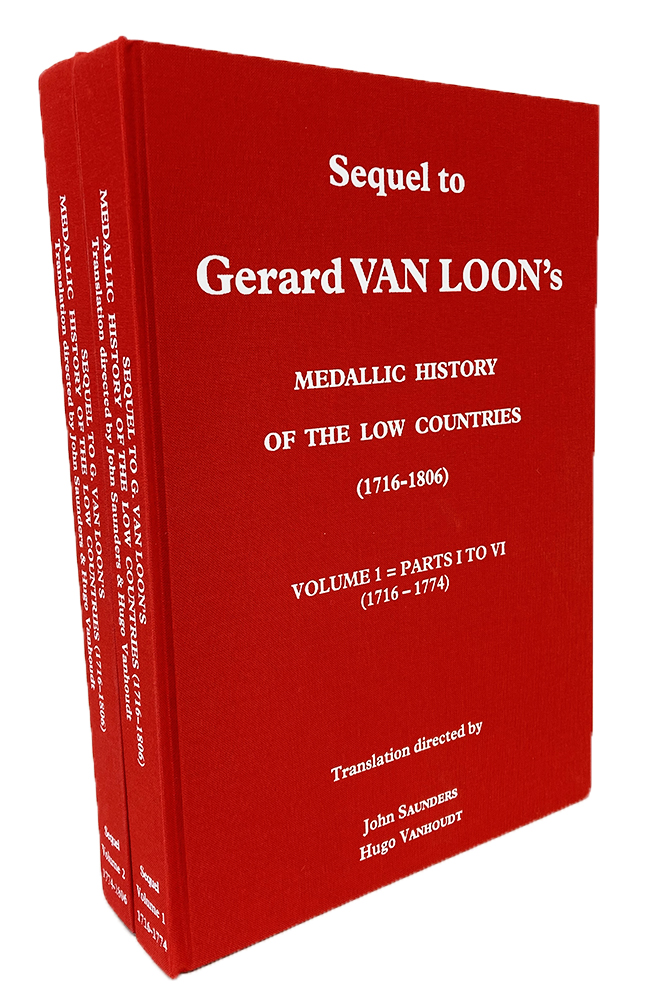
A welcome, recent addition to my library, acquired from the numismatic bookseller Kolbe and Fanning, is a translation of Gerard van Loon’s Beschryving Der Nederlandsche Historipenningen. It was originally published between 1822 and 1869 by the Second Section of the Royal Dutch Institute of Science, Literature and Fine Arts. The translation, SEQUEL TO GERARD VAN LOON’S MEDALLIC HISTORY OF THE LOW COUNTRIES (1716–1806), was published in two volumes (740pp.) in 2022. This, and the original van Loon series in translation, is highly recommended for all serious numismatic libraries.
In any event, though well pleased overall with the quality of the work (binding, printing, plates) and the translation, I must note, if only because it has made an impression that the translation of the original van Loon series did not, that there are occasional lapses, or as suggested above, infelicities, in the translation, occurring throughout the Sequel that catch the eye, sometimes to inadvertent humorous effect.
As a trivial example of a translation glitch, the honorific Excellency is translated correctly through most of the two volumes but occasionally appears as Excellence, as in Vol. 2 of Sequel, on p. 2-111, in the phrase “His Excellence the Stadholder.”
Slightly more unfortunate is the translation appearing in Vol. 1, on p. 1-104, in the description of the reverse of medal number 201 which commemorates the Peace of Dresden in 1745. The translator stated the following: “The three principal streams of Germany, viz. the Danube (DANVBIS) the Elbe (ALBIS) and the Oder (VIADRUS) under the guise of Stream Gods; above them respectively the Eagle of the Empire, of Poland, and of Prussia.” That the Danube, Elbe, and Oder are described as streams gave rise to a chuckle. Clearly river was the word for which the translator was reaching. The river-gods would not approve of being masters of mere babbling brooks.
Finally, the translation that inspired this post appeared in Vol. 2, on p. 2-110. I can do no better that present it without introduction: “And then one heard and saw that all over the country so-called volunteer corpses were founded and taught how to handle arms, for which many retired military persons were used, who received very good rewards for their training.” The translator, encountering an irregular plural, not realizing that the plural for corps is also corps, caused me to smile broadly when I came across this gem as I envisioned in my mind’s eye quite the zombie thriller.

Despite all the foregoing, the translation of the work is quite able, and the work is highly recommended. I have included links to Kolbe and Fanning and recommend a purchase if it is still available.

 Northcoast Antiquarian