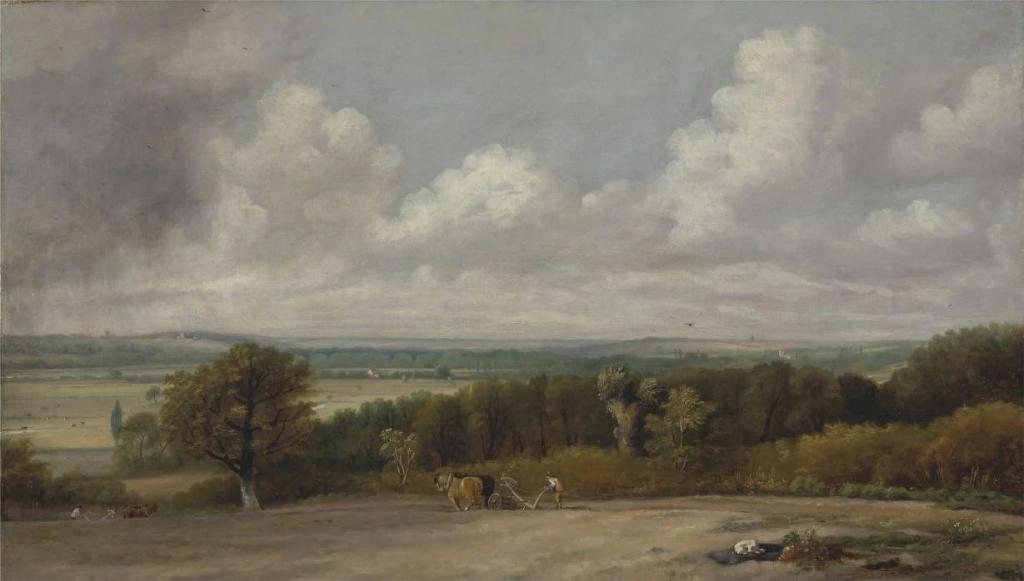
Ploughing scene in Suffolk (oil on canvas, 1824-1825) by John Constable (1776-1837). Yale Center for British Art, New Haven.
In a quiet village, there lived a diligent farmer who worked tirelessly on his land. He took great pride in the crops he grew, ensuring that each seed was planted with care and nurtured with patience. His fields were always bountiful, feeding not only his family but also the entire village.
One day, as he was plowing a new field, the farmer unearthed a strange, dark seed. It was unlike any seed he had ever seen, and though he was curious, he was also wary. The farmer considered casting the seed aside, fearing it might bring misfortune, but a voice within urged him to plant it.
After much deliberation, the farmer decided to plant the seed in a secluded corner of his field, where it could grow without disturbing his other crops. He tended to it with the same care as his other plants, watching as it sprouted and grew into a tall, sturdy tree, its leaves a deep, rich green.
As the seasons passed, the tree bore fruit—small, round, and gleaming like gold. The farmer, unsure of the fruit’s nature, hesitated to taste it. But one day, during a terrible drought that withered his other crops, he had no choice. He bit into the fruit, and to his surprise, it was not only delicious but also quenched his thirst and filled him with strength.
The farmer shared the fruit with the villagers, and soon they all marveled at its miraculous properties. The tree continued to bear fruit, regardless of the weather, and the village never again knew hunger or thirst. The farmer realized that by trusting in the unknown and nurturing it with care, he had uncovered a hidden blessing.
Moral of the Fable
Sometimes the greatest rewards come from taking risks and nurturing what is unknown or unexpected. The fable emphasizes the value of curiosity, patience, and the willingness to embrace uncertainty.
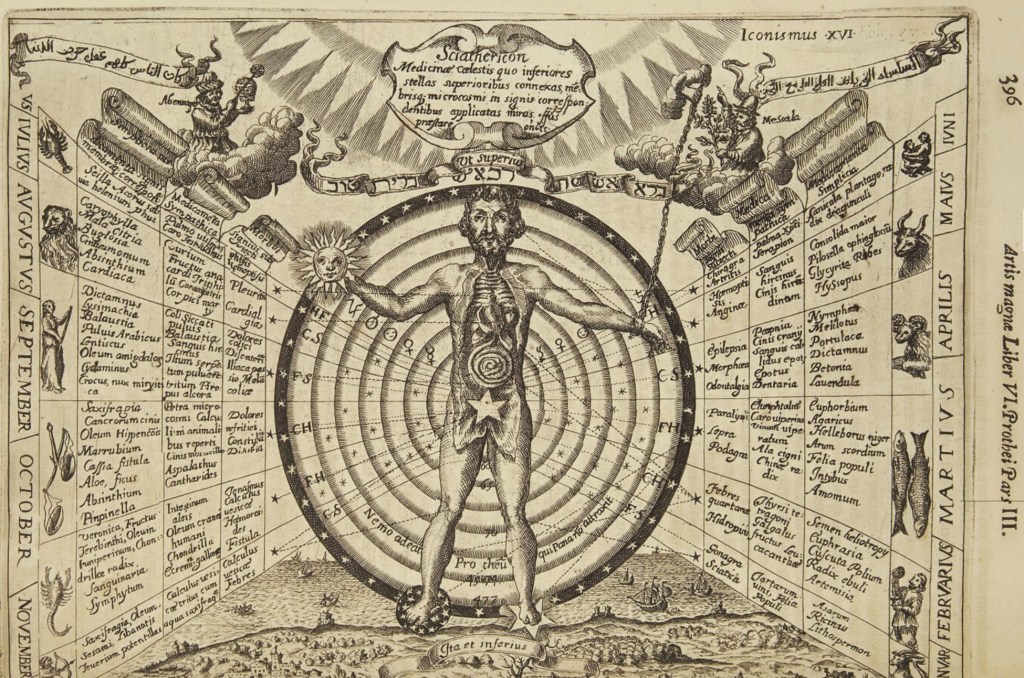
Sciathericon (engraved plate, 1671) from the 2nd edition of Ars Magna Lucis et Umbrae (“The Great Art of Light and Shadow”) by Athanasius Kircher (1602-1680). Image from the Dittrick Rare Book Collections at Case Western Reserve University, Dittrick Medical History Center.
In a distant land, where the mountains kissed the heavens and the rivers whispered secrets of the earth, there lived an ancient artisan known as the Weaver. This Weaver was not like others, for he did not spin mere cloth or thread. Instead, he wove the very fabric of existence itself—threads of light and shadow, of joy and sorrow, of hope and despair. His loom was the sky, and his spindle the stars.
The Weaver’s craft was unparalleled, for he understood the delicate balance that must be maintained in all things. Too much light, and the world would be blinded by its own brilliance; too much shadow, and it would be consumed by darkness. Thus, he wove carefully, each thread placed with intent and purpose, creating a tapestry that held the world together.
But one day, a young prince, full of ambition and pride, sought out the Weaver. He had heard tales of the Weaver’s power and desired to command the loom for himself. “Weaver,” said the prince, “grant me the knowledge of your craft, so that I may weave my own destiny, free from the bonds of fate.”
The Weaver, wise and knowing, looked upon the prince with both sorrow and understanding. “My child,” he said, “the threads of life are not to be wielded with arrogance. To weave is to understand the weight of each choice, the consequences of each action. Are you prepared to bear such a burden?”
The prince, blind to the warning, insisted. “I am prepared for anything. Teach me your ways, and I shall create a world in my image, a world of light, free from darkness.”
Seeing the prince’s determination, the Weaver sighed and granted his request. For 12 weeks, the Weaver patiently instructed the prince, teaching him the secrets of the loom, the intricacies of the threads, and the delicate balance that must be maintained. As the weeks passed, the prince began to grasp the profound wisdom woven into every strand of fabric. Finally, at the end of the 12th week, the Weaver stepped aside, allowing the prince to take his place.
Eagerly, the prince began to weave, pulling strands of light with fervor, filling the sky with radiant brilliance. But in his haste and pride, he neglected the shadows, casting them aside as unworthy. The world he created was indeed one of light, but it was harsh and unyielding, with oppressive heat bearing down relentlessly, as if the very air had become a burden. The people, blinded by the relentless glow, began to suffer, for there was no shade to rest, no night to dream.
Realizing his grave mistake, the prince sought to undo his work, but the radiant threads were stubborn, refusing to be unraveled. In despair, he turned to the Weaver for help. The Weaver, with a gentle hand, took back the loom and began to weave once more, adding threads of shadow to the prince’s creation, restoring the harmony that had been lost.
As the prince watched, he finally understood. The light could not exist without the shadow, nor the shadow without the light. Each thread had its place, its purpose, and only together could they create a world that was whole.
The prince, humbled by his folly, vowed never to forget the lesson he had learned. When he came to rule, he governed with wisdom and justice, as one who understood the value of balance in all things. And the Weaver continued his work, silently and skillfully, weaving the tapestry of existence, one thread at a time.
Moral of the Fable
The fable teaches that in all aspects of life, balance is essential. The pursuit of light without acknowledging the necessity of shadow leads to a world that is incomplete and unkind. True wisdom lies in embracing the duality of existence and recognizing that every choice carries with it a responsibility to maintain harmony.
I have completed a draft of a booklet, The Tales and Fables of Lysander Aesopides, exploring wisdom, morality, and the balance of light and shadow. Inspired by “Traditional Slovak Folktales,” I aim to reflect fable traditions and the human condition. Each tale is illustrated with carefully chosen artwork. Join me in exploring these fables, offering reflections and timeless lessons.
It is with some trepidation and absolute pleasure that I announce that I have completed a draft of a booklet, The Tales and Fables of Lysander Aesopides. This collection of fables, written under my chosen pseudonym, explores themes of wisdom, morality, and the intricate balance of light and shadow within the human experience. The name Lysander Aesopides—a blend of ‘Lysander,’ meaning ‘liberator’ or ‘one who is free,’ and ‘Aesopides,’ meaning ‘descendant of Aesop’—symbolizes a continuation of the ancient tradition of fable-telling, while also embracing a spirit of renewal and reinterpretation. Through this persona, I seek to honor the legacy of Aesop, while offering narratives that explore these timeless themes in ways that reflect the complexities of our modern world.
CLICK ABOVE IMAGE TO OPEN A DRAFT PDF BOOKLET OF THE ABOVE COLLECTION OF FABLESOR CLICK BUTTON AT END OF POSTING
The impetus for this work stems from my long appreciation for fables and folktales and the collection of such fables and tales in my library. The release of this draft coincides with the recent arrival of a cherished addition to my library—a volume entitled “Traditional Slovak Folktales”(Collected by Pavol Dobsinsky and edited and translated by David L. Cooper). The stories within, rich with cultural heritage and timeless lessons, inspired me to continue to craft my own set of tales that reflect both the universality of fable traditions and the unique nuances of our shared human condition.
You are invited to explore these fables and tales, where the old meets the new, and where every tale offers a reflection, a lesson, or perhaps even a glimpse into the complexities of our souls. This booklet will continue to grow over time. Also, I saw fit to illustrate each fable with a work of art that seemed fitting to the tale. In time, I suspect I will proffer more explanation within the publication as to why the artwork was chosen.
It is my hope that you find some pleasure in my efforts, as I certainly enjoyed the creation of these nuggets.
Winter Lament is a short musical composition inspired by an older poem I wrote years ago. In preparing it for a new musical setting with the assistance of Udio.com, I made a few adjustments and added some “oh oh” lead-in lyrics. I’ve found that modern musical genres on Udio often benefit from lyrical elements such as “oh ohs,” “hey heys,” and/or “yea yeas,” so I’ve learned to incorporate them where they enhance the piece.
WINTER LAMENT (Lyrics by Donald S. Yarab)
This composition is the first of four seasonal pieces I plan to set to music—a project clearly inspired by Vivaldi’s Four Seasons, which I listened to incessantly during my college years so many decades ago. While I may not possess Vivaldi’s genius, I find myself with the time now to explore this creative endeavor. Unfortunately, I can no longer compose music myself—my saxophone playing skills have long since faded, my keyboard abilities are modest at best, and my youngest brother is the guitarist of the family. Thus, I rely on Udio and my prompts to bring these compositions to life, though it often takes numerous attempts before I find a result that resonates.
The current video serves as a placeholder until I can source better imagery, but it suffices for now. Also contemplating retitling the work “February’s Calling,” from the first line of the refrain/chorus. The phrase “February’s calling” is employed as an insistent and contrasting metaphor to emphasize the emotional tension between the harsh, cold realities of winter and the speaker’s longing for warmth and companionship.
In any event, given the heat of August, I thought we might all appreciate the cooling sensation offered by the winter verses and images.
The Good God and the Evil God met on the mountaintop. The Good God said, “Good day to you, brother.” The Evil God did not answer. And the Good God said, “You are in bad humor today.” “Yes,” said the Evil God, “for of late I have often been mistaken for you, called by your name, and treated as if I were you, and it ill-pleases me.” And the Good God said, “But I too have been mistaken for you and called by your name.” The Evil God walked away, cursing the stupidity of man.
In my youth, I eschewed the simplistic notion that humanity was innately good or evil. Rather, I opined that humanity was innately confused—a collective of beings adrift in the vast ocean of existence, grappling with the manifold complexities of our condition. In those earlier days, my worldview was perhaps influenced by the idealism of youth, a belief that clarity could be found in the pursuit of knowledge and understanding.
Now, decades later, having traversed the cacophony of life’s myriad experiences and having engaged with countless multitudes of my fellow beings, I have arrived at a more somber conclusion. The confusion I once recognized as a fundamental aspect of our nature has revealed itself as a fertile ground upon which the basest and blackest of motives take root. It is not merely that we are confused, but that this confusion often serves as a pretext for succumbing to base emotions—emotions that, when left unchecked, lead us to actions driven by hatred, fear, and greed. Those driven by a lust for power know how to play upon, manipulate, and inflame these emotions to their advantage.
Over the past thirty or forty years, I have borne witness to the pernicious effects of these emotions, observing how they fester and metastasize within individuals and societies alike. In my professional and personal endeavors, I have encountered those whose actions are fueled by malignant self-interest, an insatiable hunger for power, or a profound disdain for “the other.” These observations have led me to a troubling realization: that the very forces that drive individuals in their personal lives—those same dark and destructive impulses—also drive nations, shaping the course of history in ways both overt and subtle.
It is here that Aleksandr Solzhenitsyn’s reflection in The Gulag Archipelago resonates with particular poignancy: “If only there were evil people somewhere insidiously committing evil deeds, and it were necessary only to separate them from the rest of us and destroy them. But the line dividing good and evil cuts through the heart of every human being.” Solzhenitsyn’s insight challenges the comforting illusion that evil is an external force, embodied in others who can be isolated and eradicated. Instead, he exposes the profound and unsettling truth that this dichotomy of good and evil resides within each of us. It is a truth that underscores the very essence of our internal struggles—a reflection of the chiaroscuro that defines the human soul.
This inner conflict and the murkiness of moral judgment were starkly impressed upon me during my youth by a singular event: the assassination of Archbishop Oscar Romero in El Salvador. Romero, a man of deep faith and profound courage, became the voice for the oppressed, the spokesman for the innocents caught in the crossfire of a brutal civil conflict. His murder, carried out while he was celebrating Mass, was not merely an act of violence; it was an act of profound darkness, a chilling reminder of the depths to which humanity can sink when driven by fear and hatred.
Chiaroscuro – Light and Shadow within Our Souls (The music which I created using Udio.com that inspired this essay, then this video, dedicated to the memory of St. Oscar Romero.)
Romero was assassinated in 1980 less than a month after he wrote the U.S. president as follows: “I am very worried by the news that the government of the United States is studying a form of abetting the arming of El Salvador…. The present junta government and above all the armed forces and security forces unfortunately have not demonstrated their capacity to resolve, in political and structural practice, the grave national problems. In general they have only reverted to repressive violence, producing a total of deaths and injuries much greater than in the recent military regimes whose systematic violation of human rights was denounced by the Inter-American Committee on Human Rights. … As archbishop of the Archdiocese of San Salvador I have an obligation to see that faith and justice reign in my country, (so) I ask you, if you truly want to defend human rights, to prohibit the giving of [U.S.] military aid to the Salvadoran government.” His plea was a direct appeal to the moral conscience of those who held the power to influence the course of the conflict, an appeal which was ignored.
What made this tragedy all the more harrowing was its connection to misguided American foreign policy—we are, after all, the “good guys.” In our fear of communism, a fear that pervaded the geopolitics of the era, we chose to support the bleakest and most ruthless elements within El Salvador with over $5 billion in military and economic aid after the assassination of Romero (equivalent to over $12 billion in 2024). In a population of under five million—of which nearly one million fled the country and nearly 85,000 were killed during the conflict—that level of spending did little for the people but clearly enriched the greed-driven American military-industrial complex and the wealthy in El Salvador. The irony was bitter: in our quest to combat what we perceived as a greater evil, we found ourselves complicit in the oppression and murder of the very innocents we claimed to protect. The financial and military support we provided did not foster peace or justice; instead, it fueled a cycle of violence and repression that devastated a nation, while enriching those who profited from the machinery of war.
Similarly, the events of September 11 unleashed a torrent of rage and hatred—emotions so blinding that they allowed those who led us to manipulate the nation into engaging in war, torture, and atrocities against parties who had no involvement in the tragic events of that day. But beyond the emotions of hate and fear, there lay another, more insidious motivation: greed. The subsequent war in Iraq, which tore asunder communities, families, and an entire nation—even if it did result in the removal of a dictator—was driven not by a quest for justice related to September 11 but by the lure of access to oil, as openly admitted by administration officials and policy documents. The opportunity to test weapons and expand the influence of the military-industrial complex was also a significant factor, furthering the interests of those who profit from conflict, which cost over $1.1 trillion. Our collective hatred blinded us to these underlying motives, distorting our perception of reality and leading us down a path of destruction. The legacy of this blindness is writ large in the deaths of thousands, tens of thousands, and even hundreds of thousands of innocent lives, as well as in the horrors of the torture that occurred at Abu Ghraib prison under our watch and the ongoing moral quagmire of Guantanamo Bay, now in its twenty-second year.
And today, we are witnessing yet another iteration of this tragic cycle in the ongoing conflict between Israel and the Palestinian people. The world watches as Israel, a nation born from the ashes of the Holocaust, wages war upon the open-air concentration camps that confine the Palestinian people—a war supported and funded in large part by the United States. The threats posed to Israel are real and must be addressed, but the hatred and fear that fuel this conflict have become so pervasive, so deeply entrenched, that they have rendered many unable to distinguish between a targeted response to the provocation of October 7, 2023, and a war of extermination against the Palestinian people. As of August 14, 2024, approximately 40,000 Palestinians have been killed and 97,000 wounded, while approximately 1,140 Israelis have been killed and 8,700 wounded. Though it should be evident, it is not, due to the lens of hatred and fear through which so many view the world—most of the dead and wounded are, in every conceivable way, innocents.
Yet, beyond hatred and fear, the influence of greed is once again unmistakable. The military-industrial complex (a fancy way to say the wealthy and greedy) profits handsomely from the $12.5 billion in military aid being funneled to Israel from the U.S. in this current crisis. This unrestrained flow of arms and support, justified by the rhetoric of defense and security, serves to perpetuate the cycle of violence, ensuring that the conflict remains unresolved and that the profits of war continue to flow.
This inability to discern between combatants and innocents, this failure to grasp the complexities and realities of the situation, has led to a bloodthirsty campaign that is as disheartening as it is devastating. The complicity of our own government, and thus ourselves, in this unrestrained violence, in this systematic destruction of lives and communities, is a burden that weighs heavily on the conscience. It is a stark reminder of the perils of allowing fear, hatred, and greed to dictate our actions, of the moral abyss we approach when we fail to temper our instincts with reason and compassion.
These events serve as powerful reminders of the perilous consequences of allowing fear, hatred, and greed to dictate our actions. They underscore the importance of vigilance, of constantly reexamining the moral implications of our choices, both as individuals and as a society. As Carol Matas so eloquently captures in Daniel’s Story: “We are alive. We are human, with good and bad in us. That’s all we know for sure. We can’t create a new species or a new world. That’s been done. Now we have to live within those boundaries. What are our choices? We can despair and curse, and change nothing. We can choose evil like our enemies have done and create a world based on hate. Or we can try to make things better.” Matas’s words are a reminder that, while we may not possess the power to reshape the world or our fundamental nature, we do have the capacity to choose how we respond to the darkness within and around us.
In this context, the chiaroscuro of human existence becomes not merely a passive observation of the interplay between light and shadow, but a call to engage actively in the struggle. It is a reminder that we must strive, both individually and collectively, to make deliberate choices that reflect our higher aspirations rather than our baser instincts. The battle between good and evil may cut through the heart of every human being, but it is within our power to choose which side we will nurture and which we will resist.
To choose despair is to abdicate this responsibility, to allow the shadows to overwhelm the light. To choose hate is to perpetuate the very evils we decry, to create a world more steeped in darkness. But to choose to make things better—to educate ourselves, to act with integrity, to engage with the world around us in a spirit of compassion and understanding—is to affirm the light, to hold fast to the belief that, despite the confusion and the darkness, redemption is always possible.
In the end, it is this choice—this daily, often arduous choice—to strive toward the light that defines our humanity. It is this struggle, this tension between what we are and what we aspire to be, that forms the heart of Chiaroscuro, both as a musical composition and as a reflection on the human condition.





 Northcoast Antiquarian