

“A rose by any other name would smell as sweet.”
— William Shakespeare, Romeo and Juliet, Act II, Scene II
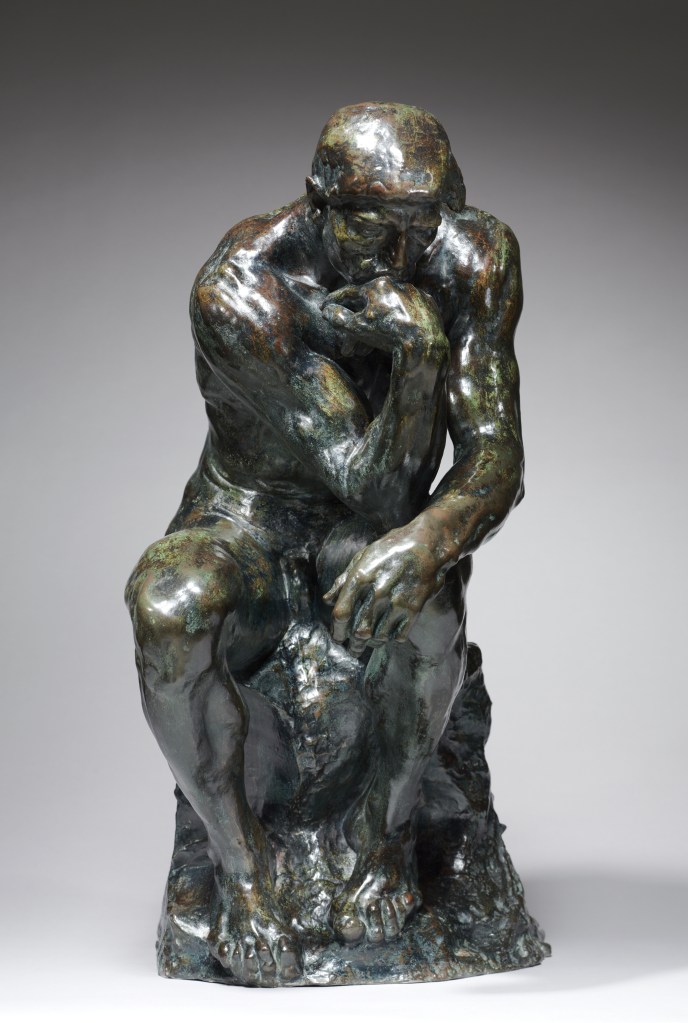
Auguste Rodin (French, 1840–1917)
Bronze, c. 1880
Collection of the Cleveland Museum of Art
Introduction
Throughout intellectual history, certain movements emerge as responses to profound existential challenges, particularly in times of crisis when traditional sources of authority and meaning prove inadequate. Pietism, a religious movement within 17th and 18th-century Lutheranism, and Absurdism, a philosophical outlook articulated in the 20th century by figures such as Albert Camus, represent two such responses. At first glance, these movements may appear to occupy separate universes: Pietism, with its emphasis on personal spirituality and divine relationship, seems rooted in religious conviction, while Absurdism, especially as developed by Camus, confronts the inherent meaninglessness of life, proposing a defiant acceptance of the absurd. Yet, beneath these surface differences lies a shared psychological strategy for coping with the limitations of human existence. Both movements involve an internal retreat to assert autonomy and agency in the face of external authority, ultimately rejecting or reinterpreting the concept of control over what life presents.
This essay explores the deep connections between Pietism and Absurdism, arguing that both movements, despite their different contexts and expressions, engage in a similar process of internal retreat and reframing of meaning. By analyzing the historical and philosophical underpinnings of each movement, as well as their respective responses to crises of autonomy, we can uncover the unexpected parallels between them. Through this comparison, we gain a deeper understanding of how individuals and communities navigate the challenges of existence, finding ways to create meaning and assert control in a world that often seems indifferent or hostile to their aspirations.
I. The Historical Contexts of Pietism and Absurdism
To fully appreciate the parallels between Pietism and Absurdism, it is essential to consider the historical contexts from which they emerged. Pietism arose in the aftermath of the Thirty Years’ War (1618–1648), a conflict that devastated much of Central Europe, particularly the German states. This war, one of the most destructive in European history, left the region in ruins, with a shattered economy, deep social fragmentation, and widespread spiritual despair. In this context, the institutional Lutheran Church, which had been a source of spiritual and social cohesion, was increasingly perceived as distant and disconnected from the immediate needs of its congregants. Philipp Jakob Spener, often considered the father of Pietism, called for a return to a more personal and heartfelt form of Christianity. Spener’s vision emphasized personal piety, the cultivation of the inner life, and a direct, unmediated relationship with God as the means of spiritual renewal.
Similarly, Camus’ philosophy of Absurdism was shaped by the profound existential crises brought on by world wars, particularly World War II. Writing in occupied France, Camus grappled with the moral and philosophical implications of a world plunged into chaos by unprecedented violence and suffering. The horrors of the war, including the Holocaust and widespread destruction, shattered many of the moral, religious, and philosophical certainties that had underpinned Western thought. In this context, Camus developed his concept of the absurd—the recognition that life is inherently devoid of meaning, a reality that can lead to either despair or rebellion. In his seminal essay The Myth of Sisyphus (1942), Camus presents Sisyphus, the mythological figure condemned to endlessly push a boulder up a hill only to see it roll back down, as the archetype of the absurd hero. Sisyphus’ rebellion lies in his acceptance of the futility of his task and his decision to find joy in the struggle itself. This defiant embrace of the absurd becomes, for Camus, a model of how to live meaningfully in a world that offers no intrinsic meaning.
Despite the centuries that separate them, the historical contexts of Pietism and Absurdism reveal a striking similarity: both movements emerged in response to the devastation and moral ambiguity wrought by catastrophic wars. The Thirty Years’ War and World War II, though vastly different in scale and nature, each led to a profound crisis of meaning. In both cases, the established structures of meaning—whether religious, political, or philosophical—seemed inadequate to address the realities of a world torn apart by violence and chaos. In response, both Pietists and Absurdists turned inward, seeking to create or rediscover meaning within the self, rather than in the external world.
II. Internal Retreat and the Assertion of Autonomy
Central to both Pietism and Absurdism is the concept of an internal retreat as a response to the recognition of powerlessness in the face of external forces. For the Pietist, this retreat involves a rejection of the institutional structures of the church, which were perceived as corrupt or spiritually empty, in favor of a direct and personal relationship with God. This inward turn was a deliberate choice to reclaim agency in a world that was often hostile as well as spiritually barren and controlled by external secular and spiritual authorities that offered little true solace. The Pietist’s focus on personal piety, repentance, and the cultivation of the inner life was not merely a withdrawal from the world but a strategic redefinition of what it meant to live a meaningful life.
Similarly, Absurdism posits that the external world is indifferent, and often hostile, to human aspirations, and that any search for absolute meaning or purpose is ultimately futile. Faced with this reality, the Absurdist retreats inward, choosing to assert autonomy by creating personal meaning through their actions and attitudes, even in the absence of any inherent purpose. This internal retreat is exemplified in the figure of Sisyphus, whose rebellion against the absurdity of his situation is not an attempt to escape his fate but to find meaning in the struggle itself. By embracing the absurd and rejecting the false comforts of external validation or hope, the Absurdist asserts control over their own experience of life.
In both Pietism and Absurdism, the internal retreat is a means of asserting autonomy in a world where external control is impossible. The Pietist’s decision to focus on a personal relationship with God, and the Absurdist’s choice to find meaning in the act of living itself, are both expressions of a deep-seated need to reclaim agency in the face of overwhelming external assaults and constraints. This retreat into the self allows both the Pietist and the Absurdist to create a sense of purpose and meaning that is independent of the external world, even as they acknowledge the limitations of their control over that world.
III. Reframing Meaning: The Creation of Purpose
A key aspect of both Pietism and Absurdism is the reframing of meaning in response to the recognition that external sources of validation are inadequate or non-existent. For the Pietist, this reframing involves a shift away from the traditional markers of religious authority and success—such as adherence to doctrine or participation in ritual—and towards the cultivation of personal piety and a “direct relationship with God.” This reorientation of values allows the Pietist himself or herself to define what it means to live a meaningful life, focusing on the internal transformation that comes from spiritual devotion rather than on external adherence, achievements, or recognition.
In Absurdism, the reframing of meaning involves a rejection of the notion that life has any inherent purpose or value. Instead, the Absurdist creates meaning through their own actions and attitudes, embracing the struggle of existence as the only source of true fulfillment. This process of meaning-making is deeply personal and likewise self-directed, relying on the individual’s ability to find joy and purpose in the act of living itself, rather than in the pursuit of some ultimate goal. For the Absurdist, meaning is not something that can be discovered in the world, but something that must be created from within.
Both movements, therefore, involve a similar process of reframing meaning in response to the limitations of external validation. The Pietist’s focus on personal spirituality and the Absurdist’s embrace of life’s struggles both represent ways of creating meaning that are independent of external authority or recognition. In this sense, both movements can be seen as responses to the same existential crisis—the realization that the external world offers little in the way of inherent meaning or purpose—and as attempts to reclaim control over one’s own experience of life.
IV. Absurdism with a Defined Purpose? A Pietist Perspective
One of the most intriguing aspects of the comparison between Pietism and Absurdism is the question of whether Pietism can be understood as a form of Absurdism with a defined purpose. The Pietist’s commitment to a personal relationship with God, and the self-directed study of the Bible (as opposed to clerically mediated study), could be seen as an “absurd” response to the same existential reality that the Absurdist confronts—the lack of inherent meaning in the world. In this light, the Pietist’s purpose is a chosen framework within which they navigate life, much like the Absurdist who chooses to live fully and autonomously despite recognizing the absurdity of existence.
From a Pietist perspective, the Absurdist’s rejection of predefined purpose might be viewed as a form of self-delusion. The act of living, even without a declared purpose, imposes a structure, a boundary within which life is conducted. In this sense, the Absurdist’s choice to embrace life’s struggles without seeking external validation could be seen as indistinguishable from the Pietist’s choice to live according to their spiritual principles. Both are volitional acts, grounded in the need to define one’s existence in a world where external authorities offer little guidance or control.
This perspective raises the possibility that the distinction between Pietism and Absurdism may be less significant than it initially appears. Both movements involve a retreat into self-definition, where the individual creates meaning and purpose in response to a world that offers little in the way of inherent validation. Whether that purpose is found in a personal relationship with God, or in the conscious embrace of life’s struggles, both the Pietist and the Absurdist are engaged in the same fundamental process of creating meaning within the constraints of an uncontrollable external reality.
V. The Interplay of Rebellion, Resignation, and Autonomy
The interplay of rebellion, resignation, and autonomy in Pietism and Absurdism reveals a complex psychological response to the challenges of the human condition. Both movements engage in a form of rebellion against external circumstances—whether it is the chaos and harshness of the provincial German states and the related materialism and formalism of the Lutheran Church or the meaninglessness of the universe. This rebellion is not about changing the external world but about asserting control over one’s internal life and creating a sense of meaning that is independent of external validation.
At the same time, both Pietism and Absurdism involve a form of resignation—a recognition of the limitations imposed by the external world. This resignation is not a passive surrender but a deliberate choice to focus on what is within one’s control. For the Pietists, this meant turning inward and cultivating a personal relationship with God. For Sisyphus and the Absurdists, it meant embracing the struggle itself and finding contentment in the act of living. This resignation is a key part of the psychological strategy that allows individuals to navigate a world that otherwise offers little in the way of inherent meaning and satisfaction.
Resilience Through Rebellion and Resignation
The psychological resilience observed in both Pietism and Absurdism stems from their ability to reinterpret adversity and find strength in internal resources. The Pietists’ resilience was anchored in their faith and their personal relationship with God, allowing them to navigate a world that seemed increasingly hostile to their material interests and spiritual values. By focusing on spiritual transformation and personal piety, they found stability and purpose that transcended the material world’s limitations.
For Camus’ absurd hero and himself, resilience is achieved through the acceptance of life’s inherent meaninglessness and the conscious decision to live fully within those constraints. Sisyphus’ act of pushing the boulder, despite its futility, becomes a metaphor for human resilience. The hero’s strength lies not in overcoming the absurd but in embracing it and finding contentment in the act of living itself. This resilience is a form of defiance against the absurdity of existence, an assertion that life’s challenges, no matter how insurmountable they may seem, do not diminish the value of living.
Creating Meaning Within Constraints
Both Pietism and Absurdism advocate for creating meaning within the constraints of a world that offers little in the way of inherent purpose. For the Pietists, this meaning is found in their spiritual journey and their relationship with God, which provide a framework for understanding and navigating life’s challenges. The Pietist’s rejection of worldly concerns in favor of personal piety represents a deliberate choice to focus on what is within their control—their spiritual life—rather than being overwhelmed by the external world’s demands.
Similarly, the absurd hero, and those who emulate him, create meaning through the very act of living, despite the absence of any ultimate purpose. For Camus, the struggle itself becomes the source of meaning, as the individual engages with life on their own terms, rejecting the notion that life’s value must come from outside themselves. This act of meaning-making is entirely self-directed and deeply personal, reflecting a commitment to autonomy and agency in the face of a purposeless universe.
The connection between Pietism and Absurdism lies in this shared emphasis on creating meaning from within, rather than seeking it in the external world. Both movements recognize that the world is full of limitations and constraints, but they also assert that individuals have the power to define their own sense of purpose and fulfillment. This focus on internal resources—whether spiritual or existential—highlights the importance of personal autonomy and resilience in navigating life’s challenges.
VI. Conclusion
In examining the shared themes between Pietism and Absurdism, we find that both movements, though arising from different historical and philosophical contexts, reflect a fundamental human response to the limitations of existence. Both engage in an internal retreat to assert autonomy and create meaning within a world that offers little external validation or control. Whether through a personal relationship with God or the embrace of life’s inherent struggles, both the Pietist and the Absurdist find ways to live meaningfully and resiliently within the constraints of their respective circumstances.
Ultimately, Pietism and Absurdism reveal that the human quest for meaning and purpose transcends specific religious or philosophical frameworks. Both movements offer valuable insights into how individuals can navigate the challenges of existence, finding ways to assert control and create meaning within the limitations imposed by the external world. By comparing these two seemingly disparate approaches, we gain a deeper understanding of the universal human experience and the strategies we use to make sense of our place in the world.
[The draft essay above was inspired by two recent posts—one discussing Isaiah Berlin’s reflections on the origins of Pietism, and another examining the Proto-Indo-European root Skei- and its derivatives, which led me to a consideration of Absurdism. It occurred to me that these two movements, though seemingly distinct, seem to blossom from similar impulses. This initial exploration of that possibility is promising.
A more comprehensive exploration, currently exceeding twenty pages with a substantial bibliography, is in progress. Whether the project evolves further depends on whether the ideas presented here bear fragrant fruit or wither on the vine.]
Discover more from Northcoast Antiquarian
Subscribe to get the latest posts sent to your email.

 Northcoast Antiquarian
A great article, thank you very much! I will use it as an opportunity to finally take a closer look at absurdism. This has been on my agenda for some time, as the absurd is often the focus of my own work.
LikeLiked by 1 person
Thank you, kind sir! Many of your articles and works of art, which I have only recently discovered, have likewise inspired me. In particular, your haikus and your essay “Can We Hear a Painting?” Regarding the latter, I have now assigned myself the task of exploring more fully the concept of Gesamtkunstwerk – which I was intuitively moving towards an exploration of late. Perhaps once you read Camus’ Sisyphus you may be inspired to commit Sisyphus himself to canvas in your unique style, or render his experience in a haiku in your ethereal manner. Again, thank you.
LikeLiked by 1 person
Thank you very much! Yes, Sisyphus! Thank you for mentioning! I have a special relation to Sisyphus, a quite strange one, and working on that topic could become most interesting.
I also only recently discovered your blog and your articles really are superb. All the best! Friedrich
LikeLiked by 2 people
My curiosity is, of course, piqued by the unique bond you reference sharing with the enigmatic Sisyphus of myth. I eagerly anticipate the fruits of any labor inspired by such a profound connection. With warmest regards and respect, Donald.
LikeLiked by 1 person
Basically, it’s about a dream that I had over and over again for many years: I was at the bottom of a crater made of gravel and was trying to reach the top edge (perhaps to get to another level of reality?). As soon as I reached the edge, the gravel gave way and I was back on the ground. It was only years later that a friend pointed out to me that this was of course Sisyphus par excellence. A simple story, but one that had consequences.
LikeLiked by 2 people
Indeed, we all harbor that One Dream of consequence in our lives, a vision that reverberates through the decades. I have written somewhat obliquely about mine and even ventured to reference it in a poem, which I then set to AI-generated music, in an essay titled, The Symbolism of Dreams: My Unforgettable Armadillo Protector. Generally, I adhere to the wisdom found in Jesus ben Sirach 34:1-2:
“Empty and false are the hopes of the senseless,
and dreams give wings to fools.
Like one grasping at shadows or chasing the wind,
so anyone who believes in dreams.”
Yet, exceptions with consequences linger. An armadillo here, a Sisyphus there—each of us, in our own way, holds onto a dream that defies the very skepticism we profess.
LikeLiked by 1 person
Oh, WOW! Great thoughts Indeed. My next post will deal with reality – in an usual way. Thanks again! 🙏🎶☀️
LikeLiked by 1 person