

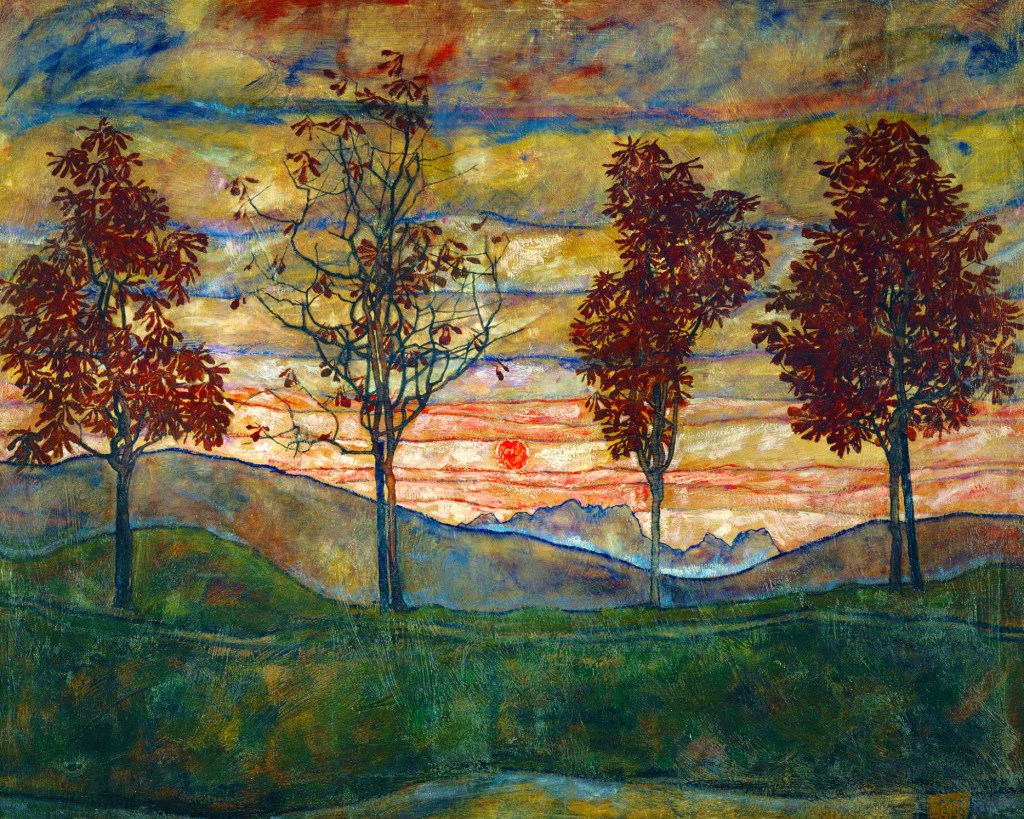
Earlier this week, I took some time to review several hundred works by Egon Schiele (1890–1918), the Austrian Expressionist painter renowned for his intense and raw depictions of the human form. Schiele’s art, with its distinctive distorted body shapes and expressive lines, often explores themes of sexuality and self-examination, particularly in his numerous self-portraits, including nudes. Personally, I am more drawn to his other works—those that portray buildings, landscapes, and more formal sittings—not out of prudishness, but because of his unique ability to capture such scenes with an aesthetic that I appreciate. His mentor, Gustav Klimt, played a significant role in shaping Schiele’s artistic development. A broader collection of his works can be found here: Egon Schiele Overview and at the YouTube video gallery below.
While Schiele’s style is compelling, his biography is troubling, and he is not someone I would have wanted to know personally. Nonetheless, many of his works possess an undeniable aesthetic appeal, although others do not resonate with me as deeply. Two pieces that I find particularly captivating are included in this post—one featured above, and the other below (which reminded me of myself researching for an article or post).

For the record, The Cleveland Museum of Art possesses two works by Schiele, neither on display. The more interesting is below.

Discover more from Northcoast Antiquarian
Subscribe to get the latest posts sent to your email.

 Northcoast Antiquarian
As an Austrian, I am of course broadly familiar with Schiele 🙂 And it is not surprising that he has been a great role model for me since my youth. It is hard to imagine, but Schiele’s graphics would have been affordable for me even when I was a poor student. In the early 1970s, two people, one of them a newspaper editor, started pushing Schiele through auctions. They outbid each other to drive up his value.
BTW, lines play a big role for me and so I also looked into Schiele’s incomparable lines in more detail. I learned that he used a so-called mason’s pencil. This is a hexagonal, flat pencil, the lead of which is therefore neither round nor square and the quality of the lines changes when you turn it while drawing.
LikeLiked by 2 people
Many things which I collected in my youth are now unaffordable to me! Some items which I purchased for $25 or $45 sold for hundreds and even thousands of dollars when I sold them at auction a few years ago. Either I had a good eye in youth or was very fortunate in my indiscriminate purchases.
It is not surprising that you were attracted to and became familiar with Schiele early. And how fortunate his work was initially affordable to you! And that you learned from his incomparable use of lines! Very fascinating who our teachers, directly or otherwise, are in life.
LikeLiked by 1 person
When we were young, there were so many good art objects at incredibly low prices. I never had to work during my studies. I just bought here and sold there – many years before the internet.
You can’t imagine how much I found in my 5 years in China (70s-80s). Eventually I started trading them on the internet.
LikeLiked by 2 people