

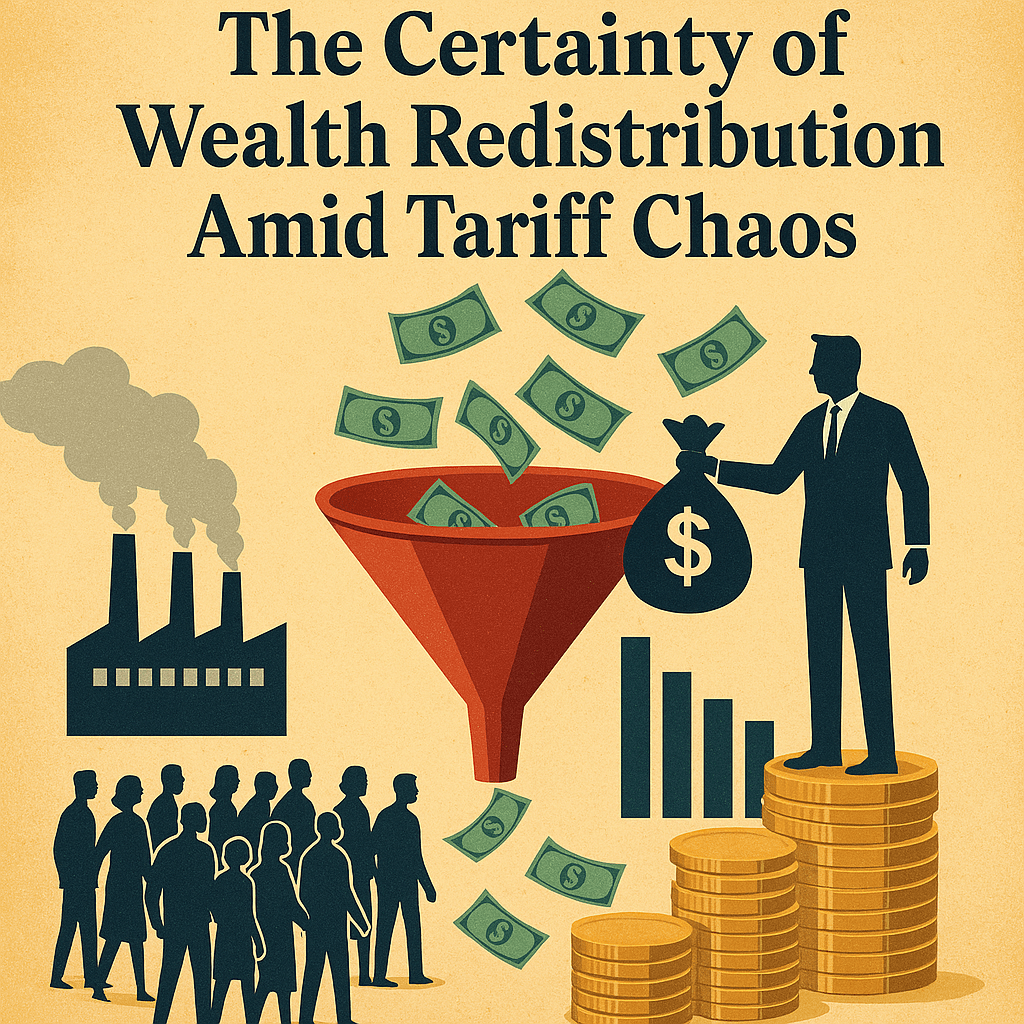
In the history of American economic policy, few moments have rivaled the current administration’s radical redirection of trade as both a break with precedent and a deliberate provocation of instability. The imposition of universal tariffs, compounded by steep duties on selected nations and penguins, has injected volatility into nearly every sector of the global economy. Yet, for all the uncertainties this policy has unleashed—geopolitical, fiscal, and industrial—one outcome is not only predictable but virtually guaranteed: a significant transfer of wealth from the broad base of American households to a narrow echelon of financial elites.
The administration’s tariff policy, sweeping in scope and nationalist in tone, has been sold to the public as the path to the restoration of American greatness, even proclaimed as a “Liberation Day.” But the reality it heralds is less one of liberation than of reallocation—specifically, a reallocation of economic burden and reward. By taxing nearly all imported goods—consumer staples, electronics, food, clothing, and industrial components—the policy imposes a direct and regressive cost on the average American. Inflationary pressures, rising production costs, and disrupted supply chains ensure that these tariffs function not merely as tools of negotiation, but as economic levers that press down on the middle and lower classes while lifting those whose wealth resides in capital rather than wages.
If the COVID-era recession taught us anything, it is that crises, when coupled with targeted monetary and fiscal policy, can act as engines of wealth concentration. During the pandemic, unprecedented interventions—stimulus checks, expanded unemployment insurance, PPP loans, and Federal Reserve liquidity—managed to momentarily soften the blow for many. Even then, the lion’s share of wealth gains went to the top 0.1%, as asset prices surged and capital-rich investors reaped the benefits of timely speculation and quantitative easing.
But the current recession-in-the-making differs in one essential respect: it is being pursued without pretense of public aid. There are no stimulus packages, no safety nets. What is offered instead is a doctrine of creative destruction: tens of thousands of federal workers laid off; regulatory agencies gutted; international partners alienated; domestic producers left to absorb new costs or pass them on to already-strained consumers. The economic pain is not an unintended consequence—it is the plan. And in such an environment, wealth will not merely trickle upward; it will flood there.
As import costs surge, businesses with transnational supply chains and logistical flexibility will shift production, seek carve-outs, and hedge against volatility. Those without such capacities—local manufacturers, family-owned farms, small retailers—will face thinning margins, layoffs, and in many cases, closure. The financial elite, holding diversified portfolios in real estate, private equity, and multinationals, will swoop into the resulting vacuum, acquiring distressed assets at discount, consolidating market share, and harvesting profits from inflationary dynamics. As was seen in the years following 2020, equity markets may fall precipitously at first, but they are likely to rebound faster than the broader economy—particularly with the Federal Reserve expected to cut interest rates in the wake of contraction. Once again, asset prices will rise. Once again, the owners of capital will see their fortunes grow.
Tariffs are traditionally viewed as blunt instruments of industrial protection. But in this case, they serve a far more surgical purpose. They extract purchasing power from the working class, undermine the viability of small and medium enterprises, and force a restructuring of the American economy around those who can absorb cost, influence policy, and pivot globally. They are not instruments of policy so much as instruments of wealth concentration.
If anything is certain in the unfolding tariff-driven crisis, it is that inequality will increase. Not in abstract or relative terms, but in concrete redistributive ones: trillions of dollars will move from wage earners and consumers to capital holders and financial intermediaries. The historical data, the institutional forecasts, and the structural logic all align. Amid the din of political slogans, retaliatory tariffs, and market disruptions, this is the one truth that should command attention.
History will not record this period as a victory for the American people. It will record it as a transformation: not of manufacturing, not of trade, but of the very architecture of American wealth—concentrated more tightly, held more distantly, and insulated more completely from the needs and voices of the many.
Discover more from Northcoast Antiquarian
Subscribe to get the latest posts sent to your email.

 Northcoast Antiquarian
One thought on “The Certainty of Wealth Redistribution Amid Tariff Chaos”