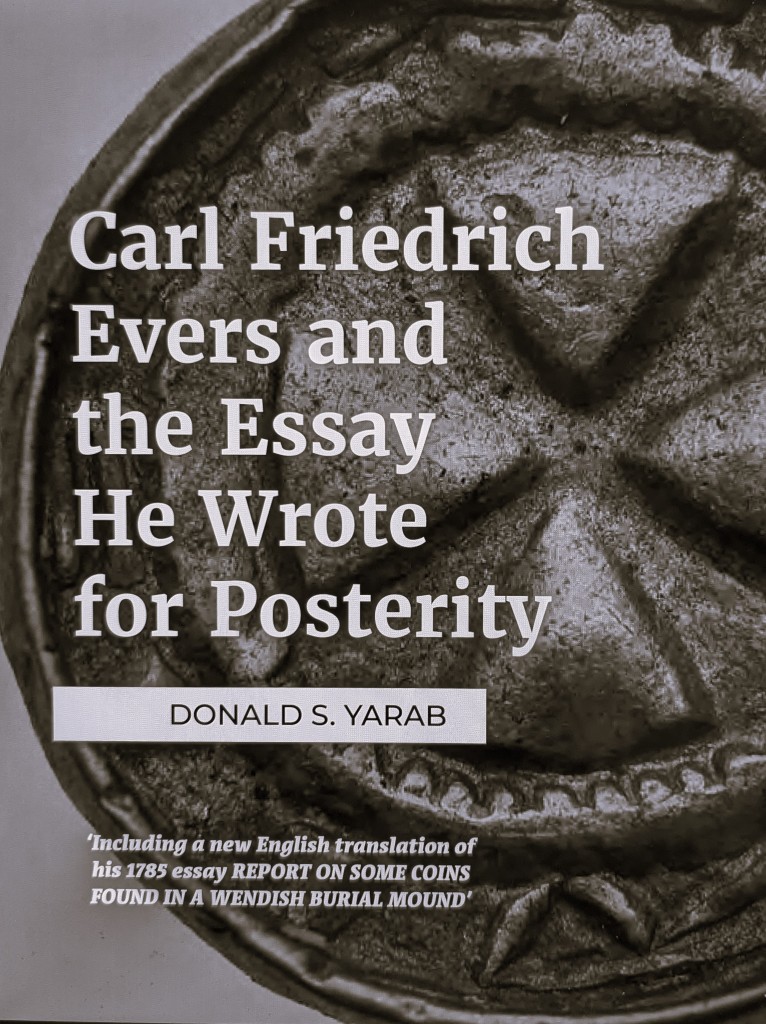
Pleased to have completed a translation of Evers’ 1785 essay, which still appears in scholarship today. Although Evers missed the mark in his attribution of the coins to the Wends, he was nonetheless one of the earliest to attempt a scholarly treatment of the coins now known as Randpfennige or cross denarii and certainly amongst the first to illustrate the coins.
A copy of the monograph I prepared to accompany the translation is available with a click of the button below:
The articles translated originally were published in Rocznik Kaliski in 2005 and 2010. An author associated with both articles was A. Kędzierski, perhaps the foremost authority on cross denarii in Poland. The articles translated are:
Kędzierski, A., Miłek, S. 2005. Mennica denarów krzyżowych w Kaliszu. Rocznik Kaliski 31, pp. 227-236.
Kędzierski, A. 2010. Czy istnieją denary krzyżowe Władysława Hermana? Rocznik Kaliski 36, pp. 255-262.
Kędzierski’s more recent works, of course, supersede and supplement these articles, but I thought it was still worth translating for better understanding the later works. The articles were translated strictly for use in personal scholarship. The translations can be accessed at the links below.
Today, I was researching the early medieval coins known variously as Sachsenpfennige, Wendenpfennige, Randpfennige, Hochrandpfennige, Denary krzyzowe, or cross denarii. As part of this research, I have been consulting the works of the earliest writers to discuss these coins, including Evers, Mader, and Lelewel. When consulting Lelewel’s Numismatique du Moyen-âge, considérée sous le rapport du type (Paris, 1835), I was absolutely thrilled with Lelewel’s sense of humor and writing style. In truth, I had a hardy chuckle when I read the section of his work which led up to his discussion of the types which are the subject of my research.
My free translation of the text that gave rise to my pleasure follows. It discusses the mutilated inscriptions, inscription fragments, or random letters, which Lelewel noted as appearing on some early medieval German coins.
The coinage of Germany offers more examples of deformity than any other; it has sometimes enigmatically imitated Anglo-Saxon coins, most often only having the remains of an inscription and thus becoming infinitely obscure. I believe there are pieces that have the letters mixed up aimlessly, without reason or symmetry. Anglo-Saxon riddles are more inventive and complete and hold more to a complicated and organized method. German riddles are rather more puzzling with their raw obscurity, outdoing all the others. Letters are mixed aimlessly, without reason, without symmetry. The captions are truncated and mutilated, and the small number of letters that are preserved are not spared harm, to such an extent that all traces to be deciphered disappear. It is not the incapacity of the artist that breaks the necks of legends and letters but his whim, or his willful inattention, or his inadvertence. You see the letters reversed ass-over-head. Sometimes they lie on their backs, sometimes crawl belly to the ground; some walk with firm feet, others turned with their legs upside down. In their continual somersaults, they appear lame and bent, their limbs are dislocated, shattered, or scattered.
Part III, p . 155 ff.
Lelewel is not wrong. He expresses his indignation with an exasperated eloquence that I have rarely encountered but which I greatly appreciate!
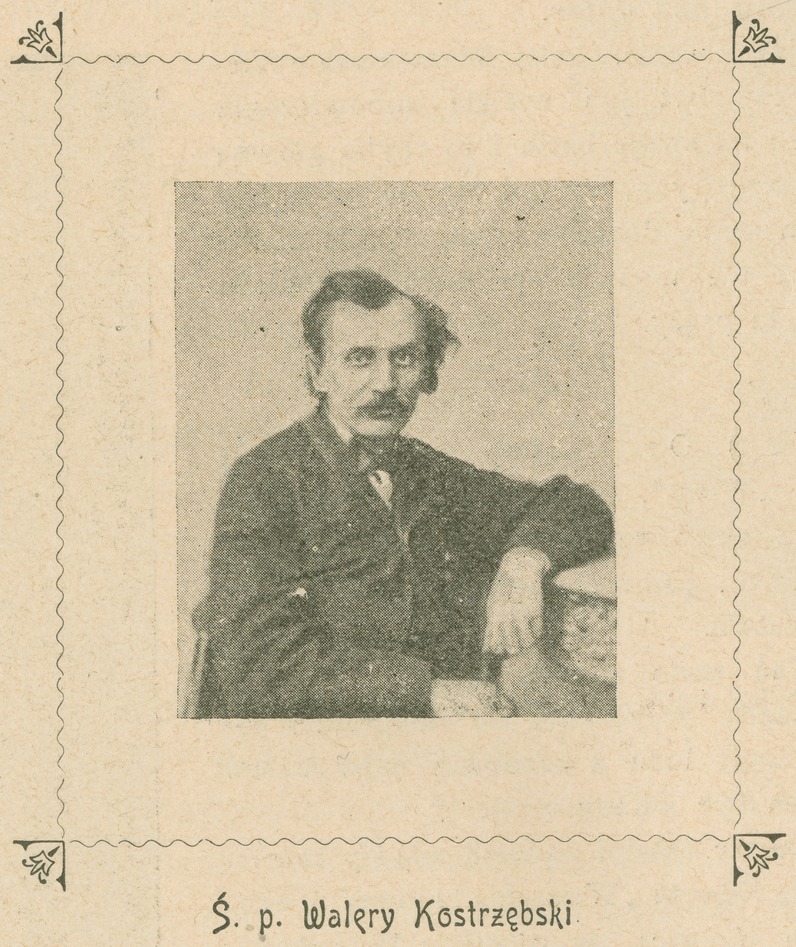
Walery Kostrzębski (8 December 1828 – 26 October 1899) was an eminent figure in Polish numismatics, whose star shone quite brightly in that lustrous circle of luminaries which included Beyer, Müller, Stronczyński, Kiska, and Przyborowski.
Kostrzębski worked as an assayer at the Warsaw Mint from 1850 through its closing in 1867. In carrying out his duties at the mint, he had an opportunity to view all the interesting numismatic materials that flowed into the mint to be melted, which sparked an intense scholarly interest in numismatics. After the mint was closed, Kostrzębski devoted himself with great enthusiasm to numismatic studies, especially of the medieval period. At the time of his death, he was undertaking a careful and exacting study of cross denars and their place in Polish numismatics.
Cross Denarii (formerly known as Sachsenpfennige or Wendenpfennige)
His work was instrumental to the studies of Marian Gumowski and the great numismatists that followed and is still routinely cited in the studies of cross denars to this day, most recently in Adam Kędzierski’s magisterial Skarb Słuszków I. Denary krzyżowe z przełomu XI i XII wieku (The Słuszków I hoard. Cross denarii from the end of the 11th and the beginning of the 12th century).
The articles collected for your convenience include a remembrance written in honor of Kostrzębski after his death and a series on cross denars that was published posthumously in his name which represented his views on what were then often called Wendenpfennige but which he called Slav denars.
Contents, which include the following, are accessible by pressing the button found below:
Bog, Walenty (1899). “Wspomnienia,” Wiadomości Numizmatyczno-Archeologiczne, Vol. IV, No. 4, p. 126-128.
Kostrzębski, Walery (1900). “O denarach Słowian zwanych wendyjskimi,” Wiadomości Numizmatyczno-Archeologiczne, Vol. IV, no.1, pp. 257-261.
Kostrzębski, Walery (1901). “O denarach Słowian zwanych wendyjskimi: ciąg dalszy,” Wiadomości Numizmatyczno-Archeologiczne Vol. IV, no. 1, pp. 303-307.





 Northcoast Antiquarian