
A Bolognino of Charles III di Durazzo

From Ovid’s Sulmona to Benedict’s Rome
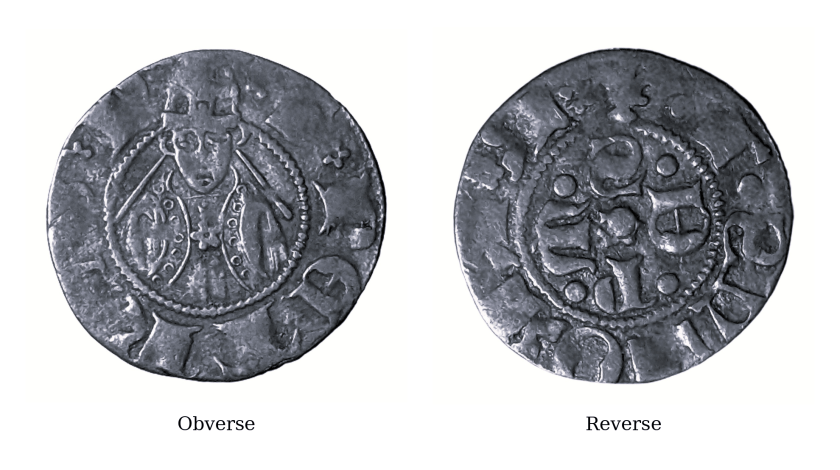

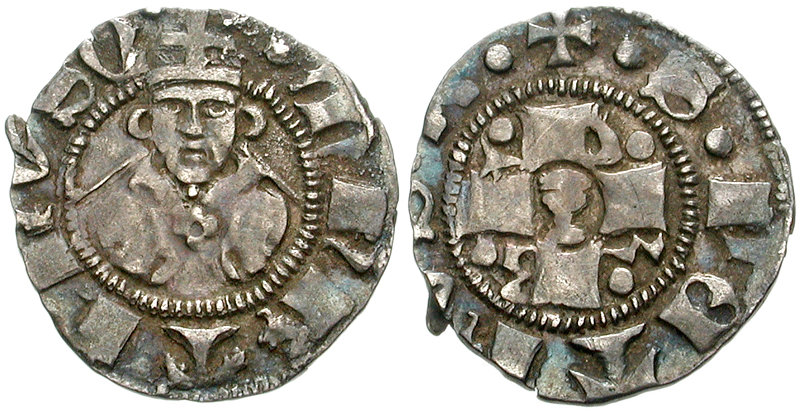
Kingdom of Sicily (Naples) – Sulmona.
Charles III of Durazzo, King of Sicily, 1381-1386,
King of Hungary, 1385-1386.
AR Bolognino of Sulmona,
.82 g., struck 1382-1385.
Obverse: Bust of St. Peter Celestine
with S PETRVS P inscription around.
Reverse: R•KROLVS•T• inscription around
with •S•M•P•E in center around pelleted cross saltire.
Reference: MEC 14, 727 variant.

Recently, I spent time attributing various coins from a small assemblage of medieval coins I purchased a decade or two ago that were either wholly unattributed or erroneously attributed by their previous owner. After all this time, I have finally turned my attention to cataloguing the coins properly. One of the coins was previously grossly misidentified as an obol from Bergamo when, in fact, I found that it was a bolognino minted in Sulmona, a much more interesting attribution, as will be discussed below. The coin is illustrated above.

The general type is familiar, and common, enough. Two examples are illustrated below. The similarities with my coin will be obvious, as will be the dissimilarities.
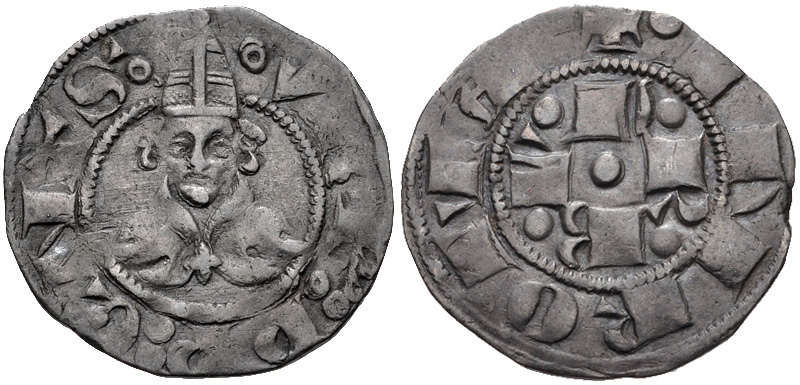

Papal States – Avignon. Urbanus V (Guillaume de Grimoard). 1362-1370.
AR Bolognino, 18mm, 1.33 g. Rome mint.
Obverse: · VRB’ : P P : QNTS’ · (annulet and double annulet stops throughout), mitred bust facing
Reverse: + · IN ROMЯ · inscription around, •V•R•B•I as central device within beaded circle.
References: CNI XV 8; Muntoni 3; Berman 198.
Source: CNG: The Coin Shop, 933495.
Papal States – Martin V (Oddone Colonna). 1417-1431.
AR Bolognino (15mm, 0.82 g, 6h). Rome mint.
Obverse: + mARTInVS Q, mitred bust facing
Reverse: +•S•PЄTRVS• inscription around, •V•R•B•I as central device within beaded circle
References: CNI XV 61; Muntoni 21; Berman 274.
Source: CNG, The Coin Shop, 820494. Ex Luparello Collection.

The similarities between my coin’s obverse and the general type are obvious and immediate. All three obverses present a mitred, front-facing papal bust within a beaded border, identified by encircling legends: VRB PP on the Urban piece, mARTInVS on the Martin piece, and S. PETRVS on mine. The reverses, too, share marked similarities: four rather heavy-looking letters are set as a central device in a cross-like pattern at the cardinal points, with pellets placed in the four diagonal angles and at the center, forming a saltire cross, all enclosed within a beaded border. Each coin’s outer legend, too, lends further identification of its origin: for Urban’s coin, an inscription declaring origin, IN ROMЯ; for Martin’s, one naming the see, S PЄTRVS; and for mine, one naming the sovereign who issued the coin, R KROLVS T (Rex Karolus Tertius).

The dissimilarities are subtle but significant. Urban’s and Martin’s obverse legends name a reigning pope in each instance, making it easy to identify the authority issuing the coins. Mine names, on its face, only S. PETRVS P and at first blush one would identify this as Saint Peter the Apostle, the first pope, making identification of the issuer difficult as the coin is not of such antiquity (but for the identification of Rex Karolus Tertius on the reverse). But we shall return to the true identity of this Saint Peter momentarily. The reverses have marked dissimilarities also. The center lettering on Urban’s and Martin’s coins spells VRBI, an unambiguous declaration that these coins are products of the City, that is, Rome. My coin’s central letters, S M P E, are cryptic by comparison, revelatory only to a those familiar with Ovid’s Tristia, specifically 4.10.1–4:

Ovid, Tristia 4.10.1–4:

Ille ego qui fuerim, tenerorum lusor amorum,
     quem legis, ut noris, accipe posteritas.
Sulmo mihi patria est, gelidis uberrimus undis,
     milia qui nouiens distat ab urbe decem.

That man I was, you know him from these lines,
the playful poet once of tender loves
receive this, posterity, and learn his name.
Sulmo is my homeland, rich in ice-cold springs,
ninety miles distant from the city’s gates.

The four letters S M P E reflect the initial letters of four words from the poem: Sulmo Mihi Patria Est — the opening words of the couplet’s third line. Ovid, writing the autobiographical Tristia from exile on the Black Sea around AD 12, gives his birthplace before he gives almost anything else about himself. Whoever cut the die for this coin took that line and folded its initials into the same cross-and-saltire device that, on other bolognini, named nothing more than the City, Rome. These letters on this bolognino therefore tell us that the coin was struck at Sulmona.

The choice of these letters on the reverse also reveals the identity of the S. PETRVS on the obverse. He is Sulmona’s own Saint Peter, Pietro da Morrone, born Pietro Angelerio, hermit of Monte Morrone a few miles outside the city walls, elected and crowned Pope Celestine V in 1294, canonized in 1313 as San Pietro Celestino, and venerated ever since as the town’s own adopted son raised to the papacy. Thus, the coin’s obverse names its saint; the reverse names its town; and the coin’s issuing authority, the Rex Karolus Tertius identified on the reverse, turns out to be Charles III di Durazzo, who is almost incidental to the coin as it is a coin about Sulmona, not the king who issued it.

Celestine V, as noted above born Pietro Angelerio and known from his hermitage on Monte Morrone as Pietro da Morrone, was, prior to being elected and serving as Catholic pontiff for five months in 1294 AD, a monk and a hermit who founded the Celestines, a branch of the Benedictine Order that survived until the 18th century. He was elected pontiff in the Catholic Church’s last non-conclave election after a two-year impasse without a pope. Though his reign was short, and many of his acts were canceled by his successor, two extraordinary edicts survived from his reign: his confirmation of the right of a pope to abdicate and his reinstatement of conclave regulations established by Gregory X’s bull Ubi periculum.

On December 13, 1294, a week after confirming that pontiffs could abdicate, Celestine V himself resigned, stating that he desired to return voluntarily to his monastic, pre-papal life. Unfortunately, his successor, Boniface VIII, fearing that the former Celestine V would be installed as an antipope against him, imprisoned his predecessor in the castle of Fumone, where he died on May 19, 1296. Pietro Angelerio, the man who had been pontiff Celestine V, was canonized by Pope Clement V on May 5, 1313.

It cannot go unnoticed that Pope Benedict XVI proclaimed a Celestine Year in 2009–2010 to mark the eight-hundredth anniversary of Pope Celestine V’s birth, and in July 2010 knelt before Celestine’s relics in Sulmona’s own cathedral. Whether those gestures were, in retrospect, unwitting rehearsal for his own resignation in 2013 — using the very mechanism of abdication Celestine had established seven centuries earlier — is a question the record does not settle. But the resonance, once noticed, is difficult to set aside.

Thus, the coin I have attributed to Sulmona becomes, in the end, a hinge between two distant moments: Ovid’s line, composed around 12 AD, cast in cipher on the coin’s reverse; and the papal practice of resignation formalized by the man on the coin’s obverse, invoked, seven centuries later, by the next pope to resign, Benedict XVI, in AD 2013. This humble bolognino, struck sometime between 1382 and 1385 AD, stands as a hinge across a resonance spanning, in the end, two thousand and one years, from Ovid’s Sulmona to Benedict’s Rome.

On Claims and Coinage: When Auction Descriptions Outrun the Evidence

The Thasian tetradrachm is among the most recognizable silver issues of the late Hellenistic world. Its garlanded Dionysus and its heroic Herakles circulated widely across the Balkans and the Lower Danube, where they became prototypes for the diverse and often striking imitative series struck by Celtic and other tribal groups from the late second to first century BC.


ISLANDS OFF THRACE, Thasos. Tetradrachm, c. 148-90/80 BC. (Silver, 16.96 g, 10 h). Obv. Head of Dionysos to right, wearing ivy wreath. Rev. ΗΡΑΚΛΕΟYΣ ΣΩΤΗΡΟΣ ΘΑΣΙΩΝ Herakles standing facing, head to left, resting his right hand on grounded club and with lion’s skin draped over his left arm; in field to left, monogram. American Numismatic Society, 1948.19.583, CC BY-NC 4.0

One such Celtic imitation appeared recently at auction. The obverse presents a highly abstracted Dionysus—angular, almost post-modern with geometric features—while the reverse reduces Herakles to a ritual stick figure framed by pellet-rows.


LOWER DANUBE REGION. Imitation of Thasos. Late 2nd-1st century BC. Tetradrachm (Silver, 32 mm, 16.36 g, 12 h). Obv. Highly stylized head of a youthful Dionysos to right. Rev. Herakles, in the form of a stick figure, standing facing, holding a club in his right hand with cloak over his left arm; four rows of pellets to left and right, and a single row below.
Nomos 37, Lot 16 (November 2025)

The cataloguer rightly observes that these transformations reflect indigenous artistic traditions rather than “primitiveness,” a point well aligned with contemporary scholarship on Celtic visual language. There is no question that the engravers were interpreting, not merely degrading, the Hellenistic prototypes.

It must be said that the auction house in question is one for which I hold the highest regard. Its catalogues have long exemplified best practice: careful numismatic description, transparent provenance, and a consistent habit of guiding collectors toward relevant current scholarship. Precisely for that reason, the explanatory note appended to this coin was so noticeable. Beneath an otherwise exemplary entry appeared the following claim:

” … recent research suggests that the striking of coins by the Celts, the ancient British, and other ancient peoples, other than the Greeks and Romans and those very strongly influenced by them, had a highly ritualistic nature. Ancient sources tell us that prior to the beginning of the minting process, the ancient die engravers would drink copious amounts of what is now known as poitín or poteen, thus, providing them with visions that they then tried to engrave. Looking at the surviving coins makes this theory seem highly likely.” Nomos 37, Lot 16

It is a vivid statement. It is also, in every sense, extraordinary.

No ancient textual source with which I am familiar describes Celtic or Danubian engravers intentionally entering states of ritual intoxication in order to produce dies. No archaeological, metallurgical, or workshop evidence with which I am familiar supports the notion of visionary drink preceding coin production. While ecstatic ritual and alcohol appear in broader Celtic cultural contexts, such general ethnographic data cannot be converted into specific claims about the minting process without concrete evidence.

Stylistic abstraction in Celtic numismatics has long been understood more soberly: as a deliberate reinterpretation of Greek prototypes through indigenous symbolic systems with their own aesthetic grammar. These coins do not require intoxicated celators to be understood; indeed, there is nothing in their style that supports such a narrative.

If research genuinely exists supporting this theory, it ought to be cited with author, title, publication, and date—particularly because the claim is, by its nature, difficult if not impossible to substantiate even if there were scant wisps of archaeological or textual evidence suggestive of such practices. The omission of such citation risks misleading those who encounter the statement and, unintentionally, lowering the high scholarly standard that this firm has otherwise consistently upheld.

The coins themselves are reward enough. Set beside the Thasian model, the Celtic imitation is not a drunken distortion but a cultural reinterpretation—evidence of a visual world reshaping the Hellenistic canon according to its own inherited forms. To impose a tale of visionary potions upon the engravers is not only unnecessary but obscures the far more interesting truth: that artistic autonomy, not intoxication, shaped these remarkable issues.

Digital Tulips in the Gutter: A Reflection on Cryptocurrency and Speculative Delusion

by Donald S. Yarab

It is even more speculative than the tulips of tulipmania—less beautiful, less tangible, and arguably, less of an asset. Tulips, after all, at least bloomed.


four assorted cryptocurrency coins
Photo by Worldspectrum on Pexels.com

Cryptocurrency has become the modern symbol of speculative excess: a phenomenon untethered from utility, value, or service to the common good. Its defenders proclaim it a revolution in finance, a challenge to the tyranny of central banks, a restoration of liberty through cryptographic purity. But peel back the gilded claims, and one finds something more brittle, more hollow, and perhaps more dangerous.

To be fair, cryptocurrency does serve certain functions. In Venezuela, citizens use Bitcoin to preserve wealth as their currency hyperinflates. In countries with collapsed banking systems, people rely on digital tokens for remittances. In regions where governments block financial transactions, cryptocurrency provides an escape valve. These are real uses, serving real needs.

But examine why these uses exist, and a darker picture emerges. Cryptocurrency functions not as a superior alternative to traditional finance, but as digital tree bark—emergency sustenance consumed only when the normal food supply has failed. It works precisely because the alternatives are catastrophically worse: worthless fiat, collapsed institutions, criminal governments. This is not cryptocurrency succeeding on its merits; it is cryptocurrency serving as expensive, volatile intermediary in humanity’s most desperate financial moments.

The Venezuelan using Bitcoin is not proving cryptocurrency’s revolutionary potential—they are demonstrating what happens when a society’s monetary system breaks down. The remittance flowing through Ethereum is not evidence of innovation—it is a costly detour around institutional failure, adding friction, fees, and volatility risk to what should be a simple transfer. Cryptocurrency serves merely as an expensive, volatile intermediary in what remains, at core, a fiat transaction. Convert fiat to cryptocurrency, pay network fees, endure price swings, convert back to fiat, pay more fees. The process only makes sense when every other option is worse.

Yet cryptocurrency evangelists take these edge cases—where their system barely outperforms complete collapse—and extrapolate them into grand claims about the future of all finance. They mistake being marginally better than failed institutions for being superior to functional ones. Should we design our financial systems around the needs of failed states and criminal enterprises? Should we burn massive amounts of energy to create digital workarounds for institutional breakdown, rather than strengthening the institutions that serve stable societies?

This is not currency in any meaningful sense of the term. It is not a stable store of value. It is not a consistent medium of exchange. It is barely a unit of account. What it offers, rather, is a kind of digital alchemy, where symbols stand in for substance and belief masquerades as value.

For the early adopter, it is a lever for disproportionate gain. For the tax dodger and the launderer, it is a haven of shadows. For the credulous speculator, it is a mirage of easy wealth—a mirage often followed by collapse. And for the society that tolerates it, it is a siphon, draining energy—literal and metaphorical—from more productive ends.

Nor is this merely a matter of theory. In 2023 alone, blockchain analysis firms estimated that over $22 billion in illicit funds were laundered through cryptocurrencies—much of it routed through decentralized exchanges, mixing services, and prepaid debit card schemes. From sanctioned regimes like Iran and North Korea to transnational crime syndicates and terrorist networks, cryptocurrency now functions as the infrastructure of choice for bypassing traditional surveillance. It is not only opaque; it is portable, borderless, and persistently one step ahead of enforcement.

The value of Bitcoin, or any coin, is not intrinsic. Gold, whatever its monetary mystique, at least has industrial applications—electronics, medical devices, aerospace components. Strip away gold’s monetary role, and it retains a floor value based on genuine utility. Cryptocurrency offers no such foundation. It represents only that some energy was spent and some consensus achieved that a bit of code might be worth something to someone else. Unlike fiat currency—however imperfect—which is at least nominally governed by institutions with public obligations, cryptocurrency is governed by no one and manipulated by many.

Cryptocurrency’s history is not merely volatile—it is littered with failure. From BitConnect’s Ponzi scheme and OneCoin’s fabricated blockchain to meme-based absurdities like Coinye (sued into oblivion by Kanye West), entire ecosystems have collapsed under the weight of fraud or fantasy. More quietly, hundreds of lesser-known coins—Auroracoin, Peercoin, Feathercoin, Nxt—have faded into digital irrelevance. According to independent trackers, over 2,000 cryptocurrencies have already failed, often within a year or two of launch.

The blockchain may be secure, but the ecosystem is anything but. Scams, rug pulls, pump-and-dump schemes, and algorithmic collapses litter the field like digital detritus. And still the faithful chant the liturgy of decentralization, innovation, and inevitability.

The irony is almost poetic. A movement born from distrust of fiat currency has created something far less stable, far less transparent, and far more volatile. At least fiat is answerable to a polity. Cryptocurrency is answerable only to its market—and its market often answers to no one but the early sellers.

What was once billed as a decentralized revolution has, under the current administration, become a centralized enterprise of a different kind—one in which the instruments of state are quietly repurposed to serve private gain. Since President Trump’s return to office, enforcement actions against cryptocurrency firms have been reversed, regulations have been softened, and public officials with deep ties to the industry have assumed the very posts designed to police it. At the center of this permissiveness is a blatant conflict of interest: the Trump family’s own holdings in digital assets—including the $TRUMP meme coin, the USD1 stablecoin, and affiliated ventures—are now believed to rival or exceed the value of their traditional real estate empire. Cryptocurrencies are no longer mere instruments of speculation; they have become the administration’s preferred asset class. In this light, regulatory indifference is not ideological—it is financial. The state is no longer simply tolerating speculative delusion; it is underwriting it. The line between financial fraud and political favoritism has not just blurred—it has all but vanished.

What we are witnessing is not the future of money, but the future of speculation unmoored from labor, utility, or production. It is a theater of illusion, where wealth appears without work, where tulips bloom not in soil but in code, and where the coin in the hand may vanish before it ever finds use.

As governments struggle to keep pace, the anonymity and jurisdictional fluidity of cryptocurrency shield perpetrators behind webs of decentralized complexity. One high-profile case involved a dark web site trafficking in child exploitation, where more than 1.3 million separate cryptocurrency addresses were used to obfuscate payment trails. Investigators ultimately uncovered the network only through transnational cooperation and painstaking digital forensics. Yet such victories are rare. In most cases, enforcement plays an endless game of jurisdictional whack-a-mole—outmatched by technology’s relentless innovation and the absence of unified oversight.

The few legitimate uses of cryptocurrency—preserving wealth during hyperinflation, circumventing capital controls, enabling remittances where banks have failed—are symptoms of institutional pathology, not harbingers of financial evolution. Building speculative manias around emergency measures is both dangerous and absurd. These are not features to celebrate but problems to solve through stronger institutions, not weaker ones.

It is not that all cryptocurrency is criminal, nor that all who engage with it are fools. But the overwhelming dynamic is clear: a frenzy of fools and frauds, chasing magic coins in the digital gutter, while the desperate few who genuinely rely on these digital workarounds bear the cost of everyone else’s speculative delusions.

We Are a Belligerent People

An Essay on Memory, Power, and the Blood Beneath Our Feet

By Donald S. Yarab

“Taking the proceedings of the Athenians toward Melos from the beginning to the end, they form one of the grossest and most inexcusable pieces of cruelty combined with injustice which Grecian history presents to us … But the treatment of the Melians goes beyond all rigor of the laws of war; for they had never been at war with Athens, nor had they done anything to incur her enmity ….” George Grote, A History of Greece (London 1850) VII, 114.¹

Though we may think otherwise, we are a belligerent people. We flatter ourselves with tales of virtue, liberty, and civilization, but our history betrays us. We are heirs not only to triumphs of culture, learning, and law, but to the unspoken litany of conquest, subjugation, and blood. The soil itself bears witness. Its silence is not empty. It murmurs the blood of men and the cries of women and children—those cast aside, broken, forgotten, or made invisible by the forward march of empire.

This thought came to me not through modern headlines, though there are many that might summon it, but while reading of the Peloponnesian War—of its needless provocations, of its spiraling brutality, of Athens, the “enlightened city,” casting off the veil of philosophy to reveal the naked face of power. It was not necessity that brought on that war, Thucydides tells us, but desire. Desire for power. Desire to dominate. Desire to possess what one has not earned and cannot keep without violence.

Nowhere is this desire more exposed than in the fate of Melos.

During a lull in the great war between Athens and Sparta, the Athenians sailed to the small island of Melos, which had attempted to remain neutral. The Melians appealed to justice, to their rights as a small people, and to the protection of the Spartans with whom they shared kinship. The Athenians responded with brutal clarity: “The strong do what they can, and the weak suffer what they must.”² When Melos refused to surrender, the Athenians besieged and conquered the city. They slaughtered the men. They enslaved the women and children.³

Before its destruction, Melos minted coins bearing the image of an apple—mēlon in Greek, a deliberate pun upon the island’s name that now carries unintended prophetic weight.⁴ And in this small emblem, I saw more than a civic badge. I saw a symbol that reached backward to Eden.

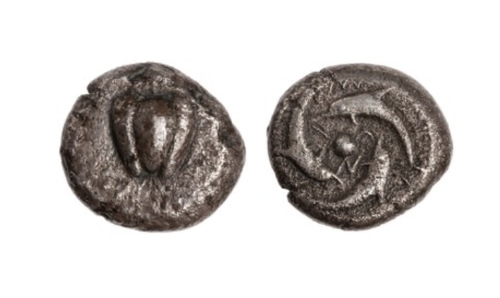
Silver stater of Melo featuring an apple on the obverse and dolphins swimming on the reverse.
Silver stater of Melos, buried c. 416 B.C. as the Athenians laid siege. The obverse of the coin bears an apple—mēlon—on the obverse, a pun on the city’s name. The reverse shows dolphins swimming around a central boss. The coin was not recovered until discovered in the early 20th century. Image courtesy of American Numismatic Society 1944.100.27879 CC BY-NC 4.0

The apple—though scripture never names the fruit—is a stand-in, in Christian tradition, for the forbidden fruit of knowledge. With it came the mythical expulsion from paradise and the ensuing inheritance of suffering, toil, and death. But in our age, as in ages past, we have not been cast out merely for seeking knowledge. We have been cast out for failing to know ourselves.

We do not seek knowledge. We seek dominion. We crave possession—of land, of treasure, of people. And in so doing, we deny our complicity. We forget. We suppress. We sanctify the victors and silence the conquered. From age to age, we retell only the parts of the story that flatter us.

And here lies the uncomfortable mirror.

In this, we are more like Athens than we care to admit. Like them, we cloak power in principle. And like them, we forget.

We in the United States have long imagined ourselves the inheritors of Athenian democracy. We trace our civic ideals to their assemblies, our rhetoric to their orators, our architecture to their temples. We forget, or do not care to remember, that Athens was also an imperial power, that its democracy was partial and exclusionary, and that it extorted tribute, enslaved its enemies, and turned allies into subjects. At Melos, it abandoned all pretense of justice. It wielded power for its own sake and cloaked the sword in reason.

So too have we. We have invaded and occupied, supported tyrants when convenient, and crushed the aspirations of distant peoples in the name of freedom. At home, we have reaped the fruits of conquest while teaching ourselves to hear only the hymns of progress and patriotism.

Consider the Trail of Tears—where we marched Cherokee, Creek, and other nations from their ancestral lands to distant territories, causing thousands of deaths. That forced removal, justified by the rhetoric of “civilization” and “progress,” has spiraled into generations of poverty, educational disadvantage, and health crises on reservations. Even today, as Native communities face disproportionate hardships, we struggle to acknowledge our national policies as their root cause.

Or look to El Salvador and Nicaragua, where American foreign policy in the 1980s supported authoritarian regimes and death squads in El Salvador while simultaneously funding the Contra rebels against Nicaragua’s Sandinista government—all in the name of anti-communism. Our military aid facilitated massacres of civilians in both countries, devastated civil society, and undermined democratic institutions. The ensuing regional instability bred gangs, poverty, and the very migration crisis that excites our domestic politics today. Yet few Americans connect today’s asylum seekers to our own actions decades ago. Like Athens at Melos, we exercise power, then avert our eyes from the consequences. Yet evidence of our actions remains, waiting to be unearthed.

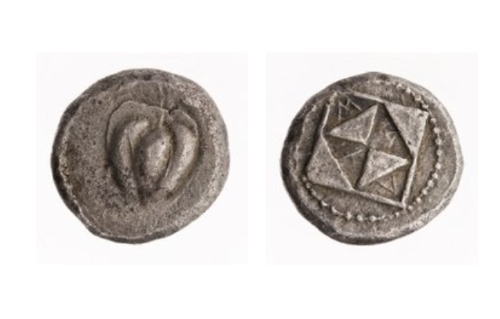
Silver stater of Melo featuring an apple on the obverse and square divided into triangles on the reverse.
Another silver stater from the soil of Melos, the blood speaks still. This one was also buried in c. 416 B.C. likely during the Athenian siege and recovered only in 1907. On the obverse it too bore the civic emblem, the apple. Its reverse, however, featured a square divided into four triangles. Image courtesy of American Numismatic Society 1959.70.2 CC BY-NC 4.0

From the soil of Melos itself, the blood speaks still. In 1907, a hoard of silver coins was unearthed—buried, according to scholars, in 416 B.C. as the Athenians closed in.⁵ Those who hid them did not live to recover the coins. Both coins bear on the obverse the apple—the symbol of Melos, its punning emblem, its name. But their reverses differ: one shows dolphins encircling a central boss, evoking the sea that once embraced the island; the other, a square divided into four triangles. These buried apples of silver—like their biblical counterpart—bear knowledge too painful to confront: the truth of what power does when unbound by conscience. These coins, long entombed, bear no voices. Yet they cry out. Like Abel’s blood, they testify—not in sound, but in presence. That these objects survived while their owners perished is both historical evidence and perfect metaphor—artifacts outlive empires, bearing witness long after the powerful have fallen. Metal as memory. Silver as witness.

We are not alone in this legacy. But neither are we innocent. The voice of justice does not go silent simply because we stop our ears. As in Genesis, so in history: the blood cries from the ground.⁶ And though we deny it, the Eternal hears.

The apple on the coin of Melos is a relic now, but its meaning remains. It is a warning. It is a mirror. Excavated from darkness, these silent witnesses challenge our comfortable narratives. It is a fruit offered again and again to each generation: not to reveal what lies in the heavens, but what lies within ourselves.

Until we dare to eat of that fruit—not in pride, but in truth—we shall remain wanderers east of Eden, armed with denial, and thus, with destiny.


Footnotes

¹ Seaman, Michael G. “The Athenian Expedition to Melos in 416 B.C.” Historia: Zeitschrift für Alte Geschichte, vol. 46, no. 4, 1997, p. 385. The epigraph featured above is an adaptation of the citation used in Seaman’s essay, which being a fine summary of emotive outrage at Athenian transgressions, could not be more finely articulated.

² Thucydides, History of the Peloponnesian War, Book V, §§89–116. The quoted phrase is a paraphrase of the Athenian argument in the Melian Dialogue, often rendered: “The strong do what they can, and the weak suffer what they must.” See: Robert B. Strassler, ed., The Landmark Thucydides (New York: Free Press, 2008), 352.

³ See Seaman, Michael G., ibid., pp. 385–418, for a detailed discussion of the motives and actions surrounding the Athenian assault on Melos.

⁴ On the apple (mēlon) as a civic pun in Melian coinage, see Sheedy, Kenneth. “Aegina, the Cyclades and Crete.” In The Oxford Handbook of Greek and Roman Coinage, ed. William Metcalf, 2012, p. 112.

⁵ See: Kallet, Lisa and John H. Kroll, The Athenian Empire: Using Coins as Sources (Cambridge University Press, 2020), 105.

⁶ Genesis 4:10: “The voice of your brother’s blood is crying to me from the ground.”

The King’s Deliverance: Musical Tribute to King Stanisław August Poniatowski’s Rescue

THE KING’S DELIVERANCE – A “Hymn” commemorating the rescue of the King from an attempted kidnapping by the Bar Confederation conspirators in 1771.

It is with pleasure that I share with you The King’s Deliverance, a musical composition inspired by the 1771 AR Medal crafted by Johann Leonhard Oexlein. This piece sets to music the lyrics written to commemorate the remarkable escape of King Stanisław August Poniatowski from an attempted abduction by the Bar Confederation, a group of Polish nobles opposed to Russian influence in the Polish-Lithuanian Commonwealth.

The medal, with its powerful inscriptions from the Psalms and intricate artistic details, captures the moment when “divine providence” intervened to protect the king. It symbolizes not only his deliverance but also the mercy he showed towards those who conspired against him. This event, which unfolded on the night of November 3, 1771, had far-reaching consequences, ultimately strengthening the king’s position. The hymn highlights the themes of justice and divine protection.

For those interested in a more detailed exploration of the medal and the history of the incident, I refer you back to an earlier post where I provide a fuller explanation of these significant historical elements.

The King’s Deliverance seeks to encapsulate these historical themes through music and lyrics, offering a tribute to this significant moment in Polish history. You are invited to watch the video and reflect on the enduring legacy of King Stanisław August’s resilience and mercy.