

A Bolognino of Charles III di Durazzo

From Ovid’s Sulmona to Benedict’s Rome
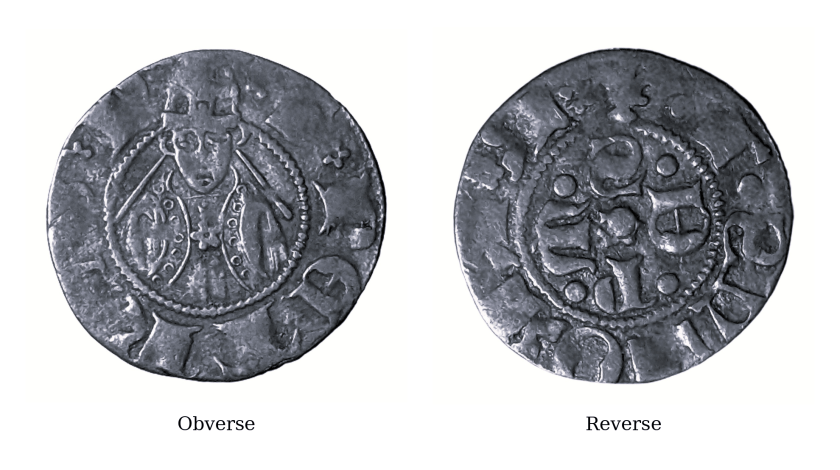

Kingdom of Sicily (Naples) – Sulmona.
Charles III of Durazzo, King of Sicily, 1381-1386,
King of Hungary, 1385-1386.
AR Bolognino of Sulmona,
.82 g., struck 1382-1385.
Obverse: Bust of St. Peter Celestine
with S PETRVS P inscription around.
Reverse: R•KROLVS•T• inscription around
with •S•M•P•E in center around pelleted cross saltire.
Reference: MEC 14, 727 variant.

Recently, I spent time attributing various coins from a small assemblage of medieval coins I purchased a decade or two ago that were either wholly unattributed or erroneously attributed by their previous owner. After all this time, I have finally turned my attention to cataloguing the coins properly. One of the coins was previously grossly misidentified as an obol from Bergamo when, in fact, I found that it was a bolognino minted in Sulmona, a much more interesting attribution, as will be discussed below. The coin is illustrated above.

The general type is familiar, and common, enough. Two examples are illustrated below. The similarities with my coin will be obvious, as will be the dissimilarities.
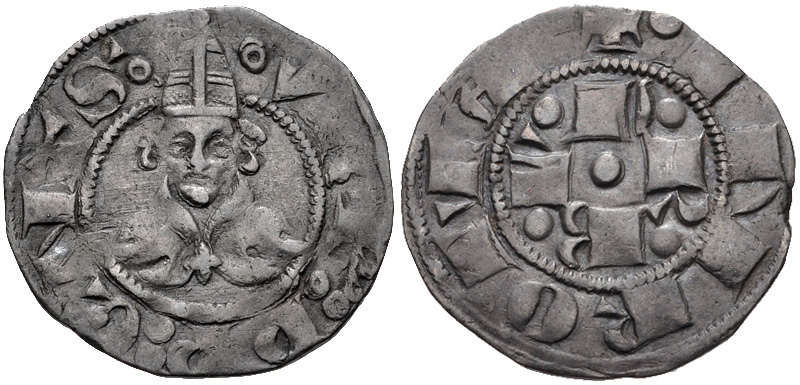

Papal States – Avignon. Urbanus V (Guillaume de Grimoard). 1362-1370.
AR Bolognino, 18mm, 1.33 g. Rome mint.
Obverse: · VRB’ : P P : QNTS’ · (annulet and double annulet stops throughout), mitred bust facing
Reverse: + · IN ROMЯ · inscription around, •V•R•B•I as central device within beaded circle.
References: CNI XV 8; Muntoni 3; Berman 198.
Source: CNG: The Coin Shop, 933495.
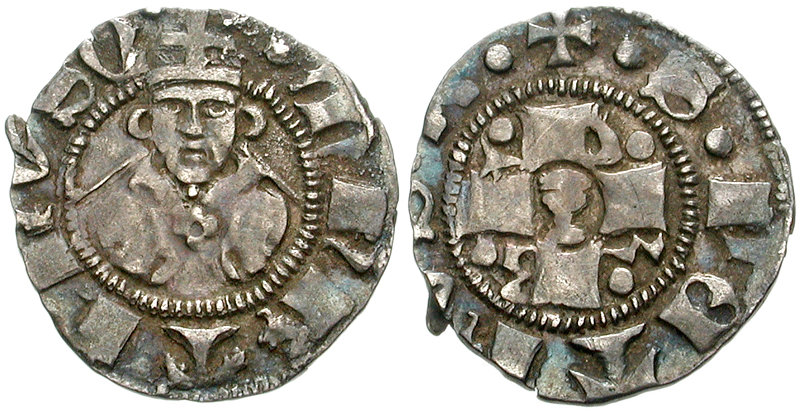
Papal States – Martin V (Oddone Colonna). 1417-1431.
AR Bolognino (15mm, 0.82 g, 6h). Rome mint.
Obverse: + mARTInVS Q, mitred bust facing
Reverse: +•S•PЄTRVS• inscription around, •V•R•B•I as central device within beaded circle
References: CNI XV 61; Muntoni 21; Berman 274.
Source: CNG, The Coin Shop, 820494. Ex Luparello Collection.

The similarities between my coin’s obverse and the general type are obvious and immediate. All three obverses present a mitred, front-facing papal bust within a beaded border, identified by encircling legends: VRB PP on the Urban piece, mARTInVS on the Martin piece, and S. PETRVS on mine. The reverses, too, share marked similarities: four rather heavy-looking letters are set as a central device in a cross-like pattern at the cardinal points, with pellets placed in the four diagonal angles and at the center, forming a saltire cross, all enclosed within a beaded border. Each coin’s outer legend, too, lends further identification of its origin: for Urban’s coin, an inscription declaring origin, IN ROMЯ; for Martin’s, one naming the see, S PЄTRVS; and for mine, one naming the sovereign who issued the coin, R KROLVS T (Rex Karolus Tertius).

The dissimilarities are subtle but significant. Urban’s and Martin’s obverse legends name a reigning pope in each instance, making it easy to identify the authority issuing the coins. Mine names, on its face, only S. PETRVS P and at first blush one would identify this as Saint Peter the Apostle, the first pope, making identification of the issuer difficult as the coin is not of such antiquity (but for the identification of Rex Karolus Tertius on the reverse). But we shall return to the true identity of this Saint Peter momentarily. The reverses have marked dissimilarities also. The center lettering on Urban’s and Martin’s coins spells VRBI, an unambiguous declaration that these coins are products of the City, that is, Rome. My coin’s central letters, S M P E, are cryptic by comparison, revelatory only to a those familiar with Ovid’s Tristia, specifically 4.10.1–4:

Ovid, Tristia 4.10.1–4:

Ille ego qui fuerim, tenerorum lusor amorum,
     quem legis, ut noris, accipe posteritas.
Sulmo mihi patria est, gelidis uberrimus undis,
     milia qui nouiens distat ab urbe decem.

That man I was, you know him from these lines,
the playful poet once of tender loves
receive this, posterity, and learn his name.
Sulmo is my homeland, rich in ice-cold springs,
ninety miles distant from the city’s gates.

The four letters S M P E reflect the initial letters of four words from the poem: Sulmo Mihi Patria Est — the opening words of the couplet’s third line. Ovid, writing the autobiographical Tristia from exile on the Black Sea around AD 12, gives his birthplace before he gives almost anything else about himself. Whoever cut the die for this coin took that line and folded its initials into the same cross-and-saltire device that, on other bolognini, named nothing more than the City, Rome. These letters on this bolognino therefore tell us that the coin was struck at Sulmona.

The choice of these letters on the reverse also reveals the identity of the S. PETRVS on the obverse. He is Sulmona’s own Saint Peter, Pietro da Morrone, born Pietro Angelerio, hermit of Monte Morrone a few miles outside the city walls, elected and crowned Pope Celestine V in 1294, canonized in 1313 as San Pietro Celestino, and venerated ever since as the town’s own adopted son raised to the papacy. Thus, the coin’s obverse names its saint; the reverse names its town; and the coin’s issuing authority, the Rex Karolus Tertius identified on the reverse, turns out to be Charles III di Durazzo, who is almost incidental to the coin as it is a coin about Sulmona, not the king who issued it.

Celestine V, as noted above born Pietro Angelerio and known from his hermitage on Monte Morrone as Pietro da Morrone, was, prior to being elected and serving as Catholic pontiff for five months in 1294 AD, a monk and a hermit who founded the Celestines, a branch of the Benedictine Order that survived until the 18th century. He was elected pontiff in the Catholic Church’s last non-conclave election after a two-year impasse without a pope. Though his reign was short, and many of his acts were canceled by his successor, two extraordinary edicts survived from his reign: his confirmation of the right of a pope to abdicate and his reinstatement of conclave regulations established by Gregory X’s bull Ubi periculum.

On December 13, 1294, a week after confirming that pontiffs could abdicate, Celestine V himself resigned, stating that he desired to return voluntarily to his monastic, pre-papal life. Unfortunately, his successor, Boniface VIII, fearing that the former Celestine V would be installed as an antipope against him, imprisoned his predecessor in the castle of Fumone, where he died on May 19, 1296. Pietro Angelerio, the man who had been pontiff Celestine V, was canonized by Pope Clement V on May 5, 1313.

It cannot go unnoticed that Pope Benedict XVI proclaimed a Celestine Year in 2009–2010 to mark the eight-hundredth anniversary of Pope Celestine V’s birth, and in July 2010 knelt before Celestine’s relics in Sulmona’s own cathedral. Whether those gestures were, in retrospect, unwitting rehearsal for his own resignation in 2013 — using the very mechanism of abdication Celestine had established seven centuries earlier — is a question the record does not settle. But the resonance, once noticed, is difficult to set aside.

Thus, the coin I have attributed to Sulmona becomes, in the end, a hinge between two distant moments: Ovid’s line, composed around 12 AD, cast in cipher on the coin’s reverse; and the papal practice of resignation formalized by the man on the coin’s obverse, invoked, seven centuries later, by the next pope to resign, Benedict XVI, in AD 2013. This humble bolognino, struck sometime between 1382 and 1385 AD, stands as a hinge across a resonance spanning, in the end, two thousand and one years, from Ovid’s Sulmona to Benedict’s Rome.

The Creation in Ovid’s Metamorphoses and A Recommended Translation

Antonio Tempesta’s etching “The Creation of the World” is based on Ovid’s ‘Metamorphoses’. Ovid, a canonical Roman poet, is best known for this epic poem, which beautifully recounts classical mythology tales. Charles Martin’s translation of Metamorphoses is recommended for its elegance and brilliance. In the poem, Ovid describes the divine creation of the universe, which Stephen M. Wheeler argues is influenced by the Homeric shield from Homer’s Iliad. Wheeler notes Ovid’s self-consciousness as a poet, suggesting that the universe’s ordering is a metaphor for the creation of the poem itself. This insightful exploration adds depth to Ovid’s captivating tale of creation.

Pūblius Ovidius Nāsō (43 BC – 17/18 AD), known in English as Ovid, is, along with Virgil and Horace, one of the three “canonical poets” of Latin literature.  He is, no doubt, best known today for his epic poem Metamorphoses, which is an extraordinarily beautiful telling of the tales of classical mythology.  I first became intimately acquainted with Metamorphoses in summer 1987 and have revisited it on multiple occasions ever since, never ceasing to be refreshed and delighted by the visit.

Metamorphoses – Ovid: A New Translation by Charles Martin, Introduction by Bernard Knox. W.W. Norton & Co., New York, 2004.

Several years ago, I purchased and read Charle Martin’s translation of Metamorphoses and do not hesitate to recommend this particular translation to you for its elegance, flow, and brilliance as demonstrated in the following excerpt.

The Creation

Before the seas and lands had been created,

before the sky that covers everything,

Nature displayed a single aspect only

throughout the cosmos; Chaos was its name,

a shapeless, unwrought mass of inert bulk

and nothing more, with the discordant seeds

of disconnected elements all heaped

together in anarchic disarray.

The sun as yet did not light up the earth,

nor did the crescent moon renew her horns,

nor was the earth suspended in midair,

balanced by her own weight, nor did the ocean

extend her arms to the margins of the land.

Although the land and sea and air were present,

land was unstable, the sea unfit for swimming,

and air lacked light; shapes shifted constantly,

and all things were at odds with one another,

for in a single mass cold strove with warm,

wet was opposed to dry and soft to hard,

and weightlessness to matter having weight.

Some god (or kinder nature) settled this

dispute by separating earth from heaven,

and then by separating sea from earth

and fluid aether from denser air;

and after these were separated out

and liberated from the primal heap,

he bound the disentangled elements

each in its place and all in harmony.

The fiery and weightless aether leapt

to heaven’s vault and claimed its citadel;

the next in lightness to be placed was air;

the denser earth drew down gross elements

and was compressed by its own gravity;

encircling water lastly found its place,

encompassing the solid earth entire.

Now when that god (whichever one it was)

had given Chaos form, dividing it

in parts which he arranged, he molded earth

into the shape of an enormous globe,

so that it should be uniform throughout.

And afterward he sent the waters streaming

in all directions, ordered waves to swell

under the sweeping winds, and sent the flood

to form new shores on the surrounded earth;

he added springs, great standing swamps and lakes,

as well as sloping rivers fixed between

their narrow banks, whose plunging waters (all

in varied places, each in its own channel)

are partly taken back into the earth

and in part flow until they reach the sea,

when they – received into larger field

of a freer flood – beat against shores, not banks.

He ordered open plains to spread themselves,

valleys to sink, the stony peaks to rise,

and forests to put on their coats of green.

And as the vault of heaven is divided

by two zones on the right and two on the left,

with a central zone, much hotter, in between,

so, by the care of this creator god,

the mass that was enclosed now by the sky

was zoned in the same way, with the same lines

inscribed upon the surface of the earth.

Heat makes the middle zone unlivable,

and the two outer zones are deep in snow;

between these two extremes, he placed two others

of temperate climate, blending cold and warmth.

Air was suspended over all of this,

proportionately heavier than aether,

as earth is heavier than water is.

He ordered mists and clouds into position,

and thunder, to make test of our resolve,

and winds creating thunderbolts and lighting.

Nor did that world-creating god permit

the winds to roam ungoverned through the air;

for even now, with each of them in charge

of his own kingdom, and their blasts controlled,

they scarcely can be kept from shattering

the world, such is the discord between brothers.

Eurus went eastward, to the lands of Dawn,

the kingdoms of Arabia and Persia,

and to the mountain peaks that lie below

the morning’s rays; and Zephyr took his place

on the western shores warmed by the setting sun.

The frozen north and Scythia were seized

by bristling Boreas; the lands opposite,

continually drenched by fog and rain,

are where the south wind, known as Auster, dwells.

Above these winds, he set the weightless aether,

a liquid free of every earthly toxin.

No sooner had he separated all

within defining limits, when the stars,

which formerly had been concealed in darkness,

began to blaze up all throughout the heavens;

and so that every region of the world

should have its own distinctive forms of life,

the constellations and the shapes of gods

occupied the lower part of heaven;

the seas gave shelter to the shining fishes,

earth received beasts, and flighty air, the birds.

An animal more like the gods than these,

more intellectually capable

and able to control the other beasts,

had not as yet appeared: now man was born,

either because the framer of all things,

the fabricator of this better world,

created man out of his own divine

substance – or else because Prometheus

took up a clod (so lately broken off

from lofty aether that it still contained

some elements in common with its kin),

and mixing it with water, molded it

into the shape of gods, who govern all.

And even though all other animals

lean forward and look down toward the ground,

he gave to man a face that is uplifted,

and ordered him to stand erect and look

directly up into the vaulted heavens

and turn his countenance to meet the stars;

the earth, that was lately rude and formless,

was changed by taking on the shapes of men.

Ovid, Metamorphoses, Book I, lines 6-125 (trans. Charles Martin)

Ovid’s tale of creation is both moving and striking, to say the least. And if one is at all like me in intellectual temperament, one cannot help but wonder where Ovid found the inspirational well for his striking poetic imagery and design. Fear not, my friends, Stephen M. Wheeler explored this issue in “Imago Mundi: Another View of the Creation in Ovid’s Metamorphoses” (The American Journal of Philology, vol. 116, no. 1, Johns Hopkins University Press, 1995, pp. 95–121, https://doi.org/10.2307/295504), an article recommended as worth your time to read.

Among other things, Wheeler argues that Ovid uses the Shield of Achilles (the Homeric Shield), from Homer’s Illiad, as “a model for his own version of the divinely created universe.” Wheeler does so by presenting evidence showing Ovid’s “allusive engagement with the Homeric shield” in his account of chaos, showing that Ovid’s description of the universe resembled the ecphrasis [i.e., the use of detailed description of a work of visual art as a literary device] of a work of art in the tradition of the Homeric shield, and that it prefigured other divine works of art in Metamorphoses, and by explaining why Ovid began the Metamorphoses with a reference to the Homeric shield as well as how the work should be read in “light of obvious allusions to Hesiod’s Theogony and the Apollonian song of Orpheus.” 

Greek, c. 470BC. Two-handled ceramic jar (amphora) depicting Hephaistos polishing the Shield of Achilles in the presence of Thetis. In the field, a pair of greaves, a helmet, tongs, hammer and saw. Bartlett Collection. (c) Museum of Fine Art Boston.

Towards the conclusion of his article, Wheeler states the following: “Ovid’s choice to begin Metamorphoses with an epic ecphrasis also highlights his own-self-consciousness as a poet.  It is well-known that the device of ecphrasis offers the poet an opportunity to reflect upon his own art while describing the art of another.  The deus et melior natura may therefore be read as a figure for the poet, and the ordering of the universe as a metaphor for creation of the poem; thus the “real” subject of Ovid’s cosmogony may be the literary creation of Metamorphoses, just as the shield of Achilles is emblematic of the creation of the Iliad” (p. 117).