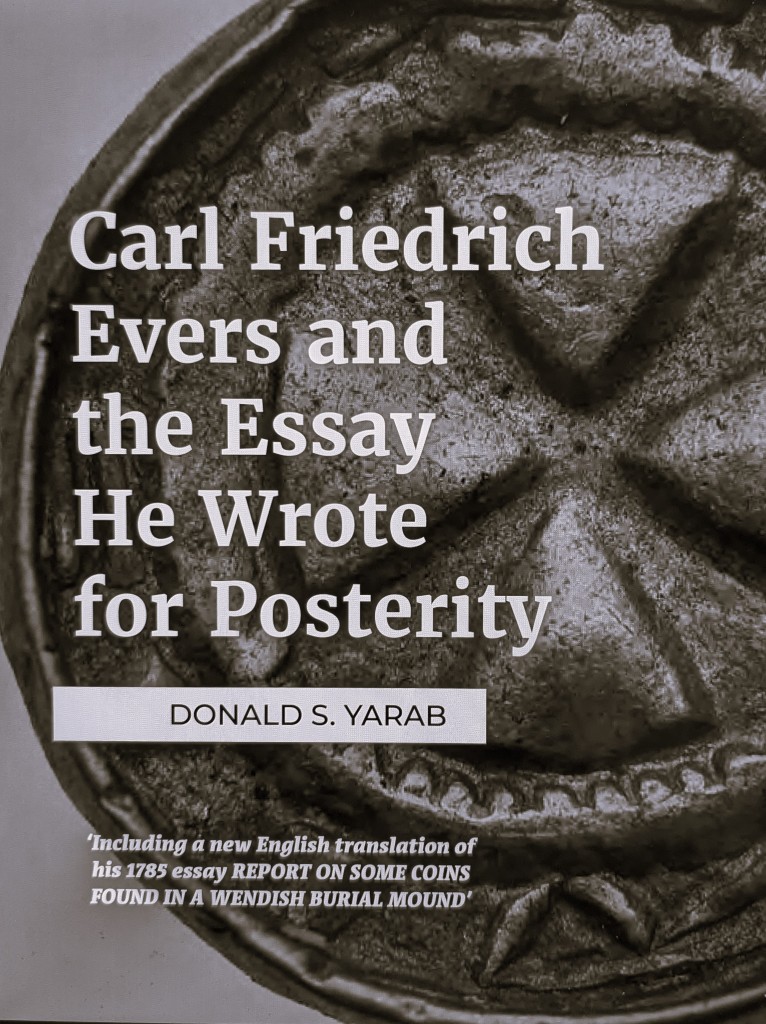

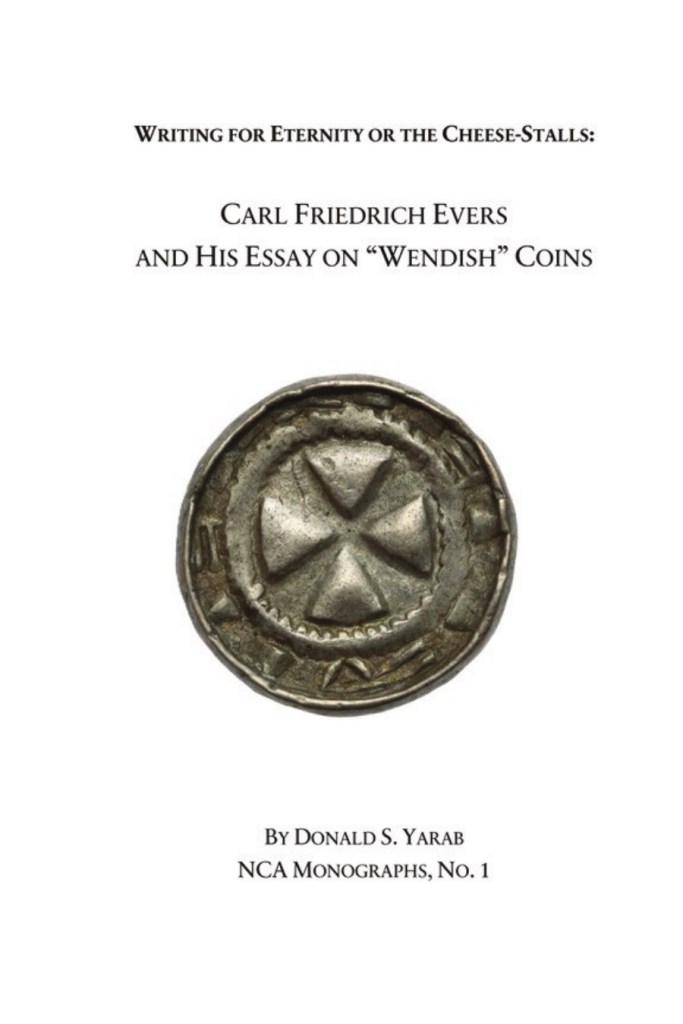
It is my pleasure to announce that Writing for Eternity or the Cheese-Stalls: Carl Friedrich Evers and His Essay on “Wendish” Coins, the first title in the Northcoast Antiquarian Monographs series, is now available in paperback.
The medieval silver coins that numismatists have called Wendenpfennige, Sachsenpfennige, Randpfennige, and cross denarii (denary krzyżowe) have resisted attribution for more than two centuries. One of the first scholars to treat them seriously was Carl Friedrich Evers (1729–1803), archivist to the dukes of Mecklenburg-Schwerin. In 1785 he published a short essay on six small coins recovered from a burial mound near Grabow and attributed them to the Wends, the Slavs of the Elbe lands. That attribution, and in time the names that grew from it, long outlived the arguments against the coins’ association with the Wends as their minting authority.
This monograph tells the story of Evers, his essay, and its reception down to the present: his career in the ducal archive and his correspondence with Johann Bernoulli; the Grabow find and the first reviews; Evers’ return to the coins in his history of Mecklenburg coinage of 1798–1799; Joseph Mader’s critique of 1803–1806; Lisch’s reconsideration of the find in 1845; and the curious afterlife of the “Wendish” label, which the German literature kept while forgetting Evers as its author; the Polish literature, by contrast, seemingly remembered him but seldom read what he wrote. An English translation of the 1785 essay and a transcription of its German text are given in the appendices.
About the title
The title comes from Evers himself. Writing to Bernoulli in October 1785, he complained of reviewers who thought archivists had neither the time nor the inclination to write “for eternity or for the cheese-stalls” (für die Ewigkeit oder Käsebuden), that is, for posterity or for wrapping paper. As it turned out, he wrote for posterity, though not in the way he intended.
Readers who saw my 2023 post on Evers will find here an entirely new and much fuller study.
Paperback, 6 × 9 in., 76pp., US$19.95 postpaid.