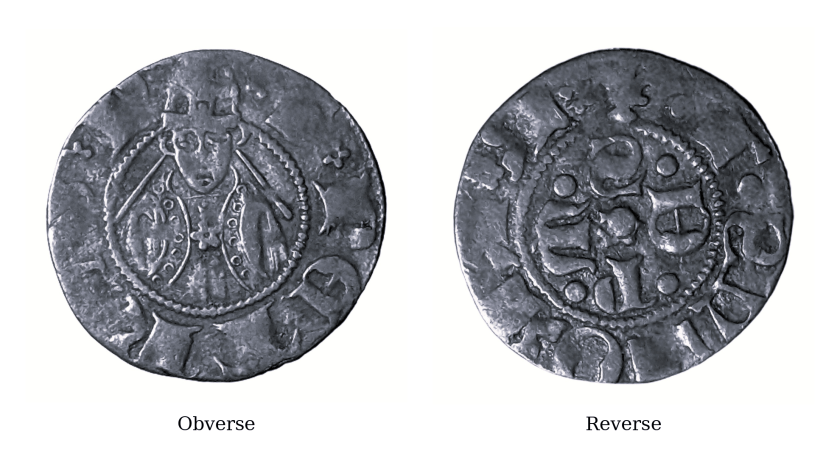
Kingdom of Sicily (Naples) – Sulmona. Charles III of Durazzo, King of Sicily, 1381-1386, King of Hungary, 1385-1386. AR Bolognino of Sulmona, .82 g., struck 1382-1385. Obverse: Bust of St. Peter Celestine with S PETRVS P inscription around. Reverse: R•KROLVS•T• inscription around with •S•M•P•E in center around pelleted cross saltire. Reference: MEC 14, 727 variant.
Recently, I spent time attributing various coins from a small assemblage of medieval coins I purchased a decade or two ago that were either wholly unattributed or erroneously attributed by their previous owner. After all this time, I have finally turned my attention to cataloguing the coins properly. One of the coins was previously grossly misidentified as an obol from Bergamo when, in fact, I found that it was a bolognino minted in Sulmona, a much more interesting attribution, as will be discussed below. The coin is illustrated above.
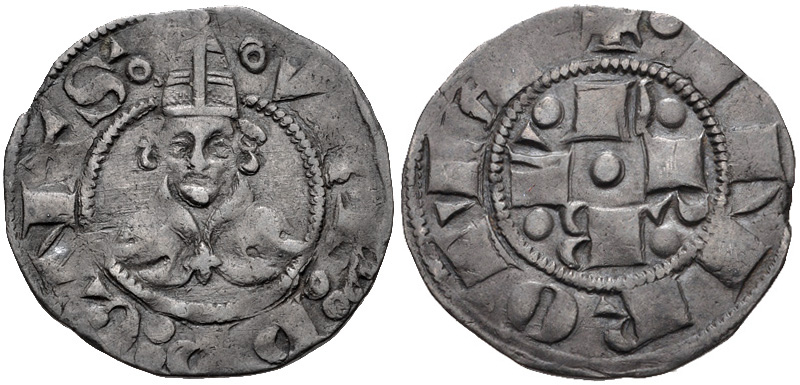
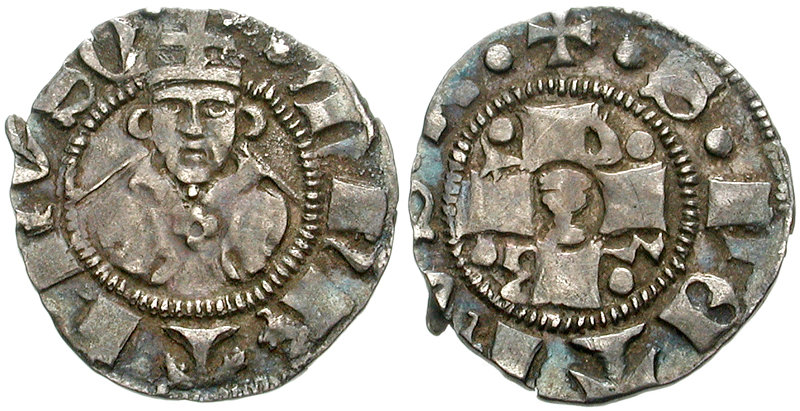
The general type is familiar, and common, enough. Two examples are illustrated below. The similarities with my coin will be obvious, as will be the dissimilarities.
Papal States – Avignon. Urbanus V (Guillaume de Grimoard). 1362-1370. AR Bolognino, 18mm, 1.33 g. Rome mint. Obverse: · VRB’ : P P : QNTS’ · (annulet and double annulet stops throughout), mitred bust facing Reverse: + · IN ROMЯ · inscription around, •V•R•B•I as central device within beaded circle. References: CNI XV 8; Muntoni 3; Berman 198. Source: CNG: The Coin Shop, 933495. Papal States – Martin V (Oddone Colonna). 1417-1431. AR Bolognino (15mm, 0.82 g, 6h). Rome mint. Obverse: + mARTInVS Q, mitred bust facing Reverse: +•S•PЄTRVS• inscription around, •V•R•B•I as central device within beaded circle References: CNI XV 61; Muntoni 21; Berman 274. Source: CNG, The Coin Shop, 820494. Ex Luparello Collection.
The similarities between my coin’s obverse and the general type are obvious and immediate. All three obverses present a mitred, front-facing papal bust within a beaded border, identified by encircling legends: VRB PP on the Urban piece, mARTInVS on the Martin piece, and S. PETRVS on mine. The reverses, too, share marked similarities: four rather heavy-looking letters are set as a central device in a cross-like pattern at the cardinal points, with pellets placed in the four diagonal angles and at the center, forming a saltire cross, all enclosed within a beaded border. Each coin’s outer legend, too, lends further identification of its origin: for Urban’s coin, an inscription declaring origin, IN ROMЯ; for Martin’s, one naming the see, S PЄTRVS; and for mine, one naming the sovereign who issued the coin, R KROLVS T (Rex Karolus Tertius).
The dissimilarities are subtle but significant. Urban’s and Martin’s obverse legends name a reigning pope in each instance, making it easy to identify the authority issuing the coins. Mine names, on its face, only S. PETRVS P and at first blush one would identify this as Saint Peter the Apostle, the first pope, making identification of the issuer difficult as the coin is not of such antiquity (but for the identification of Rex Karolus Tertius on the reverse). But we shall return to the true identity of this Saint Peter momentarily. The reverses have marked dissimilarities also. The center lettering on Urban’s and Martin’s coins spells VRBI, an unambiguous declaration that these coins are products of the City, that is, Rome. My coin’s central letters, S M P E, are cryptic by comparison, revelatory only to a those familiar with Ovid’s Tristia, specifically 4.10.1–4:
Ovid, Tristia 4.10.1–4:
Ille ego qui fuerim, tenerorum lusor amorum, quem legis, ut noris, accipe posteritas. Sulmo mihi patria est, gelidis uberrimus undis, milia qui nouiens distat ab urbe decem.
That man I was, you know him from these lines, the playful poet once of tender loves receive this, posterity, and learn his name. Sulmo is my homeland, rich in ice-cold springs, ninety miles distant from the city’s gates.
The four letters S M P E reflect the initial letters of four words from the poem: Sulmo Mihi Patria Est — the opening words of the couplet’s third line. Ovid, writing the autobiographical Tristia from exile on the Black Sea around AD 12, gives his birthplace before he gives almost anything else about himself. Whoever cut the die for this coin took that line and folded its initials into the same cross-and-saltire device that, on other bolognini, named nothing more than the City, Rome. These letters on this bolognino therefore tell us that the coin was struck at Sulmona.
The choice of these letters on the reverse also reveals the identity of the S. PETRVS on the obverse. He is Sulmona’s own Saint Peter, Pietro da Morrone, born Pietro Angelerio, hermit of Monte Morrone a few miles outside the city walls, elected and crowned Pope Celestine V in 1294, canonized in 1313 as San Pietro Celestino, and venerated ever since as the town’s own adopted son raised to the papacy. Thus, the coin’s obverse names its saint; the reverse names its town; and the coin’s issuing authority, the Rex Karolus Tertius identified on the reverse, turns out to be Charles III di Durazzo, who is almost incidental to the coin as it is a coin about Sulmona, not the king who issued it.
Celestine V, as noted above born Pietro Angelerio and known from his hermitage on Monte Morrone as Pietro da Morrone, was, prior to being elected and serving as Catholic pontiff for five months in 1294 AD, a monk and a hermit who founded the Celestines, a branch of the Benedictine Order that survived until the 18th century. He was elected pontiff in the Catholic Church’s last non-conclave election after a two-year impasse without a pope. Though his reign was short, and many of his acts were canceled by his successor, two extraordinary edicts survived from his reign: his confirmation of the right of a pope to abdicate and his reinstatement of conclave regulations established by Gregory X’s bull Ubi periculum.
On December 13, 1294, a week after confirming that pontiffs could abdicate, Celestine V himself resigned, stating that he desired to return voluntarily to his monastic, pre-papal life. Unfortunately, his successor, Boniface VIII, fearing that the former Celestine V would be installed as an antipope against him, imprisoned his predecessor in the castle of Fumone, where he died on May 19, 1296. Pietro Angelerio, the man who had been pontiff Celestine V, was canonized by Pope Clement V on May 5, 1313.
It cannot go unnoticed that Pope Benedict XVI proclaimed a Celestine Year in 2009–2010 to mark the eight-hundredth anniversary of Pope Celestine V’s birth, and in July 2010 knelt before Celestine’s relics in Sulmona’s own cathedral. Whether those gestures were, in retrospect, unwitting rehearsal for his own resignation in 2013 — using the very mechanism of abdication Celestine had established seven centuries earlier — is a question the record does not settle. But the resonance, once noticed, is difficult to set aside.
Thus, the coin I have attributed to Sulmona becomes, in the end, a hinge between two distant moments: Ovid’s line, composed around 12 AD, cast in cipher on the coin’s reverse; and the papal practice of resignation formalized by the man on the coin’s obverse, invoked, seven centuries later, by the next pope to resign, Benedict XVI, in AD 2013. This humble bolognino, struck sometime between 1382 and 1385 AD, stands as a hinge across a resonance spanning, in the end, two thousand and one years, from Ovid’s Sulmona to Benedict’s Rome.
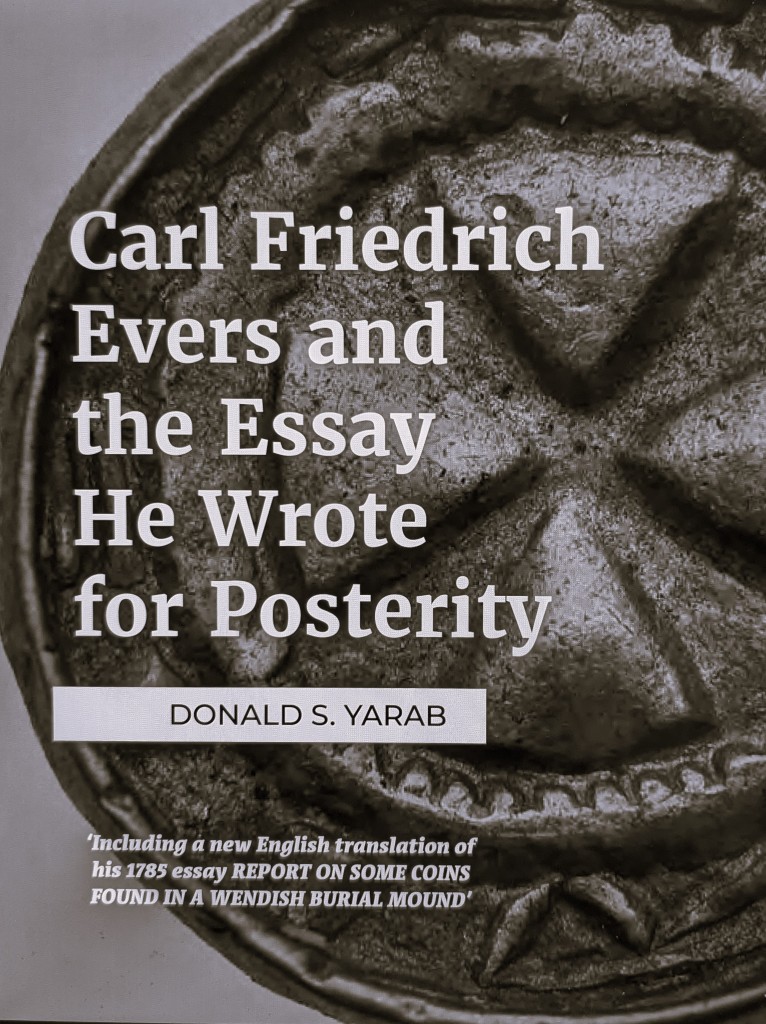
Pleased to have completed a translation of Evers’ 1785 essay, which still appears in scholarship today. Although Evers missed the mark in his attribution of the coins to the Wends, he was nonetheless one of the earliest to attempt a scholarly treatment of the coins now known as Randpfennige or cross denarii and certainly amongst the first to illustrate the coins.
A copy of the monograph I prepared to accompany the translation is available with a click of the button below:
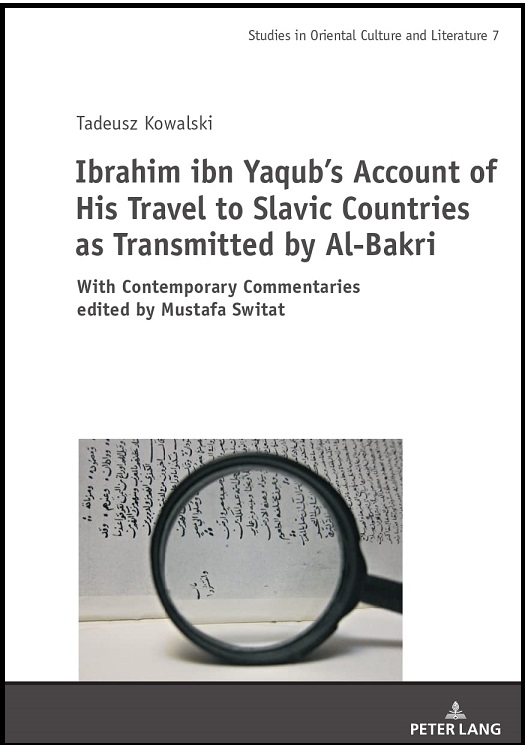
2022 Release of English Translation of Kowalski’s Invaluable Scholarship
12/30/31 UPDATE: A review of the work above was published in Polish by D. Sikorski in 2023 which is highly critical of the work for its lack of fidelity to Kowalski’s original scholarship and translation, as well as for its lack of familiarity with the scope and breath of all the relevant current scholarship. The review stated that the editor “made several decisions significantly changing the original shape of the old edition, in places even scandalously distorting it.“ The review illustrated a number of the editorial and factual failings in the work in detail. The reviewer summarized his opinion rather succinctly as follows: “Among the positive aspects of the presented book is primarily the availability in a widely understood language of T. Kowalski’s findings regarding Ibrahim ibn Jakub and his extensive and very detailed commentaries on al-Bakri’s text. On the negative side, the main issue is the removal of the critical apparatus from the Arabic text, depriving it of its scholarly character. Another serious flaw of the publication is the attempt to include two different English translations in one text. Thirdly, there is an inadequate discussion of the state of research on Ibrahim’s text.” I note that, on balance, the work still retains some utility for those who cannot access Kowalski’s work, or who cannot read works in Polish or Arab regarding Ibrahim’s Account; however, I share the reviewer’s enthusiasm for an upcoming release by French Arabist, Jean-Charles Ducène, who is preparing an edition of all fragments of Ibrahim’s Account for Monumenta Germaniae Historica – as the reviewer noted, the forthcoming edition by Ducène will render the above work and its deficiencies obsolete and eclipse T. Kowalski’s work in terms of the text.See review at:Sikorski, D. (2023). Review of Ibrahim ibn Yaqub’s Account of His Travel to Slavic Countries as Transmitted by al-Bakri, with Contemporary Commentaries, by M. Switat (Ed.), A. Waśkiewicz (Trans.). Roczniki Historyczne, 89, 179-186.
In February 2022, my post entitled “Remarks on Mieszko’s Payments to His Warriors: ‘Market Weights’ or ‘Good Coins (Dirhams) of Fixed Value’?” noted that the above referenced translation of Kowalski’s 1946 foundational scholarship [Relacja Ibrāhīma ibn Ja’ḳūba z podróży do krajów słowiańskich w przekazie al-Bekrīego (Relatio Ibrāhīm ibn Ja’ḳūb de itinere Slavico, quo traditur apud al-Bekrī). Cracow: PAU, 1946] was forthcoming. I have been eagerly awaiting its arrival ever since. It has finally been published and, this week, I received my long-anticipated copy.
Previous to this translation of Ibrahim ibn Yaqub’s references to Slavic lands based on his travels in the 960s, I relied on the very able and sound English translations of Dmitrij Mishin (Mishin 1996) and Paul Lunde and Caroline Stone (Lunde and Stone 2012). I was aware of the 1946 Kowalski scholarship because all translations of Ibrahim ibn Yaqub’s original texts ultimately draw from the well of Kowalski’s 1946 magisterial work. Unfortunately, I was unable to draw upon that well both because of the language barrier and the physical inaccessibility of the work. The newly released publication allows me and others who faced similar barriers to finally access much of Kowalski’s original 1946 scholarship. Unfortunately, four of the original supplementary essays by other scholars in the work were not republished due to copyright issues. Although the essays were likely outdated, it would no doubt have been beneficial to understand the full scholarly context of the original publication to have had those essays in translation.
The new publication does not, ultimately, disappoint, in spite of the copyright issues limiting the completeness of its re-publication in translation. Of course, the heart of the work is its presentation of the translation, from Arabic, of Ibrahim ibn Yaqub’s references to Slavic lands. The translation is remarkably detailed, thorough, and heavily footnoted. It quickly becomes apparent that this translation is the first I will consult when I am researching and writing, as it is clearly the foundation upon which my understanding will be built. However, when writing narratively, rather than for scholarly purposes, my quotations will continue to come from Mishin or Lunde and Stone. One quick illustrative example will suffice to demonstrate why.
In Kowalski 2022, the first lines of the Arabic text are translated as follows (citations removed): “Slavs are those born {belong to descendants (come from descendant)} of Mādhāy Ibn {the son of} Yāfith. Their dwellings {continually} [spread] from the north to the west.” In Lunde and Stone 2012, the same lines are translated as follows:”The Saqāliba are the descendants of Mādhāy, son of Yāfith (Japheth) and they dwell in the north-west.”
Obviously, Kowalski is a translation foundational to scholarly understanding (especially with its abundant citations) whereas Lunde and Stone is a translation useable in flowing narratives.
The translation also includes extensive, helpful philological commentary, a reconstruction of the biographical identity of Ibrahim ibn Yaqub, and a very useful discussion of proposed dates for his travels. Of particular note are two new commentaries by Mateusz Bogucki and Mateusz Wilk. Bogucki contributed an entry entitled “Archaeological Commentary on Ibrāhīm ibn Yaʿqūb’s Account” while Wilk contributed one entitled “Ibrāhīm ibn Yaʿqūb’s Account in the Context of Source Analysis.” Finally, there are biographical notes, indices of names, and the Arabic text which was translated.
Although I am thrilled to add this work to my library, and will consult it frequently, as I already have, I am somewhat disappointed that the opportunity presented by its publication to attach the most recent, more clarifying scholarship, when warranted, was not exploited more robustly. Several areas where such updates were possible were identified in a 2006 conference celebrating the 60th anniversary of the publication of Kalkowski’s 1946 work. The conference papers were published in Zaborski, Andrzej (ed.). Ibrahim Ibn Jakub i Tadeusz Kowalski w sześćdziesiątą rocznicę edycji, Cracow, 2008.
I wrote about one area of particular interest in my February 2022 post. Although that area was ostensibly addressed in Bogucki’s commentary in the new publication, Bogucki’s treatment of the issue is puzzling and incomplete, as I will discuss below.
In my February 2022 post, I quoted this excerpt from Mishin:
Ibrahim Ibn Ya’Qub reported the following regarding Mieszko and his realm: “The country of Mashaqqah [that is Mieszko, earlier in the text identified as ‘King of the North’] is the largest one among the countries [of the Slavs]. It abounds in food, meat, honey, and agricultural produce. The taxes are collected in market weights. Those are the salary of his men in every month, and each of them has a certain amount of them to get. He has three thousand warriors wearing coats of mail; a hundred of them is worth a thousand of other warriors in the battle. He gives those men clothes, horses, arms, and everything they need. If a child is born to one of them, he orders the child to be paid a maintenance, regardless of the latter’s sex. When the child grows, and he is a boy, he marries him and pays the dowry to her father. The dowry of the Slavs if very big, and they pay it in the same way as the Berbers do. If a man, thus, has two or three daughters, he gets rich, but if he has two sons, he becomes poor.”
Mishin (1996), pp. 187-188.
I noted that scholars have long focused on the references to the taxes collected and paid by Mieszko to support his three thousand warriors, the warriors which allowed Mieszko to expand, consolidate, and stabilize his realm because current scholarship does not support that Mieszko issued any coinage of his own. Rather, it shows that his son, Boleslaw Chrobry, struck Poland’s first denars between 992 A.D. and 1000 A.D. (see Suchodolski 2019 and Suchodolski 2015 for a discussion of which denars are contenders for earliest denars struck in Poland).
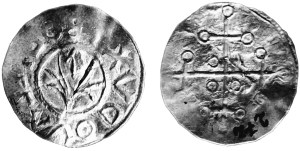
Denar of Boleslaus Chrobry of Poland, ca. 992-1000 A.D. Tree of life with arrow, inscription / cross. One of the contenders for the first coins struck in Poland. Photograph from Suchodolski 2015.
Accordingly, we must look elsewhere for what, exactly, Mieszko may have collected for taxes and used to pay his force of warriors.
Mishin, in his translation, indicated that Mieszko collected taxes in “market weights,” which were then used to pay his warriors a fixed monthly salary. As I noted in February 2022, Mishin based his translation, “market weights” for matāqīl al-murquatiyya, on Kowalski’s scholarship. Kowalski arrived at this rather peculiar translation because al-matāqīl or al-matākīl is the Arabic word for dinar, a gold coin, which did not circulate in Slavic lands and it was modified by a previously unattested or corrupted modifying word al-murquatīyya or al-marqatīya, which Kowalski rendered as market or commercial.
In a paper prepared for a 2006 conference celebrating the 60th anniversary of Kowalski’s remarkable scholarship regarding the testimony of Ibrahim Ibn Ya’qub, Andrzej Zaborski discussed this translation issue at length, noting that alternatives proposed over the years have include Byzantine money (a proposal widely rejected), legal tender/money, and his own hypotheses, “good coins of fixed value” or “coins of diminished value.” Zaborski concluded that the translation issue required further investigation. (Zaborski, pp. 64-65).
In February 2022, I suggested that the text itself had revealed all that it would yield and that the evidence on the ground, or rather in the ground, argued that “good coins of fixed value” should prevail as the preferred translation. To support this contention, I appealed to the numismatic hoard evidence. Specifically, I made the following argument:
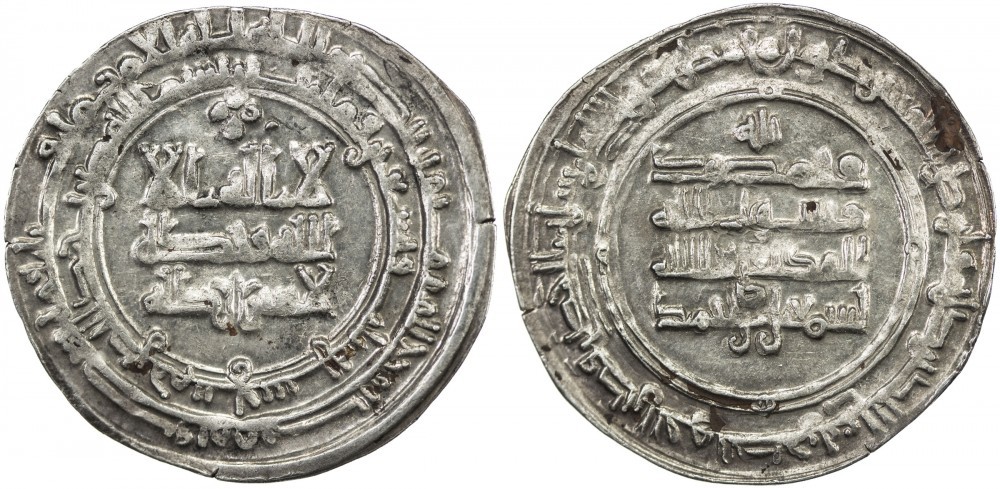
A Dirham of the type found in hoards in Poland from the early 10th century. SAMANID: Isma’il I, 892-907, AR dirham (2.89g), Balkh, AH293, A-1443. Photograph courtesy Stephen Album Rare Coins.
Mateusz Bogucki discussed the use of silver dirhams in Slavic lands in 2011, based on hoard evidence, and divided the time periods during which the hoards went into the ground into seven phases. Bogucki’s Phase III most aligns with the period during which Mieszko is referred to as collecting taxes and paying warriors salaries. Here is, in part, what Bogucki has to say about that period: “Phase III (early tenth century). At the turn of the ninth and tenth centuries, an important change in dirham importation may be observed. A significantly greater number of hoards are known from the period 900-40, and they are much larger (up to 1,000 coins). They are found in eastern Poland, Great Poland and Pomerania. Dirhams are almost exclusively whole coins. Some complete (undamaged) ornaments also occur in the hoards. Analysis of the coins and ornaments demonstrates that, during this phase, two important routes were in use. Coins found in Pomerania came via the Baltic, whereas coins in the eastern parts of Poland and Great Poland arrived mainly via the eastern land-route” (Bogucki (2011), p. 136).
In 2016, Bogucki explicitly tied the influx of dirhams into Poland to Mieszko’s use of mercenaries to consolidate his realm: “Assuming the chronology of the deposits is solid, it may even be suggested that the influx of silver to Wielkopolska from the East preceded the Pomeranian route by more than a decade and was initially greater in importance. The issue of the commodity exchanged for silver in the early-Piast state is still difficult to ascertain. It is apparent that the metal was needed to pay for mercenary services and to develop a proper network of administration and infrastructure based on strongholds. Archaeological research proves that the first half of the 10th century, when the core of the state in Wielkopolska was being established, brought destruction to a large percentage of tribal stronghold centres. Juxtaposing these facts with the chronology of the influx of oriental silver into Wielkopolska (discussed above) and the information found in written Arab sources, we may conclude that the economic basis for building the earliest Piast state came from selling slaves – the inhabitants of the destroyed tribal centres of Wielkopolska. By eliminating their hostile neighbours, the Piasts acquired silver, which they could use to consolidate their power” (Bogucki 2016, p. 246).
Based on the above, we know that Mieszko had access to good quality dirhams, in quantity, and that the dirhams were not yet always reduced to intensely fragmented hack-silver (where they would need to be regularly weighed to be paid out as a salary) as they were in later phases (such as Phase IV, from 970-1010 A.D., which Bogucki noted often included coins and items that were “intensely fragmented”). This adds support to Zaborski’s hypothesis, and my contention, that the contentious translation should be “good coins of fixed value” rather than the unsatisfactory and less supportable “market weights.” I note that Bogucki, in a 2005 paper, made passing reference to the issue of the form of the warrior salaries (in an article that was poorly translated into English) without addressing the underlying translation issue:
In my opinion buying meat by silver doesn’t hinder from buying by the silver politically loyalty. In the matter of salary and taxes it’s better to quote the words of Ibrahim: ‘Received by him (king Mieszko I) taxes are trade weights. They are used as payment for his mans (knights). Each month to each man it’s a known number of it’ (Kowalski 1946, 50). Here is necessary to comment the term trade weights –mataqil murquatiyya. Ibrahim might have known the name of dirhems, the western European denars he called Kinszar, so I think that Ibrahim noticed the hack silver, taken not for pieces, but for weight. This relation doesn’t mean that salary and taxes weren’t paid in animals, grain or any other goods. But it shows, that in this matter it isn’t possible to give only one single answer.
Bogucki (2005), p. 1152.
So, in 2005, Bogucki published an article translating the Arabic phrase at issue as trade weights. He does so because he views the currency in circulation in the Polish lands at the time of Ibrahim ibn Yaqub’s writing as either whole dirhams or, more likely, intensely fragmented hack-silver. So, how does Bogucki view the issue in his commentary in the new translation in 2022?
Bogucki writes the following:
Ibrahim also wrote that in Mieszko I’s country, taxes were levied in al-matākīlal-marqatiya. This term was originally rendered as ‘commercial weights’; however, W. Kubiak has proved that the term actually denoted coins. Ibrahim seems to have used a familiar term to describe collecting fragmented silver by weight. The crucial information is that taxes were collected in metal coins. Naturally, it is difficult to assume that each peasant individually paid the prince in silver, but a complex fiscal system, where a peasant or a craftsman paid his due to the relevant official (the town comes) in produce, animals or products, and the official, in his turn, paid the prince with silver seems highly probable. Incidentally, Arab dirhams were widely used in Mieszko I’s country, a fact that Ibrahim fails to mention (he did note their use at Otto I’s court, however). It is worth recalling here that in the light of the most recent research, the slave trade, in which slaves were sold for Arab silver, played an important role in building Mieszko I’s power. Naturally, direct archaeological material does not corroborate the slave trade, but wide-scale archaeological studies seem to confirm this thesis.
Kowalski (2022), pp. 168-169.
Although it is gratifying that Bogucki is seemingly prepared to render the disputed phrase as referring to coins and no longer referring to weights, it is unclear how he would actually translate it, if at all. Is he proposing that the words be translated, as Kubiak did, as market money, or current coin, or market coin? I note that Zaborski, in reviewing Kubiak’s scholarship, was troubled by Kubiak’s interpretation as it relied on a translation that embraced etymology for market that was only attested in the 20th century in the Arabic dialect of the Jews of Algiers (Zaborski, pp. 48 and 65). The brevity of Bogucki’s comments on the issue leave these questions unaddressed, unfortunately.
On balance, however, the scholarly debate has advanced sufficiently that any translation of the phrase involving weights may be set aside. For my own purposes, I will leave the phrase untranslated, as Lunde and Stone do in their translation, and provide a note indicating that current scholarship understands the phrase as meaning current coin (e.g., dirhams and/or hack-silver).
REFERENCES/SOURCES: (Blue boxes may be clicked to be taken to reference works available online for review. Red boxes indicate reference works are not available for online review. If a link for a blue box is no longer working, please advise me of such as nca@northcoastantiquarian.com. Thank you.).
Note: Zabroski’s work is a compilation of scholarly papers read at a May 2006 conference celebrating the 60th anniversary of the publication of the first and most critical edition of Ibrahim Ibn Ya’Qub’s reports on the Slavs, which had been prepared and published by Tadeusz Kowalski [Kowalski, Tadeusz. Relacja Ibrāhīma ibn Ja’ḳūba z podróży do krajów słowiańskich w przekazie al-Bekrīego (Relatio Ibrāhīm ibn Ja’ḳūb de itinere Slavico, quo traditur apud al-Bekrī). Cracow: PAU, 1946].
Cross Denar similar to those found in the Słuszków Hoards CROSS DENAR: Anonymous, ca. 1070-1100, AR pfennig (0.79g), Gumowski-59; Dannenberg-1341, Bishop’s crozier surrounded by pellets // cross with pellets and crescents in quarters, raised rims of the randpfennig type, possibly struck at Halle-Giebichenstein or Merseberg, Fine to VF, S. The early pfennige of Saxony have seen a number of different attributions over the years. Some were known as “wendenpfennige” from the native Slavic peoples of eastern Germany and Pomerania and others as “randpfennige” (rim pfennigs) from their up-raised edges and attributed to the early Polish bishoprics and kingdoms. More recent studies have concluded they were civic issues of various eastern cities, with places such as Bremen, Halle-Giebichenstein, Meissen, Merseberg, and Naumburg being cited as points of origin. Ex Stephen Album Rare Coins Auction 31, Lot 1309 (2018).
The first hoard from the village of Słuszków near Kalisz was discovered accidentally in 1935. Krzysztof Dąbrowski, head of the archaeological department of the Institute of the History of Material Culture of the Polish Academy of Sciences (Kalisz), and later director of the State Archaeological Museum, secured the hoard for the state, thereby preserving it for study. The hoard, as it currently survives, is presently located in the Muzeum Okręgowe Ziemi Kaliskiej (District Museum of the Kalisz Region). The deposit has over 13,000 pieces, largely comprised of the later varieties of cross denarii, but also large module denars of the palatine Sieciech, Western European coins, and silver ornaments and “silver cakes”. The content and deposit date of this hoard provided scholars with the opportunity to address the issue of the origin of the later types of cross denars, which were the most common circulating coin in eleventh-century Poland. The reader is encouraged to review the sources linked below for a survey of the advances which the hoard has allowed. I have included an English translation of one of the most important articles for your convenience.
Surprisingly, the actual discovery location of the 1935 hoard in Słuszków is still unknown, despite repeated efforts by archaeologists to relocate it. Recently, however, it was reported by Archeologia Żywa (see articles cited below) that archaeologists from Kalisz and Warsaw were successful in finding an additional deposit of 6,500 silver coins in a corn field near the village of Słuszków, arranged in linen pouches, along with silver cakes, fragments of lead, and four gold rings, while searching for the original discovery location in November 2020.
Adam Kędzierski, an extraordinary scholar and archaeologist with the Interdisciplinary Center of Archaeological Research (Kalisz) of the Polish Academy of Sciences, reported the circumstances of the find: “According to the official version, the [original 1935 hoard, Słuszków 1] was hidden at the intersection of the border of three plots, located in the northern part of the village. This information turned out to be false, which is why during this year’s exploration work, attention was focused on the field closer to the road. This place was identified by the Rev. Jan Stachowiak, who obtained the information from the original finders of the hoard in the early 80s.” Kędzierski said the new hoard of denars was found within two days of the commencement of archaeological work in a well-preserved clay vessel “filled to the brim” located about 12 inches below the surface.
From my perspective, one of the gold rings in the recent hoard is most historically intriguing and raises the most interesting questions. The ring at issue is inscribed, in Cyrillic, Господ]ипомъзи [ра]бесвое[и] Марии. Adrian Jusupović, of the Institute of History (Warsaw) of the Polish Academy of Sciences, translates this inscription to “Lord help your servant Maria.” Kędzierski, after reviewing the coins in the latest hoard, which is now called Słuszków 2, has determined that, as the deposit can be dated to around 1105 A.D., the ring hypothetically can be attributed to the wife of Duke Casimir the Restorer of Poland, Duchess Maria Dobroniega (1010/1016 – 1087 A.D.), daughter of Grand Duke Vladimir of Kiev.
I hope to prepare a comprehensive summary of all the pertinent literature, with appropriate pictures, in the near future, outlining the understanding of the role of cross denars in Polish numismatic history by scholars.
SOURCES/REFERNCES:
Blue buttons are linked to the articles referenced. The first article is a new translation, in English, of the article immediately below it. If you have suggestions for improvements in the translation, please do not hesitate to contact me at nca@northcoastantiquarian.com.
A Dirham of the type found in hoards in Poland from the early 10th century. SAMANID: Isma’il I, 892-907, AR dirham (2.89g), Balkh, AH293, A-1443. Photograph courtesy Stephen Album Rare Coins.
Widukind of Corvey’s Deeds of the Saxons [Res gestae saxonicae], records the following: “They happily received Wichmann, who then wore down the barbarians, who lived even further away, with numerous battles. Wichmann defeated King Miesco, who ruled over the Slavs called the Licicaviki, in two battles, and killed his brother. He then extorted a great quantity of booty from them” (Widukind of Corvey, p. 140).
Widukind’s entry regarding Mieszko, typically attributed to the year 963 A.D., is generally identified as the earliest reference to Mieszko and the polity he reigned over, latterly known as Poland. However, some scholars have posited that the fragmentary reports on the Slavs prepared by Ibrahim Ibn Ya’Qub al-Isra’ili at-Turtushi, which were latterly preserved through their incorporation into Al-Bakrī’s Kitāb al-masālik wa’l-mamālik (Book of the Roads and Kingdoms), may have reflected travels that occurred as early as 961-962 A.D., not the usually posited 965-966 A.D., and thus antedate Widukind’s first entry regarding Mieszko and his Slavs (Zaborski, p. 8).
Miezko I, the historically attested founder of Poland’s Piast Dynasty
Ibrahim Ibn Ya’Qub reported the following regarding Mieszko and his realm: “The country of Mashaqqah [that is Mieszko, earlier in the text identified as ‘King of the North’] is the largest one among the countries [of the Slavs]. It abounds in food, meat, honey, and agricultural produce. The taxes are collected in market weights. Those are the salary of his men in every month, and each of them has a certain amount of them to get. He has three thousand warriors wearing coats of mail; a hundred of them is worth a thousand of other warriors in the battle. He gives those men clothes, horses, arms, and everything they need. If a child is born to one of them, he orders the child to be paid a maintenance, regardless of the latter’s sex. When the child grows, and he is a boy, he marries him and pays the dowry to her father. The dowry of the Slavs if very big, and they pay it in the same way as the Berbers do. If a man, thus, has two or three daughters, he gets rich, but if he has two sons, he becomes poor” (Mishin, pp. 187-188).
“Wichman defeated and mortally wounded, surrenders to Mieszko I, handing over his sword to the ruler” – illustration from “Album de Wilna” by Jan Kazimierz Wilczyński. (1787). Source: Muzeum Narodowe w Krakowie – Photograph by Karol Kowalik
What is of particular interest to the numismatically inclined, and has been of interest to generations of scholars, are the references to the taxes collected and paid by Mieszko to support the three thousand warriors, warriors that allowed Mieszko to expand, consolidate, and stabilize his realm and, as recorded in a second entry by Widukind, become friend of the emperor and enjoy ultimate victory over Wichman (Widukind of Corvey, pp. 143-145).
Denar of Boleslaus Chrobry of Poland, ca. 992-1000 A.D. Tree of life with arrow, inscription / cross. One of the contenders for the first coins struck in Poland. Photograph from Suchodolski 2015.
As current scholarship does not support that Mieszko issued any coinage of his own and reveals that his son, Boleslaw Chrobry, struck Poland’s first denars between 992 A.D. and 1000 A.D. (see Suchodolski 2019 and Suchodolski 2015 for a discussion of which denars are contenders for earliest denars struck in Poland), we must look elsewhere for what, exactly, Mieszko may have collected for taxes and used to pay his force of mercenary warriors.
Mishin, in his translation of Ibrahim Ibn Ya’Qub, indicated that Mieszko collected taxes in “market weights,” which were then used to pay his warriors a fixed monthly salary. This peculiar translation, “market weights,” is ultimately based on the scholarship of Tadeusz Kowalski, who proposed this translation (matᾱqῑl al-murquatiyya) (because the Arabic word for “dinar” (matᾱqῑl) was followed by a corrupted (?) or unattested Arabic word modifying it which has stymied the best attempts of scholars searching for an appropriate translation for generations but which some, including Kowalski, viewed as meaning market (al-murquatiyya) – and a market dinar would, hypothetically be most appropriately translated as a “market weight”.
In a paper prepared for a 2006 conference celebrating the 60th anniversary of Kowalski’s remarkable scholarship regarding the testimony of Ibrahim Ibn Ya’qub, Andrzej Zaborski discussed this translation issue at length, noting that alternatives proposed over the years have include Byzantine money (a proposal widely rejected), legal tender/money, and his own hypotheses, “good coins of fixed value” or “coins of diminished value.” Zaborski concluded that the translation issue required further investigation. (Zaborski, pp. 64-65). I suggest that the text has revealed all that it will yield and that the evidence on the ground, or rather in the ground, argues that “good coins of fixed value” should prevail as the preferred translation. To support this contention, I appeal to the numismatic hoard evidence.
Mateusz Bogucki discussed the use of dirhams in Slavic lands in 2011, based on hoard evidence, and divided the time periods during which the hoards went into the ground into seven phases. Bogucki’s Phase III most aligns with the period during which Mieszko is referred to as collecting taxes and paying warriors salaries. Here is, in part, what Bogucki has to say about that period: “Phase III (early tenth century). At the turn of the ninth and tenth centuries, an important change in dirham importation may be observed. A significantly greater number of hoards are known from the period 900-40, and they are much larger (up to 1,000 coins). They are found in eastern Poland, Great Poland and Pomerania. Dirhams are almost exclusively whole coins. Some complete (undamaged) ornaments also occur in the hoards. Analysis of the coins and ornaments demonstrates that, during this phase, two important routes were in use. Coins found in Pomerania came via the Baltic, whereas coins in the eastern parts of Poland and Great Poland arrived mainly via the eastern land-route” (Bogucki (2011), p. 136).
In 2016, Bogucki explicitly tied the influx of dirhams into Poland to Mieszko’s use of mercenaries to consolidate his realm: “Assuming the chronology of the deposits is solid, it may even be suggested that the influx of silver to Wielkopolska from the East preceded the Pomeranian route by more than a decade and was initially greater in importance. The issue of the commodity exchanged for silver in the early-Piast state is still difficult to ascertain. It is apparent that the metal was needed to pay for mercenary services and to develop a proper network of administration and infrastructure based on strongholds. Archaeological research proves that the first half of the 10th century, when the core of the state in Wielkopolska was being established, brought destruction to a large percentage of tribal stronghold centres. Juxtaposing these facts with the chronology of the influx of oriental silver into Wielkopolska (discussed above) and the information found in written Arab sources, we may conclude that the economic basis for building the earliest Piast state came from selling slaves – the inhabitants of the destroyed tribal centres of Wielkopolska. By eliminating their hostile neighbours, the Piasts acquired silver, which they could use to consolidate their power” (Bogucki 2016, p. 246).
Based on the above, we know that Mieszko had access to good quality dirhams, in quantity, and that the dirhams were not yet reduced to hacksilber (where they would need to be regularly weighed to be paid out as a salary) as they were in later phases (such as Phase IV, from 970-1010 A.D., which Bogucki noted often included coins and items that were “intensely fragmented”). This adds support to Zaborski’s hypothesis, and my contention, that the contentious translation should be “good coins of fixed value” rather than the unsatisfactory and less supportable “market weights.” I note that Bogucki, in a 2005 paper, made passing reference to the issue of the form of the warrior salaries (in an article that was poorly translated into English) without addressing the underlying translation issue being discussed in this post :
In my opinion buying meat by silver doesn’t hinder from buying by the silver politically loyalty. In the matter of salary and taxes it’s better to quote the words of Ibrahim: ‘Received by him (king Mieszko I) taxes are trade weights. They are used as payment for his mans (knights). Each month to each man it’s a known number of it’ (Kowalski 1946, 50). Here is necessary to comment the term trade weights –mataqil murquatiyya. Ibrahim might have known the name of dirhems, the western European denars he called Kinszar, so I think that Ibrahim noticed the hack silver, taken not for pieces, but for weight. This relation doesn’t mean that salary and taxes weren’t paid in animals, grain or any other goods. But it shows, that in this matter it isn’t possible to give only one single answer.
Bogucki (2005), p. 1152.
I suspect if Bogucki would reflect further on the issue, and consider the later arguments of Zaborski and the nature of the hoard evidence when Mieszko was doing the bulk of the consolidation of his polity, he might abandon his attachment from market weights to good coins of fixed value. Yet, it is important to take note of the hacksilber hoards and what they may represent and for that, I direct readers to the comments in the article below by Florin Curta.
And finally, as if in response to the 60th Anniversary Conference honoring Kowalski’s scholarship, an updated edition of his work, translated into English, will soon be released. The editor of the new edition was Mustafa Switat, a Research Fellow with the University of Warsaw. Of course, I am most eagerly awaiting to see how the most recent scholarship addresses the issue of the translation issue discussed above and whether Zaborski’s proposed resolution is adopted or perhaps another solution is at hand.
REFERENCES/SOURCES: (Blue boxes may be clicked to be taken to reference works available online for review. Red boxes indicate reference works are not available for online review. If a link for a blue box is no longer working, please advise me of such as nca@northcoastantiquarian.com. Thank you.).
Note: Zabroski’s work is a compilation of scholarly papers read at a May 2006 conference celebrating the 60th anniversary of the publication of the first and most critical edition of Ibrahim Ibn Ya’Qub’s reports on the Slavs, which had been prepared and published by Tadeusz Kowalski [Kowalski, Tadeusz. Relacja Ibrāhīma ibn Ja’ḳūba z podróży do krajów słowiańskich w przekazie al-Bekrīego (Relatio Ibrāhīm ibn Ja’ḳūb de itinere Slavico, quo traditur apud al-Bekrī). Cracow: PAU, 1946]. The May 2006 conference concluded by calling for an updated edition of Kalkowski’s work to be published, with appropriate emendations to reflect the latest scholarship, and for it to be translated into English. Fortunately, the conference’s appeal has been answered as the following is soon to be released: Kowalski, Tadeusz. Ibrāhīm ibn Yaʿqūb’s Account of His Travel to Slavic Countries as Transmitted by Al-Bakri with Contemporary Commentary. Ed. Mustafa Switat. Trans. Agnieszka Waskiewicz.