The Two Carriages: A Meditation on Kajetan Sołtyk

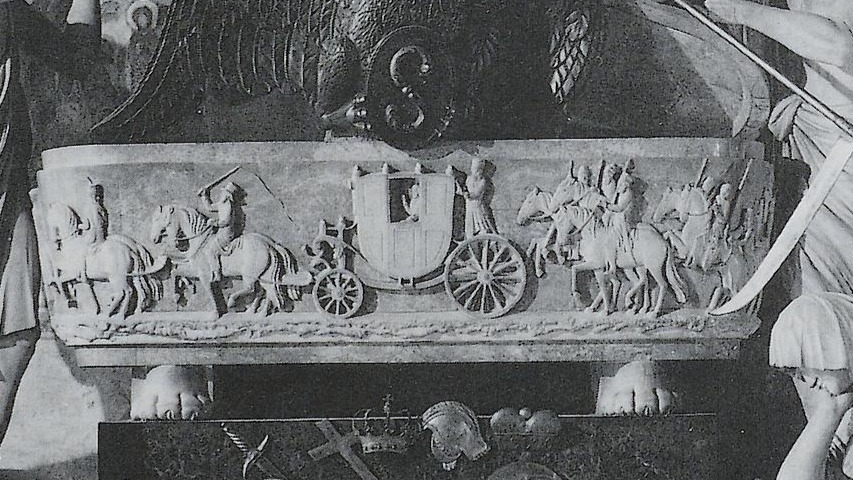
Detail of the sarcophagus relief, funerary monument of Bishop Kajetan Ignacy Sołtyk (1715-1788), Chapel of the Holy Cross, Wawel Cathedral, Kraków. The relief depicts Sołtyk’s deportation by Russian troops to Kaługa, 1767. Photograph: S. Michta, from Studia Waweliana, vol. 1, 1992, p. 86.

In the Holy Cross Chapel of the Wawel Cathedral in Kraków stands the funerary monument of Kajetan Ignacy Sołtyk, sixty-seventh Bishop of Kraków — commissioned by his nephew Michał in 1790, the year of Poland’s second partition. On the face of the sarcophagus, rendered in low relief, a carriage moves under cavalry escort along a road that leads, though the stone does not say so, to Kaługa, in the Russian interior. The year was 1767. Sołtyk had been seized by Russian troops by order of the Russian ambassador for opposing Russia’s political and religious program for the Commonwealth during the Sejm, bundled into a carriage, and driven east — a political abduction so brazen that it became, in the decades following, one of the founding outrages of Polish martyrological memory. He would not return for five years.

The monument transforms that enforced journey into the central scene of a man’s significance: not his episcopate, not his theology, not his political career, but the moment he was taken away against his will and transformed into a patriot-martyr — a transformation his later years, marked by mental collapse and withdrawal from public life, would do nothing to complicate in the popular memory.

That is one carriage.

There is another, less well-known but preserved in prose.

The Entry of Kajetan Sołtyk, Bishop of Kraków, Prince of Siewierz, into Kraków Castle to the Cathedral Church in the year 1759 (c.1814) by Michał Stachowicz (1768–1825).

The memoirist Jędrzej Kitowicz, describing the ceremonial processions that opened each session of the Sejm — the king riding from his palace to the Sejm, flanked by the ranked carriages of senators and deputies, each equipage expressing by the number of its liveried attendants the precise degree of its owner’s dignity — notes that the most elaborate display permitted by custom consisted of twelve lackeys and six haiduks (the tall liveried footmen whose Hungarian-style dress and ceremonial bearing made them among the most visible markers of aristocratic magnificence), a number not exceeded even by the king himself. In fact it was exceeded by one participant only. Kajetan Sołtyk, in the first year of his episcopate at Kraków, appeared in the procession of 1760 with twenty-four lackeys, twelve haiduks, and four pages. Already in his second year, Kitowicz adds with characteristic dryness, he had reduced this magnificent display to conventional proportions.

Two carriages, then. One at the height of his career, one at its nadir. One the expression of an ambition so consuming it overreached even the sovereign’s ceremonial precedence; the other the instrument of a foreign power’s contempt for Polish sovereignty and ecclesiastical dignity. In both, the bishop is being carried — not walking of his own volition, not the autonomous agent of his own movement, but the passenger of forces that exceed his will. In 1760 those forces are internal: a visceral hunger for visibility, for precedence, for recognition. In 1767 they are external and violent. But the structural resemblance is uncanny and instructive. He is always at the center of an attended vehicle. What changes is not the form, but only the hand that commands the escort.

Kitowicz does not moralize. He gives you the numbers — twenty-four, twelve, four — and then simply notes, almost in passing, the reduction that followed. Whether the correction came from rebuke or recognition of excess, the record does not say. It is enough that the excess was seen and then moderated and not repeated.

What the monument suppresses, and what Kitowicz preserves, is that earlier carriage: the one that moved through Warsaw under twenty-four lackeys, announcing to every observer that the newly installed Bishop of Kraków had arrived and was to be noticed above all others, including the king. Michał Sołtyk knew the record. He chose which carriage to put on the sarcophagus.

The choice, motivated by familial piety and political calculation, was not wrong — or not simply wrong, though neither was it uncontested. Sołtyk’s reputation has never settled into a single image. Those who remembered him as a patriot and victim were matched, even in his own lifetime, by those who remembered him as a man whose turbulent ambitions had done as much to destabilize the Republic as the foreign powers that preyed upon it. The martyrological image the monument proposes is one reading of the man — a powerful reading, and one that history has repeatedly ratified — but it is a reading, not a verdict. What it identifies correctly is the hinge. The deportation to Kaługa became the organizing fact of his significance. The twenty-four lackeys made him conspicuous for a season; the cavalry escort made his memory, his conspicuousness, permanent.

There is a certain grammar to this, whether one chooses to call it providential or merely historical. The force that humiliated him accomplished what his own will had sought, and failed, to secure: an uncontested image of magnitude, carried not along the Kraków Road in Warsaw but forward into a posterity that required, as Poland required, its martyrs. Sołtyk, a Catholic bishop and political operator with a pronounced taste for the theatrical and excess, would not have found the role uncongenial. The monument does not lie, exactly. It chooses. It fixes upon the carriage that tells the truth it prefers and lets the other fall away—not into oblivion, but into the keeping of a memoirist who recorded what he saw, and of those who return to it.


Sources

The fullest current scholarship on Sołtyk’s funerary monument and the attribution of its design to Father Sebastian Sierakowski draws on Joanna Daranowska-Łukaszewska, “Kto jest autorem nagrobka biskupa Kajetana Sołtyka w katedrze na Wawelu?” (Studia Waweliana, vol. 1, 1992). The account of the Sejm processions and Sołtyk’s ceremonial display is drawn from Jędrzej Kitowicz, Opis obyczajów za panowania Augusta III (Description of Customs in the Reign of Augustus III). Background on Sołtyk’s seizure and deportation draws on Kazimierz Rudnicki, Biskup Kajetan Sołtyk (Kraków, 1906), and on the archival and biographical materials assembled in the course of the author’s ongoing work on a biography of the bishop.

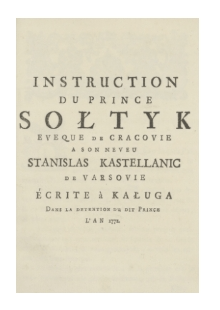
Instruction of Prince Sołtyk, Bishop of Kraków, to His Nephew Stanisław, Castellan of Warsaw — Written at Kaługa during the Detention of the Said Prince, in the Year 1771


The decrees of the Eternal One, to which I have always rendered a blind obedience and a perfect resignation, being beyond all fathoming, I do not know the term of my detention.

But judging that the time has come when you must go and see foreign lands, I write to my brother, His Excellency the Palatine of Łęczyca, that he may regulate your departure and your route.

With regard to your conduct, I prescribe to you certain articles which will serve you as light and guide in your travels, and will guard you, if you follow them, against every false step.

The most essential thing, and the first that I most earnestly recommend to you, is the Christian, Catholic, and Roman Religion, in whose bosom you were born and which you have professed since your childhood.

I protest to you by all that is most sacred that it is the best of all those that exist in the world.

It formerly united all others, but the world having inclined toward change, and men, through the weakness of their nature, being more inclined to evil than to good, the age has produced strong spirits who revolted against our Holy Mother the Church and went astray. Your age permits you to judge the danger of such errors.

Love, then, this holy Religion as your mother; respect her as your sovereign; and support her on every occasion.

Among so many people whom you will see, know, and frequent — even in Catholic countries — you will find monsters of abomination who will have no religion, or who, after the example of the Pharisees, will possess only its appearance. It is against such persons that you must be most on your guard, and you must support your Religion with all your strength, even to the shedding of the last drop of your blood, when the case demands it.

Religion, in its purity, being the source of all good, you cannot preserve it except by opposing the spirit of faith to those innovations that tend to weaken and destroy a Religion which cannot subsist without faith.


You must always be entirely convinced that you can succeed in nothing without the assistance of God. It is He who must guide you in your travels, in your studies, in your conduct, in your advancement, in all your progress, in your destiny in this world — and in what is of still greater importance, in the career which must lead you to eternity.

You cannot flatter yourself that you will obtain this assistance except by meriting His grace; and you can never promise yourself this grace without an entire confidence in God, without an irreproachable conscience, and without having a soul without stain. To this end I conjure you to choose one day in each month to make your Confession and to receive Holy Communion.

You will carefully observe hearing Mass every Sunday and on the Feast Days prescribed by the Church. You will take care to avoid the hours when certain churches are frequented only to put oneself on display, and you will choose those where you may attend Divine Service with the recollection that the sanctity of the place demands.

When you enjoy good health, observe religiously Lent and the other fast days. The perversity of the Age will perhaps attempt to cast ridicule on your conduct in this regard; but when one has done one’s duty, they can only wound those who, through a spirit of intellectual libertinage, seek something to censure. Such remarks, which can only be uttered by scatterbrains, must not turn you away from what the Church commands.

If illness requires that you renounce fasting, then follow the physician’s prescription, with the permission of the local Bishop or Curé, and preserve the sentiments of a good Christian.

True Piety is solid; it disowns hypocrisy; uprightness is its domain; it alone will inspire your duties, provide for your needs, and lead you to your end.

All your talents without it will become useless; and they will bear fruit without limit from the moment she accompanies them.

You will attend Sermons to perfect yourself in the ways of Salvation and to instruct yourself in the matters of holy doctrine.

It is not too much to ask of you a quarter of an hour morning and evening for meditation. Self-knowledge is the most instructive book we can consult; but who are those who truly wish to study themselves?


One seeks out all the works that appear, to charm one’s boredom, to flatter one’s self-love, or to satisfy one’s curiosity, and one neglects the examination of the Heart and the Soul, which can furnish us with far more useful instruction.

Nothing is rarer among men than knowledge of oneself; all other study is preferred to that of one’s own heart.

You have reason enough to understand how necessary this is for every Christian, and that it detracts in nothing from the estate of a man destined to live in the great world.

Flee absolutely from the wicked, and from those who make a way of being without character, without morals, without Religion, and without conscience; their feigned probity must be suspect to you.

As there will be some of this kind even among the honest persons you frequent, it is of the utmost importance to learn to discern them, in order to be able to avoid them.

You will succeed in this by informing yourself carefully, before committing yourself to any Society, of those who compose it, and by judging from the morals and character of those with whom you may bind yourself in friendship.

Would you cease to be good because the world abounds in the wicked? If you have ridicule to fear, it can only come from imitating bad originals. You will never run such risks by imitating the good actions of those who have one and the same Religion and virtue for their guide.

Guard yourself from reading bad Books as from a dangerous poison. Besides being condemned by the Head of our Church, you will draw no utility from them and will place yourself in danger of being perverted. There remain so many excellent books in all the sciences to which you may apply yourself that it is superfluous to seek out bad ones. Every obstacle that could oppose itself to the fruit you must gather from your education must be removed.

In the different countries you will see in your travels, you will observe the different forms of government — such as the Despotic, the Monarchical, the Aristocratic, the Democratic, and the Anarchical. You will combine their strengths and weaknesses in order to learn and appreciate that of your own Fatherland.

Far, then, from bringing back upon your return maxims injurious to the constitution of our State, you will strengthen more and more both mind and heart in the sentiments of the love you owe to your Nation.


You who would gamble away your money at play lose a precious time that you could employ to far better purpose. One makes enemies thereby, draws troublesome affairs upon oneself, inflames the blood, and risks verifying the Proverb that places on the same level the Gambler, the Dupe, and the Knave.

I do not forbid you games of commerce; I desire only that you not attach yourself to them with passion, and that you engage in them only out of complaisance when Society demands it, or as a relaxation after your studies. But my affection for you obliges me to use my authority to forbid you absolutely every game of chance.

Strive to cultivate a fund of gaiety of spirit; it suits young Gentlemen well, renders them agreeable in Society, contributes to their health, and seems to establish a certain harmony between mind and heart. But it must have nothing in common with coarse pleasantries, nor with a dissolute and indecent mirth; in a word, it must be rather the laughter of the soul than of the senses.

You will draw further instructions from His Excellency the Palatine of Łęczyca, my brother and your uncle. He has for you the very bowels of a father’s love, and his wisdom will supply what concerns the circumstances of your departure.

It is he who will choose for you a Governor, who will serve as friend and companion.

It is for you to observe strictly all that I prescribe here, all that Monsignor the Palatine will suggest to you, and all that your Mentor will counsel.

I have arranged your allowance; you will lack nothing. But as you are not yet of age to bear the burden of expenditure, the money will be placed in the hands of your Governor. He will spare nothing for what your needs require, and you will not demand of him any superfluity you could do without — since it is necessary that you learn in your youth to be generous without prodigality, and economical without avarice.

I flatter myself that the length of this writing will cause you no tedium, and that you will take it on the contrary as an evident mark of my tenderness, which interests itself in your glory, your honor, your reputation, your prosperity, your health, and the salvation of your Soul.

Count upon my affection as upon the thing in the world most assured to you — all the more since you are not unaware that I intend the succession of my estate to you after my death, if you render yourself worthy of it.

I also wish to persuade myself that you bear me friendship and gratitude; I ask of you a proof thereof that will cost you no more than half an hour each month, which you will employ in rereading this writing with attention.


You would afflict me deeply if you regarded these reflections as simple moral maxims uttered by a Bishop, or as a piece composed to display eloquence or erudition. I desire on the contrary to see you fully persuaded that it is a friend of the heart who speaks to you, who finds in it no other interest than your own.

I finish by embracing you tenderly and giving you my Benediction. I pray God and address to Him my most ardent vows, that He may assist you in your travels, your return, and shower you with His Benedictions.

CAJETAN SOŁTYK, PRINCE-BISHOP OF KRAKÓW, DUKE OF SIEWIERZ.


A Note on the “Instruction of Prince Sołtyk”

On the night of 13 October 1767, Russian troops, acting under the orders of Ambassador Nikolai Repnin, seized Kajetan Sołtyk, Bishop of Kraków, together with three other senators who had opposed Russian interference in the affairs of the Polish-Lithuanian Commonwealth. Without trial, charge, or any form of legal process, Sołtyk was carried across the border into Russia and confined at Kaługa, a provincial city some 150 miles southwest of Moscow, where he remained for five years.

At the time of his abduction, he was the most prominent Catholic bishop in Poland, occupying the see of Kraków, first among the dioceses of the realm. His seizure was immediately understood, both within Poland and across Catholic Europe, as an act of sovereign violation: the forcible removal of a senator and a bishop by a foreign power for actions taken in the course of a deliberative assembly.

It was in this captivity that Sołtyk composed the present Instruction, a letter of moral and practical counsel addressed to his nephew Stanisław, Castellan of Warsaw, who was preparing to undertake the customary tour of foreign countries expected of a young nobleman. The document is dated 1771, in the fourth year of his detention. Writing in French, the common language of Polish aristocratic culture, Sołtyk ranges across religion, self-knowledge, conduct in society, the dangers of bad company and bad books, the comparative observation of governments, and the prudent management of money and leisure. These themes are framed throughout by the unmistakable tenderness of a man who, though deprived of his liberty and removed from the exercise of his offices, retained undiminished his sense of episcopal authority, patrician dignity, and familial obligation.

The Instruction was subsequently published and circulated both as a personal document and as a form of political testimony: evidence that the captive bishop remained in full possession of his faculties and steadfast in his convictions. It stands as one of the more intimate texts to survive from Sołtyk’s long captivity, and among the more revealing—not as the rhetoric of martyrdom, but as the record of a great nobleman’s mind at work in confinement, attending, as best he could, to those he loved and to the reputation he intended to preserve.

Zbigniew Herbert’s Poem on Caligula’s Contempt: The Appointment of the Horse Incitatus

Gaius (Caligula). AD 37-41. Æ Sestertius. Photograph from CNG, Triton XXVII Auction, Lot 675.

The Roman Emperor Caligula, to demonstrate his contempt for the Roman Senate, appointed, by some accounts, his horse, Incitatus, to the Senate so that the horse could be made a consul of Rome. This ancient tale is called to mind by events of recent days, but not for reasons many may suspect. The following poem of Zbigniew Herbert (translated by Oriana Ivy) suggests that the horse had merits as an appointee which many of the recent suggested appointees do not.

***

Caligula Speaks

Among all the citizens of Rome

I loved only one

Incitatus–a horse

when he entered the Senate

the unstainable toga of his coat

gleamed in the midst

of purple-lined assassins

Incitatus possessed many merits

he never made speeches

had a stoic temperament

I think at night in the stable he read the philosophers

I loved him so much that one day I decided to crucify him

but his noble anatomy made it impossible

he accepted the honor of consulship with indifference

exercised authority in the best manner

that is not at all

he would not be persuaded toward a lasting liason

with my second wife Caesonia

thus unfortunately the lineage of centaur caesars

was not engendered

that’s why Rome fell

I determined to have him declared a god

but on the ninth day before the February calends

Cherea Cornelius Sabinus and the other fools

interfered with my pious plans

he accepted the news of my death with calm

was thrown out of the palace and condemned to exile

he bore this blow with dignity

he died without descendants

slaughtered by a thick-skinned butcher from Ancium

Tacitus is silent

about the posthumous fate of his meat

The King’s Deliverance: Musical Tribute to King Stanisław August Poniatowski’s Rescue

THE KING’S DELIVERANCE – A “Hymn” commemorating the rescue of the King from an attempted kidnapping by the Bar Confederation conspirators in 1771.

It is with pleasure that I share with you The King’s Deliverance, a musical composition inspired by the 1771 AR Medal crafted by Johann Leonhard Oexlein. This piece sets to music the lyrics written to commemorate the remarkable escape of King Stanisław August Poniatowski from an attempted abduction by the Bar Confederation, a group of Polish nobles opposed to Russian influence in the Polish-Lithuanian Commonwealth.

The medal, with its powerful inscriptions from the Psalms and intricate artistic details, captures the moment when “divine providence” intervened to protect the king. It symbolizes not only his deliverance but also the mercy he showed towards those who conspired against him. This event, which unfolded on the night of November 3, 1771, had far-reaching consequences, ultimately strengthening the king’s position. The hymn highlights the themes of justice and divine protection.

For those interested in a more detailed exploration of the medal and the history of the incident, I refer you back to an earlier post where I provide a fuller explanation of these significant historical elements.

The King’s Deliverance seeks to encapsulate these historical themes through music and lyrics, offering a tribute to this significant moment in Polish history. You are invited to watch the video and reflect on the enduring legacy of King Stanisław August’s resilience and mercy.

The Medal Commemorating King Stanisław II August Poniatowski’s Escape From Harm

The 1771 AR Medal by Johann Leonhard Oexlein serves as a remarkable numismatic artifact that commemorates a pivotal moment in Polish history—the delivery of King Stanisław August Poniatowski from a plot against him orchestrated by the Confederation of Bar. This post aims to shed light on the intricate details of its design and the political climate of the time.

The Medal’s Artistic Elements

The medal, measuring 44mm in diameter and weighing 21.84 grams, is a work of intricate craftsmanship. The obverse features the Latin inscription “NOLITE TANGERE CHRISTOS MEOS,” which translates to “Do not touch my anointed ones.” It is a quotation from the Bible, Psalm 105:15 (or 103:15 in the Latin Vulgate), where God warns the kings of the earth not to harm his chosen people and his prophets. It depicts an attack on the king by two Furies, one holding a sword and another a torch. The Hand of God descends from a cloud to protect the king, while a storm looms over a cityscape in the background. The artist, J.L. Oexlein, places his signature at the lower right, and the date and time of the event are inscribed in the exergue.

The reverse of the medal bears another Latin inscription, “OCVLI DOMINI SVPER IVSTOS,” meaning “The eyes of the Lord are upon the righteous.” It is another quotation from the Bible, Psalm 34:15 (or 33:16 in the Latin Vulgate), where David praises God for his protection and deliverance from his enemies. Here, King Stanislaus stands before a palace, flanked by kneeling subjects. The exergue carries the phrase “FIDA POLONIA/GAVDET,” which can be translated as “Faithful Poland rejoices.”

Historical Context

The Bar Confederation was a movement of Polish nobles and gentry that opposed the Russian influence and interference in Poland’s affairs in the late 18th century. It was formed in 1768 at the fortress of Bar in Podolia, now part of Ukraine, and lasted until 1772. The confederates opposed Polish king Stanisław II August Poniatowski, who was seen as a puppet of Russia, and against the Russian army that freely accessed much of Poland. They also resisted the reforms that granted equal rights to religious minorities, such as Protestants and Orthodox Christians, in the predominantly Catholic country. 

In 1770, the Council of the Bar Confederation proclaimed King Stanisław II August Poniatowski dethroned. Richard Butterwick narrates the events which followed quite ably:

Having declared Stanisław August’s reign void, [the Bar Confederates] decided to abduct him, probably in order to put him on trial. However, the attempt backfired badly, not least because only the king’s version of events is known. In short it is as follows:

On the evening of 3 November 1771 Stanisław August was returning to the Royal Castle from a visit to the nearby residence of Michał Czartoryski, when confederate riders surrounded his lightly guarded carriage. After a brief struggle, they headed out of the city with the wounded monarch. One by one, they lost either their nerve or their bearings, until the king was able to talk round the last of his captors and find refuge in the house of a miller. Help soon arrived from Warsaw. Whatever else actually happened that night, afterwards Stanisław August was able to depict the confederates to all Europe as regicides, and himself as a man of mercy. Despite the pressure from Catherine II for the severest penalties to be applied to the ‘regicides’, he kept his promise to spare his last captor’s life. He even paid him a pension in exile for the remainder of his reign.

-Butterwick, R. (2020). The Polish-Lithuanian Commonwealth 1733-1795: Light and Flame, Yale University Press: New Haven. p. 115.

Butterwick notes that Stanisław August preserved the clothes that he had been wearing that evening as “quasi-relics,” and interpreted his survival from the conspiracy as a sign that he was destined to achieve great things for the Commonwealth. The king also placed even greater trust in Divine Providence going forward. The direct action against the king, however, had unfortunate and far-reaching consequences for the Bar Confederation.

In 1772, Adam Naruszewicz wrote an ode commemorating the king’s remarkable clemency towards the conspirators. Naruszewicz’s “ODA III DO SPRAWIEDLIWOŚCI,” included, at lines 57-60, the following statement: “I can only interpret such a fate as a marvel: to have kings as defenders of their own grievances, to seek revenge through kindness, and with a sincere mind prefer mercy over being a hero of power” (from Naruszewicz, A. (2005). Poezje zebrane.  Vol. II. Wolska, B. (ed). Poland: Instytut Badań Literackich. p. 109, which read: “Polszczę to tylko takie los zostawił dziwy: mieć królów obrońcami urazy właściwej, szukać zemsty dobrocią, a umysłem szczerem woleć litości, niż być mocy bohaterem”).

AR Medal by Jan Filip Holzhaeusser. 
POLAND. 1771, Featuring Adam Naruszewicz and Maciej Sarbiewski.
AR Medal by Jan Filip Holzhaeusser.
POLAND. 1771, Featuring Adam Naruszewicz and Maciej Sarbiewski.
Struck by order of Stanisław August to commemorate these famous Polish poets.
HC-3961

Wolska, the editor of the volume that I translated the ode fragment from, implied that Naruszewicz seemed to be contrasting Stanisław August’s humanitarianism with rulers such as the usurper Catherine II and expansionist Frederick II who found their fame on policies of aggression and wars that lead to the deaths of many people (from Naruszewicz, A. (2005), p. 6, which read: “Daje to okazję do przeciwsta wienia postawy pełnej humanitaryzmu władcom budującym swe zna czenie i sławę na wzbudzającej strach agresywnej polityce i wojnach, które przyczyniają się do śmierci wielu ludzi”).

Political Repercussions

The direct assault on the person of the king led the Habsburgs and other foreign courts to withdraw their support from the Confederation of Bar, resulting in, among other things, the expulsion of their members from their territories. This incident also provided the neighboring powers—Russia, Prussia, and Austria—a pretext to highlight the so-called “Polish anarchy,” thereby “justifying” their interventionist policies and the first partition of Poland. Consequently, the Confederation lost much of its European support, and the king reverted to the Russian faction.

Conclusion

The 1771 AR Medal by Johann Leonhard Oexlein is not merely a numismatic curiosity; it is a tangible representation of this tumultuous period in Polish history. It encapsulates the complexities of political alliances, the fervor of nationalistic movements, and the divine providence attributed to the survival of a king. As such, it serves as an invaluable artifact for scholars and enthusiasts interested in the interplay between numismatics and history.