The Two Carriages: A Meditation on Kajetan Sołtyk

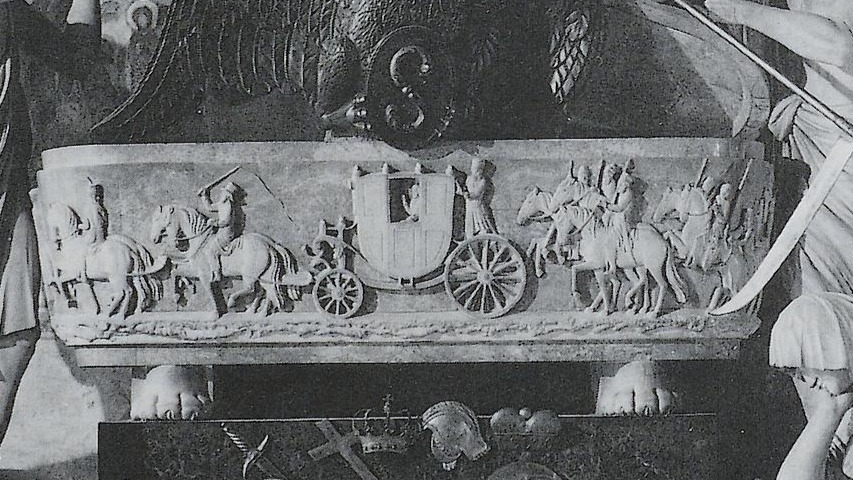
Detail of the sarcophagus relief, funerary monument of Bishop Kajetan Ignacy Sołtyk (1715-1788), Chapel of the Holy Cross, Wawel Cathedral, Kraków. The relief depicts Sołtyk’s deportation by Russian troops to Kaługa, 1767. Photograph: S. Michta, from Studia Waweliana, vol. 1, 1992, p. 86.

In the Holy Cross Chapel of the Wawel Cathedral in Kraków stands the funerary monument of Kajetan Ignacy Sołtyk, sixty-seventh Bishop of Kraków — commissioned by his nephew Michał in 1790, the year of Poland’s second partition. On the face of the sarcophagus, rendered in low relief, a carriage moves under cavalry escort along a road that leads, though the stone does not say so, to Kaługa, in the Russian interior. The year was 1767. Sołtyk had been seized by Russian troops by order of the Russian ambassador for opposing Russia’s political and religious program for the Commonwealth during the Sejm, bundled into a carriage, and driven east — a political abduction so brazen that it became, in the decades following, one of the founding outrages of Polish martyrological memory. He would not return for five years.

The monument transforms that enforced journey into the central scene of a man’s significance: not his episcopate, not his theology, not his political career, but the moment he was taken away against his will and transformed into a patriot-martyr — a transformation his later years, marked by mental collapse and withdrawal from public life, would do nothing to complicate in the popular memory.

That is one carriage.

There is another, less well-known but preserved in prose.

The Entry of Kajetan Sołtyk, Bishop of Kraków, Prince of Siewierz, into Kraków Castle to the Cathedral Church in the year 1759 (c.1814) by Michał Stachowicz (1768–1825).

The memoirist Jędrzej Kitowicz, describing the ceremonial processions that opened each session of the Sejm — the king riding from his palace to the Sejm, flanked by the ranked carriages of senators and deputies, each equipage expressing by the number of its liveried attendants the precise degree of its owner’s dignity — notes that the most elaborate display permitted by custom consisted of twelve lackeys and six haiduks (the tall liveried footmen whose Hungarian-style dress and ceremonial bearing made them among the most visible markers of aristocratic magnificence), a number not exceeded even by the king himself. In fact it was exceeded by one participant only. Kajetan Sołtyk, in the first year of his episcopate at Kraków, appeared in the procession of 1760 with twenty-four lackeys, twelve haiduks, and four pages. Already in his second year, Kitowicz adds with characteristic dryness, he had reduced this magnificent display to conventional proportions.

Two carriages, then. One at the height of his career, one at its nadir. One the expression of an ambition so consuming it overreached even the sovereign’s ceremonial precedence; the other the instrument of a foreign power’s contempt for Polish sovereignty and ecclesiastical dignity. In both, the bishop is being carried — not walking of his own volition, not the autonomous agent of his own movement, but the passenger of forces that exceed his will. In 1760 those forces are internal: a visceral hunger for visibility, for precedence, for recognition. In 1767 they are external and violent. But the structural resemblance is uncanny and instructive. He is always at the center of an attended vehicle. What changes is not the form, but only the hand that commands the escort.

Kitowicz does not moralize. He gives you the numbers — twenty-four, twelve, four — and then simply notes, almost in passing, the reduction that followed. Whether the correction came from rebuke or recognition of excess, the record does not say. It is enough that the excess was seen and then moderated and not repeated.

What the monument suppresses, and what Kitowicz preserves, is that earlier carriage: the one that moved through Warsaw under twenty-four lackeys, announcing to every observer that the newly installed Bishop of Kraków had arrived and was to be noticed above all others, including the king. Michał Sołtyk knew the record. He chose which carriage to put on the sarcophagus.

The choice, motivated by familial piety and political calculation, was not wrong — or not simply wrong, though neither was it uncontested. Sołtyk’s reputation has never settled into a single image. Those who remembered him as a patriot and victim were matched, even in his own lifetime, by those who remembered him as a man whose turbulent ambitions had done as much to destabilize the Republic as the foreign powers that preyed upon it. The martyrological image the monument proposes is one reading of the man — a powerful reading, and one that history has repeatedly ratified — but it is a reading, not a verdict. What it identifies correctly is the hinge. The deportation to Kaługa became the organizing fact of his significance. The twenty-four lackeys made him conspicuous for a season; the cavalry escort made his memory, his conspicuousness, permanent.

There is a certain grammar to this, whether one chooses to call it providential or merely historical. The force that humiliated him accomplished what his own will had sought, and failed, to secure: an uncontested image of magnitude, carried not along the Kraków Road in Warsaw but forward into a posterity that required, as Poland required, its martyrs. Sołtyk, a Catholic bishop and political operator with a pronounced taste for the theatrical and excess, would not have found the role uncongenial. The monument does not lie, exactly. It chooses. It fixes upon the carriage that tells the truth it prefers and lets the other fall away—not into oblivion, but into the keeping of a memoirist who recorded what he saw, and of those who return to it.


Sources

The fullest current scholarship on Sołtyk’s funerary monument and the attribution of its design to Father Sebastian Sierakowski draws on Joanna Daranowska-Łukaszewska, “Kto jest autorem nagrobka biskupa Kajetana Sołtyka w katedrze na Wawelu?” (Studia Waweliana, vol. 1, 1992). The account of the Sejm processions and Sołtyk’s ceremonial display is drawn from Jędrzej Kitowicz, Opis obyczajów za panowania Augusta III (Description of Customs in the Reign of Augustus III). Background on Sołtyk’s seizure and deportation draws on Kazimierz Rudnicki, Biskup Kajetan Sołtyk (Kraków, 1906), and on the archival and biographical materials assembled in the course of the author’s ongoing work on a biography of the bishop.

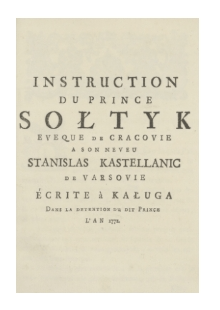
Instruction of Prince Sołtyk, Bishop of Kraków, to His Nephew Stanisław, Castellan of Warsaw — Written at Kaługa during the Detention of the Said Prince, in the Year 1771


The decrees of the Eternal One, to which I have always rendered a blind obedience and a perfect resignation, being beyond all fathoming, I do not know the term of my detention.

But judging that the time has come when you must go and see foreign lands, I write to my brother, His Excellency the Palatine of Łęczyca, that he may regulate your departure and your route.

With regard to your conduct, I prescribe to you certain articles which will serve you as light and guide in your travels, and will guard you, if you follow them, against every false step.

The most essential thing, and the first that I most earnestly recommend to you, is the Christian, Catholic, and Roman Religion, in whose bosom you were born and which you have professed since your childhood.

I protest to you by all that is most sacred that it is the best of all those that exist in the world.

It formerly united all others, but the world having inclined toward change, and men, through the weakness of their nature, being more inclined to evil than to good, the age has produced strong spirits who revolted against our Holy Mother the Church and went astray. Your age permits you to judge the danger of such errors.

Love, then, this holy Religion as your mother; respect her as your sovereign; and support her on every occasion.

Among so many people whom you will see, know, and frequent — even in Catholic countries — you will find monsters of abomination who will have no religion, or who, after the example of the Pharisees, will possess only its appearance. It is against such persons that you must be most on your guard, and you must support your Religion with all your strength, even to the shedding of the last drop of your blood, when the case demands it.

Religion, in its purity, being the source of all good, you cannot preserve it except by opposing the spirit of faith to those innovations that tend to weaken and destroy a Religion which cannot subsist without faith.


You must always be entirely convinced that you can succeed in nothing without the assistance of God. It is He who must guide you in your travels, in your studies, in your conduct, in your advancement, in all your progress, in your destiny in this world — and in what is of still greater importance, in the career which must lead you to eternity.

You cannot flatter yourself that you will obtain this assistance except by meriting His grace; and you can never promise yourself this grace without an entire confidence in God, without an irreproachable conscience, and without having a soul without stain. To this end I conjure you to choose one day in each month to make your Confession and to receive Holy Communion.

You will carefully observe hearing Mass every Sunday and on the Feast Days prescribed by the Church. You will take care to avoid the hours when certain churches are frequented only to put oneself on display, and you will choose those where you may attend Divine Service with the recollection that the sanctity of the place demands.

When you enjoy good health, observe religiously Lent and the other fast days. The perversity of the Age will perhaps attempt to cast ridicule on your conduct in this regard; but when one has done one’s duty, they can only wound those who, through a spirit of intellectual libertinage, seek something to censure. Such remarks, which can only be uttered by scatterbrains, must not turn you away from what the Church commands.

If illness requires that you renounce fasting, then follow the physician’s prescription, with the permission of the local Bishop or Curé, and preserve the sentiments of a good Christian.

True Piety is solid; it disowns hypocrisy; uprightness is its domain; it alone will inspire your duties, provide for your needs, and lead you to your end.

All your talents without it will become useless; and they will bear fruit without limit from the moment she accompanies them.

You will attend Sermons to perfect yourself in the ways of Salvation and to instruct yourself in the matters of holy doctrine.

It is not too much to ask of you a quarter of an hour morning and evening for meditation. Self-knowledge is the most instructive book we can consult; but who are those who truly wish to study themselves?


One seeks out all the works that appear, to charm one’s boredom, to flatter one’s self-love, or to satisfy one’s curiosity, and one neglects the examination of the Heart and the Soul, which can furnish us with far more useful instruction.

Nothing is rarer among men than knowledge of oneself; all other study is preferred to that of one’s own heart.

You have reason enough to understand how necessary this is for every Christian, and that it detracts in nothing from the estate of a man destined to live in the great world.

Flee absolutely from the wicked, and from those who make a way of being without character, without morals, without Religion, and without conscience; their feigned probity must be suspect to you.

As there will be some of this kind even among the honest persons you frequent, it is of the utmost importance to learn to discern them, in order to be able to avoid them.

You will succeed in this by informing yourself carefully, before committing yourself to any Society, of those who compose it, and by judging from the morals and character of those with whom you may bind yourself in friendship.

Would you cease to be good because the world abounds in the wicked? If you have ridicule to fear, it can only come from imitating bad originals. You will never run such risks by imitating the good actions of those who have one and the same Religion and virtue for their guide.

Guard yourself from reading bad Books as from a dangerous poison. Besides being condemned by the Head of our Church, you will draw no utility from them and will place yourself in danger of being perverted. There remain so many excellent books in all the sciences to which you may apply yourself that it is superfluous to seek out bad ones. Every obstacle that could oppose itself to the fruit you must gather from your education must be removed.

In the different countries you will see in your travels, you will observe the different forms of government — such as the Despotic, the Monarchical, the Aristocratic, the Democratic, and the Anarchical. You will combine their strengths and weaknesses in order to learn and appreciate that of your own Fatherland.

Far, then, from bringing back upon your return maxims injurious to the constitution of our State, you will strengthen more and more both mind and heart in the sentiments of the love you owe to your Nation.


You who would gamble away your money at play lose a precious time that you could employ to far better purpose. One makes enemies thereby, draws troublesome affairs upon oneself, inflames the blood, and risks verifying the Proverb that places on the same level the Gambler, the Dupe, and the Knave.

I do not forbid you games of commerce; I desire only that you not attach yourself to them with passion, and that you engage in them only out of complaisance when Society demands it, or as a relaxation after your studies. But my affection for you obliges me to use my authority to forbid you absolutely every game of chance.

Strive to cultivate a fund of gaiety of spirit; it suits young Gentlemen well, renders them agreeable in Society, contributes to their health, and seems to establish a certain harmony between mind and heart. But it must have nothing in common with coarse pleasantries, nor with a dissolute and indecent mirth; in a word, it must be rather the laughter of the soul than of the senses.

You will draw further instructions from His Excellency the Palatine of Łęczyca, my brother and your uncle. He has for you the very bowels of a father’s love, and his wisdom will supply what concerns the circumstances of your departure.

It is he who will choose for you a Governor, who will serve as friend and companion.

It is for you to observe strictly all that I prescribe here, all that Monsignor the Palatine will suggest to you, and all that your Mentor will counsel.

I have arranged your allowance; you will lack nothing. But as you are not yet of age to bear the burden of expenditure, the money will be placed in the hands of your Governor. He will spare nothing for what your needs require, and you will not demand of him any superfluity you could do without — since it is necessary that you learn in your youth to be generous without prodigality, and economical without avarice.

I flatter myself that the length of this writing will cause you no tedium, and that you will take it on the contrary as an evident mark of my tenderness, which interests itself in your glory, your honor, your reputation, your prosperity, your health, and the salvation of your Soul.

Count upon my affection as upon the thing in the world most assured to you — all the more since you are not unaware that I intend the succession of my estate to you after my death, if you render yourself worthy of it.

I also wish to persuade myself that you bear me friendship and gratitude; I ask of you a proof thereof that will cost you no more than half an hour each month, which you will employ in rereading this writing with attention.


You would afflict me deeply if you regarded these reflections as simple moral maxims uttered by a Bishop, or as a piece composed to display eloquence or erudition. I desire on the contrary to see you fully persuaded that it is a friend of the heart who speaks to you, who finds in it no other interest than your own.

I finish by embracing you tenderly and giving you my Benediction. I pray God and address to Him my most ardent vows, that He may assist you in your travels, your return, and shower you with His Benedictions.

CAJETAN SOŁTYK, PRINCE-BISHOP OF KRAKÓW, DUKE OF SIEWIERZ.


A Note on the “Instruction of Prince Sołtyk”

On the night of 13 October 1767, Russian troops, acting under the orders of Ambassador Nikolai Repnin, seized Kajetan Sołtyk, Bishop of Kraków, together with three other senators who had opposed Russian interference in the affairs of the Polish-Lithuanian Commonwealth. Without trial, charge, or any form of legal process, Sołtyk was carried across the border into Russia and confined at Kaługa, a provincial city some 150 miles southwest of Moscow, where he remained for five years.

At the time of his abduction, he was the most prominent Catholic bishop in Poland, occupying the see of Kraków, first among the dioceses of the realm. His seizure was immediately understood, both within Poland and across Catholic Europe, as an act of sovereign violation: the forcible removal of a senator and a bishop by a foreign power for actions taken in the course of a deliberative assembly.

It was in this captivity that Sołtyk composed the present Instruction, a letter of moral and practical counsel addressed to his nephew Stanisław, Castellan of Warsaw, who was preparing to undertake the customary tour of foreign countries expected of a young nobleman. The document is dated 1771, in the fourth year of his detention. Writing in French, the common language of Polish aristocratic culture, Sołtyk ranges across religion, self-knowledge, conduct in society, the dangers of bad company and bad books, the comparative observation of governments, and the prudent management of money and leisure. These themes are framed throughout by the unmistakable tenderness of a man who, though deprived of his liberty and removed from the exercise of his offices, retained undiminished his sense of episcopal authority, patrician dignity, and familial obligation.

The Instruction was subsequently published and circulated both as a personal document and as a form of political testimony: evidence that the captive bishop remained in full possession of his faculties and steadfast in his convictions. It stands as one of the more intimate texts to survive from Sołtyk’s long captivity, and among the more revealing—not as the rhetoric of martyrdom, but as the record of a great nobleman’s mind at work in confinement, attending, as best he could, to those he loved and to the reputation he intended to preserve.

Confessio: The Half-Remembered

A Liturgy for Those Who Have Forgotten the Words


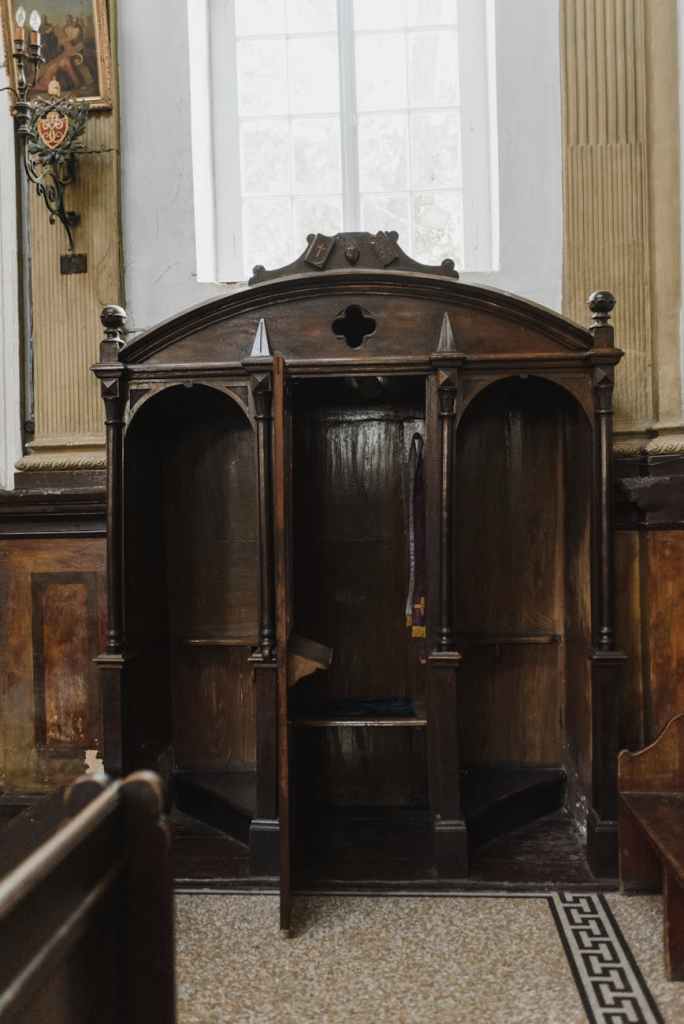
Confessional
Photo by Arina Krasnikova on Pexels.com

Forgive us, Father, for we have sinned,
It has been… we cannot count the years—
since we knew what sin meant.

We mouth the words the nuns and priests once taught us,
but the syllables taste foreign now,
like prayers in a dead language
we pretend to understand.

We have forgotten why we kneel,
though still our knees recall the stone.
We have lost the thread of what was broken,
but feel the weight of something severed.

We built cathedrals out of doubt
and filled them with our questions.
We replaced altars with algorithms,
confession with comment sections.

We are no longer sure You are listening—
or if listening is something we invented
to make the silence bearable,
the vastness less vacant.

We have sinned—we think—
though we are not sure against what.
Against nature? Against each other?
Against some half-remembered covenant,
written in a script we can no longer read?

We recite the forms like actors
who have forgotten their motivation,
performing the ancient motions
because they feel like muscle memory—
like DNA calling us home
to a house we are no longer certain exists.

Still we gather, still we whisper
these inherited incantations,
hoping they might still hold power,
hoping the words might remember
what we have forgotten.

O my God… we are… we think we are…
sorry… for having… for having what?
For having forgotten how to finish this prayer?

Bread, Balance, and the Burden of Freedom in Dostoevsky’s The Grand Inquisitor

A Meditation on the Grand Inquisitor in Light of Metaphor and Meaning

“Man seeks not so much God as the miraculous… For man seeks not so much freedom as someone to bow before.”
— The Grand Inquisitor, The Brothers Karamazov

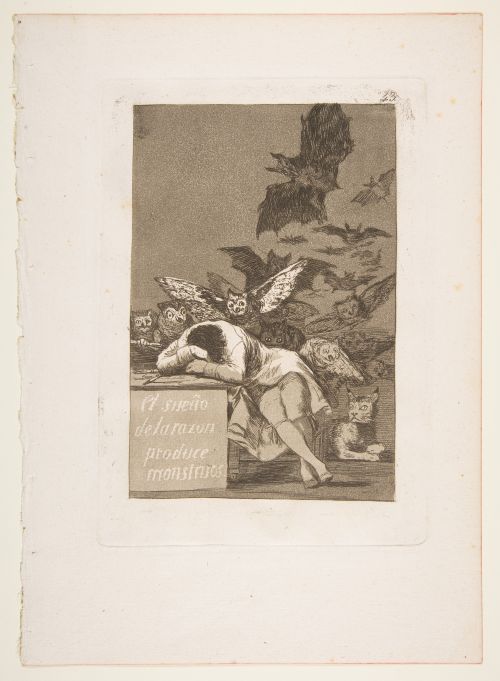
Francisco Goya’s The Sleep of Reason Produces Monsters (1799)—an image of what emerges when the mind abdicates its responsibility: not freedom, but fantasy; not peace, but nightmare. Where reason sleeps, the trinity of miracle, mystery, and authority awakens to devour.

In Dostoevsky’s The Brothers Karamazov, the tale of the Grand Inquisitor remains one of the most unsettling parables in modern literature. Told by Ivan Karamazov to his younger brother Alyosha, the fable imagines Christ returning during the Spanish Inquisition—only to be arrested and silenced by the Church. The Inquisitor, a cardinal of imposing intellect and grave compassion, does not accuse Christ of falsehood, but of cruelty: You gave them freedom, he says, when they needed bread. You gave them mystery, when they needed answers. You gave them love, when they needed order.

There was a time, decades ago, in the earnest conviction of my youth, when I found myself perplexed by the Grand Inquisitor’s logic. I did not admire him, nor excuse his authoritarianism, but I recognized the ache that underpinned his argument. Bread matters. Peace matters. Even then, I sensed the moral gravity of the dilemma he posed: How does one respond to suffering in a world that is often brutal, hungry, and unforgiving?

But I also responded viscerally to something else: the pen of Dostoevsky was not just crafting a fable, but weaponizing a caricature. The Inquisitor was not simply a tragic figure—he was also a polemic against Catholicism, a projection of Dostoevsky’s own religious bigotry. As someone educated within the Catholic tradition, I saw the ugliness beneath the fable—the prejudice tucked behind the parable’s grandeur. The critique was not only of power, but of Rome. The Inquisitor’s mitre bore the unmistakable weight of Jesuit anti-types, cloaked in suspicion and veiled accusation. My disquiet, then, was not only with the Inquisitor’s words, but with the frame within which they were uttered.

And yet, despite its polemical underpinnings, the parable remains one of the most profound meditations on freedom and faith in modern literature. Its imaginative force exceeds its prejudices. The Inquisitor endures not only as a critique, but as a haunting embodiment of the human temptation to trade liberty for comfort.

And that temptation has not faded. The Grand Inquisitor endures because he gives voice to something deeply human, and psychologically real: the desire for security, for certainty, for order amidst chaos. It is a desire that remains active—arguably ascendant—in our own time. One hears the Inquisitor’s voice today in populist strongmen, in the cynical strategist’s smirk, in the media apparatus that soothes while it divides, and in slogans that promise greatness through obedience—Make America Great Again, for instance, the rallying cry of a leader who proclaimed, “I am the only one who can save this nation,” inviting not deliberation, but devotion. The trinity he offers—miracle, mystery, and authority—is the very catechism of modern demagoguery.

This reflection, then, is not a defense of the Inquisitor, but an attempt to understand his appeal, and to reclaim the concepts he distorts. In my recent essay on literalism, metaphor, and balance, I sought to describe the menace of the literalist disposition—a mentality that cannot live with ambiguity, that flees from the poetic, and that finds in surface meaning a shield against the deeper, riskier call of the soul. Here, I apply that lens to the Inquisitor’s three pillars.

Miracle and the Tyranny of the Literal

The Inquisitor offers miracle as literal spectacle: bread conjured from stone, laws suspended, proof offered to silence doubt. He rebukes Christ for refusing to perform such signs in the desert, calling His restraint an act of cruelty rather than spiritual wisdom.

Even as a young reader, I did not mistake the Inquisitor’s miracle for holiness. But I understood that hunger cannot be spiritualized away. In a world where the body is often broken before the spirit can rise, the refusal to give bread seems harsh.

What I have since come to understand is that bread must be shared, not wielded—and that miracles, if they mean anything at all, must point beyond themselves. A miracle that ends conversation is not a miracle but a manipulation.

We have seen modern versions of such miracles: promises made and spectacles staged not to elevate understanding, but to prove power. Consider the border wall—hailed not merely as a policy, but as a singular, salvific act. Its construction, real or exaggerated, was brandished as proof of providence, as the visible sign that the nation could be made great, pure, and safe again. Nor was it the only such “miracle.” Similar wonders were promised: the immediate end of the Russian invasion of Ukraine, the revival of a fading industrial economy, the return of jobs long gone, and the rapid reordering of the global market in our favor. These, too, were presented as guarantees—not to be debated, but to be believed. And like the Inquisitor’s miracles, they have largely yet to be seen.

In my essay on literalism and metaphor, I argued that literalism becomes a menace when it displaces metaphor—when it insists on one meaning, one proof, one visible sign. The Inquisitor’s miracles are precisely that: spectacles that end the need for faith. They are miracles without meaning.

Mystery and the Collapse of Metaphor

The Inquisitor’s use of mystery is a case study in spiritual containment. Mystery becomes the guarded unknown, parceled out by clerical authority to pacify rather than provoke. It is not a sacred unknowing, but a fog of confusion meant to keep the people docile.

But true mystery, like true metaphor, does not confuse—it illuminates by depth. It renders the world porous to truth. It refuses finality not because it is evasive, but because it is more honest than premature closure allows.

I did not reject mystery in youth, nor do I now. But I reject the collapse of mystery into secrecy, the transformation of the ineffable into the inaccessible. Metaphor must breathe. Mystery must invite. When weaponized, they become not sacred, but sinister.

In our current dysfunctional era, mystery is often replaced by conspiracy—a counterfeit that plays the same psychological role, offering significance without wisdom, awe without humility. The literalist disposition, fearing true complexity, gravitates toward these shallow depths. Conspiracy is mystery stripped of humility. It retains the trappings of hidden knowledge but closes the mind rather than opening it. It flatters the believer with secrets while shielding them from ambiguity. It is not reverence for the unknown, but a refuge from the supposed unbearable complexity of reality.

We see this vividly in the ecosystem of conspiracy theories surrounding Trump’s political movement. Whether it is the belief that a global cabal of elites and pedophiles is secretly running the world (QAnon), or that massive voter fraud orchestrated by shadowy networks altered the outcome of the 2020 election, or that figures like Barack Obama, Hillary Clinton, or George Soros are puppet-masters in an international scheme to undermine American sovereignty—each offers an illusion of secret insight in place of the real work of understanding. These narratives are not pursued for their truthfulness but for their emotional certainty. They replace sacred mystery with a kind of gnosis—fierce, insular, and self-reinforcing.

And like the Inquisitor’s mystery, they are not shared to free the soul, but to bind it—to a worldview, to a figure (whether cult, religious, or political leader, a distinction without merit or significance), to a sense of exceptionalist belonging. The effect is not illumination but containment.

Authority and the Displacement of Balance

The Inquisitor’s authority is final, paternal, and brutal in its compassion. It replaces freedom with peace, conscience with obedience. Its appeal lies not only in its force, but in its promise: You no longer have to choose. I will choose for you. And I will feed you.

As I have aged, I have come to see that this vision is not merely imposed—it is desired. Much of the populace is psychologically predisposed to respond favorably to such authority, whether it comes in vestments or slogans. It offers relief from the burden of discernment. It relieves the anxiety of paradox.

This recognition—that the hunger for certainty is as much internal as external—has shaped my own philosophical trajectory.

And that is where the menace lies. This is not a top-down problem alone, but a convergence of design and desire. The Inquisitor gives the people what they already, in some meaningful manner, want: a world made safe through submission. The leader becomes the sole interpreter of truth, the guarantor of safety, the vessel of meaning. Authority becomes a theology in itself.

We have seen this in our time, where devotion to a figure supplants loyalty to principle. When a leader proclaims “I am the only one who can save this nation,” and is met not with unease but with cheers, authority has ceased to be a mediating presence and has become a metaphysical claim. It no longer balances tension; it obliterates it.

In contrast, the authority I defended in my earlier essay was not coercive, but mediating—a balancing presence, a harmonizing voice. It does not dominate or dismiss. It holds the tension without collapsing it. It does not provide peace through closure, but through co-suffering. It listens. It waits.

The Bread and the Burden

So no, I did not approve of the Grand Inquisitor—not in youth, not now. But I acknowledged, and still acknowledge, the ache beneath his argument. It was not cruelty that made him persuasive, but compassion twisted into control—a desire to ease pain by removing the possibility of choice.

What I now see more clearly is that this fable is not merely a theological drama. It is a psychological map. The Grand Inquisitor is the high priest of the literalist disposition—offering miracle that silences, mystery that obscures, authority that absolves.

That disposition is not confined to Dostoevsky’s century. It is at work now—in every movement that prefers spectacle to sign, dogma to dialogue, power to presence. It thrives in political rhetoric, in media narratives, in spiritual systems that replace grace with control.

Dostoevsky does not argue against it. Christ does not rebut it. He answers with a kiss.

A kiss without domination.
A kiss that respects freedom.
A kiss that does not resolve the tension, but chooses to love within it.

That is the burden of freedom: not only to bear it ourselves, but to offer it to others, knowing they may prefer their chains.

To offer bread, but not as bribe.
To teach, but not as demand.
To speak, but not to silence.
To live, still and quietly,
within the balance that resists the Inquisitor’s call.

To refuse the miracle that enslaves,
To offer bread and still preserve the soul,
That is the quiet defiance the world most needs.

The Lasting Influence of the Ursuline Sisters on My Writing Style

It is incontrovertible that I abhor beginning a written sentence with a first person personal pronoun. This aversion was engrained in me by Sister Madeleine in the first grade when I attended Saint Luke Catholic School in Boardman, Ohio. As I vaguely recall, fifty years later, Sister explained in age appropriate terms that it was exceedingly narcissistic to begin a sentence centered upon oneself. Thus, to this very day, I twist a sentence to no end to avoid such a sin, though sometimes I cannot avoid such a transgression.

Curious as to whether I was remembering the source of my predilection correctly, I recently conferred with my older sister, who also attended St. Luke Catholic School, to inquire if she had been instructed as I had been, regarding the use of first person personal pronouns at the beginning of sentences by the Ursuline Sisters at St. Luke Catholic School. She quickly confirmed that she had been so instructed and that, like myself, she still avoided beginning sentences with a first person personal pronoun with the result that she often found herself twisting perfectly fine sentences into contorted jumbles for little reason. Laughter ensued as we both recognized the hilarity of the situation.

The Ursuline Sisters who taught us at Saint Luke Catholic School were excellent teachers and role models, and we both remember them fondly. Sister Mary and Sister Madeleine were kind and generous and exemplified the best of both the education profession and the Church. And if on occasion my writing is a bit convoluted because of their slightly misguided effort to teach children to avoid excessive self-centeredness, I can live with that.