A new monograph on the archivist Carl Friedrich Evers, his 1785 essay on six coins from a burial mound near Grabow, and how his “Wendish” attribution outlived two centuries of scholarship.
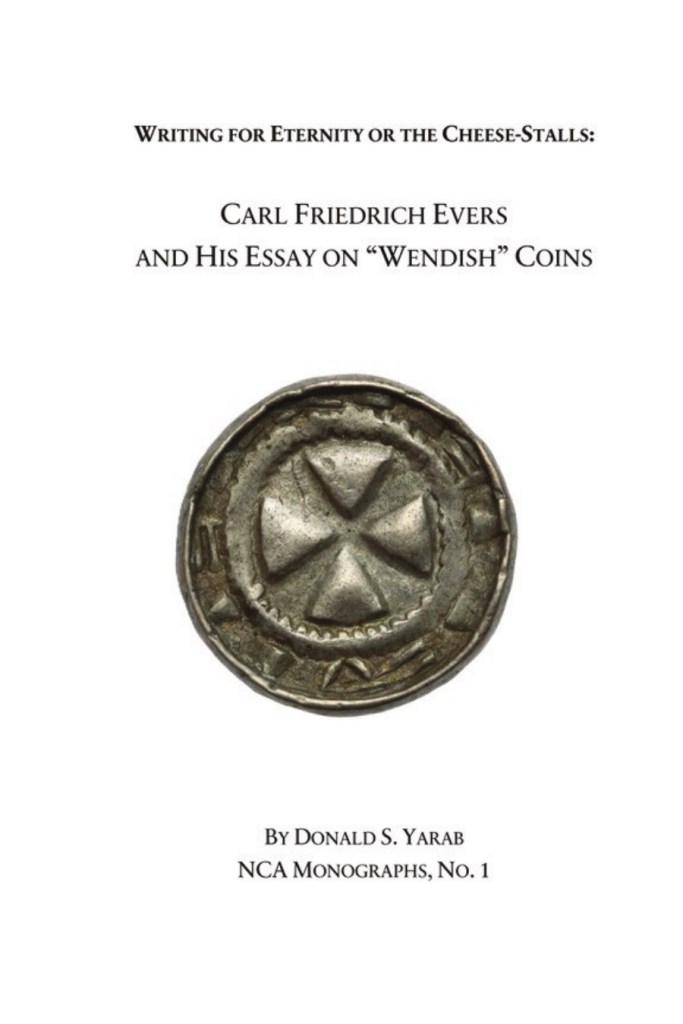
It is my pleasure to announce that Writing for Eternity or the Cheese-Stalls: Carl Friedrich Evers and His Essay on “Wendish” Coins, the first title in the Northcoast Antiquarian Monographs series, is now available in paperback.
The medieval silver coins that numismatists have called Wendenpfennige, Sachsenpfennige, Randpfennige, and cross denarii (denary krzyżowe) have resisted attribution for more than two centuries. One of the first scholars to treat them seriously was Carl Friedrich Evers (1729–1803), archivist to the dukes of Mecklenburg-Schwerin. In 1785 he published a short essay on six small coins recovered from a burial mound near Grabow and attributed them to the Wends, the Slavs of the Elbe lands. That attribution, and in time the names that grew from it, long outlived the arguments against the coins’ association with the Wends as their minting authority.
This monograph tells the story of Evers, his essay, and its reception down to the present: his career in the ducal archive and his correspondence with Johann Bernoulli; the Grabow find and the first reviews; Evers’ return to the coins in his history of Mecklenburg coinage of 1798–1799; Joseph Mader’s critique of 1803–1806; Lisch’s reconsideration of the find in 1845; and the curious afterlife of the “Wendish” label, which the German literature kept while forgetting Evers as its author; the Polish literature, by contrast, seemingly remembered him but seldom read what he wrote. An English translation of the 1785 essay and a transcription of its German text are given in the appendices.
About the title
The title comes from Evers himself. Writing to Bernoulli in October 1785, he complained of reviewers who thought archivists had neither the time nor the inclination to write “for eternity or for the cheese-stalls” (für die Ewigkeit oder Käsebuden), that is, for posterity or for wrapping paper. As it turned out, he wrote for posterity, though not in the way he intended.
Readers who saw my 2023 post on Evers will find here an entirely new and much fuller study.
The decrees of the Eternal One, to which I have always rendered a blind obedience and a perfect resignation, being beyond all fathoming, I do not know the term of my detention.
But judging that the time has come when you must go and see foreign lands, I write to my brother, His Excellency the Palatine of Łęczyca, that he may regulate your departure and your route.
With regard to your conduct, I prescribe to you certain articles which will serve you as light and guide in your travels, and will guard you, if you follow them, against every false step.
The most essential thing, and the first that I most earnestly recommend to you, is the Christian, Catholic, and Roman Religion, in whose bosom you were born and which you have professed since your childhood.
I protest to you by all that is most sacred that it is the best of all those that exist in the world.
It formerly united all others, but the world having inclined toward change, and men, through the weakness of their nature, being more inclined to evil than to good, the age has produced strong spirits who revolted against our Holy Mother the Church and went astray. Your age permits you to judge the danger of such errors.
Love, then, this holy Religion as your mother; respect her as your sovereign; and support her on every occasion.
Among so many people whom you will see, know, and frequent — even in Catholic countries — you will find monsters of abomination who will have no religion, or who, after the example of the Pharisees, will possess only its appearance. It is against such persons that you must be most on your guard, and you must support your Religion with all your strength, even to the shedding of the last drop of your blood, when the case demands it.
Religion, in its purity, being the source of all good, you cannot preserve it except by opposing the spirit of faith to those innovations that tend to weaken and destroy a Religion which cannot subsist without faith.
You must always be entirely convinced that you can succeed in nothing without the assistance of God. It is He who must guide you in your travels, in your studies, in your conduct, in your advancement, in all your progress, in your destiny in this world — and in what is of still greater importance, in the career which must lead you to eternity.
You cannot flatter yourself that you will obtain this assistance except by meriting His grace; and you can never promise yourself this grace without an entire confidence in God, without an irreproachable conscience, and without having a soul without stain. To this end I conjure you to choose one day in each month to make your Confession and to receive Holy Communion.
You will carefully observe hearing Mass every Sunday and on the Feast Days prescribed by the Church. You will take care to avoid the hours when certain churches are frequented only to put oneself on display, and you will choose those where you may attend Divine Service with the recollection that the sanctity of the place demands.
When you enjoy good health, observe religiously Lent and the other fast days. The perversity of the Age will perhaps attempt to cast ridicule on your conduct in this regard; but when one has done one’s duty, they can only wound those who, through a spirit of intellectual libertinage, seek something to censure. Such remarks, which can only be uttered by scatterbrains, must not turn you away from what the Church commands.
If illness requires that you renounce fasting, then follow the physician’s prescription, with the permission of the local Bishop or Curé, and preserve the sentiments of a good Christian.
True Piety is solid; it disowns hypocrisy; uprightness is its domain; it alone will inspire your duties, provide for your needs, and lead you to your end.
All your talents without it will become useless; and they will bear fruit without limit from the moment she accompanies them.
You will attend Sermons to perfect yourself in the ways of Salvation and to instruct yourself in the matters of holy doctrine.
It is not too much to ask of you a quarter of an hour morning and evening for meditation. Self-knowledge is the most instructive book we can consult; but who are those who truly wish to study themselves?
One seeks out all the works that appear, to charm one’s boredom, to flatter one’s self-love, or to satisfy one’s curiosity, and one neglects the examination of the Heart and the Soul, which can furnish us with far more useful instruction.
Nothing is rarer among men than knowledge of oneself; all other study is preferred to that of one’s own heart.
You have reason enough to understand how necessary this is for every Christian, and that it detracts in nothing from the estate of a man destined to live in the great world.
Flee absolutely from the wicked, and from those who make a way of being without character, without morals, without Religion, and without conscience; their feigned probity must be suspect to you.
As there will be some of this kind even among the honest persons you frequent, it is of the utmost importance to learn to discern them, in order to be able to avoid them.
You will succeed in this by informing yourself carefully, before committing yourself to any Society, of those who compose it, and by judging from the morals and character of those with whom you may bind yourself in friendship.
Would you cease to be good because the world abounds in the wicked? If you have ridicule to fear, it can only come from imitating bad originals. You will never run such risks by imitating the good actions of those who have one and the same Religion and virtue for their guide.
Guard yourself from reading bad Books as from a dangerous poison. Besides being condemned by the Head of our Church, you will draw no utility from them and will place yourself in danger of being perverted. There remain so many excellent books in all the sciences to which you may apply yourself that it is superfluous to seek out bad ones. Every obstacle that could oppose itself to the fruit you must gather from your education must be removed.
In the different countries you will see in your travels, you will observe the different forms of government — such as the Despotic, the Monarchical, the Aristocratic, the Democratic, and the Anarchical. You will combine their strengths and weaknesses in order to learn and appreciate that of your own Fatherland.
Far, then, from bringing back upon your return maxims injurious to the constitution of our State, you will strengthen more and more both mind and heart in the sentiments of the love you owe to your Nation.
You who would gamble away your money at play lose a precious time that you could employ to far better purpose. One makes enemies thereby, draws troublesome affairs upon oneself, inflames the blood, and risks verifying the Proverb that places on the same level the Gambler, the Dupe, and the Knave.
I do not forbid you games of commerce; I desire only that you not attach yourself to them with passion, and that you engage in them only out of complaisance when Society demands it, or as a relaxation after your studies. But my affection for you obliges me to use my authority to forbid you absolutely every game of chance.
Strive to cultivate a fund of gaiety of spirit; it suits young Gentlemen well, renders them agreeable in Society, contributes to their health, and seems to establish a certain harmony between mind and heart. But it must have nothing in common with coarse pleasantries, nor with a dissolute and indecent mirth; in a word, it must be rather the laughter of the soul than of the senses.
You will draw further instructions from His Excellency the Palatine of Łęczyca, my brother and your uncle. He has for you the very bowels of a father’s love, and his wisdom will supply what concerns the circumstances of your departure.
It is he who will choose for you a Governor, who will serve as friend and companion.
It is for you to observe strictly all that I prescribe here, all that Monsignor the Palatine will suggest to you, and all that your Mentor will counsel.
I have arranged your allowance; you will lack nothing. But as you are not yet of age to bear the burden of expenditure, the money will be placed in the hands of your Governor. He will spare nothing for what your needs require, and you will not demand of him any superfluity you could do without — since it is necessary that you learn in your youth to be generous without prodigality, and economical without avarice.
I flatter myself that the length of this writing will cause you no tedium, and that you will take it on the contrary as an evident mark of my tenderness, which interests itself in your glory, your honor, your reputation, your prosperity, your health, and the salvation of your Soul.
Count upon my affection as upon the thing in the world most assured to you — all the more since you are not unaware that I intend the succession of my estate to you after my death, if you render yourself worthy of it.
I also wish to persuade myself that you bear me friendship and gratitude; I ask of you a proof thereof that will cost you no more than half an hour each month, which you will employ in rereading this writing with attention.
You would afflict me deeply if you regarded these reflections as simple moral maxims uttered by a Bishop, or as a piece composed to display eloquence or erudition. I desire on the contrary to see you fully persuaded that it is a friend of the heart who speaks to you, who finds in it no other interest than your own.
I finish by embracing you tenderly and giving you my Benediction. I pray God and address to Him my most ardent vows, that He may assist you in your travels, your return, and shower you with His Benedictions.
CAJETAN SOŁTYK, PRINCE-BISHOP OF KRAKÓW, DUKE OF SIEWIERZ.
On the night of 13 October 1767, Russian troops, acting under the orders of Ambassador Nikolai Repnin, seized Kajetan Sołtyk, Bishop of Kraków, together with three other senators who had opposed Russian interference in the affairs of the Polish-Lithuanian Commonwealth. Without trial, charge, or any form of legal process, Sołtyk was carried across the border into Russia and confined at Kaługa, a provincial city some 150 miles southwest of Moscow, where he remained for five years.
At the time of his abduction, he was the most prominent Catholic bishop in Poland, occupying the see of Kraków, first among the dioceses of the realm. His seizure was immediately understood, both within Poland and across Catholic Europe, as an act of sovereign violation: the forcible removal of a senator and a bishop by a foreign power for actions taken in the course of a deliberative assembly.
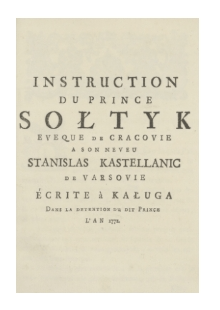
It was in this captivity that Sołtyk composed the present Instruction, a letter of moral and practical counsel addressed to his nephew Stanisław, Castellan of Warsaw, who was preparing to undertake the customary tour of foreign countries expected of a young nobleman. The document is dated 1771, in the fourth year of his detention. Writing in French, the common language of Polish aristocratic culture, Sołtyk ranges across religion, self-knowledge, conduct in society, the dangers of bad company and bad books, the comparative observation of governments, and the prudent management of money and leisure. These themes are framed throughout by the unmistakable tenderness of a man who, though deprived of his liberty and removed from the exercise of his offices, retained undiminished his sense of episcopal authority, patrician dignity, and familial obligation.
The Instruction was subsequently published and circulated both as a personal document and as a form of political testimony: evidence that the captive bishop remained in full possession of his faculties and steadfast in his convictions. It stands as one of the more intimate texts to survive from Sołtyk’s long captivity, and among the more revealing—not as the rhetoric of martyrdom, but as the record of a great nobleman’s mind at work in confinement, attending, as best he could, to those he loved and to the reputation he intended to preserve.
Some time ago, I noted a small but telling anachronism in a modern translation of Homer: the appearance of blue in a poetic world that had not yet learned to name it as a discrete chromatic color. The observation was not novel, but it was instructive. Once noticed, such moments have a way of reappearing.
Recently, I encountered the same impulse in a translation of Hesiod’s Theogony.
One careful, respectful, the other good, but slightly reckless:
“with her alone the dark-haired one lay down in a soft meadow among spring flowers.”²
“The Blue-haired god slept with Medusa on the gentle meadow amidst the spring flowers.”³
Both translators footnote that Poseidon is being named without being named, identified solely by an epithet.
Nothing in the Greek has changed. The verb (παρελέξατο), the setting (ἐν μαλακῷ λειμῶνι), even the delicacy of the spring flowers (ἄνθεσιν εἰαρινοῖσι) remain constant. The divergence lies entirely in Κυανοχαίτης.
In archaic Greek, κυανός does not function as a discrete color term. It denotes depth, darkness, sheen—the quality of shadowed mass rather than hue. Joined to χαίτη, it identifies Poseidon by a familiar epic epithet: dark-haired, dark-maned, sea-deep. To render this as “blue-haired” is not a neutral literalism; it imports a modern chromatic category into a poetic system that did not yet organize perception in that way.⁴
Set beside the Greek, the difference becomes immediately visible. “Dark-haired” preserves the archaic register and the restraint of epic diction. “Blue-haired,” by contrast, draws the line forward abruptly. In contemporary English, blue hair belongs less to gods than to declarations—of taste, rebellion, or personal idiosyncratic identity. The sea recedes, and instead of an elemental god rising from its depths, one half-expects the crash of a punk rock concert to break into Hesiod’s meadow, amplifiers humming where spring flowers had been.
These moments are small, but they matter. Translation is always interpretation, but it is also a discipline of restraint. When modern colors slip too easily into ancient verse, they do more than brighten the palette; they alter the weather of the poem itself.
Read alongsideFeeling Blue, this passage suggests that the problem is not isolated or accidental, but persistent: whenever modern color names intrude too confidently into archaic poetry, they risk replacing ancient depth with contemporary noise.
Notes
Hesiod, Theogony 279, Greek text in Glenn W. Most, ed. and trans., Theogony, Works and Days, Testimonia, Loeb Classical Library 57 (Cambridge, MA: Harvard University Press, 2018), 24.
Ibid., 25.
Barry B. Powell, trans., The Poems of Hesiod: Theogony, Works and Days, & The Shield of Herakles (Berkeley: University of California Press, 2017), 49.
See LSJ, s.v. κυανός; Brent Berlin and Paul Kay, Basic Color Terms: Their Universality and Evolution (Berkeley: University of California Press, 1969); W. E. Gladstone, Studies on Homer and the Homeric Age, vol. 3 (Oxford: Oxford University Press, 1858).
Over decades of reading, I have traveled through worlds made accessible only by the alchemy of translation. I have wandered with Gilgamesh through Akkadian laments, pondered existence through German philosophy, felt the passionate dialectics of Danish thought, traced the monetary history of Chinese civilization, and followed the angular syntax of Old Norse sagas. I have encountered the theological precision of Medieval Latin, the passionate arguments of French existentialism, the compressed intensity of Hebrew psalms, and the illuminating insights of Spanish mysticism. From Sumerian creation myths to Aramaic scripture to Polish modernist fiction, from the heroic verse of Old English epics to classical Russian realist literature—and doubtless I have forgotten others, to my shame—an entire lifetime of reading has been built on the labors of those who possess what seems to me a kind of supernatural skill.
These translators are linguistic engineers and lexical lyricists working in multiple masteries simultaneously. They must command not just two languages but two literary traditions, two ways of organizing thought, two sets of cultural assumptions about how meaning moves through words. They must be scholars, poets, acoustic artisans, and cultural ambassadors all at once. The precision required is staggering: a single word choice can shift the moral center of a character, the rhythm of a line can determine whether a passage soars or stumbles, and the decision to preserve or adapt a cultural reference can make a text feel ancient or immediate.
What astonishes me most is not just the technical virtuosity required—though that alone would command respect—but the creative courage these practitioners demonstrate. They must make countless decisions in the space between languages where no perfect answers exist, where every choice involves both gain and loss. They work in the knowledge that their efforts will be scrutinized, compared, and inevitably found wanting in some dimension, yet they persist in attempting the impossible: carrying not just words but worlds across the vast spaces between human languages.
I approach translation not as a scholar of the field but as a reader acutely conscious of this debt. The essays that follow examine moments where translators face their greatest challenges—words, phrases, and passages that resist transfer from one language to another, or that demonstrate remarkable ingenuity when confronting texts where even the original language contains indwelling ambiguities. These are the places where translation reveals itself not as mechanical substitution but as interpretive art, where the impossibility of perfect equivalence becomes the very condition for creative meaning-making.
My perspective is that of someone who has been repeatedly astonished by what translators manage to accomplish, someone grateful for the cultural wandering their work has made possible. If these essays contribute anything to the ongoing conversation about translation, I hope it is a deepened appreciation for the miraculous ordinariness of the translator’s task: taking what is said in one language, whether with clarity, ambiguity, or poetic force, and seeking ways to let it speak, however imperfectly, in another.
The debt is vast. The gratitude is boundless. And now the conversation begins.
The Fifth Word: An Introduction
Or: How One Greek Word Launched Four Centuries of πολύτροποι
There exists, in the fifth position of the opening line of Homer’s Odyssey, a single Greek word that has tormented, delighted, and obsessed translators for centuries. To most readers, the opening line flows effortlessly: “Tell me, Muse, of the man….” And every translation affixes a descriptive word or several words to the man based on Homer’s fifth Greek word. But for the translator, the fifth word halts progress like a boulder in the stream of translation. The word is πολύτροπον (polytropon), the accusative case of πολύτροπος (polytropos), a descriptor so rich, so layered, so fundamentally untranslatable in any simple sense, that it has spawned not just a multiplicity of different English renderings, but an entire cottage industry of scholarly exploration.
This is where our series begins—not because polytropos is necessarily the most important word in the Odyssey, but because it perfectly embodies the central mystery of translation: the gap between what words mean and what they are made to mean in another tongue. Every choice a translator makes in approaching polytropos reveals something fundamental about how they understand not just Odysseus, not just Homer, but the very art and alchemy of translation itself.
Translation’s Creative Challenge
Polytropos is deceptively simple in construction. The prefix poly- means “many” or “much.” The root tropos means “turn,” “way,” or “manner.” Put them together and you get, quite literally, “many-turning” or “of many ways.” The construction appears straightforward.
But herein lies the difficulty: tropos carries within it a fundamental ambiguity about agency. As Emily Wilson, the translator of the latest English-language translation of The Odyssey that I have acquired has explained, the word presents a choice between describing someone who turns many ways (actively, cunningly, by choice) or someone who is turned many ways (passively, by fate, by the gods, by circumstance). Is this a man who manipulates his path through the world, or one whose path has been manipulated by forces beyond his control? Or, perhaps, by some combination of both active and passive turns?
The Greek does not resolve this ambiguity—it embraces it. And therein lies the translator’s dilemma.
A Plenitude of Solutions
Consider how various translators across four centuries have approached this single word:
George Chapman (1614): “that many a way / Wound with his wisdom to his wished stay”
John Ogilby (1669): “Prudent”
Thomas Hobbes (1674): “the man”
Alexander Pope (1725): “The Man, for Wisdom’s various arts renown’d”
William Cowper (1802): “For shrewdness famed/And genius versatile”
Samuel Butler (1900): “that ingenious hero”
T.E. Shaw (1932): “the various-minded man”
W.H.D. Rouse (1937): “the man who was never at a loss”
E.V. Rieu (1946): “that resourceful man”
Robert Fitzgerald (1961): “that man skilled in all ways of contending”
Richmond Lattimore (1967): “the man of many ways”
Allen Mandelbaum (1990): “of many wiles”
Robert Fagles (1996): “the man of twists and turns”
Stanley Lombardo (2000): “the cunning hero”
Emily Wilson (2017): “the complicated man”
The range is remarkable—from Chapman’s elaborate wordplay to Hobbes’s complete evasion, from Pope’s ornate expansion to Wilson’s stark modernity, each choice reflects not just linguistic preference but philosophical commitment about what translation should and can accomplish.
Wilson’s Innovation
The most recent translation in my library is Emily Wilson’s Odyssey. Wilson’s rendering for polytropon—“complicated”—offers an interesting approach to preserving the word’s semantic ambiguity while signaling moral and psychological depth, though scholarly reception has been mixed.² Its Latin root complicare, “to fold together,” aptly captures a figure whose facets—cunning, suffering, manipulation, endurance—are not easily separated, suggesting as Wilson notes, “someone whose multiple aspects are folded into a single identity, difficult to unravel or understand completely.” This translation does not resolve ambiguity; it revels in it. Where earlier translators sought precision through lexical equivalence, Wilson embraces complexity through conceptual resonance.
The Sound of Meaning
Translation, however, is not just about semantic equivalence—it is also about music, rhythm, and the physical experience of language in the mouth and ear. In the original Greek, polytropos participates in a complex pattern of sound and rhythm:
The repetition of the poly- sound connects polytropos to polla (“many”) in the same line and to planchthe (“wandered”) in the next, creating a sonic unity that reinforces the semantic connection between Odysseus’s many-sidedness and his many wanderings. This musical dimension is almost impossible to preserve in English, forcing translators to choose between acoustic and semantic fidelity.
The varied renderings of πολύτροπον by translators across centuries reflect not only aesthetic and lexical choices, but also deeper assumptions about the nature and purpose of translation itself—assumptions that resonate with and are interrogated by major theoretical frameworks.
Translation as Theory, Translation as Politics
Each translator’s approach to polytropos reveals their fundamental assumptions about what translation should accomplish, assumptions that echo through the major theoretical debates of the past century. Should translation prioritize:
Lexical fidelity to source structures?
Preservation of aesthetic complexity?
Contemporary accessibility and clear interpretation?
Resistance to reductive meaning-making?
Cultural and political responsibility?
The impossible thing is that these goals often conflict. Wilson’s “complicated” is perhaps more accessible to contemporary ears and possibly more interpretively rich than Lattimore’s “of many ways,” but it sacrifices literal connection to its Greek roots. Fagles’s “twists and turns” preserves ambiguity through metaphor, capturing both the active dimension (Odysseus creating twists through his cunning) and the passive dimension (being turned by forces beyond his control), while also preserving the literal sense of physical wandering and the metaphorical sense of mental agility. Notably, among the dozens of English translations preceding Fagles, only two others—T.S. Norgate’s “of many a turn” (1858) and Albert Cook’s “of many turns” (1967)—preserved the Greek roots as literally as Fagles’ “twists and turns.”³ Each translator joins rather than replaces the ongoing conversation about what this untranslatable word might mean.⁴
The challenge of polytropos connects to broader conversations about what translation is and what it should do—conversations that have produced some of the most influential theoretical writings of the past century.
Walter Benjamin’s 1923 essay “Die Aufgabe des Übersetzers,” best known in English as “The Task of the Translator,” remains perhaps the most cited work in translation theory, arguing that translation should not aim for communication but for a kind of “pure language”—not found in either source or target, but revealed in their interplay—that emerges in the space between languages. For Benjamin, the translator’s task is not to convey meaning but to find the way languages complement each other, revealing what he calls their “kinship.” Applied to polytropos, Benjamin might advocate for something like “many-turned” or “much-turning”—preserving the German-like compound structure that reveals the kinship between Greek and English through their shared capacity for word-building. He would resist choosing between active and passive readings, instead creating a translation that holds both possibilities in tension, allowing the “pure language” that exists between Greek and English to emerge.
Susan Sontag’s 1966 “Against Interpretation” offers a different but related challenge to conventional approaches to meaning-making. Sontag argues that interpretation—which she sees as analogous to translation—often becomes “the revenge of the intellect upon art,” impoverishing works by reducing them to predetermined meanings. Her call for an “erotics of art” rather than a “hermeneutics of art” parallels the translator’s dilemma: how to preserve the sensual, immediate impact of a work while necessarily transforming it. Sontag might prefer leaving polytropos untranslated entirely, forcing readers to encounter the word’s irreducible foreignness, or choose the most literal rendering—”many-turning”—while resisting any footnotes that would “interpret” the ambiguity away. Her approach would preserve what she calls the work’s “sensuous surface,” letting readers experience the word’s mystery rather than having it explained into submission.
Vladimir Nabokov’s “Problems of Translation: Onegin in English” (1955) stakes out an extreme position in favor of literal fidelity. Nabokov argues that “the clumsiest literal translation is a thousand times more useful than the prettiest paraphrase,” advocating for translations with “footnotes reaching up like skyscrapers to the top of this or that page so as to leave only the gleam of one textual line between commentary and eternity” rather than the kind of elegant adaptation that sacrifices accuracy for readability. His approach to Eugene Onegin exemplifies this philosophy, creating what he called an “interlinear” translation that preserves every nuance at the cost of natural English. Nabokov would almost certainly render polytropos as “of many turnings” with extensive footnotes explaining every possible meaning: “1) having many devices/stratagems, 2) being turned in many directions by fate, 3) taking many paths, 4) being versatile in character, 5) cunning, 6) much-traveled…” His translation would sacrifice English fluency entirely for exhaustive accuracy, creating what he called “truthful ugliness” rather than “beautiful deception.”⁴
Gayatri Spivak’s “The Politics of Translation” (1992) brings postcolonial and feminist perspectives to bear on these questions. Spivak argues that translation is never neutral but always involves power dynamics, particularly when translating from “weaker” languages into English, the “language of power.” She advocates for what she calls “surrender” to the source text and criticizes translations that over-assimilate foreign works to make them accessible to Western readers, creating what she terms “translatese.” Spivak might choose something like “many-wayed” that preserves the Greek’s strangeness while questioning Western heroic ideals. She would resist translations that make Odysseus too familiar to English readers, warning against rendering polytropos as “resourceful” or “cunning”—words that domesticate Greek concepts of heroism into comfortable English categories. Her footnotes would address how translation choices reflect cultural power dynamics.
George Steiner’s monumental After Babel (1998) frames these concerns in terms of cultural encounter, arguing that translation is fundamentally an act of aggression where the translator “invades, extracts, and brings home” meaning from the foreign text—a conception that resonates deeply with postcolonial critiques of translation as cultural appropriation. Steiner might embrace a translation that acknowledges the “violence” of cultural appropriation—perhaps “man of manifold turnings” that sounds deliberately archaic, marking the temporal and cultural distance we must cross to reach Homer. He would want readers to feel they are encountering something genuinely foreign that has been “brought home” but not domesticated.
The Birth of a Series
These theoretical frameworks illuminate why polytropos serves as the perfect introduction to “The Fifth Word”—not just the series, but the concept. Every significant work of translated literature contains moments like this, words or phrases that crystallize the fundamental challenges of moving meaning between languages and cultures. These moments reveal translation not as a mechanical process of substitution, but as an art form in its own right, requiring creativity, interpretation, and impossible choices.
In each essay that follows, we will examine these crucial moments—the words that challenge translators and the art of translation, that force translators to become interpreters, that reveal the beautiful impossibility of perfect communication between languages. We will explore how different translators have approached these challenges, what their choices reveal about their understanding of the source text and target audience, and what these translation decisions mean for readers who encounter these works only in translation.
Some essays in this irregular series will focus on single words, like polytropos. Others will examine phrases, passages, or even entire approaches to a text. What unites them is the conviction that these moments of translation difficulty are not obstacles to be overcome, but windows into meaning itself—opportunities to understand not just what texts say, but how meaning moves through time, space, and the minds of readers separated by centuries and cultures.
Translation, at its best, does not just move words from one language to another—it creates critical access to intended meaning, oft revealing new ways of understanding both the source and target cultures. The history of translating polytropos is not just a record of different approaches; it is a map of how Western culture has understood heroism, character, and human complexity over the centuries.
Each new translation of The Odyssey does not replace its predecessors—it joins the conversation, adding another voice to an ongoing dialogue about what these ancient words might mean for contemporary readers. In this sense, translation is less like solving a puzzle than like composing music, with each translator adding their own interpretation to a theme that will never be definitively resolved.
This is what “The Fifth Word” will explore: the fertile space between languages, where meaning is not merely transferred but transformed—reborn, refracted, and made newly strange. Each essay will examine these crucial moments—the words that break translation, that force translators to become interpreters, that reveal the beautiful impossibility of perfect communication between languages.
Welcome to “The Fifth Word.” The journey begins here, but like the wanderings of Odysseus himself, who knows where it will lead us?
Notes
The Greek text is taken from Homer, Homer’s Odyssey, edited with English notes, appendices, etc. by W. Walter Merry and James Riddell, 2nd ed., rev. (Oxford: Clarendon Press, 1886), p. 1. The scholarly apparatus notes πολύτροπον as meaning “of many devices” (p. 1, fn. 8).
For mixed scholarly reception of Wilson’s translation, see Richard H. Armstrong, review of Homer: The Odyssey, by Emily Wilson, Museum Helveticum 75, no. 2 (2018): 225-226; and Richard Whitaker, “Homer’s Odyssey Three Ways: Recent Translations by Verity, Wilson, and Green,” Acta Classica 63 (2020): 241-254. For more positive mainstream reception, see Gregory Hays, “A Version of Homer That Dares to Match Him Line for Line,” New York Times Book Review, December 5, 2017; and Tim Parks, “The Visible Translator,” New York Review of Books, March 31, 2021. For Wilson’s own discussion of translating πολύτροπον, see Wyatt Mason, “The First Woman to Translate the ‘Odyssey’ Into English,” New York Times Magazine, November 2, 2017.
For the observation about Norgate and Cook being the only predecessors to preserve the Greek roots literally, see Wyatt Mason, “The First Woman to Translate the ‘Odyssey’ Into English,” New York Times Magazine, November 2, 2017.
Wilson implicitly rejects Nabokov’s approach, arguing that translations requiring footnotes reaching up like skyscrapers or dictionary-based translation represent “a simple and fundamental misunderstanding … of what any translation is doing.” See Mason, “The First Woman to Translate the ‘Odyssey’ Into English.”
The author’s preference would be Fagles’s “twists and turns” with annotation explaining that polytropos (πολύτροπος) contains an inherent grammatical ambiguity—tropos (τρόπος) can indicate either twists and turns inflicted by fate or the gods, or twists and turns of cunning and choice by Odysseus himself—that no English rendering can preserve without explanatory note.
Bibliography
Primary Sources: Homer Translations
Butler, Samuel. The Odyssey of Homer. London: A.C. Fifield, 1900.
Chapman, George. The Odysseys of Homer. 1614. Reprint, with introduction and notes by Richard Hooper, M.A., F.S.A. London: John Russell Smith, 1857.
Cowper, William. The Odyssey of Homer. 2nd ed., with copious alterations and notes. London: Bunney and Gold, 1802.
Fagles, Robert. The Odyssey. New York: Viking, 1996.
Fitzgerald, Robert. The Odyssey. New York: Doubleday, 1961.
Hobbes, Thomas. The Iliads and Odysses of Homer. 1st AMS ed. New York: AMS Press, 1979. Facsimile of: 2nd ed. London: W. Crook, 1677.
Lattimore, Richmond. The Odyssey of Homer. New York: Harper & Row, 1967.
Mandelbaum, Allen. The Odyssey. New York: Bantam Classics, 1990.
Ogilby, John. Homer His Odysses Translated. London: Printed by James Flesher, for the Authour, 1669.
Pope, Alexander. The Odyssey of Homer. A new edition, with additional notes, critical and illustrative by Gilbert Wakefield, B.A. London: Printed for J. Johnson, W. J. and J. Richardson, W. Otridge and Son, et al., 1806.
Rieu, E.V. The Odyssey. Baltimore: Penguin Books, 1946.
Rouse, W.H.D. The Story of Odysseus. London: Thomas Nelson, 1937.
Shaw, T.E. The Odyssey of Homer. Introduction by John Finley. Norwood, Massachusetts: The Plimpton Press, 1932.
Wilson, Emily. The Odyssey. New York: W.W. Norton, 2017.
Translation Theory: Essential Essays
Benjamin, Walter. “Die Aufgabe des Übersetzers.” 1923. In Translation as a Form: A Centennial Commentary on Walter Benjamin’s “The Task of the Translator,” edited by Douglas Robinson, 1st ed. London: Routledge, 2022.
Nabokov, Vladimir. “Problems of Translation: Onegin in English.” Partisan Review 22, no. 4 (1955): 496-512. Reprinted in Theories of Translation: An Anthology of Essays from Dryden to Derrida, edited by John Biguenet and Rainer Schulte, 127-143. Chicago: University of Chicago Press, 1992.
Sontag, Susan. “Against Interpretation.” 1966. In Against Interpretation and Other Essays, 3-14. New York: Farrar, Straus and Giroux, 1966.
Spivak, Gayatri Chakravorty. “The Politics of Translation.” 1992. In Living Translation, by Gayatri Chakravorty Spivak et al. London: Seagull Books, 2022.
Steiner, George. After Babel: Aspects of Language and Translation. 3rd ed. Oxford: Oxford University Press, 1998.
Secondary Sources
Armstrong, Richard H. “Homer for Scalawags: Emily Wilson’s ‘Odyssey.’” Los Angeles Review of Books, August 5, 2018.
Exploring the translation of “Twinkle, Twinkle, Little Star” into Latin after creating additional stanzas for the rhyme, I was inspired by the contemporary Celtic music sound provided by Udio.com. The resulting creation, “Celestial Reflections,” is set to a Celtic vibe by Udio. This linguistic and musical endeavor is documented in a video titled “Reflexiones Caelestes” on Youtube. The link to the video is provided.
Occasionally attempting to translate simple English into easy Latin (with the assistance of memory, dictionaries, and software), and being quite taken with the contemporary Celtic sound of the music on Udio.com, I thought I would translate Twinkle, Twinkle, Little Star into Latin, adding two additional stanzas of my own creation to the first one, and see what it sounded like when set to a Celtic vibe on Udio. “Celestial Reflections” (“Reflexiones Caelestes”) is the result.
“Celestial Reflections – Twinkle, Twinkle, Little Star”
My Latin is crude and rough, I admit. My first stanza is:
Micat, micat, parva stella, Quam miror quid sis bella! Sursum supra mundi alti, Sicut gemma in caelo.
Mica, Mica, parva stella; Miror quaenam sis tam bella. Splendens eminus in illo, Alba velut gemma caelo.
The differences are intriguing, as the second line in my translation, “How I wonder/marvel at what a beauty you are!”, contrasts with the League’s rendering, “I wonder what makes you so beautiful.” My third line, “Up above the world so high,” differs from the League’s “Shining afar in that place.” Similarly, my fourth line, “like a gem in the sky,” contrasts with the League’s “white like a gem in the heavens.” The primary distinction lies in the League’s effort to rhyme the Latin words, a technique I did not employ. Additionally, the League chose to specify the gem as explicitly white, enhancing its resemblance to a diamond. Such nuances underscore the divide between scholars and an amateur such as myself!
For those interested, the English translation of the two additional stanzas I added may be as follows:
Twinkle, twinkle, purest star, Your radiant form, Through the night you give brilliance, You make a path through the darkness.
Twinkle, twinkle, bright star, In the rare celestial path, You shine with eternal light, You tint the night with sweet sleep.