A new monograph on the archivist Carl Friedrich Evers, his 1785 essay on six coins from a burial mound near Grabow, and how his “Wendish” attribution outlived two centuries of scholarship.
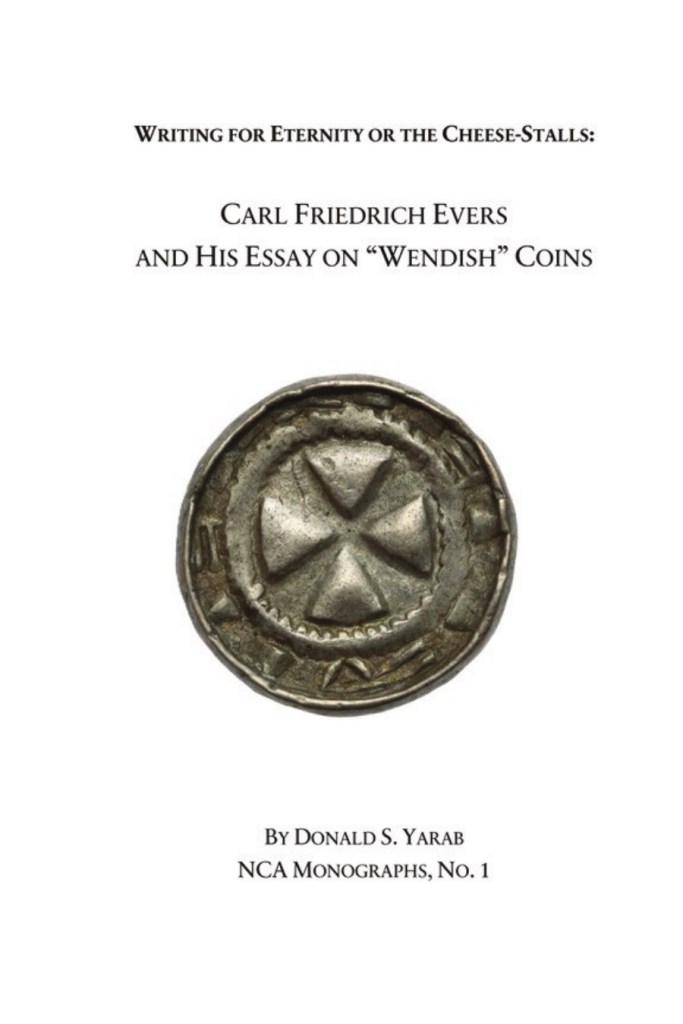
It is my pleasure to announce that Writing for Eternity or the Cheese-Stalls: Carl Friedrich Evers and His Essay on “Wendish” Coins, the first title in the Northcoast Antiquarian Monographs series, is now available in paperback.
The medieval silver coins that numismatists have called Wendenpfennige, Sachsenpfennige, Randpfennige, and cross denarii (denary krzyżowe) have resisted attribution for more than two centuries. One of the first scholars to treat them seriously was Carl Friedrich Evers (1729–1803), archivist to the dukes of Mecklenburg-Schwerin. In 1785 he published a short essay on six small coins recovered from a burial mound near Grabow and attributed them to the Wends, the Slavs of the Elbe lands. That attribution, and in time the names that grew from it, long outlived the arguments against the coins’ association with the Wends as their minting authority.
This monograph tells the story of Evers, his essay, and its reception down to the present: his career in the ducal archive and his correspondence with Johann Bernoulli; the Grabow find and the first reviews; Evers’ return to the coins in his history of Mecklenburg coinage of 1798–1799; Joseph Mader’s critique of 1803–1806; Lisch’s reconsideration of the find in 1845; and the curious afterlife of the “Wendish” label, which the German literature kept while forgetting Evers as its author; the Polish literature, by contrast, seemingly remembered him but seldom read what he wrote. An English translation of the 1785 essay and a transcription of its German text are given in the appendices.
About the title
The title comes from Evers himself. Writing to Bernoulli in October 1785, he complained of reviewers who thought archivists had neither the time nor the inclination to write “for eternity or for the cheese-stalls” (für die Ewigkeit oder Käsebuden), that is, for posterity or for wrapping paper. As it turned out, he wrote for posterity, though not in the way he intended.
Readers who saw my 2023 post on Evers will find here an entirely new and much fuller study.
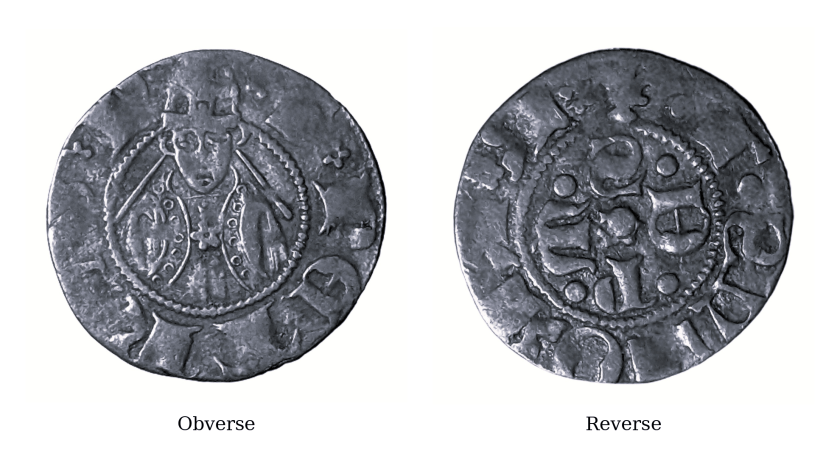
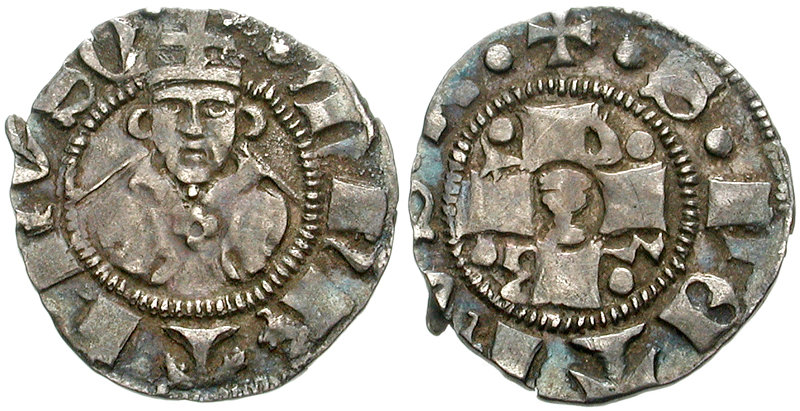
Kingdom of Sicily (Naples) – Sulmona. Charles III of Durazzo, King of Sicily, 1381-1386, King of Hungary, 1385-1386. AR Bolognino of Sulmona, .82 g., struck 1382-1385. Obverse: Bust of St. Peter Celestine with S PETRVS P inscription around. Reverse: R•KROLVS•T• inscription around with •S•M•P•E in center around pelleted cross saltire. Reference: MEC 14, 727 variant.
Recently, I spent time attributing various coins from a small assemblage of medieval coins I purchased a decade or two ago that were either wholly unattributed or erroneously attributed by their previous owner. After all this time, I have finally turned my attention to cataloguing the coins properly. One of the coins was previously grossly misidentified as an obol from Bergamo when, in fact, I found that it was a bolognino minted in Sulmona, a much more interesting attribution, as will be discussed below. The coin is illustrated above.
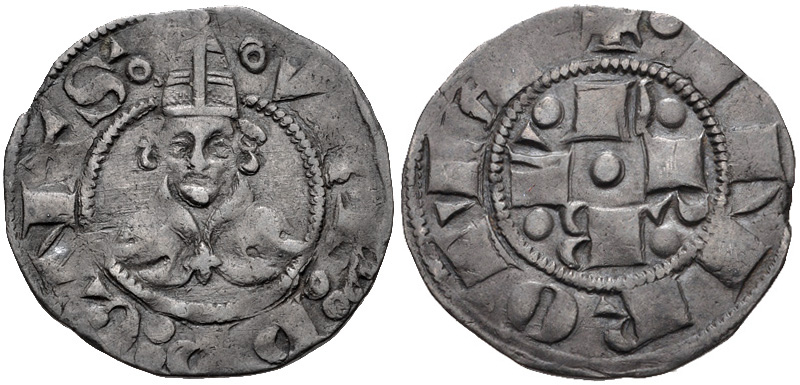
The general type is familiar, and common, enough. Two examples are illustrated below. The similarities with my coin will be obvious, as will be the dissimilarities.
Papal States – Avignon. Urbanus V (Guillaume de Grimoard). 1362-1370. AR Bolognino, 18mm, 1.33 g. Rome mint. Obverse: · VRB’ : P P : QNTS’ · (annulet and double annulet stops throughout), mitred bust facing Reverse: + · IN ROMЯ · inscription around, •V•R•B•I as central device within beaded circle. References: CNI XV 8; Muntoni 3; Berman 198. Source: CNG: The Coin Shop, 933495. Papal States – Martin V (Oddone Colonna). 1417-1431. AR Bolognino (15mm, 0.82 g, 6h). Rome mint. Obverse: + mARTInVS Q, mitred bust facing Reverse: +•S•PЄTRVS• inscription around, •V•R•B•I as central device within beaded circle References: CNI XV 61; Muntoni 21; Berman 274. Source: CNG, The Coin Shop, 820494. Ex Luparello Collection.
The similarities between my coin’s obverse and the general type are obvious and immediate. All three obverses present a mitred, front-facing papal bust within a beaded border, identified by encircling legends: VRB PP on the Urban piece, mARTInVS on the Martin piece, and S. PETRVS on mine. The reverses, too, share marked similarities: four rather heavy-looking letters are set as a central device in a cross-like pattern at the cardinal points, with pellets placed in the four diagonal angles and at the center, forming a saltire cross, all enclosed within a beaded border. Each coin’s outer legend, too, lends further identification of its origin: for Urban’s coin, an inscription declaring origin, IN ROMЯ; for Martin’s, one naming the see, S PЄTRVS; and for mine, one naming the sovereign who issued the coin, R KROLVS T (Rex Karolus Tertius).
The dissimilarities are subtle but significant. Urban’s and Martin’s obverse legends name a reigning pope in each instance, making it easy to identify the authority issuing the coins. Mine names, on its face, only S. PETRVS P and at first blush one would identify this as Saint Peter the Apostle, the first pope, making identification of the issuer difficult as the coin is not of such antiquity (but for the identification of Rex Karolus Tertius on the reverse). But we shall return to the true identity of this Saint Peter momentarily. The reverses have marked dissimilarities also. The center lettering on Urban’s and Martin’s coins spells VRBI, an unambiguous declaration that these coins are products of the City, that is, Rome. My coin’s central letters, S M P E, are cryptic by comparison, revelatory only to a those familiar with Ovid’s Tristia, specifically 4.10.1–4:
Ovid, Tristia 4.10.1–4:
Ille ego qui fuerim, tenerorum lusor amorum, quem legis, ut noris, accipe posteritas. Sulmo mihi patria est, gelidis uberrimus undis, milia qui nouiens distat ab urbe decem.
That man I was, you know him from these lines, the playful poet once of tender loves receive this, posterity, and learn his name. Sulmo is my homeland, rich in ice-cold springs, ninety miles distant from the city’s gates.
The four letters S M P E reflect the initial letters of four words from the poem: Sulmo Mihi Patria Est — the opening words of the couplet’s third line. Ovid, writing the autobiographical Tristia from exile on the Black Sea around AD 12, gives his birthplace before he gives almost anything else about himself. Whoever cut the die for this coin took that line and folded its initials into the same cross-and-saltire device that, on other bolognini, named nothing more than the City, Rome. These letters on this bolognino therefore tell us that the coin was struck at Sulmona.
The choice of these letters on the reverse also reveals the identity of the S. PETRVS on the obverse. He is Sulmona’s own Saint Peter, Pietro da Morrone, born Pietro Angelerio, hermit of Monte Morrone a few miles outside the city walls, elected and crowned Pope Celestine V in 1294, canonized in 1313 as San Pietro Celestino, and venerated ever since as the town’s own adopted son raised to the papacy. Thus, the coin’s obverse names its saint; the reverse names its town; and the coin’s issuing authority, the Rex Karolus Tertius identified on the reverse, turns out to be Charles III di Durazzo, who is almost incidental to the coin as it is a coin about Sulmona, not the king who issued it.
Celestine V, as noted above born Pietro Angelerio and known from his hermitage on Monte Morrone as Pietro da Morrone, was, prior to being elected and serving as Catholic pontiff for five months in 1294 AD, a monk and a hermit who founded the Celestines, a branch of the Benedictine Order that survived until the 18th century. He was elected pontiff in the Catholic Church’s last non-conclave election after a two-year impasse without a pope. Though his reign was short, and many of his acts were canceled by his successor, two extraordinary edicts survived from his reign: his confirmation of the right of a pope to abdicate and his reinstatement of conclave regulations established by Gregory X’s bull Ubi periculum.
On December 13, 1294, a week after confirming that pontiffs could abdicate, Celestine V himself resigned, stating that he desired to return voluntarily to his monastic, pre-papal life. Unfortunately, his successor, Boniface VIII, fearing that the former Celestine V would be installed as an antipope against him, imprisoned his predecessor in the castle of Fumone, where he died on May 19, 1296. Pietro Angelerio, the man who had been pontiff Celestine V, was canonized by Pope Clement V on May 5, 1313.
It cannot go unnoticed that Pope Benedict XVI proclaimed a Celestine Year in 2009–2010 to mark the eight-hundredth anniversary of Pope Celestine V’s birth, and in July 2010 knelt before Celestine’s relics in Sulmona’s own cathedral. Whether those gestures were, in retrospect, unwitting rehearsal for his own resignation in 2013 — using the very mechanism of abdication Celestine had established seven centuries earlier — is a question the record does not settle. But the resonance, once noticed, is difficult to set aside.
Thus, the coin I have attributed to Sulmona becomes, in the end, a hinge between two distant moments: Ovid’s line, composed around 12 AD, cast in cipher on the coin’s reverse; and the papal practice of resignation formalized by the man on the coin’s obverse, invoked, seven centuries later, by the next pope to resign, Benedict XVI, in AD 2013. This humble bolognino, struck sometime between 1382 and 1385 AD, stands as a hinge across a resonance spanning, in the end, two thousand and one years, from Ovid’s Sulmona to Benedict’s Rome.
There will come a day when sacred Ilion shall perish, and Priam, and the people of Priam of the good ashen spear.
—Homer, Iliad 6.447–449, in A. T. Murray, trans., William F. Wyatt, Loeb Classical Library 170 (Cambridge, MA: Harvard University Press, 1924), 306-307.
O City, City, head of all cities; O City, City—behold the City, the center of the four quarters of the world; O City, City, boast of the faithful and destruction of the barbarian.
—Michaelis Ducae Nepotis, Historia Byzantina, ed. Immanuel Bekker (Bonnae: Ed. Weber, 1834), 41.1-3.
I
The signs gathered like storm-clouds over stone. The moon held three hours in shadow, as if faithfully remembering an ominous decree. The City’s ikon slipped from its golden frame, while rain came hard, with hail, and darkened the candles’ light.
Fog lay thick upon the streets at dawn, as though the Lord of history had withdrawn His gaze and left the walls to reckon with themselves.
That night a luminous glow hovered over the dome of Hagia Sophia— to those within, a burning crown of sorrow; to those without, a sign the City’s time was done.
II
The emperor took up the old, hard work of prayer. Along the battered circuit of the walls he walked, bearing ikons and relics in his hands, with Greeks and Latins chanting side by side, their quarrels stilled beneath a sorrowful resolve.
The Mother of God, the martyrs, the confessors— all were invoked as if their names could buttress mortar more than stone.
In the Great Church, under the shadowed dome, he knelt, seeking pardon—from bishops, from people— received the mysteries, asked to be forgiven, then rose to bid farewell to those of his own house before he went alone to read the nighted ramparts.
III
The last assault came early, unheralded. Waves of men broke upon the landward walls until the very earth seemed to remember Troy.
He moved along the parapets with measured speech, offering encouragement and what comfort he could, standing where the shot tore stone to dust.
For a time the line held firm, the Rhomaioi answering iron with iron, fire with fire. But hope, not courage, failed first.
Then Giustiniani faltered, wounded, borne away, and with his going something in the defence gave way— not the line itself, but what had held the line together.
Through the small, forgotten gate of Kerkoporta the first invaders entered— banner against beleaguered sky;
the towers fell, and the wall itself failed open, not by thunderbolt, but by an unattended door.
IV
When the breach could no longer be denied, they urged him to flee—to seek a ship, a safer shore— but he refused to outlive the City he had served.
Casting aside the purple and the eagle— signs of basileus kai autokratōr Rhōmaiōn— he stripped himself of what set him apart and stepped into the tumult like any other man.
Sword in hand, he went to where the fighting thickened into one indistinguishable struggle, so that no eye might easily discern which body among the fallen had been emperor.
Later they searched for him among the dead, found a head, perhaps his, to lift before the sultan’s gaze; yet some would say no certain corpse was ever found, that beneath the sealed Golden Gate stone keeps a vigil, and that a marble emperor bides his time in sleep until the City, once more, has walls to be defended.
When I read The Independent article linked below, I immediately recalled what I call here, in my response essay, The Catalan Principle. The contrast seemed too telling to ignore. Although I do not, in truth, endorse the sanction discussed—certainly not in ordinary circumstances—the historical example provides a striking counterpoint to the modern rhetoric of punishment directed only at the powerless.
Medieval Catalonia—a principality within the Crown of Aragon, governed by its own Cortes and its own body of law—developed one of Europe’s most exacting systems for regulating bankers. This severe and unforgiving regime was born not of vengeance, but of a sober understanding of where real civic danger, and indeed real violence, actually lay. The legislators knew that a banker held the community’s life in his hands. A single failure of trust could ruin families, wipe out savings, and collapse the economic life of a city, indeed, a region. They therefore placed the full burden of responsibility on the man seated at the banker’s bench—the banca, the literal table or counter from which he conducted his trade and at which depositors entrusted him with their funds (the same bench that, when broken, gave us the word bankrupt).
Beginning in 1300, a banker was personally liable for every entry in his sworn journal, his entire estate pledged to his depositors. Should he fail, he was immediately proclaimed bankrupt and disgraced, then confined on bread and water until he made every injured party whole. In 1321, the Cortes went further: a banker who failed to repay his depositors—within one year for past failures, or immediately thereafter—was to be proclaimed bankrupt throughout Catalonia, beheaded, and his property liquidated for restitution. Most strikingly, the law added:
The sovereign may not pardon him unless his creditors have been fully satisfied.
No royal favoritism.
No political clemency.
No early counterpart to the corrupt presidential or gubernatorial pardons used to absolve wealthy offenders in the present era for their financial and other crimes.
This was not theoretical. In 1360, the banker Francesch Castello was beheaded in front of his own bench—the very table at which he had accepted deposits—after failing to repay those whose savings he held in trust. The medieval world understood that economic destruction is a form of violence, and that the most consequential harms are often inflicted by those with power, not by those without it.
Which brings us to idea voiced recently by billionaire Joe Lonsdale for a return to public hangings as a display of “masculine leadership.” His proposed spectacle targets the familiar objects of elite contempt: the poor, the desperate, the socially marginal. Crime, in his imagination, flows upward from the street, not downward from the boardroom.
But consider what a medieval-style code would demand today. If we applied the Catalan principle—that those who hold the wealth of others in trust bear the highest responsibility—we would direct our harshest penalties not at the powerless, but at:
executives who obliterate pensions through financial engineering,
bank officers whose decisions wipe out depositors,
corporate officers whose malfeasances and misfeasances devastate multitudes, in some instances, entire communities,
institutional leaders who destroy livelihoods while shielding their officers through legal artifice.
Would Lonsdale applaud that as “masculine leadership”? Or is his appetite for the gallows limited to those who possess nothing worth stealing?
The Catalan legislators understood something our own era too often obscures: the powerful commit the greatest harms, and justice serves the common good only when it restrains them first.
What Lonsdale demands is not justice but hierarchy—punishment downward, indulgence upward. The medieval world, in this case, was the more virtuous, the more honest. It placed the noose (or lowered the axe, as the case may be) where the damage was greatest: at the bench of the wealthy who had destroyed the lives of others, and it did not permit them to purchase their way out of accountability.
Source: Usher, A. Payson. (1943). The early history of deposit banking in Mediterranean Europe. Cambridge, Mass.: Harvard university press, 239-242.
καὶ ἀπέστρεψεν Εζεκίας τὸ πρόσωπον αὐτοῦ πρὸς τὸν τοῖχον, καὶ ηὔξατο πρὸς κύριον… “And Hezekiah turned his face to the wall, and prayed to the Lord…” —2 Kings 20:2 (LXX)
I Winter withdrew its favour. The palace lay in stillness, its stones holding the residue of vows spoken by emperors long buried— a gold-lit catechism of dominion now muted by cold. Through corridors dimmed by age he walked without retinue or herald, a man whose burden had outlived the empire he was sworn to guard. The ikon-lamps flickered as he passed, their trembling halos soft upon the air.
II He paused where councils once assembled, where envoys bent the knee and treaties were sealed with hopes already fraying at the edge. The saints on the walls looked on— remote as lost kinsmen— their silence neither blame nor blessing, only the deep stillness of unchanging gaze. He felt the breadth of that silence in his bones.
III Past stewards and tired officers he entered the inner chambers where the breath of the world falls thin. There the bed waited—a narrow shore between the living and the lived. He lay upon it gently, as though the body remembered how to yield before the mind would grant its leave. Outside, the city kept its vigil of endurance. An emperor—basileus kai autokratōr Rhomaíōn— whose sceptre had become an inheritance for hands that proved no stronger.
IV At last, in the quiet appointed to all men, he gathered the remnants of his strength and made the gesture Scripture preserved: the turning of a face toward solitude. Slowly, without lament or plea, the emperor shifted toward the wall, entrusting what remained of breath and light to the austere mercy of obscurity— and to the uncrowned hours that follow every reign.