In the photographs taken within the Oval Office (2017, 2025), the seat of American executive authority has been transformed into something older and stranger—a sanctuary of royal consecration. At its center sits Donald J. Trump, head bowed, encircled by ministers and advisers whose hands rest upon him in the gesture of impositio manuum, the laying on of hands. Their eyes are closed, lips moving in prayer, yet their posture speaks less of intercession than of veneration. What unfolds in that moment is not simply political theater but a ritual reenactment of an ancient idea: that power may be embodied, sanctified, and made flesh.
Impositio Manuum 2017
The Reversal of Benediction
In Christian and pre-Christian rites alike, the laying on of hands conveys the transmission of grace or authority. The priest’s touch confers the Spirit upon the baptized; the bishop’s hand consecrates the king. Here, however, the direction of sanctification is reversed. The clergy do not mediate divine blessing to the ruler on behalf of the people; they draw legitimacy from him. The bowed heads and concentric hands create a living reliquary around the sovereign’s body. The Oval Office, ordinarily a stage for civil governance, has been re-imagined as an apse, its curved wall a secular altar niche. What was intended as prayer has become an act of anointment—without chrism, yet heavy with its symbolism. In 2025, the Christian supplicants’ language included a declaration of divine appointment: “You assigned him, you appointed him, you anointed him for such a time as this…”
Impositio Manuum 2025
The Living Law
Ernst H. Kantorowicz, in The King’s Two Bodies, described how medieval jurisprudence conceived the ruler as lex animata—the “living law.” The sovereign’s person contained within it both the mortal, fallible flesh (corpus naturale) and the immortal, juridical body politic (corpus mysticum). Law was not merely administered by the king; it was enfleshed in him. The maxim omnia iura in scrinio pectoris imperatoris—“all laws reside in the emperor’s breast”—expressed the same belief: that the sovereign’s will constituted legality itself.
Trump’s self-understanding, as revealed in his statements that “I (have) the right to do anything that I want to do. I’m the president of the United States,” and that he could even “declassify by thinking” alone, reflects this archaic conception of sovereignty. In the photographs, that philosophy becomes visible form. His body, ringed by supplicants, stands as the physical repository of authority: thought and flesh fused into the living source of law. The constitutional process is eclipsed by a medieval metaphysic—the emperor’s breast revived within a republic.
The Mystical Body of the Republic
In Kantorowicz’s analysis, the king’s dual body was not a theological curiosity but a political necessity: it allowed the continuity of the realm despite the mortality of its ruler. The body politic outlived the natural body through the fiction of divine investiture. Yet in the Oval Office images, the relationship is inverted. The ruler’s flesh absorbs the polity rather than the polity transcending the ruler. The praying ministers become members of his mystical body, as if the state were incarnate in him rather than he in the state. The photographs thus performs a political transubstantiation—the transformation of a secular office into a sacred organism whose head alone is divine.
Iconography of Idolatry
The camera captures only the back of the president’s head in one of the images, a composition that echoes the devotional art of relic veneration. The viewer’s gaze aligns with the worshippers’ hands, all converging on the same luminous focal point: the golden hair, haloed by the light of the room. The gesture is tactile worship, the contact-relic as conduit of grace. In medieval reliquaries, touch transmitted sanctity; here it transmits legitimacy. The image collapses the distinction between religion and politics, portraying a people seeking salvation through proximity to power.
The Return of the Arcane Sovereign
What Kantorowicz chronicled as a vanished theology of monarchy reappears in modern populist guise. The constitutional republic, built upon the rejection of divine kingship, finds itself haunted by its ghost. The sovereign’s “two bodies” are re-fused: the office and the man, the law and the will, the symbol and the flesh. Those who kneel do so not before the law but before its living embodiment. When the sovereign’s body absorbs the state, law becomes indistinguishable from will. In such a regime, dissent is not disagreement—it is heresy. The king’s body, once divided for the safety of the state, is whole again.
The danger lies not only in the man but in the myth reborn around him—the longing for the immediate, the personal, the sacred ruler who is the nation. In that longing, the modern citizen becomes medieval subject once more. And the Oval Office, once the seat of the people’s servant, becomes the sanctuary of an arcane sovereign whose heart, like the emperor’s of old, is presumed to contain all laws within its breast.
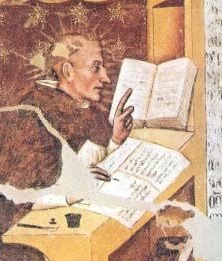
Conveniences commonplace today were once novel. In this regard, today let us remember with gratitude Vincent of Beauvais, who died in 1264 AD, for making access to to the content of books easier. He is credited as having been the first writer to systematically provide indexes for his works, a trend which others eventually followed. He added an index to every single book of his Speculum historiale after 1244. This kind of apparatus only spread more widely in the field of historical writing during the fourteenth century, beginning with the Tabula secundum litterarum ordinem alphabeti on the same work by Vincent, composed by Jean Hautfuney in Avignon around 1320. Thank you, Vincent!
Source: Kujawiński, J. (2015). Commenting on historical writings in medieval Latin Europe: A reconnaissance. Acta Poloniae Historica, Volume 112, 169. Especially see footnote 26, which states the following: “See the study and edition by Monique Paulmier, ‘Jean Hautfuney, Tabula super Speculum historiale fratris Vincentii’, Spicae. Cahiers de l’Atelier Vincent de Beauvais, Nouvelle série, 2 (1980), 19–263 (on Vincent’s indexes, see 20–3), and ibidem, 3 (1981), 5–208. Both Vincent’s and Jean’s indexes are discussed within the history of medieval historiography by Guenée, Histoire et culture historique, 232–7, and within the history of medieval indexes by Olga Weijers, ‘Les index au Moyen Âge sont-ils un genre littéraire?’ in Leonardi, Morelli, Santi (eds.), Fabula in tabula, 11–22, here: 20–1, and il. 5.”
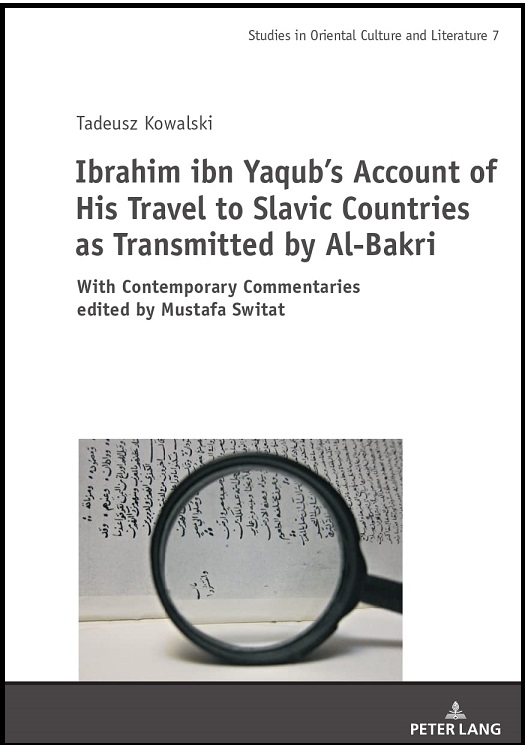
2022 Release of English Translation of Kowalski’s Invaluable Scholarship
12/30/31 UPDATE: A review of the work above was published in Polish by D. Sikorski in 2023 which is highly critical of the work for its lack of fidelity to Kowalski’s original scholarship and translation, as well as for its lack of familiarity with the scope and breath of all the relevant current scholarship. The review stated that the editor “made several decisions significantly changing the original shape of the old edition, in places even scandalously distorting it.“ The review illustrated a number of the editorial and factual failings in the work in detail. The reviewer summarized his opinion rather succinctly as follows: “Among the positive aspects of the presented book is primarily the availability in a widely understood language of T. Kowalski’s findings regarding Ibrahim ibn Jakub and his extensive and very detailed commentaries on al-Bakri’s text. On the negative side, the main issue is the removal of the critical apparatus from the Arabic text, depriving it of its scholarly character. Another serious flaw of the publication is the attempt to include two different English translations in one text. Thirdly, there is an inadequate discussion of the state of research on Ibrahim’s text.” I note that, on balance, the work still retains some utility for those who cannot access Kowalski’s work, or who cannot read works in Polish or Arab regarding Ibrahim’s Account; however, I share the reviewer’s enthusiasm for an upcoming release by French Arabist, Jean-Charles Ducène, who is preparing an edition of all fragments of Ibrahim’s Account for Monumenta Germaniae Historica – as the reviewer noted, the forthcoming edition by Ducène will render the above work and its deficiencies obsolete and eclipse T. Kowalski’s work in terms of the text.See review at:Sikorski, D. (2023). Review of Ibrahim ibn Yaqub’s Account of His Travel to Slavic Countries as Transmitted by al-Bakri, with Contemporary Commentaries, by M. Switat (Ed.), A. Waśkiewicz (Trans.). Roczniki Historyczne, 89, 179-186.
In February 2022, my post entitled “Remarks on Mieszko’s Payments to His Warriors: ‘Market Weights’ or ‘Good Coins (Dirhams) of Fixed Value’?” noted that the above referenced translation of Kowalski’s 1946 foundational scholarship [Relacja Ibrāhīma ibn Ja’ḳūba z podróży do krajów słowiańskich w przekazie al-Bekrīego (Relatio Ibrāhīm ibn Ja’ḳūb de itinere Slavico, quo traditur apud al-Bekrī). Cracow: PAU, 1946] was forthcoming. I have been eagerly awaiting its arrival ever since. It has finally been published and, this week, I received my long-anticipated copy.
Previous to this translation of Ibrahim ibn Yaqub’s references to Slavic lands based on his travels in the 960s, I relied on the very able and sound English translations of Dmitrij Mishin (Mishin 1996) and Paul Lunde and Caroline Stone (Lunde and Stone 2012). I was aware of the 1946 Kowalski scholarship because all translations of Ibrahim ibn Yaqub’s original texts ultimately draw from the well of Kowalski’s 1946 magisterial work. Unfortunately, I was unable to draw upon that well both because of the language barrier and the physical inaccessibility of the work. The newly released publication allows me and others who faced similar barriers to finally access much of Kowalski’s original 1946 scholarship. Unfortunately, four of the original supplementary essays by other scholars in the work were not republished due to copyright issues. Although the essays were likely outdated, it would no doubt have been beneficial to understand the full scholarly context of the original publication to have had those essays in translation.
The new publication does not, ultimately, disappoint, in spite of the copyright issues limiting the completeness of its re-publication in translation. Of course, the heart of the work is its presentation of the translation, from Arabic, of Ibrahim ibn Yaqub’s references to Slavic lands. The translation is remarkably detailed, thorough, and heavily footnoted. It quickly becomes apparent that this translation is the first I will consult when I am researching and writing, as it is clearly the foundation upon which my understanding will be built. However, when writing narratively, rather than for scholarly purposes, my quotations will continue to come from Mishin or Lunde and Stone. One quick illustrative example will suffice to demonstrate why.
In Kowalski 2022, the first lines of the Arabic text are translated as follows (citations removed): “Slavs are those born {belong to descendants (come from descendant)} of Mādhāy Ibn {the son of} Yāfith. Their dwellings {continually} [spread] from the north to the west.” In Lunde and Stone 2012, the same lines are translated as follows:”The Saqāliba are the descendants of Mādhāy, son of Yāfith (Japheth) and they dwell in the north-west.”
Obviously, Kowalski is a translation foundational to scholarly understanding (especially with its abundant citations) whereas Lunde and Stone is a translation useable in flowing narratives.
The translation also includes extensive, helpful philological commentary, a reconstruction of the biographical identity of Ibrahim ibn Yaqub, and a very useful discussion of proposed dates for his travels. Of particular note are two new commentaries by Mateusz Bogucki and Mateusz Wilk. Bogucki contributed an entry entitled “Archaeological Commentary on Ibrāhīm ibn Yaʿqūb’s Account” while Wilk contributed one entitled “Ibrāhīm ibn Yaʿqūb’s Account in the Context of Source Analysis.” Finally, there are biographical notes, indices of names, and the Arabic text which was translated.
Although I am thrilled to add this work to my library, and will consult it frequently, as I already have, I am somewhat disappointed that the opportunity presented by its publication to attach the most recent, more clarifying scholarship, when warranted, was not exploited more robustly. Several areas where such updates were possible were identified in a 2006 conference celebrating the 60th anniversary of the publication of Kalkowski’s 1946 work. The conference papers were published in Zaborski, Andrzej (ed.). Ibrahim Ibn Jakub i Tadeusz Kowalski w sześćdziesiątą rocznicę edycji, Cracow, 2008.
I wrote about one area of particular interest in my February 2022 post. Although that area was ostensibly addressed in Bogucki’s commentary in the new publication, Bogucki’s treatment of the issue is puzzling and incomplete, as I will discuss below.
In my February 2022 post, I quoted this excerpt from Mishin:
Ibrahim Ibn Ya’Qub reported the following regarding Mieszko and his realm: “The country of Mashaqqah [that is Mieszko, earlier in the text identified as ‘King of the North’] is the largest one among the countries [of the Slavs]. It abounds in food, meat, honey, and agricultural produce. The taxes are collected in market weights. Those are the salary of his men in every month, and each of them has a certain amount of them to get. He has three thousand warriors wearing coats of mail; a hundred of them is worth a thousand of other warriors in the battle. He gives those men clothes, horses, arms, and everything they need. If a child is born to one of them, he orders the child to be paid a maintenance, regardless of the latter’s sex. When the child grows, and he is a boy, he marries him and pays the dowry to her father. The dowry of the Slavs if very big, and they pay it in the same way as the Berbers do. If a man, thus, has two or three daughters, he gets rich, but if he has two sons, he becomes poor.”
Mishin (1996), pp. 187-188.
I noted that scholars have long focused on the references to the taxes collected and paid by Mieszko to support his three thousand warriors, the warriors which allowed Mieszko to expand, consolidate, and stabilize his realm because current scholarship does not support that Mieszko issued any coinage of his own. Rather, it shows that his son, Boleslaw Chrobry, struck Poland’s first denars between 992 A.D. and 1000 A.D. (see Suchodolski 2019 and Suchodolski 2015 for a discussion of which denars are contenders for earliest denars struck in Poland).
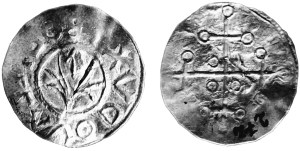
Denar of Boleslaus Chrobry of Poland, ca. 992-1000 A.D. Tree of life with arrow, inscription / cross. One of the contenders for the first coins struck in Poland. Photograph from Suchodolski 2015.
Accordingly, we must look elsewhere for what, exactly, Mieszko may have collected for taxes and used to pay his force of warriors.
Mishin, in his translation, indicated that Mieszko collected taxes in “market weights,” which were then used to pay his warriors a fixed monthly salary. As I noted in February 2022, Mishin based his translation, “market weights” for matāqīl al-murquatiyya, on Kowalski’s scholarship. Kowalski arrived at this rather peculiar translation because al-matāqīl or al-matākīl is the Arabic word for dinar, a gold coin, which did not circulate in Slavic lands and it was modified by a previously unattested or corrupted modifying word al-murquatīyya or al-marqatīya, which Kowalski rendered as market or commercial.
In a paper prepared for a 2006 conference celebrating the 60th anniversary of Kowalski’s remarkable scholarship regarding the testimony of Ibrahim Ibn Ya’qub, Andrzej Zaborski discussed this translation issue at length, noting that alternatives proposed over the years have include Byzantine money (a proposal widely rejected), legal tender/money, and his own hypotheses, “good coins of fixed value” or “coins of diminished value.” Zaborski concluded that the translation issue required further investigation. (Zaborski, pp. 64-65).
In February 2022, I suggested that the text itself had revealed all that it would yield and that the evidence on the ground, or rather in the ground, argued that “good coins of fixed value” should prevail as the preferred translation. To support this contention, I appealed to the numismatic hoard evidence. Specifically, I made the following argument:
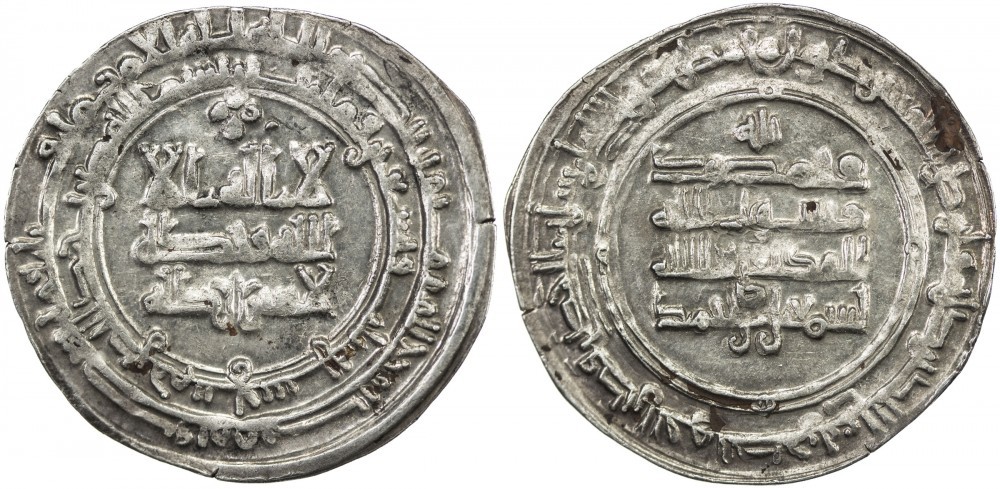
A Dirham of the type found in hoards in Poland from the early 10th century. SAMANID: Isma’il I, 892-907, AR dirham (2.89g), Balkh, AH293, A-1443. Photograph courtesy Stephen Album Rare Coins.
Mateusz Bogucki discussed the use of silver dirhams in Slavic lands in 2011, based on hoard evidence, and divided the time periods during which the hoards went into the ground into seven phases. Bogucki’s Phase III most aligns with the period during which Mieszko is referred to as collecting taxes and paying warriors salaries. Here is, in part, what Bogucki has to say about that period: “Phase III (early tenth century). At the turn of the ninth and tenth centuries, an important change in dirham importation may be observed. A significantly greater number of hoards are known from the period 900-40, and they are much larger (up to 1,000 coins). They are found in eastern Poland, Great Poland and Pomerania. Dirhams are almost exclusively whole coins. Some complete (undamaged) ornaments also occur in the hoards. Analysis of the coins and ornaments demonstrates that, during this phase, two important routes were in use. Coins found in Pomerania came via the Baltic, whereas coins in the eastern parts of Poland and Great Poland arrived mainly via the eastern land-route” (Bogucki (2011), p. 136).
In 2016, Bogucki explicitly tied the influx of dirhams into Poland to Mieszko’s use of mercenaries to consolidate his realm: “Assuming the chronology of the deposits is solid, it may even be suggested that the influx of silver to Wielkopolska from the East preceded the Pomeranian route by more than a decade and was initially greater in importance. The issue of the commodity exchanged for silver in the early-Piast state is still difficult to ascertain. It is apparent that the metal was needed to pay for mercenary services and to develop a proper network of administration and infrastructure based on strongholds. Archaeological research proves that the first half of the 10th century, when the core of the state in Wielkopolska was being established, brought destruction to a large percentage of tribal stronghold centres. Juxtaposing these facts with the chronology of the influx of oriental silver into Wielkopolska (discussed above) and the information found in written Arab sources, we may conclude that the economic basis for building the earliest Piast state came from selling slaves – the inhabitants of the destroyed tribal centres of Wielkopolska. By eliminating their hostile neighbours, the Piasts acquired silver, which they could use to consolidate their power” (Bogucki 2016, p. 246).
Based on the above, we know that Mieszko had access to good quality dirhams, in quantity, and that the dirhams were not yet always reduced to intensely fragmented hack-silver (where they would need to be regularly weighed to be paid out as a salary) as they were in later phases (such as Phase IV, from 970-1010 A.D., which Bogucki noted often included coins and items that were “intensely fragmented”). This adds support to Zaborski’s hypothesis, and my contention, that the contentious translation should be “good coins of fixed value” rather than the unsatisfactory and less supportable “market weights.” I note that Bogucki, in a 2005 paper, made passing reference to the issue of the form of the warrior salaries (in an article that was poorly translated into English) without addressing the underlying translation issue:
In my opinion buying meat by silver doesn’t hinder from buying by the silver politically loyalty. In the matter of salary and taxes it’s better to quote the words of Ibrahim: ‘Received by him (king Mieszko I) taxes are trade weights. They are used as payment for his mans (knights). Each month to each man it’s a known number of it’ (Kowalski 1946, 50). Here is necessary to comment the term trade weights –mataqil murquatiyya. Ibrahim might have known the name of dirhems, the western European denars he called Kinszar, so I think that Ibrahim noticed the hack silver, taken not for pieces, but for weight. This relation doesn’t mean that salary and taxes weren’t paid in animals, grain or any other goods. But it shows, that in this matter it isn’t possible to give only one single answer.
Bogucki (2005), p. 1152.
So, in 2005, Bogucki published an article translating the Arabic phrase at issue as trade weights. He does so because he views the currency in circulation in the Polish lands at the time of Ibrahim ibn Yaqub’s writing as either whole dirhams or, more likely, intensely fragmented hack-silver. So, how does Bogucki view the issue in his commentary in the new translation in 2022?
Bogucki writes the following:
Ibrahim also wrote that in Mieszko I’s country, taxes were levied in al-matākīlal-marqatiya. This term was originally rendered as ‘commercial weights’; however, W. Kubiak has proved that the term actually denoted coins. Ibrahim seems to have used a familiar term to describe collecting fragmented silver by weight. The crucial information is that taxes were collected in metal coins. Naturally, it is difficult to assume that each peasant individually paid the prince in silver, but a complex fiscal system, where a peasant or a craftsman paid his due to the relevant official (the town comes) in produce, animals or products, and the official, in his turn, paid the prince with silver seems highly probable. Incidentally, Arab dirhams were widely used in Mieszko I’s country, a fact that Ibrahim fails to mention (he did note their use at Otto I’s court, however). It is worth recalling here that in the light of the most recent research, the slave trade, in which slaves were sold for Arab silver, played an important role in building Mieszko I’s power. Naturally, direct archaeological material does not corroborate the slave trade, but wide-scale archaeological studies seem to confirm this thesis.
Kowalski (2022), pp. 168-169.
Although it is gratifying that Bogucki is seemingly prepared to render the disputed phrase as referring to coins and no longer referring to weights, it is unclear how he would actually translate it, if at all. Is he proposing that the words be translated, as Kubiak did, as market money, or current coin, or market coin? I note that Zaborski, in reviewing Kubiak’s scholarship, was troubled by Kubiak’s interpretation as it relied on a translation that embraced etymology for market that was only attested in the 20th century in the Arabic dialect of the Jews of Algiers (Zaborski, pp. 48 and 65). The brevity of Bogucki’s comments on the issue leave these questions unaddressed, unfortunately.
On balance, however, the scholarly debate has advanced sufficiently that any translation of the phrase involving weights may be set aside. For my own purposes, I will leave the phrase untranslated, as Lunde and Stone do in their translation, and provide a note indicating that current scholarship understands the phrase as meaning current coin (e.g., dirhams and/or hack-silver).
REFERENCES/SOURCES: (Blue boxes may be clicked to be taken to reference works available online for review. Red boxes indicate reference works are not available for online review. If a link for a blue box is no longer working, please advise me of such as nca@northcoastantiquarian.com. Thank you.).
Note: Zabroski’s work is a compilation of scholarly papers read at a May 2006 conference celebrating the 60th anniversary of the publication of the first and most critical edition of Ibrahim Ibn Ya’Qub’s reports on the Slavs, which had been prepared and published by Tadeusz Kowalski [Kowalski, Tadeusz. Relacja Ibrāhīma ibn Ja’ḳūba z podróży do krajów słowiańskich w przekazie al-Bekrīego (Relatio Ibrāhīm ibn Ja’ḳūb de itinere Slavico, quo traditur apud al-Bekrī). Cracow: PAU, 1946].
Recently, I had the pleasure of reading Piotr Gorecki’s “The Early Piasts Imagined: New Work in the Political History of Early Medieval Poland,” published in The Mediaeval Journal, Vol. 1, No. 2 (2011) pp. 81-102. Gorecki provided an in-depth discussion of three extraordinary works, originally published in the Polish language and now available in English translations, which approach history from a different angle. He explained the trend as follows:
“From time to time, we are lucky to find ourselves in the midst of a historiographical conjunction: a moment of shared interest, among quite different communities of historians, in a major subject and in the concepts and methods through which that subject is best understood. Today, one such subject is a new kind of political history. Chronologically, it is centred in the late- and the post-Carolingian world. Substantively, it differs sharply from its older, ‘traditional’ variant, which was centred on formal institutions and conceptualized largely in terms drawn from late-modern statecraft. Its practitioners sometimes underscore the contrast in semantic terms, because in some scholarly vernaculars (though not in English), the earlier variant has a specifying name: Verfassungsgeschichte in German, historia ustroju (or historia panstwa i prawa) in Polish. The new variant of the discipline is defined, in part, through a rejection of such labels and of the conceptual baggage they supposedly carry.
However it is named, the new political history presumes that the realities of earlier medieval Europe cannot adequately be understood with concepts and categories drawn from late-modern law, politics, and administration. Therefore, the updated discipline examines, at least as a point of departure, an altogether different range of phenomena. These are fundamentally centred on power. Power, as it is actually pursued by individual historians, is a rather elastic subject, but can at its core be specified along two lines: first, as a set of resources available to its possessor, which that possessor can bring to bear upon a given set of circumstances; second, as its possessor’s capacity to impose his or her will upon other protagonists and thus to transform those circumstances.
Inquiry into those elements of power opens up several related subjects. One is the experience of power: the nature and the extent of its impact upon the people subjected to it. Another is the ‘representation’ of power, that is to say, a deliberate communication, directed at some significant audience, about power, by the possessor of that power or by someone else. Power may be ‘represented’ through a variety of media: words, spoken or written; pictures and other artefacts; gestures including, but not limited to, rituals or displays of emotion” (pp. 81-82).
Gorecki addressed the following three works in his article:
Zbigniew Dalewski. (2008). Ritual and Politics: Writing the History of a Dynastic Conflict in Medieval Poland. Brill.
Andrzej Pleszczynski. (2011). The Birth of a Stereotype: Polish Rulers and Their Country in German Writings c. 1000 A.D. Brill.
Przemyslaw Wiszewski. (2010). Domus Bolezlai; values and Social Identity in Dynastic Traditions of Medieval Poland (c. 966-1138). Brill.
Before moving away from Gorecki’s article, which I encourage you to read, I want to highlight two short paragraphs from the article that had particular resonance with me.
“The long Polish legacy of writing about ‘national’ (and, to a lesser degree, other types of)‘consciousness’ closely resembles what in English has more recently been conceptualized as the study of collective or social memory, and of the identity (or the range of identities) grounded in such memory. Wiszewski’s explicit concern with memory, much reiterated in his book, is especially pertinent. For those same reasons, the work, especially in Poland, about świadomość narodowa closely resembles – is, in fact, an instance of – more recent inquiries in English work into medieval understandings of the past, medieval ‘origins of peoples’ (origines gentium), and medieval ‘ethnogenesis’, understood in today’s conceptually updated sense.
Perhaps the core of that conceptual updating, today, is the recognition that identity (or, to get closer to the original Polish term, ‘consciousness’) is historically contingent rather than an intrinsic notion. Identity is not a trait; it is a creation. All three books are major contributions to that proposition. Wiszewski, Pleszczynski, and Dalewski approach the early medieval notions about ‘the Poles’ – to those ‘Poles’ themselves, to their contemporary observers, and to historians today – in terms of an active production, interpretation, and negotiation of that and other organizing categories, by particular authors, over the three centuries that form the chronological time span of these books. Pleszczynski is especially emphatic in his strong rejection of any intrinsic association between ‘the Piasts’, ‘the Poles’, and ‘Poland’, as a kind of primeval package, but all three emphasize the historical and the contingent. Thus, when they are viewed from the longer perspective of Polish ‘national consciousness’, these works resolutely move away from even a suggestion of essentialism” (pp. 100-101).
From the above, I especially noted the nine words: “Identity is not a trait; it is a creation.” They were quite present in my mind when I subsequently read “Cod and Herring in Medieval Poland” by Daniel Makowiecki et al., which appeared in the following book:
Barett, J.H., & Orton D.C. (2016). Cod and Herring: The Archaeology and History of Medieval Sea Fishing. Oxbow Books.
Before I suggest why “Cod and Herring in Medieval Poland” immediately struck me as relating to Piast power and the creation of Polish identity, I want to discuss two small, discrete sections from Pleszczynski’s The Birth of a Stereotype. In Chapter 2, Section 2.1.3., “Dominus [Sclaviniae] Sources on the Events of 1000,” the work discusses the events surrounding Emperor Otto III’s visit to Duke Bolesław I in Poland in 1000 A.D. (known as the Congress of Gniezno). During the visit, among other things, and most pertinent to our discussion, Otto III raised Gniezno to the rank of an archbishopric and created at least three subordinate dioceses: the bishopric of Kraków, the Bishopric of Wrocław, and the Bishopric of Kołobrzeg. In The Birth of a Stereotype, this event was discussed as follows:
“Let us now return to the interrupted analysis of the accounts by the annalists in order to examine how they commented on the establishing of the archbishopric of Gniezno, which was the most important event, from a historical perspective, associated with the emperor’s visit to the country of the Piasts in 1000. The already mentioned annalist of Quedlinburg did not write a single word about the fact that the Church metropolis was established following Otto III’s will. The only trace of his knowledge of the subject, which is obvious, could be the words that Otto III did not want to accept any presents from Boleslav, because he arrived in his country not to take, but to give. However, we will not find in the text the completion of the meaning of the phrase, as there is no mention what exactly the Piast ruler got from the generous emperor. Exceptions are the annals of Niederaltaich and of Hildesheim. Both these accounts in the form available today are secondary sources, as they are dependent on the older, lost texts, whose content must have been transformed. They also bear a very close resemblance to each other. These texts tell us the emperor organized the synod in the country of the Slavs, whose agenda was the establishing of the Church metropolis with seven bishoprics for Gaudentius, St. Adalbert’s brother. That is all. No other details concerning this event can be found in these accounts. At the same time, the latter of the mentioned annalists, who wrote his works before the mid-11th century in Hildesheim, most seemingly tried to introduce his own amendments to the older accounts whose content was unclear for him. Thus he associated the action taken by the emperor in year 1000 with Prague and mentioned Boleslav III from Bohemia as the ruler asking the German monarch for establishing the archbishopric in his country.
This was written, however, when the country of the Piasts found itself on the sidelines of the German elites’ sphere of interest, and the role of the empire’s ally in Central Europe together with the name of the Slavic territory linked with the empire had been taken over from the Polish rulers by the Premislids long ago. It is the chronicle by Thietmar which can serve, to a certain extent, as the key for the analysis of other sources that describe the events of 1000. The bishop of Merseburg, even though his text was also exposed to a certain tendency, tried diligently to collect facts and even mentioned tritely those issues that did not suit him” (pp. 130-131).
At this point, I will quote directly from the relevant portion of Thietmar’s Chronicon where Otto III establishes the Polish church, as Pleszczynski engages in a lengthy diversion and, when he does eventually quote Thietmar’s Chronicon, does not quote the whole of the relevant portion of the Chronicon:
“Without delay, he established an archbishopric there, as I hope legitimately, but without the consent of the aforementioned bishop to whose diocese this whole region is subject. He committed the new foundation to Radim, the martyr’s brother, and made subject to him Bishop Reinbern of Kołobrzeg, Bishop Poppo of Kraków, and Bishop John of Wrocław, but not Unger of Poznan. And with great solemnity, he also placed holy relics in an altar which had been established there” (Diethmar von Merseburg. (2001). Ottonian Germany: The Chronicon of Thietmar of Merseburg. United Kingdom: Manchester University Press, pp. 183-184).
Next, I wish to recite a small portion of Chapter 2, Section 2.2.2., “Dux infaustus – an Evil Ruler and a False Christian.” The relevant section states: “The Piast, acting in the way described above, confirmed his status of an intermediary between Christ, the king of kings, a universal monarch, and the people subjected to his authority. The Polish monarch showed that he kept watch over the sacred peace and the order of his community. He also gave his people law, and made the impression of his actions even bigger by setting his own example. Besides, Boleslav revealed in his interpretation of the religious law his superior position in the sacred hierarchy, above the clergymen, and demonstrated his religious royal prerogatives. Thietmar confirms in another passage of his chronicle that the Piast’s practices were not only his passing fancy, but also formed part of a bigger, well-thought-out action. In his analysis, quite in-depth, at least as compared with the interest other chroniclers of the day took in the Slavic land, the bishop of Merseburg examines legal practices existing in his country and praises draconian penalties for breaking the taboo of marriage. Next the famous passage appears in his chronicle about breaking teeth of those sinners who did not fast when ordered to. What is the most important, however, is that the Piast, performing actions described by the chronicler, demonstrated for his Christian partners, especially German, that he was one of them and that he understood what the ruler’s duties were, also in the moral sphere. What is more, he tried to convince his observers that he was very good at was he was doing. Roman Michałowski has recently noticed that the initiative of extending the period of Lent to the maximum—the most radical idea in the whole of Europe pushed through by Chrobry—aimed to integrate the community and separate it from others. This sort of practice must have reached its goal in the long run, but the origins of the Piast ruler’s directive lie probably in his copying royal conduct, in a more intense form, known to us from the Frankish circles, which was also practiced in the Ottonian period” (pp. 175-176).
As Pleszczynski did not cite the language from Thietmar’s Chronicon regarding fasting, and some of the relevant surrounding language, I shall provide it here. “In her [Oda, wife of Boleslaw] husband’s kingdom, the customs are many and varied. They are also harsh, but occasionally quite praiseworthy. The populace must be fed like cattle and punished as one would a stubborn ass. Without severe punishment, the prince cannot put them to any useful purpose. If anyone in this land should presume to abuse a foreign matron and thereby commit fornication, the act is immediately avenged through the following punishment. The guilty party is led on to the market bridge, and his scrotum is affixed to it with a nail. Then, after a sharp knife has been placed next to him, he is given the harsh choice between death or castration. Furthermore, anyone found to have eaten meat after Septuagesima is severely punished, by having his teeth knocked out. The law of God, newly introduced in these regions, gains more strength from such acts of force than from any fast imposed by the bishops” Chronicon, pp. 361-362.
The above, then, consistent with the ideas of power, image, and representation, with which we began, and the notion of the creation of identity, both the creation of the Piast monarchial identity and identity as Christian people, are seen in the creation of an archdioceses and dioceses coterminous with the Piast polity and the vigorous enforcement of Church law by a pious Piast monarch. These notions were buttressed, explicitly and implicitly, when I read “Cod and Herring in Medieval Poland” and noted how the most salient portions underlined, as you will shortly see, how trade/exchange interests reinforced monarchial and religious interests and identity viz-a-viz the diocese of Kołobrzeg, herring, and fasting from meat. In the following selection from “Cod and Herring in Medieval Poland” I have deleted parenthetical references.
“Turning to historical evidence, the first records of herring trade in Poland were written in the twelfth and thirteenth centuries – with some reference to earlier, eleventh-century events. The most important sources are Herbord’s Life of Otto (written AD 1158–59) and the early twelfth-century chronicle of Gallus Anonymous. The latter includes a description of the siege of Kołobrzeg by the army of Bolesław Krzywousty of the Piast dynasty from Wielkopolska: ‘salted and stinking fish suffices for our forebears, we come for fresh ones splashing in the ocean’. This passage is illuminating insofar as it implies the trade of salted herring to the Polish interior. Its emphasis on access to fresh fish is less significant. The Piast dynasty had already conquered Wolin – which has archaeological evidence of early herring fishing, as noted above – in AD 967. Moreover, most herring must have been salted for storage, transport and/or trade rather than eaten fresh – as implied by the consumption of what may have been cured herring at Kołobrzeg-Budzistowo itself.
The socio-economic context of the growth in herring trade to the Polish interior would appear to be the formation of the Polish state and the adoption of Christianity. Almost all of the early inland herring finds are from strongholds or settlements that are part of stronghold complexes in Wielkopolska (Giecz, Grzybowo, Dziekanowice, Poznań, Kruszwica and Ujście, plus Krosno Odrzańskie in Lubuska Land). The creation of state infrastructure presumably combined increased demand for surplus goods with improved opportunities for long-range exchange (be it market trade or substantivist redistribution). Moreover, the adoption of Christianity by Mieszko I in AD 966 probably led to the adoption of Christian fasting practices among at least some elements of the population.
The conquest of Wolin and then Kołobrzeg by the Piast dynasty is indicative of the relationship between Polish state formation and the development of the herring trade. Wolin was a major port of trade in the tenth century, with abundant evidence of fishing for herring and related herring family (Clupeidae) species. Kołobrzeg was a stronghold settlement and community of fishermen at this time, rather than a trading emporium. Nevertheless, its salt springs were clearly critical to the development of long-range trade in herring. Given the relationship between fish trade and Christian fasting practices, it may not be a coincidence that Kołobrzeg was one of three bishoprics of the Polish state created in the year AD 1000” [emphasis added] pp. 190-191.
Wiszewski, in Domus Bolezlai, would presumably see the same power and image representations related to herring and the city centered on herring from the above reading as, in his work, he noted, after discussing Thietmar’s Chronicon, that Duke Bolesław I was keen to project images related to the authority of the Church in Poland and his role in ensuring Christianity’s successful introduction among a resistant population (pp. 53-54).
Cross Denar similar to those found in the Słuszków Hoards CROSS DENAR: Anonymous, ca. 1070-1100, AR pfennig (0.79g), Gumowski-59; Dannenberg-1341, Bishop’s crozier surrounded by pellets // cross with pellets and crescents in quarters, raised rims of the randpfennig type, possibly struck at Halle-Giebichenstein or Merseberg, Fine to VF, S. The early pfennige of Saxony have seen a number of different attributions over the years. Some were known as “wendenpfennige” from the native Slavic peoples of eastern Germany and Pomerania and others as “randpfennige” (rim pfennigs) from their up-raised edges and attributed to the early Polish bishoprics and kingdoms. More recent studies have concluded they were civic issues of various eastern cities, with places such as Bremen, Halle-Giebichenstein, Meissen, Merseberg, and Naumburg being cited as points of origin. Ex Stephen Album Rare Coins Auction 31, Lot 1309 (2018).
The first hoard from the village of Słuszków near Kalisz was discovered accidentally in 1935. Krzysztof Dąbrowski, head of the archaeological department of the Institute of the History of Material Culture of the Polish Academy of Sciences (Kalisz), and later director of the State Archaeological Museum, secured the hoard for the state, thereby preserving it for study. The hoard, as it currently survives, is presently located in the Muzeum Okręgowe Ziemi Kaliskiej (District Museum of the Kalisz Region). The deposit has over 13,000 pieces, largely comprised of the later varieties of cross denarii, but also large module denars of the palatine Sieciech, Western European coins, and silver ornaments and “silver cakes”. The content and deposit date of this hoard provided scholars with the opportunity to address the issue of the origin of the later types of cross denars, which were the most common circulating coin in eleventh-century Poland. The reader is encouraged to review the sources linked below for a survey of the advances which the hoard has allowed. I have included an English translation of one of the most important articles for your convenience.
Surprisingly, the actual discovery location of the 1935 hoard in Słuszków is still unknown, despite repeated efforts by archaeologists to relocate it. Recently, however, it was reported by Archeologia Żywa (see articles cited below) that archaeologists from Kalisz and Warsaw were successful in finding an additional deposit of 6,500 silver coins in a corn field near the village of Słuszków, arranged in linen pouches, along with silver cakes, fragments of lead, and four gold rings, while searching for the original discovery location in November 2020.
Adam Kędzierski, an extraordinary scholar and archaeologist with the Interdisciplinary Center of Archaeological Research (Kalisz) of the Polish Academy of Sciences, reported the circumstances of the find: “According to the official version, the [original 1935 hoard, Słuszków 1] was hidden at the intersection of the border of three plots, located in the northern part of the village. This information turned out to be false, which is why during this year’s exploration work, attention was focused on the field closer to the road. This place was identified by the Rev. Jan Stachowiak, who obtained the information from the original finders of the hoard in the early 80s.” Kędzierski said the new hoard of denars was found within two days of the commencement of archaeological work in a well-preserved clay vessel “filled to the brim” located about 12 inches below the surface.
From my perspective, one of the gold rings in the recent hoard is most historically intriguing and raises the most interesting questions. The ring at issue is inscribed, in Cyrillic, Господ]ипомъзи [ра]бесвое[и] Марии. Adrian Jusupović, of the Institute of History (Warsaw) of the Polish Academy of Sciences, translates this inscription to “Lord help your servant Maria.” Kędzierski, after reviewing the coins in the latest hoard, which is now called Słuszków 2, has determined that, as the deposit can be dated to around 1105 A.D., the ring hypothetically can be attributed to the wife of Duke Casimir the Restorer of Poland, Duchess Maria Dobroniega (1010/1016 – 1087 A.D.), daughter of Grand Duke Vladimir of Kiev.
I hope to prepare a comprehensive summary of all the pertinent literature, with appropriate pictures, in the near future, outlining the understanding of the role of cross denars in Polish numismatic history by scholars.
SOURCES/REFERNCES:
Blue buttons are linked to the articles referenced. The first article is a new translation, in English, of the article immediately below it. If you have suggestions for improvements in the translation, please do not hesitate to contact me at nca@northcoastantiquarian.com.