The Two Carriages: A Meditation on Kajetan Sołtyk

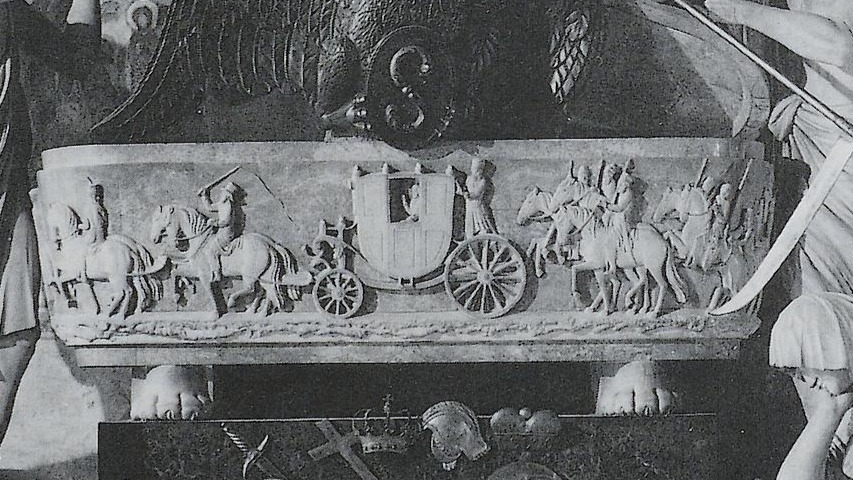
Detail of the sarcophagus relief, funerary monument of Bishop Kajetan Ignacy Sołtyk (1715-1788), Chapel of the Holy Cross, Wawel Cathedral, Kraków. The relief depicts Sołtyk’s deportation by Russian troops to Kaługa, 1767. Photograph: S. Michta, from Studia Waweliana, vol. 1, 1992, p. 86.

In the Holy Cross Chapel of the Wawel Cathedral in Kraków stands the funerary monument of Kajetan Ignacy Sołtyk, sixty-seventh Bishop of Kraków — commissioned by his nephew Michał in 1790, the year of Poland’s second partition. On the face of the sarcophagus, rendered in low relief, a carriage moves under cavalry escort along a road that leads, though the stone does not say so, to Kaługa, in the Russian interior. The year was 1767. Sołtyk had been seized by Russian troops by order of the Russian ambassador for opposing Russia’s political and religious program for the Commonwealth during the Sejm, bundled into a carriage, and driven east — a political abduction so brazen that it became, in the decades following, one of the founding outrages of Polish martyrological memory. He would not return for five years.

The monument transforms that enforced journey into the central scene of a man’s significance: not his episcopate, not his theology, not his political career, but the moment he was taken away against his will and transformed into a patriot-martyr — a transformation his later years, marked by mental collapse and withdrawal from public life, would do nothing to complicate in the popular memory.

That is one carriage.

There is another, less well-known but preserved in prose.

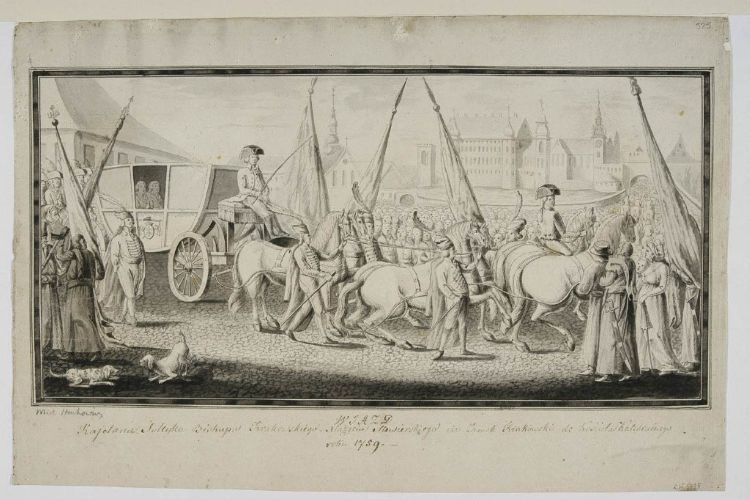
The Entry of Kajetan Sołtyk, Bishop of Kraków, Prince of Siewierz, into Kraków Castle to the Cathedral Church in the year 1759 (c.1814) by Michał Stachowicz (1768–1825).

The memoirist Jędrzej Kitowicz, describing the ceremonial processions that opened each session of the Sejm — the king riding from his palace to the Sejm, flanked by the ranked carriages of senators and deputies, each equipage expressing by the number of its liveried attendants the precise degree of its owner’s dignity — notes that the most elaborate display permitted by custom consisted of twelve lackeys and six haiduks (the tall liveried footmen whose Hungarian-style dress and ceremonial bearing made them among the most visible markers of aristocratic magnificence), a number not exceeded even by the king himself. In fact it was exceeded by one participant only. Kajetan Sołtyk, in the first year of his episcopate at Kraków, appeared in the procession of 1760 with twenty-four lackeys, twelve haiduks, and four pages. Already in his second year, Kitowicz adds with characteristic dryness, he had reduced this magnificent display to conventional proportions.

Two carriages, then. One at the height of his career, one at its nadir. One the expression of an ambition so consuming it overreached even the sovereign’s ceremonial precedence; the other the instrument of a foreign power’s contempt for Polish sovereignty and ecclesiastical dignity. In both, the bishop is being carried — not walking of his own volition, not the autonomous agent of his own movement, but the passenger of forces that exceed his will. In 1760 those forces are internal: a visceral hunger for visibility, for precedence, for recognition. In 1767 they are external and violent. But the structural resemblance is uncanny and instructive. He is always at the center of an attended vehicle. What changes is not the form, but only the hand that commands the escort.

Kitowicz does not moralize. He gives you the numbers — twenty-four, twelve, four — and then simply notes, almost in passing, the reduction that followed. Whether the correction came from rebuke or recognition of excess, the record does not say. It is enough that the excess was seen and then moderated and not repeated.

What the monument suppresses, and what Kitowicz preserves, is that earlier carriage: the one that moved through Warsaw under twenty-four lackeys, announcing to every observer that the newly installed Bishop of Kraków had arrived and was to be noticed above all others, including the king. Michał Sołtyk knew the record. He chose which carriage to put on the sarcophagus.

The choice, motivated by familial piety and political calculation, was not wrong — or not simply wrong, though neither was it uncontested. Sołtyk’s reputation has never settled into a single image. Those who remembered him as a patriot and victim were matched, even in his own lifetime, by those who remembered him as a man whose turbulent ambitions had done as much to destabilize the Republic as the foreign powers that preyed upon it. The martyrological image the monument proposes is one reading of the man — a powerful reading, and one that history has repeatedly ratified — but it is a reading, not a verdict. What it identifies correctly is the hinge. The deportation to Kaługa became the organizing fact of his significance. The twenty-four lackeys made him conspicuous for a season; the cavalry escort made his memory, his conspicuousness, permanent.

There is a certain grammar to this, whether one chooses to call it providential or merely historical. The force that humiliated him accomplished what his own will had sought, and failed, to secure: an uncontested image of magnitude, carried not along the Kraków Road in Warsaw but forward into a posterity that required, as Poland required, its martyrs. Sołtyk, a Catholic bishop and political operator with a pronounced taste for the theatrical and excess, would not have found the role uncongenial. The monument does not lie, exactly. It chooses. It fixes upon the carriage that tells the truth it prefers and lets the other fall away—not into oblivion, but into the keeping of a memoirist who recorded what he saw, and of those who return to it.


Sources

The fullest current scholarship on Sołtyk’s funerary monument and the attribution of its design to Father Sebastian Sierakowski draws on Joanna Daranowska-Łukaszewska, “Kto jest autorem nagrobka biskupa Kajetana Sołtyka w katedrze na Wawelu?” (Studia Waweliana, vol. 1, 1992). The account of the Sejm processions and Sołtyk’s ceremonial display is drawn from Jędrzej Kitowicz, Opis obyczajów za panowania Augusta III (Description of Customs in the Reign of Augustus III). Background on Sołtyk’s seizure and deportation draws on Kazimierz Rudnicki, Biskup Kajetan Sołtyk (Kraków, 1906), and on the archival and biographical materials assembled in the course of the author’s ongoing work on a biography of the bishop.

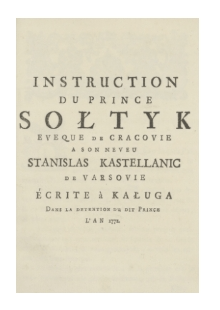
Instruction of Prince Sołtyk, Bishop of Kraków, to His Nephew Stanisław, Castellan of Warsaw — Written at Kaługa during the Detention of the Said Prince, in the Year 1771


The decrees of the Eternal One, to which I have always rendered a blind obedience and a perfect resignation, being beyond all fathoming, I do not know the term of my detention.

But judging that the time has come when you must go and see foreign lands, I write to my brother, His Excellency the Palatine of Łęczyca, that he may regulate your departure and your route.

With regard to your conduct, I prescribe to you certain articles which will serve you as light and guide in your travels, and will guard you, if you follow them, against every false step.

The most essential thing, and the first that I most earnestly recommend to you, is the Christian, Catholic, and Roman Religion, in whose bosom you were born and which you have professed since your childhood.

I protest to you by all that is most sacred that it is the best of all those that exist in the world.

It formerly united all others, but the world having inclined toward change, and men, through the weakness of their nature, being more inclined to evil than to good, the age has produced strong spirits who revolted against our Holy Mother the Church and went astray. Your age permits you to judge the danger of such errors.

Love, then, this holy Religion as your mother; respect her as your sovereign; and support her on every occasion.

Among so many people whom you will see, know, and frequent — even in Catholic countries — you will find monsters of abomination who will have no religion, or who, after the example of the Pharisees, will possess only its appearance. It is against such persons that you must be most on your guard, and you must support your Religion with all your strength, even to the shedding of the last drop of your blood, when the case demands it.

Religion, in its purity, being the source of all good, you cannot preserve it except by opposing the spirit of faith to those innovations that tend to weaken and destroy a Religion which cannot subsist without faith.


You must always be entirely convinced that you can succeed in nothing without the assistance of God. It is He who must guide you in your travels, in your studies, in your conduct, in your advancement, in all your progress, in your destiny in this world — and in what is of still greater importance, in the career which must lead you to eternity.

You cannot flatter yourself that you will obtain this assistance except by meriting His grace; and you can never promise yourself this grace without an entire confidence in God, without an irreproachable conscience, and without having a soul without stain. To this end I conjure you to choose one day in each month to make your Confession and to receive Holy Communion.

You will carefully observe hearing Mass every Sunday and on the Feast Days prescribed by the Church. You will take care to avoid the hours when certain churches are frequented only to put oneself on display, and you will choose those where you may attend Divine Service with the recollection that the sanctity of the place demands.

When you enjoy good health, observe religiously Lent and the other fast days. The perversity of the Age will perhaps attempt to cast ridicule on your conduct in this regard; but when one has done one’s duty, they can only wound those who, through a spirit of intellectual libertinage, seek something to censure. Such remarks, which can only be uttered by scatterbrains, must not turn you away from what the Church commands.

If illness requires that you renounce fasting, then follow the physician’s prescription, with the permission of the local Bishop or Curé, and preserve the sentiments of a good Christian.

True Piety is solid; it disowns hypocrisy; uprightness is its domain; it alone will inspire your duties, provide for your needs, and lead you to your end.

All your talents without it will become useless; and they will bear fruit without limit from the moment she accompanies them.

You will attend Sermons to perfect yourself in the ways of Salvation and to instruct yourself in the matters of holy doctrine.

It is not too much to ask of you a quarter of an hour morning and evening for meditation. Self-knowledge is the most instructive book we can consult; but who are those who truly wish to study themselves?


One seeks out all the works that appear, to charm one’s boredom, to flatter one’s self-love, or to satisfy one’s curiosity, and one neglects the examination of the Heart and the Soul, which can furnish us with far more useful instruction.

Nothing is rarer among men than knowledge of oneself; all other study is preferred to that of one’s own heart.

You have reason enough to understand how necessary this is for every Christian, and that it detracts in nothing from the estate of a man destined to live in the great world.

Flee absolutely from the wicked, and from those who make a way of being without character, without morals, without Religion, and without conscience; their feigned probity must be suspect to you.

As there will be some of this kind even among the honest persons you frequent, it is of the utmost importance to learn to discern them, in order to be able to avoid them.

You will succeed in this by informing yourself carefully, before committing yourself to any Society, of those who compose it, and by judging from the morals and character of those with whom you may bind yourself in friendship.

Would you cease to be good because the world abounds in the wicked? If you have ridicule to fear, it can only come from imitating bad originals. You will never run such risks by imitating the good actions of those who have one and the same Religion and virtue for their guide.

Guard yourself from reading bad Books as from a dangerous poison. Besides being condemned by the Head of our Church, you will draw no utility from them and will place yourself in danger of being perverted. There remain so many excellent books in all the sciences to which you may apply yourself that it is superfluous to seek out bad ones. Every obstacle that could oppose itself to the fruit you must gather from your education must be removed.

In the different countries you will see in your travels, you will observe the different forms of government — such as the Despotic, the Monarchical, the Aristocratic, the Democratic, and the Anarchical. You will combine their strengths and weaknesses in order to learn and appreciate that of your own Fatherland.

Far, then, from bringing back upon your return maxims injurious to the constitution of our State, you will strengthen more and more both mind and heart in the sentiments of the love you owe to your Nation.


You who would gamble away your money at play lose a precious time that you could employ to far better purpose. One makes enemies thereby, draws troublesome affairs upon oneself, inflames the blood, and risks verifying the Proverb that places on the same level the Gambler, the Dupe, and the Knave.

I do not forbid you games of commerce; I desire only that you not attach yourself to them with passion, and that you engage in them only out of complaisance when Society demands it, or as a relaxation after your studies. But my affection for you obliges me to use my authority to forbid you absolutely every game of chance.

Strive to cultivate a fund of gaiety of spirit; it suits young Gentlemen well, renders them agreeable in Society, contributes to their health, and seems to establish a certain harmony between mind and heart. But it must have nothing in common with coarse pleasantries, nor with a dissolute and indecent mirth; in a word, it must be rather the laughter of the soul than of the senses.

You will draw further instructions from His Excellency the Palatine of Łęczyca, my brother and your uncle. He has for you the very bowels of a father’s love, and his wisdom will supply what concerns the circumstances of your departure.

It is he who will choose for you a Governor, who will serve as friend and companion.

It is for you to observe strictly all that I prescribe here, all that Monsignor the Palatine will suggest to you, and all that your Mentor will counsel.

I have arranged your allowance; you will lack nothing. But as you are not yet of age to bear the burden of expenditure, the money will be placed in the hands of your Governor. He will spare nothing for what your needs require, and you will not demand of him any superfluity you could do without — since it is necessary that you learn in your youth to be generous without prodigality, and economical without avarice.

I flatter myself that the length of this writing will cause you no tedium, and that you will take it on the contrary as an evident mark of my tenderness, which interests itself in your glory, your honor, your reputation, your prosperity, your health, and the salvation of your Soul.

Count upon my affection as upon the thing in the world most assured to you — all the more since you are not unaware that I intend the succession of my estate to you after my death, if you render yourself worthy of it.

I also wish to persuade myself that you bear me friendship and gratitude; I ask of you a proof thereof that will cost you no more than half an hour each month, which you will employ in rereading this writing with attention.


You would afflict me deeply if you regarded these reflections as simple moral maxims uttered by a Bishop, or as a piece composed to display eloquence or erudition. I desire on the contrary to see you fully persuaded that it is a friend of the heart who speaks to you, who finds in it no other interest than your own.

I finish by embracing you tenderly and giving you my Benediction. I pray God and address to Him my most ardent vows, that He may assist you in your travels, your return, and shower you with His Benedictions.

CAJETAN SOŁTYK, PRINCE-BISHOP OF KRAKÓW, DUKE OF SIEWIERZ.


A Note on the “Instruction of Prince Sołtyk”

On the night of 13 October 1767, Russian troops, acting under the orders of Ambassador Nikolai Repnin, seized Kajetan Sołtyk, Bishop of Kraków, together with three other senators who had opposed Russian interference in the affairs of the Polish-Lithuanian Commonwealth. Without trial, charge, or any form of legal process, Sołtyk was carried across the border into Russia and confined at Kaługa, a provincial city some 150 miles southwest of Moscow, where he remained for five years.

At the time of his abduction, he was the most prominent Catholic bishop in Poland, occupying the see of Kraków, first among the dioceses of the realm. His seizure was immediately understood, both within Poland and across Catholic Europe, as an act of sovereign violation: the forcible removal of a senator and a bishop by a foreign power for actions taken in the course of a deliberative assembly.

It was in this captivity that Sołtyk composed the present Instruction, a letter of moral and practical counsel addressed to his nephew Stanisław, Castellan of Warsaw, who was preparing to undertake the customary tour of foreign countries expected of a young nobleman. The document is dated 1771, in the fourth year of his detention. Writing in French, the common language of Polish aristocratic culture, Sołtyk ranges across religion, self-knowledge, conduct in society, the dangers of bad company and bad books, the comparative observation of governments, and the prudent management of money and leisure. These themes are framed throughout by the unmistakable tenderness of a man who, though deprived of his liberty and removed from the exercise of his offices, retained undiminished his sense of episcopal authority, patrician dignity, and familial obligation.

The Instruction was subsequently published and circulated both as a personal document and as a form of political testimony: evidence that the captive bishop remained in full possession of his faculties and steadfast in his convictions. It stands as one of the more intimate texts to survive from Sołtyk’s long captivity, and among the more revealing—not as the rhetoric of martyrdom, but as the record of a great nobleman’s mind at work in confinement, attending, as best he could, to those he loved and to the reputation he intended to preserve.

The King’s Deliverance: Musical Tribute to King Stanisław August Poniatowski’s Rescue

THE KING’S DELIVERANCE – A “Hymn” commemorating the rescue of the King from an attempted kidnapping by the Bar Confederation conspirators in 1771.

It is with pleasure that I share with you The King’s Deliverance, a musical composition inspired by the 1771 AR Medal crafted by Johann Leonhard Oexlein. This piece sets to music the lyrics written to commemorate the remarkable escape of King Stanisław August Poniatowski from an attempted abduction by the Bar Confederation, a group of Polish nobles opposed to Russian influence in the Polish-Lithuanian Commonwealth.

The medal, with its powerful inscriptions from the Psalms and intricate artistic details, captures the moment when “divine providence” intervened to protect the king. It symbolizes not only his deliverance but also the mercy he showed towards those who conspired against him. This event, which unfolded on the night of November 3, 1771, had far-reaching consequences, ultimately strengthening the king’s position. The hymn highlights the themes of justice and divine protection.

For those interested in a more detailed exploration of the medal and the history of the incident, I refer you back to an earlier post where I provide a fuller explanation of these significant historical elements.

The King’s Deliverance seeks to encapsulate these historical themes through music and lyrics, offering a tribute to this significant moment in Polish history. You are invited to watch the video and reflect on the enduring legacy of King Stanisław August’s resilience and mercy.

Joachim Lelewel: An Exemplary Man of Modesty

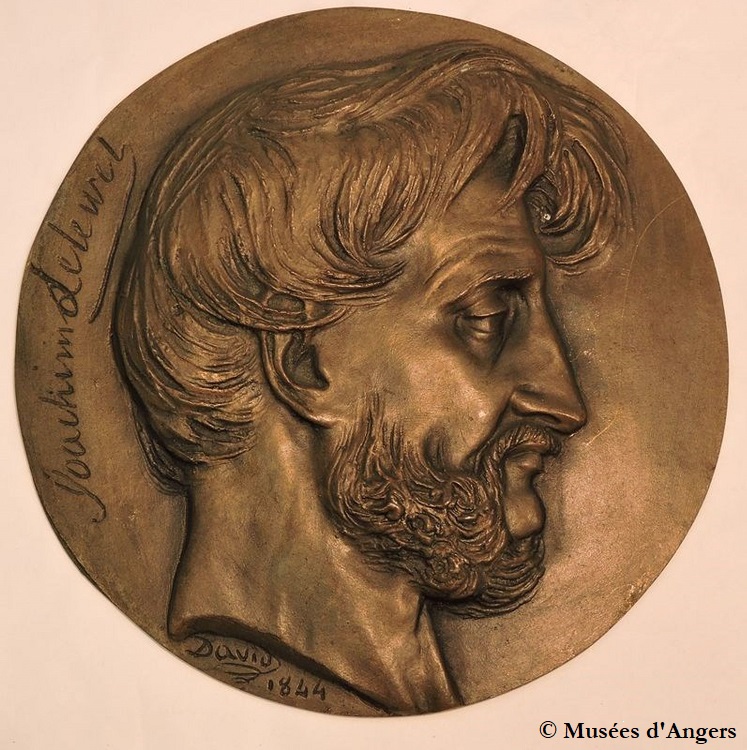
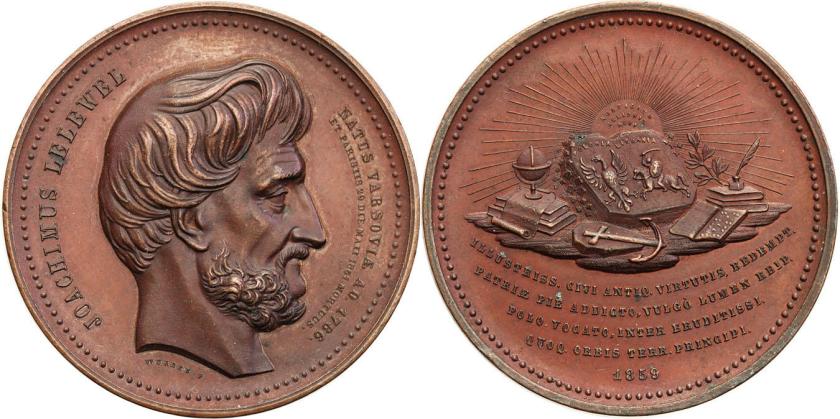
Bronze medal, 16.2 cm, of Joachim Lelewel, uniface, by David d'Angers, 1844.

Bronze medal, 16.2 cm, of Joachim Lelewel, uniface, by David d’Angers, 1844.


Joachim Lelewel, the esteemed Polish patriot, numismatist, historian, and geographer, has left an indelible mark on the field of medieval numismatics through his extensive research, publications, and profound expertise. Today, I had the pleasure of delving into an article from years past, which provided invaluable insights into Lelewel’s character and accomplishments (button links to article in original French and translation below). It is my fervent belief that Lelewel’s humility and modesty, virtues often lacking in today’s prominent figures, serve as a refreshing reminder of authenticity and integrity.


One striking aspect of Lelewel’s character was his remarkable aversion to having his portrait drawn or otherwise commemorated. Despite the fervent demand for his likeness from his countless admirers, he tenaciously resisted such endeavors. Nevertheless, his resolve was eventually breached, leading to the creation of one of the most renowned portraits of Lelewel—the medal by David d’Angers (1788-1856), a highly skilled sculptor and medallist of the 19th century.

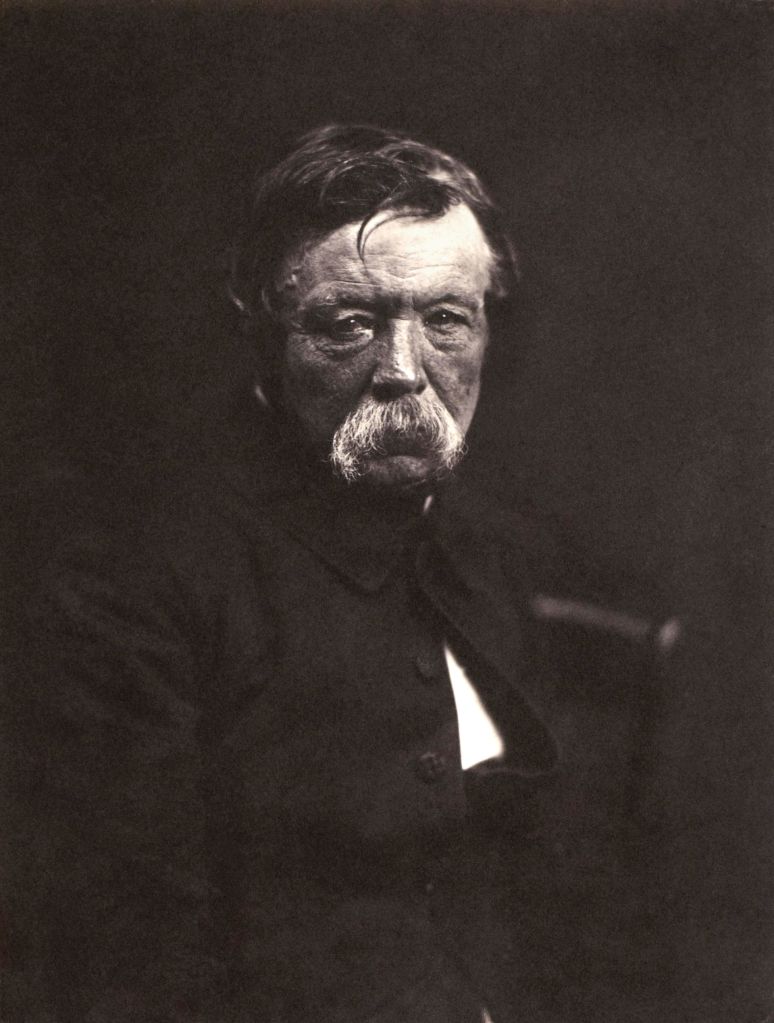
Photography of David d'Angers in 1853, photograph by Édouard Baldus

David d’Angers in 1853, photograph by Édouard Baldus


In an enlightening passage from the article, Lelewel’s correspondence sheds light on the creation of the medallion by David:

In the same collection of letters [written by Lelewel], we find some interesting details regarding the large medallion that David made of Lelewel. The few sentences we encounter in his letters show how much Lelewel avoided any publicity or external displays, even from his friends and his own family.

In response to a question posed by his brother Jean about his portrait, Lelewel replied on December 8, 1844: “I conclude this long letter with a little news that will let you know that if you won’t have the painting, at least you will soon have the satisfaction of seeing me in bronze. The very famous sculptor David has been making various efforts for a long time to obtain my profile. Recently, he stayed in Brussels and came to my place with a pencil in hand. I didn’t have the possibility to show him the door or snatch his pencil away, but he didn’t reach his goal without difficulties.[1] Finally, you will have me in bronze, rejoice!”

Jean became impatient and asked about the medallion. But there was no sign of life from David. “Has David done anything? I don’t know. He hasn’t sent me anything, but I’ve heard that he had other urgent works,” Lelewel wrote.[2] “I’m finally sending you two plaster medallions sent by David; they will certainly break at my place. If you want the one in bronze, come and get it yourself.” On January 20, 1846, Lelewel wrote, “David refused to make a portrait of the Prince of Orleans, but he sculpts vagabonds.”

Lelewel’s admirers made several medals in his honor, but the old loner was not at all proud. In one of his many letters,[3] he writes in a moment of good humor: “The Belgians steal from me; there is no doubt that my ‘facies’ is my material and intellectual property. They respect this property in such a way: Hart struck a large medal. Three copies of the small medal were brought to me by the Schoors brothers, wealthy numismatic enthusiasts whom I did not know before. Geefs, one of the top sculptors here, often came to my place without being invited. I thought his visits had a purpose and that he came to steal from me. It’s done! He told me that he has an order for a copy of my bust in alabaster for Volhynia or Podolia.” What Lelewel tells us about the difficulties he caused David when he wanted to draw his profile is perfectly true. He created difficulties for anyone who wanted to paint his portrait. Such cases often arose, as many of his Belgian and Polish admirers desired to have his likeness. From another source, we learn about the portrait of our scholar painted by Jean van Eycken. The widow of a friend of Lelewel, Mrs. Casimir Korybut-Daszkiewicz, was determined to have the portrait of this great patriot. As we know, it was not easy. But Jean van Eycken accepted the proposal and succeeded in painting the portrait through a trick. He painted through a partially opened door during a long conversation that Lelewel had with a Belgian democrat who was in on the secret. In this oil painting, Lelewel is depicted standing, his right hand resting on a cane, and his left hand placed behind his back in a gesture familiar to him. He is dressed in a blue working blouse. This portrait was later purchased by Chopin’s nephew, Colonel Henry Jedrzejewicz, who lived in Paris.

We also know of another portrait painted without Lelewel’s knowledge in 1854 by Guminski. This time, he is depicted sitting while drawing one of his geographical maps, with his left hand also behind his back. In the background, several shelves with books can be seen, as well as a chair holding his hat and handkerchief. Numerous photographs of this portrait were spread throughout Poland, and the original belonged to Jozefowicz, who resided in Paris.


[1] The drawing by David is in print room of the Royal Library of Brussels.

[2] Letter of May 1845.

[3] Letter of December 15, 1858.

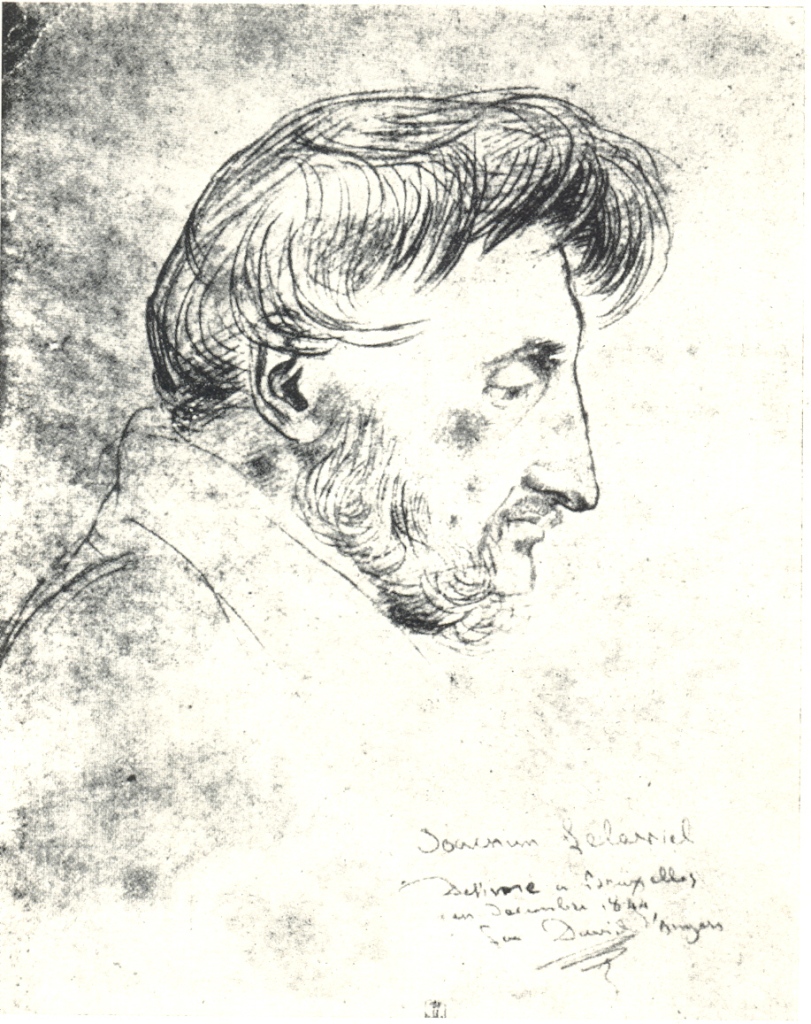
The pencil drawing created by David is extant. It was used to create the medal at the start of this posting.

Pencil drawing of Joachim Lelewel by David d'Angers, 1844.

Pencil drawing of Joachim Lelewel by David d’Angers, 1844.


The enduring impact of David’s medal of Lelewel resonated profoundly, inspiring numerous other artists to adopt his image for their own portraits. It is not difficult to find examples of other medallists who drew inspiration from David’s creation. Two notable examples immediately come to mind…

Bronze medal by Hart, 1858. H-Cz. 3932.


Bronze medal by Wurden, 1859. H-Cz. 5393.


The legacy of Joachim Lelewel includes not just his scholarship but his unwavering modesty and aversion to public display. The latter remain integral facets of his character that continue to captivate our imagination. His refusal to be immortalized in portraits and the anecdotes surrounding his resistance only serve to enhance our admiration for this exceptional man, whose contributions to numismatics and historical research endure to this day.

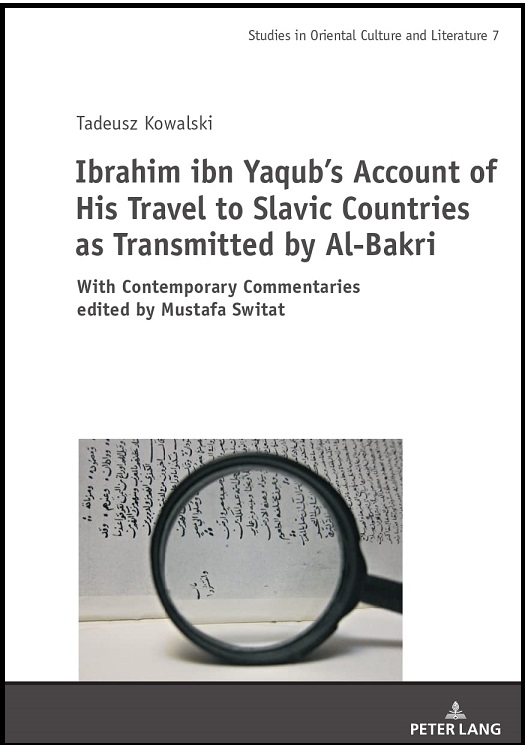
NEW BOOK: Tadeusz Kowalski. Ibrāhīm ibn Yaʿqūb’s Account of His Travel to Slavic Countries as Transmitted by Al-Bakri. With Contemporary Commentaries edited by Mustafa Switat.

Book Cover of Tadeusz Kowalski's Ibrahim ibn Yaqub's Account of His Travel to Slavic Countries as Transmitted by Al-Bakri. With Contemporary Commentaries edited by Mustafa Switat.
2022 Release of English Translation of Kowalski’s Invaluable Scholarship

In February 2022, my post entitled “Remarks on Mieszko’s Payments to His Warriors: ‘Market Weights’ or ‘Good Coins (Dirhams) of Fixed Value’?” noted that the above referenced translation of Kowalski’s 1946 foundational scholarship [Relacja Ibrāhīma ibn Ja’ḳūba z podróży do krajów słowiańskich w przekazie al-Bekrīego (Relatio Ibrāhīm ibn Ja’ḳūb de itinere Slavico, quo traditur apud al-Bekrī). Cracow: PAU, 1946] was forthcoming. I have been eagerly awaiting its arrival ever since. It has finally been published and, this week, I received my long-anticipated copy.

Previous to this translation of Ibrahim ibn Yaqub’s references to Slavic lands based on his travels in the 960s, I relied on the very able and sound English translations of Dmitrij Mishin (Mishin 1996) and Paul Lunde and Caroline Stone (Lunde and Stone 2012). I was aware of the 1946 Kowalski scholarship because all translations of Ibrahim ibn Yaqub’s original texts ultimately draw from the well of Kowalski’s 1946 magisterial work. Unfortunately, I was unable to draw upon that well both because of the language barrier and the physical inaccessibility of the work. The newly released publication allows me and others who faced similar barriers to finally access much of Kowalski’s original 1946 scholarship. Unfortunately, four of the original supplementary essays by other scholars in the work were not republished due to copyright issues. Although the essays were likely outdated, it would no doubt have been beneficial to understand the full scholarly context of the original publication to have had those essays in translation.

The new publication does not, ultimately, disappoint, in spite of the copyright issues limiting the completeness of its re-publication in translation. Of course, the heart of the work is its presentation of the translation, from Arabic, of Ibrahim ibn Yaqub’s references to Slavic lands. The translation is remarkably detailed, thorough, and heavily footnoted. It quickly becomes apparent that this translation is the first I will consult when I am researching and writing, as it is clearly the foundation upon which my understanding will be built. However, when writing narratively, rather than for scholarly purposes, my quotations will continue to come from Mishin or Lunde and Stone. One quick illustrative example will suffice to demonstrate why.

In Kowalski 2022, the first lines of the Arabic text are translated as follows (citations removed): “Slavs are those born {belong to descendants (come from descendant)} of Mādhāy Ibn {the son of} Yāfith. Their dwellings {continually} [spread] from the north to the west.” In Lunde and Stone 2012, the same lines are translated as follows:”The Saqāliba are the descendants of Mādhāy, son of Yāfith (Japheth) and they dwell in the north-west.”

Obviously, Kowalski is a translation foundational to scholarly understanding (especially with its abundant citations) whereas Lunde and Stone is a translation useable in flowing narratives.

The translation also includes extensive, helpful philological commentary, a reconstruction of the biographical identity of Ibrahim ibn Yaqub, and a very useful discussion of proposed dates for his travels. Of particular note are two new commentaries by Mateusz Bogucki and Mateusz Wilk. Bogucki contributed an entry entitled “Archaeological Commentary on Ibrāhīm ibn Yaʿqūb’s Account” while Wilk contributed one entitled “Ibrāhīm ibn Yaʿqūb’s Account in the Context of Source Analysis.” Finally, there are biographical notes, indices of names, and the Arabic text which was translated.

Although I am thrilled to add this work to my library, and will consult it frequently, as I already have, I am somewhat disappointed that the opportunity presented by its publication to attach the most recent, more clarifying scholarship, when warranted, was not exploited more robustly. Several areas where such updates were possible were identified in a 2006 conference celebrating the 60th anniversary of the publication of Kalkowski’s 1946 work. The conference papers were published in Zaborski, Andrzej (ed.).  Ibrahim Ibn Jakub i Tadeusz Kowalski w sześćdziesiątą rocznicę edycji, Cracow, 2008.

I wrote about one area of particular interest in my February 2022 post. Although that area was ostensibly addressed in Bogucki’s commentary in the new publication, Bogucki’s treatment of the issue is puzzling and incomplete, as I will discuss below.

In my February 2022 post, I quoted this excerpt from Mishin:   

Ibrahim Ibn Ya’Qub reported the following regarding Mieszko and his realm: “The country of Mashaqqah [that is Mieszko, earlier in the text identified as ‘King of the North’] is the largest one among the countries [of the Slavs].  It abounds in food, meat, honey, and agricultural produce.  The taxes are collected in market weights.  Those are the salary of his men in every month, and each of them has a certain amount of them to get.  He has three thousand warriors wearing coats of mail; a hundred of them is worth a thousand of other warriors in the battle.  He gives those men clothes, horses, arms, and everything they need.  If a child is born to one of them, he orders the child to be paid a maintenance, regardless of the latter’s sex.  When the child grows, and he is a boy, he marries him and pays the dowry to her father.  The dowry of the Slavs if very big, and they pay it in the same way as the Berbers do.  If a man, thus, has two or three daughters, he gets rich, but if he has two sons, he becomes poor.”  

Mishin (1996), pp. 187-188.

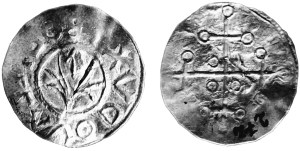
I noted that scholars have long focused on the references to the taxes collected and paid by Mieszko to support his three thousand warriors, the warriors which allowed Mieszko to expand, consolidate, and stabilize his realm because current scholarship does not support that Mieszko issued any coinage of his own. Rather, it shows that his son, Boleslaw Chrobry, struck Poland’s first denars between 992 A.D. and 1000 A.D. (see Suchodolski 2019 and Suchodolski 2015 for a discussion of which denars are contenders for earliest denars struck in Poland).

Denar of Boleslaus the Brave, one of the first coins struck in Poland, between 992 and 1000 A.D.  Image from Stanislaw Suchodolski article in WN from 2015.
Denar of Boleslaus Chrobry of Poland, ca. 992-1000 A.D. Tree of life with arrow, inscription / cross. One of the contenders for the first coins struck in Poland.
Photograph from Suchodolski 2015.

Accordingly, we must look elsewhere for what, exactly, Mieszko may have collected for taxes and used to pay his force of warriors.

Mishin, in his translation, indicated that Mieszko collected taxes in “market weights,” which were then used to pay his warriors a fixed monthly salary. As I noted in February 2022, Mishin based his translation, “market weights” for matāqīl al-murquatiyya, on Kowalski’s scholarship. Kowalski arrived at this rather peculiar translation because al-matāqīl or al-matākīl is the Arabic word for dinar, a gold coin, which did not circulate in Slavic lands and it was modified by a previously unattested or corrupted modifying word al-murquatīyya or al-marqatīya, which Kowalski rendered as market or commercial.

In a paper prepared for a 2006 conference celebrating the 60th anniversary of Kowalski’s remarkable scholarship regarding the testimony of Ibrahim Ibn Ya’qub, Andrzej Zaborski discussed this translation issue at length, noting that alternatives proposed over the years have include Byzantine money (a proposal widely rejected), legal tender/money, and his own hypotheses, “good coins of fixed value” or “coins of diminished value.”  Zaborski concluded that the translation issue required further investigation.  (Zaborski, pp. 64-65). 

In February 2022, I suggested that the text itself had revealed all that it would yield and that the evidence on the ground, or rather in the ground, argued that “good coins of fixed value” should prevail as the preferred translation. To support this contention, I appealed to the numismatic hoard evidence. Specifically, I made the following argument:

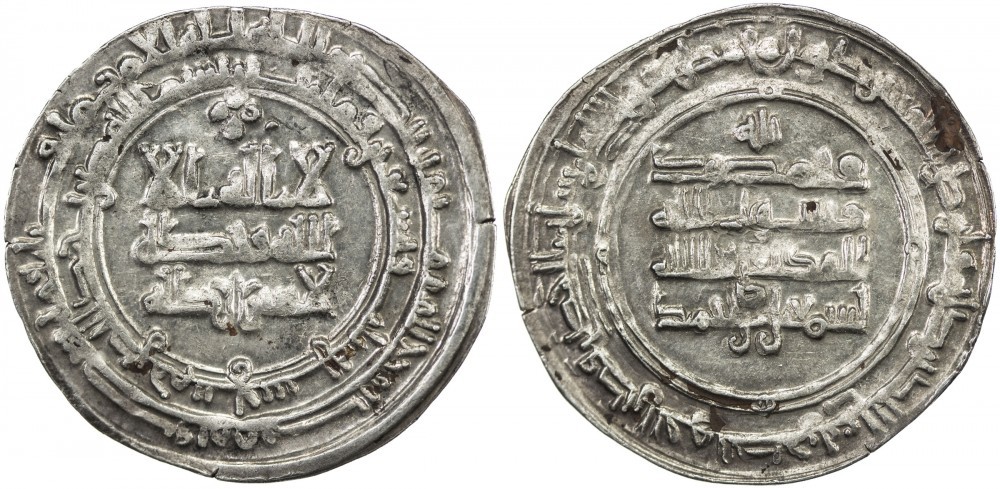
A SAMANID dirham of Isma'il I who ruled between 892-907 of the type that was found in hoards in Poland according to Bogucki.
A Dirham of the type found in hoards in Poland from the early 10th century.
SAMANID: Isma’il I, 892-907, AR dirham (2.89g), Balkh, AH293, A-1443.
Photograph courtesy Stephen Album Rare Coins.

Mateusz Bogucki discussed the use of silver dirhams in Slavic lands in 2011, based on hoard evidence, and divided the time periods during which the hoards went into the ground into seven phases.  Bogucki’s Phase III most aligns with the period during which Mieszko is referred to as collecting taxes and paying warriors salaries.  Here is, in part, what Bogucki has to say about that period: “Phase III (early tenth century). At the turn of the ninth and tenth centuries, an important change in dirham importation may be observed. A significantly greater number of hoards are known from the period 900-40, and they are much larger (up to 1,000 coins). They are found in eastern Poland, Great Poland and Pomerania. Dirhams are almost exclusively whole coins. Some complete (undamaged) ornaments also occur in the hoards. Analysis of the coins and ornaments demonstrates that, during this phase, two important routes were in use. Coins found in Pomerania came via the Baltic, whereas coins in the eastern parts of Poland and Great Poland arrived mainly via the eastern land-route” (Bogucki (2011), p. 136). 

In 2016, Bogucki explicitly tied the influx of dirhams into Poland to Mieszko’s use of mercenaries to consolidate his realm: “Assuming the chronology of the deposits is solid, it may even be suggested that the influx of silver to Wielkopolska from the East preceded the Pomeranian route by more than a decade and was initially greater in importance. The issue of the commodity exchanged for silver in the early-Piast state is still difficult to ascertain. It is apparent that the metal was needed to pay for mercenary services and to develop a proper network of administration and infrastructure based on strongholds. Archaeological research proves that the first half of the 10th century, when the core of the state in Wielkopolska was being established, brought destruction to a large percentage of tribal stronghold centres. Juxtaposing these facts with the chronology of the influx of oriental silver into Wielkopolska (discussed above) and the information found in written Arab sources, we may conclude that the economic basis for building the earliest Piast state came from selling slaves – the inhabitants of the destroyed tribal centres of Wielkopolska. By eliminating their hostile neighbours, the Piasts acquired silver, which they could use to consolidate their power” (Bogucki 2016, p. 246).

Based on the above, we know that Mieszko had access to good quality dirhams, in quantity, and that the dirhams were not yet always reduced to intensely fragmented hack-silver (where they would need to be regularly weighed to be paid out as a salary) as they were in later phases (such as Phase IV, from 970-1010 A.D., which Bogucki noted often included coins and items that were “intensely fragmented”).  This adds support to Zaborski’s hypothesis, and my contention, that the contentious translation should be “good coins of fixed value” rather than the unsatisfactory and less supportable “market weights.” I note that Bogucki, in a 2005 paper, made passing reference to the issue of the form of the warrior salaries (in an article that was poorly translated into English) without addressing the underlying translation issue:

In my opinion buying meat by silver doesn’t hinder from buying by the silver politically loyalty. In the matter of salary and taxes it’s better to quote the words of Ibrahim: ‘Received by him (king Mieszko I) taxes are trade weights. They are used as payment for his mans (knights). Each month to each man it’s a known number of it’ (Kowalski 1946, 50). Here is necessary to comment the term trade weights –mataqil murquatiyya. Ibrahim might have known the name of dirhems, the western European denars he called Kinszar, so I think that Ibrahim noticed the hack silver, taken not for pieces, but for weight. This relation doesn’t mean that salary and taxes weren’t paid in animals, grain or any other goods. But it shows, that in this matter it isn’t possible to give only one single answer.

Bogucki (2005), p. 1152.

So, in 2005, Bogucki published an article translating the Arabic phrase at issue as trade weights. He does so because he views the currency in circulation in the Polish lands at the time of Ibrahim ibn Yaqub’s writing as either whole dirhams or, more likely, intensely fragmented hack-silver. So, how does Bogucki view the issue in his commentary in the new translation in 2022?

Bogucki writes the following:

Ibrahim also wrote that in Mieszko I’s country, taxes were levied in al-matākīl al-marqatiya. This term was originally rendered as ‘commercial weights’; however, W. Kubiak has proved that the term actually denoted coins. Ibrahim seems to have used a familiar term to describe collecting fragmented silver by weight. The crucial information is that taxes were collected in metal coins. Naturally, it is difficult to assume that each peasant individually paid the prince in silver, but a complex fiscal system, where a peasant or a craftsman paid his due to the relevant official (the town comes) in produce, animals or products, and the official, in his turn, paid the prince with silver seems highly probable. Incidentally, Arab dirhams were widely used in Mieszko I’s country, a fact that Ibrahim fails to mention (he did note their use at Otto I’s court, however). It is worth recalling here that in the light of the most recent research, the slave trade, in which slaves were sold for Arab silver, played an important role in building Mieszko I’s power. Naturally, direct archaeological material does not corroborate the slave trade, but wide-scale archaeological studies seem to confirm this thesis.

Kowalski (2022), pp. 168-169.

Although it is gratifying that Bogucki is seemingly prepared to render the disputed phrase as referring to coins and no longer referring to weights, it is unclear how he would actually translate it, if at all. Is he proposing that the words be translated, as Kubiak did, as market money, or current coin, or market coin? I note that Zaborski, in reviewing Kubiak’s scholarship, was troubled by Kubiak’s interpretation as it relied on a translation that embraced etymology for market that was only attested in the 20th century in the Arabic dialect of the Jews of Algiers (Zaborski, pp. 48 and 65). The brevity of Bogucki’s comments on the issue leave these questions unaddressed, unfortunately.

On balance, however, the scholarly debate has advanced sufficiently that any translation of the phrase involving weights may be set aside. For my own purposes, I will leave the phrase untranslated, as Lunde and Stone do in their translation, and provide a note indicating that current scholarship understands the phrase as meaning current coin (e.g., dirhams and/or hack-silver).

REFERENCES/SOURCES: (Blue boxes may be clicked to be taken to reference works available online for review. Red boxes indicate reference works are not available for online review. If a link for a blue box is no longer working, please advise me of such as nca@northcoastantiquarian.com. Thank you.).

Note: Zabroski’s work is a compilation of scholarly papers read at a May 2006 conference celebrating the 60th anniversary of the publication of the first and most critical edition of Ibrahim Ibn Ya’Qub’s reports on the Slavs, which had been prepared and published by Tadeusz Kowalski [Kowalski, Tadeusz.  Relacja Ibrāhīma ibn Ja’ḳūba z podróży do krajów słowiańskich w przekazie al-Bekrīego (Relatio Ibrāhīm ibn Ja’ḳūb de itinere Slavico, quo traditur apud al-Bekrī). Cracow: PAU, 1946].