Music and lyrics for Angelus Novus, Angel of History. Lyrics inspired by Walter Benjamin’s essay, in which he dubbed Paul Klee’s Angelus Novus the angel of history. Music created through use of udio.com.
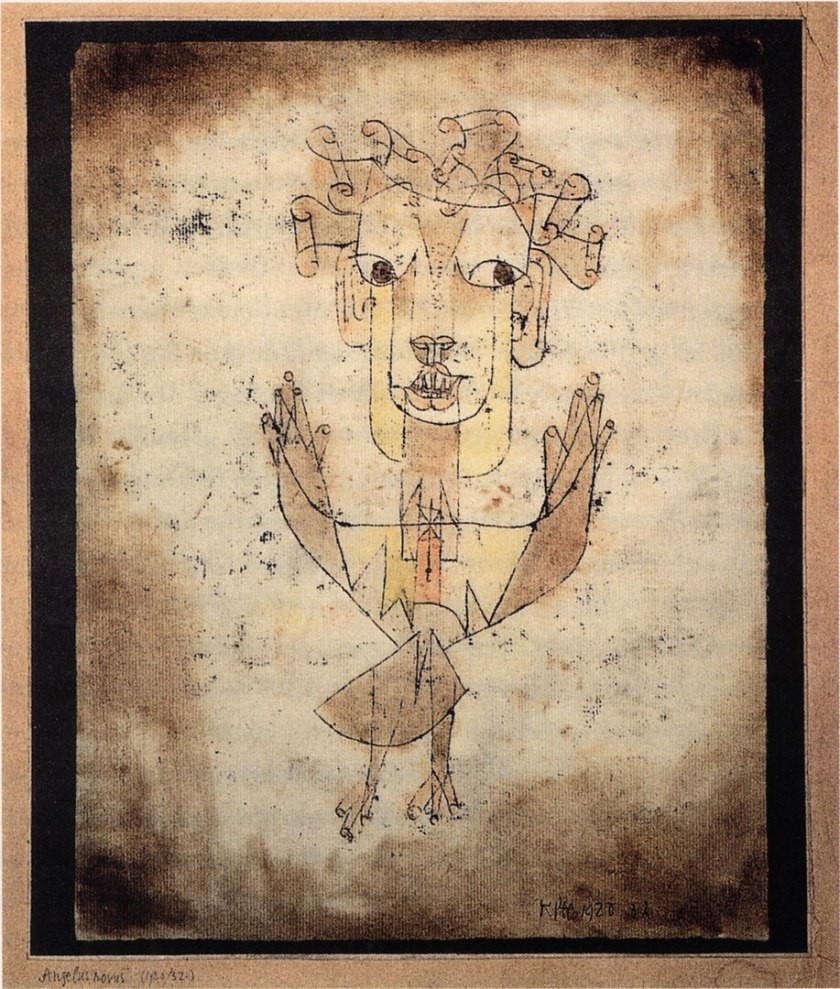
Angelus Novus, monoprint, 1920, by Paul Klee.
The Lyrics below were written by D.S. Yarab, and inspired by Walter Benjamin’s 1940 essay, On the Concept of History, in which Walter Benjamin dubbed Paul Klee’s Angelus Novus the Angel of History in the following haunting paragraph: “A Klee painting named Angelus Novus shows an angel looking as though he is about to move away from something he is fixedly contemplating. His eyes are staring, his mouth is open, his wings are spread. This is how one pictures the angel of history. His face is turned toward the past. Where we perceive a chain of events, he sees one single catastrophe which keeps piling wreckage upon wreckage and hurls it in front of his feet. The angel would like to stay, awaken the dead, and make whole what has been smashed. But a storm is blowing from Paradise; it has got caught in his wings with such violence that the angel can no longer close them. The storm irresistibly propels him into the future to which his back is turned, while the pile of debris before him grows skyward. This storm is what we call progress.” The music was created with artful prompts using AI at Udio.com.
It is safe to observe that neither lyricists nor composers are at risk of displacement. For proof, see, at the end of this post, below the transcription of my lyrics, the video of the work by the artist Laurie Anderson, who used the same Benjamin essay for inspiration for her work, “The Dream Before.” I came across her work several days after I posted my video and thought it would make a good addition to the original post so amended my post to include it.
Audio file of Eyes of Stone, an alternative musical setting of the Lyrics below.
Lyrics to “Angelus Novus, Angel of History” by Donald S. Yarab
Verse:
Angelus Novus stands alone, Gazing back with eyes of stone, Mouth agape, wings open wide, Witness to the endless tide.
Chorus:
Angelus, angel of history, Wreckage piled, a single catastrophe, Storm from Paradise, wings unfurled, Propels him onward, to the future hurled.
Verse:
Where we see events unfold, He sees ruins, stories told, Wreckage piling at his feet, Dreams of wholeness, incomplete.
Chorus:
Angelus, angel of history, Wreckage piled, a single catastrophe, Storm from Paradise, wings unfurled, Propels him onward, to the future hurled.
Verse:
Storm of progress, fierce and strong, Drives him ever, far along, Backwards facing, forward thrust, Dreams of past now turned to dust.
Chorus:
Angelus, angel of history, Wreckage piled, a single catastrophe, Storm from Paradise, wings unfurled, Propels him onward, to the future hurled.
Verse:
Angel yearning, dead to wake, Mend the shattered, for their sake, But the storm, it will not cease, Angel’s plight, no sign of peace.
Chorus:
Angelus, angel of history, Wreckage piled, a single catastrophe, Storm from Paradise, wings unfurled, Propels him onward, to the future hurled.
Coda:
Angelus Novus, forward driven, By the storm, no peace is given, Angel of history, face of sorrow, Through the wreckage, towards tomorrow.
The past few days I have been researching the muse of History, Clio. That led me to read (and re-read) a highly academic article written by Stephen Bann in 1987 entitled “Clio in Part: On Antiquarianism and the Historical Fragment.” Aside from leading me to then read a wonderful essay by Nietzche entitled “On the Use and Abuse of History,” it led me to view the Paul Klee monoprint above, Angelus Novus. About which:
Walter Benjamin purchased the monoprint in 1921. Mr. Benjamin committed suicide in 1940 to escape the Nazis. In any event, in the ninth thesis of his 1940 essay “On the Concept of History”, Walter Benjamin describes Angelus Novus as an image of the angel of history and writes:
“A Klee painting named Angelus Novus shows an angel looking as though he is about to move away from something he is fixedly contemplating. His eyes are staring, his mouth is open, his wings are spread. This is how one pictures the angel of history. His face is turned toward the past. Where we perceive a chain of events, he sees one single catastrophe which keeps piling wreckage upon wreckage and hurls it in front of his feet. The angel would like to stay, awaken the dead, and make whole what has been smashed. But a storm is blowing from Paradise; it has got caught in his wings with such violence that the angel can no longer close them. The storm irresistibly propels him into the future to which his back is turned, while the pile of debris before him grows skyward. This storm is what we call progress.”
A useful explanatory work of scholarship explaining the work which I recommend is Behind the Angel of History: The “Angelus Novus” and Its Interleaf by Annie Bourneuf (University of Chicago Press, 2022). The YouTube video below is also a nice summary of the monoprint and Benjamin’s connection with it.
Clay tablets. Story of Gilgamesh and Aga. Old Babylonian period, 2003-1595 BC. Sulaymaniyah Museum, Iraqi Kurdistan. (CC-BY SA 4.0. Dr. Osama Shukir Muhammed Amin).
Homer, even if the fictive creator of the Iliad and the Odyssey, is inseparable in the mind from those masterful and inspiring works of literature. Equally inseparable should be Sin-lēqi-unninni from the Epic of Gilgamesh.
Andrew George, whose engaging translation of the Epic of Gilgamesh is readily acknowledged by later translators of the epic as “a master class in philological precision and ingenuity,” has this to say about Sin-lēqi-unninni:
According to Babylonian tradition the [Epic of Gilgamesh] was the work of a certain Sîn-lēqi-unninni, a scholar from Uruk who was believed to have been a contemporary of Gilgamesh himself. However, Sîn-lēqi-unninni bears a name of a kind not found before the second millennium, so the tradition clearly preserved an anachronism. Instead, there is little doubt that Sîn-lēqi-unninni’s name was associated with the epic because he was the man who gave it its final, fixed form. Sîn-lēqi-unninni is thus one of the earliest editors in recorded history. From a comparison of the standard version of the first millennium with the older fragments we know that the person responsible for the standard version remodeled the poem. He provided it with a new prologue and recast the story to emphasize the theme of wisdom gained through suffering. Probably he was responsible for interpolating a version of the flood story, adapted from the old poem of Atra-hasis, and for appending to the epic as Tablet XII the rump of one of the Sumerian poems of Bilgames in an Akkadian prose translation. He left his mark also on the prosody, reducing variation in parallel and similar passages by combining their lines and repeating them verbatim to produce a text characterized by long sections of repetition where older versions had none. For this he often stands accused of damaging the poem’s literary qualities, but at the same time it can be argued that he introduced a profundity of thought that was probably lacking in the older versions.
Though the editorship of Sîn-lēqi-unninni probably changed the poem so radically that it is no wonder the Babylonians later named him as its author, it is clear from the multiple versions of the second millennium and from the existence of textual variants in the standard version of the first millennium, that he was not the only individual to leave his mark on the written epic. However, we know nothing of these others.
George, Andrew (2008) ‘Shattered tablets and tangled threads: Editing Gilgamesh, then and now.’ Aramazd. Armenian Journal of Near Eastern Studies, 3 (1). pp. 11-12.
George, perhaps, does an injustice to Sin-lēqi-unninni, by relegating him to the role of editor alone. Sin-lēqi-unninni was not mere scribe, nor compilator, nor even editor; rather, because of the number and weight of the substantive additions and structural changes he made to the epic, we may rightly view him as an ingenious co-creator of the ever-inspiring epic, such that modern publications could have a title page reading Sin-lēqi-unninni’s Epic of Gilgamesh.
The life that you seek you will never find: when the gods created mankind, death they dispensed to mankind, life they kept for themselves.
The Epic of Gilgamesh (2020), A. George, p. xlv
Two other translations of the poem in my library, both meritorious and worthy of note, include the recently published Gilgamesh: A New Translation of the Ancient Epic, by Sophus Helle (2021), which sought to strike a middle ground between George’s scholarly translation and the “translations of translations,” which can be used to described the other work in my library, Stephen Mitchell’s Gilgamesh (2004). Harold Bloom described Mitchell’s version of Gilgamesh as the “best I have seen in English” at the time it was published.
Gilgamesh is a well I go to for reflection and creative thought repeatedly. This is not surprising, as The New York Review of Books concisely notes that Gilgamesh inspires reflection and creativity on a multiplicity of levels:
In the century and a half since its rediscovery, however, and especially since World War II, Gilgamesh has made up for lost time. It has been translated into at least two dozen languages and been the inspiration for countless works of theater, film, poetry, fiction, and visual art. Musical responses to Gilgamesh include several operas, a ballet, hip-hop, jazz fusion, and an ear-pummeling track called “Gilgameš” by the Greek extreme metal band Rotting Christ.
Gilgamesh has also been acclaimed as the earliest work of ecological literature and included in The Columbia Anthology of Gay Literature as a founding text of queer writing, for its treatment of the relationship between Gilgamesh and his wild-man friend, Enkidu. The cultural energy of Gilgamesh shows no sign of dimming; the novelist Naja Marie Aidt describes it as a “fireball” that “has torn through time,” constantly in a process of reentry to the present.
New York Review of Books (October 20, 2022), “A Fireball from the Sands,” by Robert Macfarlane.
Some of my favorite more recent creative endeavors include two musical works. The first is a Lament on the Death of Enkidu, set to music and sung in Akkadian, based on the poetry of the epic. Peter Pringle, the creator, notes that he was helped along in his pronunciation of the Akkadian by Dr. George. It is simply stunning. Take a moment to listen and reflect on your mortality.
Gilgamesh’s Lament for the Death of Enikidu
The second is a nod to the ecological message that many find in the epic related to the consequences of the indiscriminate felling of the cedar forest in Lebanon. As explained in the New York Review of Books:
During the UK’s pandemic lockdown, [Robert] Macfarlane cowrote an album with the singer-songwriter and actor Johnny Flynn, Lost in the Cedar Wood. They collaborated on lyrics, sharing photos of notebook pages while in their respective homes, and Flynn would set them to music. “It felt like a wild wonder, to be able to feed words into the Johnny Flynn Song Machine and get a demo back a few days later!”
In addition to daily life in lockdown, the album is inspired by the Epic of Gilgamesh: “We wanted to write something both ancient and urgent,” said Macfarlane. “At the heart of Gilgamesh is the story of an unwise ruler, Gilgamesh himself, taking his axe to the Sacred Cedar Wood and felling these extraordinary trees. A few months after we began work on it, the Fairy Creek calamity started to unfold on Vancouver Island, with the premier of British Columbia, John Horgan, allowing the logging of the old-growth cedar forest there, including trees up to 2,000 years old.” Lines like “It was the first of the tellings/Of all of the fellings” (from the song “Tree Rings”), while unfortunately evergreen, took on a particular significance.
New York Review of Books (July 10, 2021), Ramblin’ Man. Robert Macfarlane, interviewed by Willa Glickman.
Johnny Flynn and Robert Macfarlane’s Tree Rings
To circle back to the beginning, this remarkable creativity is very much, I believe, the result of the creativity and authorship of the ancient editor of the Epic of Gilgamesh, Sîn-lēqi-unninni. He deserves more credit for the depth and reflection which is inspired by the ancient epic in its most familiar form. Let us celebrate his memory every time we read the epic or enjoy any of its derivative inspirational works.
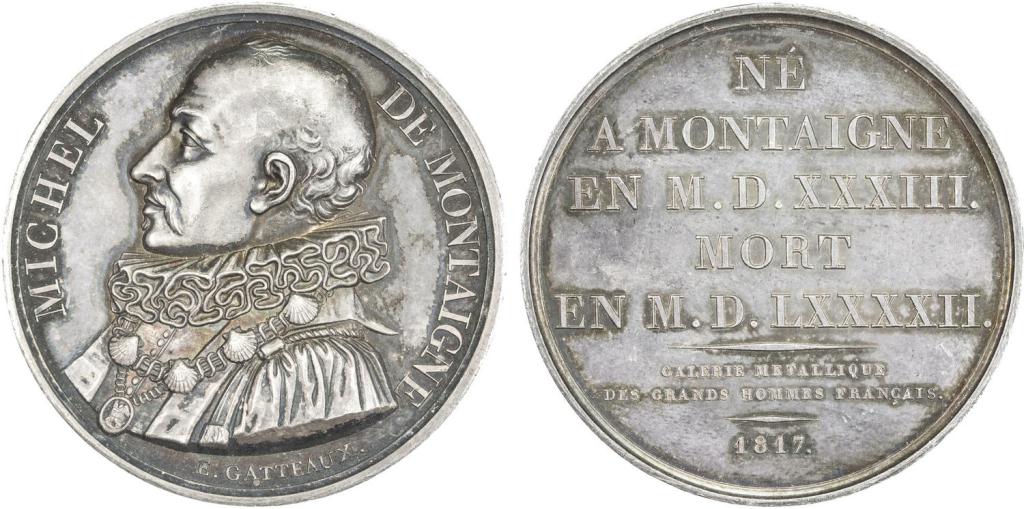
AR medal, 1817, 41mm by E. Gatteaux of Michel De Montaigne. Bust of De Montaigne left, MICHEL DE MONTAIGNE around, engraver E. GATTEAUX below // NE’ / A MONTAIGNE / EN M. D. LXXXIII. / MORT / EN M.D.LXXXXII. / GALERIE METALLIQUE / DES GRANDS HOMMES FRANCAIS. / 1817. Ex: STEPHEN ALBUM RARE COINS, AUCTION 29, LOT 748. Image and description courtesy Stephen Album Rare Coins.
“I quote others only in order the better to express myself.”
In The Origins of Money (Philip Grierson. The Origins of Money. Research in Economic Anthropology, Vol. 1, 1978, pp. 1-35), Grierson, in discussing the origin of monetary values, noted that monetary values pre-existed market economies and that monetary values were well-attested as existing in “customary” and “command” pre-market societies. He stated that “[i]n such societies [monetary values] provided a scale for evaluating personal injuries in the institution which the Anglo-Saxons termed the wergild, and it is in this institution that the origin of money as a standard of value must, I believe, be sought. The practice of wergild, that of paying a compensation primarily for the killing of a man but the term by extension covering compensations for injuries to himself or his family and household, is most familiar to us in its Indo-European setting” (p.12). Grierson proffers various supporting evidence for his thesis, but one linguistic and one quite trivial and ancillary struck my fancy.
Grierson’s linguistic argument presents concisely and rather convincingly the connection between monetary value and its compensatory use in its opening paragraph (although, I note, that his evidence, linguistic and otherwise, does not, of course, dilute other arguments for the origins of money that are often discussed that are unrelated to markets):
“Our best approach to the problem is through the testimony of language, often the most revealing key to the structure of early societies. It has naturally not been neglected by writers on early money. Everyone is familiar with the connection of pecunia and pecus – this was known to the Romans themselves – of fee and O.E. feoh, cow (mod. Germ. Vieh), of the derivation of shilling and rouble (rubl’) from verbs meaning to cut (skilja, rupit’. i.e., pieces of precious metal), of the relationship of talent, lira, and pound with the process of weighing metal. What we are concerned with, however, are not particular units but the notion of money in general and how it was first used. Much of our own vocabulary is borrowed from Latin by way of French and is not relevant to Germanic antiquities, though one may note in passing that pay comes through Fr. Payer from Lat. pacare “to pacify” ‘to make peace with,” and that behind the idea of appeasing your creditor lies the more revealing pacere, to come to terms with the injured party. Si membrum rupsit, ni cum eo pacit, talio esto, “If a limb is injured, unless peace is made with him (i.e., with the injured party, by paying compensation), there shall be retaliation,” was the Roman doctrine, as set out in the Law of the Twelve Tables” (footnotes redacted, pp. 15-16).
After exploring his linguistic argument, Grierson noted that it might be difficult to generalize from the available “compensatory law codes” for the pre-market Germanic, Celtic and Russian societies to other early pre-market Indo-European societies but he noted that the available codes provide an extraordinary wealth of detail. In this regard, he noted that the compilers of the codes “sometimes seem to be trying to provide for every contingency, of however improbable a nature.” “The other is their occasional frivolity, for some of their provisions, especially in the Celtic codes, must have been inserted more or less in fun. How else can one explain … the responsa of Cormac Mac Art and Cennfaeladh in the Book of Aicill providing compensations for bee stings – Irish bees were apparently of unexampled ferocity – but allowing a deduction of the value of a bee from the compensation if the bee was killed by the injured party? Clearly such provisions were not meant to be taken seriously” (p 17).
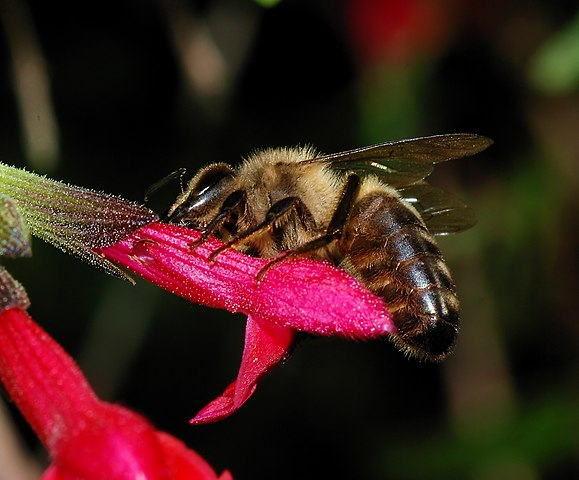
The unexampled ferocity of Irish bees had me immediately scampering to find out more about the Book of Aicill, its authors, and precisely what it said about Irish bees and how their attacks were to be compensated. Having examined the Book of Aicill, I would disagree that frivolity was intended. Either the section was intended in earnest or was intended as an example of how an arbiter should reason through similar, but perhaps more likely and just as serious, injuries. For here is what the pages dedicated to the ferocious Irish bees said in the book:
Injuries in the case of bees. That is, a hive is the fine for the blinding, and two hives for the killing of a person; and a book mentions the hive for the blinding, and it does not mention two hives for the killing; but as there is twice the ‘eric’-fine due from a person for killing a person that there is for blinding him, it is right from this, that it is twice the ‘eric’-fine which is due from a bee for blinding him that should be due for killing him. A man’s full meal of honey is the fine for drawing blood; a fifth of the full meal for an injury which leaves a lump, three-fourths of it for a white blow which leaves a sinew in pain, or green, or swollen, or red; if it be one or two of these injuries that are present, it (the penalty) is one-fifth with half one-fifth; one-fifth only for his natural white wound. A hive is the fine for the death-maim necessitating the removal of a limb, but if there be no removal of a limb, it (the fine) is a hive, less one-seventh; two-thirds of it for a ‘cumhal’-maim; one-third of it for a tent-wound of six ‘seds’; one-sixth or one-seventh part is to be added to it for the tent-wound of seven ‘seds.’
From the owners of the bees these fines are due for the persons. What shall be due from the persons for the bees? If the person has killed the bee while blinding him or inflicting a wound on him until it reaches bleeding, a proportion of the full meal of honey equal to the ‘eric’-fine for the wound shall be remitted in the case; the remainder is to be paid by the owner of the bee to the person injured. If the person killed the bee while inflicting a white wound upon him, they (the fines) shall be set off against each other. If the person killed the bee while inflicting a lump-wound on him, four-fifths of the fine shall be remitted, and one-fifth paid. If it was while inflicting a white wound which left a sinew under pain, or green, or swollen, or red, he killed the bee, three-fifths of the fine are to be remitted, and two-fifths paid. If it was while inflicting one or two of them (the wounds) he killed the bee, half one-fifth is to be remitted, and one-fifth paid. From the owners of the bees these fines are due for the persons, and from the persons for the bees. What shall be due from the owners of the bees for the animals injured, and from the owners of the animals for the bees? If the bee has blinded or killed the animal, what shall be the fine for it? The proportion which the hive that is due from the owners of the bees bears to the fine for their blinding the person, or which the two hives that are due for their killing him bear to the natural body-fine of the person, is the proportion which the full natural dire-fine of the animal shall bear to that fine which shall be due from the bee for blinding or killing it (the animal). One-half of what is due for killing it is due for blinding it, or inflicting a death maim which necessitates the removal of a limb; if there be no removal of a limb, it (the fine) is one-half, less half one fifth, if it be a quadruple animal; or one-half, less the half of one-half, if it be an animal of double. Two-thirds of this are due for a ‘cumhal’-maim; one-third for a tent wound of six ‘seds’; and an equivalent of a sixth or seventh part is to be added to it for a tent- wound of seven ‘seds,’ over and above what shall be due for the tent-wound of six ‘seds.’
What shall be due from a bee for making the animal bleed? The proportion which the full meal of honey that is due from a bee for making a person bleed bears to the hive that is due from it for killing him, is the proportion which the ‘eric’-fine for blinding or killing the animal bears to that which will be due from a bee for making it bleed, i.e. four-fifths is the proportion for its lump-wound, three-fifths for its white wound which leaves a sinew in pain, or green, or swollen, or red. If it be one or two of them that are inflicted, it (the fine) is two-fifths and half one-fifth. Two-fifths is the proportion for a natural white wound. From the owners of the bees these fines are due for the animals. What shall be due from the owners of animals for the bees? If the animal killed the bee while in the act of blinding it, or killing it, or inflicting a wound upon it until it reaches bleeding, a proportion of the ‘eric’-fine for the wound equal to a full meal of honey shall be remitted, and the remainder shall be paid by the owner of the bee to the owner of the animal. If it was while in the act of causing the animal to bleed it (the animal) killed the bee, they i.e. the bleeding of the animal and the killing of the bee, shall be set off against each other; or else, indeed, according to others, the difference which is between causing a person to bleed and causing an animal to bleed is the difference that shall be paid by the owner of the animal to the owner of the bee. If it was while inflicting a lump-wound on it the bee was killed, four-fifths shall be remitted, and one-fifth, the difference, paid. If it was while inflicting a white wound which left a sinew in pain, or green, or swollen, or red, the bee was killed, three fifths shall be remitted, and two-fifths, for the difference, paid. If the bee was killed while inflicting one or two of them (the wounds), two-fifths and a half shall be remitted, and two-fifths and a half, for the difference, paid. If the bee was killed while inflicting a natural white wound on it (the animal), one fifth shall be remitted, and four-fifths, for the difference, paid.
If there were many gardens, or if there were many bees, lots are to be cast to discover from which garden the injury was done; and when it shall have been discovered, if there were many possessions in that garden, lots are to be cast on them till the particular possession be discovered from which the injury was done; and when it shall have been discovered, if there were many hives’ in that possession, lots are to be cast upon them until the particular hive from which the injury was done shall have been discovered. And the reason why this is done is, that a bad hive may not be given in place of a good hive, or that a good hive may not be given in place of a bad hive; but that the very hive from which the injury was done may go for the injury. If it was intentionally or inadvertently in unlawful anger the person killed the bee, a man’s full meal of honey shall be given as compensation, and four full meals as dire-fine. If it was inadvertently in lawful anger he killed the bee, a man’s full meal of honey is given as compensation, and two full meals as dire-fine. If it was through unnecessary profit he killed the bee, only a full meal of honey is given as compensation. This is due from the bees of a native freeman for a person; the half thereof from the bees of a stranger; a fourth of it from the bees of a foreigner; there is nothing due from the bees of a daer-person, until it reaches sick maintenance or compensation, or, according to others, even when it does. From the bees of a native freeman this is due for a person; four-sevenths thereof from the bees of a stranger; two-sevenths and one-fourteenth from the bees of a foreigner; there is nothing due from the bees of a daer-person, until it reaches sick maintenance or compensation, or, according to others, even when it does. From the bees of a native freeman this is due for a cow; the half thereof from the bees of a stranger; a fourth of it from the bees of a foreigner; and there is nothing from the bees of a daer-person until it reaches sick maintenance or compensation, or, according to others, even when it does. From the bees of a native freeman this is due for a horse; half thereof from the bees of a stranger; a fourth of it from the bees of a foreigner; and there is nothing due from the bees of a daer-person until it reaches sick maintenance or compensation, or, according to others, even when it does. From the bees of a native freeman this is due; a fourth thereof from the bees of a stranger; a half and a seventh from the bees of a foreigner; an exact half from the bees of a daer person.
The sophistication of the compensatory structure regarding damages for injuries from bees discussed in the Book of Aicill does not strike me as being as frivolous as Grierson suggested when one considers that the temperature of a cup of coffee from a fast food franchise which spills onto an elderly woman, an incident deemed by many frivolous, can justifiably make a successful $2.9 million tort claim in the American legal system (Andrea Gerlin. A Matter of Degree: How a Jury Decided That a Coffee Spill Is Worth $2.9. Wall Street Journal. September 1, 1994). So perhaps the sagacity and foresightedness of authors of the Book of Aicill were greater than Grierson and others perceived.
As to the authors, Laurence Ginnell (Laurence Ginnell. The Brehon Laws: A Legal Handbook. T. Fisher Unwin, London, 1894), provided a colorful, even if antiquated background, for them and the Book of Aicill in his legal handbook well over century ago. I quote liberally from therein:
The whole of the Book of Aicill is composed of the opinions or placita of two eminent men, illustrious in law and in other respects: The first was King Cormac mac Airt, otherwise called Cormac ua Cuinn; the second was Cennfaeladh the Learned. Cormac was one of the most deservedly celebrated of the monarchs of ancient Erinn. He was Ard-Rig from A.D. 227 until 266 (according to others from 218 until 260). He was, as his names signify, the son of Art and the grandson of Conn of the Hundred Battles, both monarchs of Erinn, and he was the father of Cairbre who may be said to have succeeded him, the very short reign of Eochaidh alone intervening. He was also the father of Grainne, celebrated in the Fenian poetry of Oisin and his contemporaries. In youth he was violent enough, perhaps unscrupulous in pursuit of power; but his subsequent life proved that his ambition rose from the solid basis of ability to rule men; and to this extent, as also by the use he made of power when acquired, he justified himself. He was a great reformer of the national institutions of his time, civil and military, including the Feis of Tara; and most of the traces of its former greatness now existing at Tara are attributed to his time. Consistently with his reforming spirit, he was a great patron of literature, art, and industry, the first of whose patronage we have undoubted evidence. He either wrote himself or procured the writing of several works on law, history, and other important subjects. Some of these works on subjects other than law were still extant so late as the seventeenth century, but appear to have been since destroyed or lost. Among the useful things for which the country was indebted to Cormac was the introduction of the water-mill. He had the first mill erected on a small stream on the slope of Tara. He was a man in many respects far in advance of his time. Though living long before Saint Patrick’s arrival, and king of a pagan nation, there is reason for thinking that he was a believer in Christianity before his death. He at all events ceased to believe in the pagan gods. …
According to one Gaelic authority Cormac was the author of the text of the Book of Aicill throughout, and Cennfaeladh afterwards modified and commented on the whole of it, besides adding some of the case law which had grown up in the interval. And I am inclined to think that this view is correct. However, the introduction to the Book of Aicill gives a different account, and naturally it is that usually accepted. It begins thus: “The place of this book is Aicill, close to Tara, and its time is the time of Coirpri Lifechair (Carbre of the Liffey), the son of Cormac, and its author is Cormac, and the cause of its having been composed was the blinding of the eye of Cormac by Aengus Gabhuaidech.” Owing to the loss of his eye, Cormac became incapable under the Irish law of retaining the sovereignty, “because it is a prohibited thing for one with a blemish to be king at Tara.” The sovereignty was transferred to his son, after a temporary usurper had been got rid of, and Cormac retired to Aicill, now called Skreen, near Tara. It is stated that in difficult cases he was consulted by his son the young king. However this may be, a great deal of the Book of Aicill is written as if in answer to questions submitted, and the answer in each case begins with the words, “My son, that thou mayest know.”
It was on account of this injury to his eye that Cormac expelled the Deisi from the district in Meath still from them called Deece, and drove them to Munster where they settled and gave their name to a district there also.
Having told where, when, on what occasion, and by whom, the book was first written, the introduction proceeds: “These were the place and time of it as far as regards Cormac. But as regards Cennfaeladh, its place is Daire Lurain (now Derryloran, in Tyrone), and its time was the time of Domhnall, son of Aedh, son of Ainmire; and its author was Cennfaeladh, son of Oilell, and the cause of its being composed was that part of his brain was taken out of his [Cennfaeladl1’s] head after it had been split in the battle of Magh Rath.” The Domhnall (Donal) in whose reign this occurred was monarch of Ireland and fought the battle of Magh Rath (now Anglicised Moira) in A.D. 634 (? 642) against Congal Claen, king of Uladh.
The foregoing statements are remarkably clear and explicit. They represent the Book of Aicill as the production of two authors, one writing in the third century, the other in the seventh. Notwithstanding this, Sir Henry Maine, the standard authority on ancient law, in his learned discoveries of “village communities” where they never existed, represents Cennfaeladh as assisting Cormac! Worse still, I find an Irish author saying gravely that Cormac was just the man to appreciate Cennfaeladh’s services! Granted that Cormac was highly endowed, still the power of appreciating services rendered more than three hundred years after his owndeath can hardly be conceded even to Cormac mac Airt; and if he had such power, any express recognition of Cennfaeladh’s services would then have been rather premature.
In future, after considering the above, when confronted with a ferocious Irish bee, you may have occasion to reflect on the Book of Aicill and the ultimate origins of money. And, more importantly, if in future you are injured by said ferocious Irish bee, you will know what compensation you may seek for redress for the injury inflicted from the owner of the hive of the mischievous bee.