Aristonicus of Pergamum: Rise And Fall

The content details the historical events surrounding the rise and fall of Eumenes III, also known as Aristonicus, in the kingdom of Pergamum. It explores the political turmoil and power struggles involving Rome, rebellions, and military confrontations. The narrative also touches upon the potential for a compelling play or opera based on these events, with a focus on the character development of key figures. The text is supplemented with an excerpt from a possible libretto, where Aristonicus reflects on his fate. Overall, it provides rich material for dramatic storytelling, combining historical significance with personal introspection.

A snippet of Aristonicus’ story as “opera.”

The Roman Prequel: Tiberius Gracchus and the Bequest of Attalus III

In the late 130s BC, Tiberius Gracchus, serving as a tribune in Rome, emerged as a polarizing figure through his vigorous advocacy for the passage of the lex agraria. This legislation aimed to redistribute land from the affluent elite to the impoverished masses, engendering substantial animosity among the propertied interests. Reflecting the entrenched hostility of these interests, the Roman Senate obstructed the law’s implementation by withholding the requisite funding, thus stymying Gracchus’ reformist agenda.

In 133 BC, the political tensions reached a crescendo when Tiberius Gracchus “accepted” the bequest of Attalus III of Pergamum. Upon his death, Attalus III bequeathed his kingdom, personal treasure, and royal estates to the Roman people. This testament explicitly excluded the city of Pergamum, other Greek cities with their respective territories, and temple lands from the bequest. Gracchus sought to employ this newfound wealth to finance his agrarian reforms, viewing it as an opportunity to alleviate social inequalities. However, his opponents perceived this maneuver as an audacious encroachment upon the Senate’s prerogatives and an exacerbation of the threat to property rights and societal propriety.

Kingdom of Pergamum circa 188 B.C. under the Attalid Dynasty
The Kingdom of Pergamum, located in Asia Minor, was ruled by the Hellenistic Attalid Dynasty. This dynasty was founded by Philetairos, who ruled from approximately 282 to 263 B.C. In 188 B.C., the kingdom greatly benefited from the Treaty of Apamea, whereby the Roman Senate granted Pergamum extensive territories formerly held by the defeated Seleucid Empire.

In the wake of these escalating tensions, Gracchus’ adversaries felt justified in resorting to extralegal measures. In a purported “defense” of property and societal order, they orchestrated the murder of Tiberius Gracchus and unceremoniously disposed of his body in the Tiber River. A subsequent purge of his followers from the political sphere ensued, marking a dark chapter in Rome’s history. This brutal response underscored the lengths to which the conservative elite were willing to go to preserve their privileges and stifle reformist efforts.

The Challenge to Attalus III’s Bequest in Pergamum: Rise of Aristonicus

The statue of Aristonicus, known as Eumenes III, King of Pergamum between 133-129 BC, which stands in the city of Pergamum, now known as the city of Bergama, Turkey.

Meanwhile, in Pergamum, Aristonicus, the half-brother of Attalus III and son of Eumenes II and a harpist or lyre-player from Ephesus, declared his intention to seize the throne of Pergamum by right of his lineage, irrespective of the intentions of Attalus III and the Romans. Adopting the regnal name Eumenes III, Aristonicus garnered significant support, amassing both troops and ships, and commenced his campaign to conquer the kingdom of Pergamum. Initially, he achieved notable successes both on land and at sea. He raised the standard of uprising at Leucase, Phocaea joined him, and he conquered Colophon, Notium, Samos, and Myndus. His efforts were further bolstered by his ability to secure sufficient precious metals and strike them into coinage, as evidenced by the cistophorus illustrated below. The coinage series, and its significance, is discussed in an interesting 2021 article written by Lucia Carbone, “A New-ish Cistophorus for the Rebel Aristonicus.”
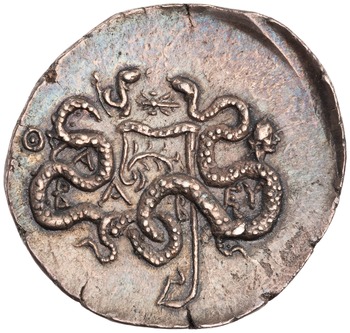
Reverse of AR cistophorus of Eumenes III of Pergamun featuring two coiled serpents between bow-case and bow. BA EY, a winged thunderbolt above the bow-case and a beardless male head in field right. ANS 1944.100.37579 American Numismatic Society

Roots and Support of Aristonicus’ Uprising

Aristonicus’ uprising was fundamentally rooted in the succession crisis following the death of Attalus III. As an illegitimate son of Eumenes II, Aristonicus claimed the throne of Pergamon under the name Eumenes III, challenging the Roman claim based on Attalus III’s testament. His campaign can be viewed through several lenses:

  1. Dynastic Claim: Aristonicus presented himself as the rightful heir to the Pergamene throne, contesting the Roman-imposed transition. This dynastic legitimacy resonated with certain segments of the population who were loyal to the Attalid lineage.
  2. Social and Economic Grievances: The uprising tapped into widespread discontent among various social groups, including disenfranchised citizens, slaves, and other marginalized populations. Aristonicus’ promise of social reform and liberation found a receptive audience among those dissatisfied with the existing social and economic order.
  3. Anti-Roman Sentiment: There was considerable resentment towards Roman interference and the impending direct control over Pergamon. Aristonicus’ resistance symbolized a broader opposition to the expansionist policies of Rome and its impact on local autonomy.

Support Base

Aristonicus’ supporters came from diverse backgrounds, reflecting the multi-faceted nature of the uprising:

  1. Disenfranchised Individuals and Slaves: A significant portion of Aristonicus’ forces consisted of slaves and lower-class citizens. The promise of freedom and a more equitable society motivated these groups to join the uprising. Aristonicus’ vision of a utopian society, often referred to as “Citizens of the Sun” (Heliopolitae), aimed to create an egalitarian state that resonated with these marginalized groups [Recent scholarship provides ample grounds to re-evaluate the significance and meaning of the Heliopolitae titulature and the role of slaves/disenfranchised individuals. (see Daubner in sources below)].
  2. Local Greek Cities: While some Greek cities in Asia Minor supported Rome, others were sympathetic to Aristonicus, driven by a desire to preserve their autonomy and resist Roman dominance. These cities provided crucial support in terms of resources and manpower.
  3. Mercenaries and Soldiers: Aristonicus also attracted professional soldiers and mercenaries who saw an opportunity in the conflict. Their military expertise was vital in the early successes of the uprising.

Eumenes III (Aristonicus): The Struggle for Support and Survival

Eumenes III (Aristonicus) faced significant challenges in his bid to consolidate power. Despite his initial successes, he failed to win over many citizens of the city of Pergamum itself and was unable to conquer the city. It is plausible that the citizens believed they would be better off freed from royal governance and trusted that the Romans would honor Attalus III’s will by not incorporating them directly under Roman rule. Furthermore, Eumenes III did not gain the support of the kings of neighboring Hellenistic kingdoms, all of whom marched against him at Rome’s behest. These neighboring monarchs, wary of Aristonicus’ revolutionary ideals and eager to maintain favorable relations with Rome, aligned themselves against him.

Despite this formidable opposition, Rome’s local allies initially struggled to subdue Eumenes III. His forces proved resilient and capable, inflicting notable casualties on their adversaries. A significant moment in the conflict was the death of Ariarathes V of Cappadocia, who perished in battle against Aristonicus’ forces, underscoring the intensity and ferocity of the resistance. The support Aristonicus garnered from disenfranchised groups, including slaves and lower-class citizens, played a crucial role in sustaining his campaign against the combined might of Rome and its allies.

By 131 BC, the Romans were compelled to dispatch an army under the command of the consul Publius Licinius Crassus Mucianus to confront the challenge posed by Eumenes III and secure the legacy bequeathed to them by Attalus III. However, Crassus Mucianus was captured by Eumenes’ forces and, after striking one of his captors, was killed. His decapitated head was sent to Eumenes III, marking a grim turn in the conflict. This event underscored the determination and ferocity of Aristonicus’ resistance, significantly alarming Rome and its allies.

The Beginning of the End for Aristonicus

Although the defeat of a Roman army could have signaled the beginning of success for Eumenes III, it was, in fact, the onset of his decline. This turn of fortune came not at the hands of the Romans, but from Ephesus. Unsettled by the new king’s numerous naval victories and conquests, Ephesus armed a fleet and engaged Eumenes III in battle off the coast of Cyme in Aeolis. The outcome was decisive, forcing Eumenes to abandon the coast and withdraw into the interior.

This defeat also marked a transformation in the character of Eumenes III’s reign. In an effort to broaden his appeal and replenish his forces, he called upon peasants from royal domains, slaves, and others whom historians characterize as underprivileged. To the slaves, he promised freedom; to the others, economic relief. His appeal was successful, and multitudes responded to his call. He named his new followers Heliopolitae [Ἡλιοπολῖται], Citizens of the Sun.[1] This utopian vision of a society based on equality and justice resonated deeply with those disenfranchised by the existing order.

Ideological Influences: Blossius of Cumae and the Heliopolitae

One must wonder if Eumenes was motivated in the “social program” of his recruitment campaign (e.g., emancipation and economic relief) by his reported association at this point with the Stoic philosopher Blossius of Cumae, a devoted ally of Tiberius Gracchus. Blossius had fled Rome after Tiberius’ murder and attached himself to Eumenes. Some historians perceive Blossius’ ideological influence in the Heliopolitae movement. Blossius, having been a proponent of the Gracchan reforms, likely brought with him a philosophical foundation that emphasized social justice and the alleviation of inequality. His presence in Eumenes III’s court suggests a continuity of the radical ideas that had stirred Rome, now transplanted to Asia Minor and adapted to the local context.

The Final Defeat and Capture of Eumenes III

In the wake of Crassus’ defeat in 130 B.C., the Roman Senate dispatched the consul Marcus Perperna to subdue Eumenes III and secure the Kingdom of Pergamum for Rome. Perperna promptly arrived, assembled his troops, and marched into the interior, where he decisively defeated Eumenes. Aristonicus had expanded his campaign inland, focusing on regions such as Lydia and Mysia, including the strategic city of Kyzikos. His efforts in these areas were marked by a combination of military engagements and political maneuvering to gain the support of local populations. Despite these efforts, Eumenes was ultimately outmatched by the superior Roman forces. Following his defeat, he fled to the city of Stratonicea, where the Romans besieged him. The siege was marked by a protracted struggle, as the Romans systematically cut off supplies, starving the city and its defenders into submission. Ultimately, Eumenes was captured and sent to Rome in chains. In 129 B.C., the Senate decreed his execution by strangulation, thus extinguishing his challenge to Roman authority.

Consolidation of Roman Rule and the Fate of the Heliopolitae

Following the capture of Eumenes III, the Romans proceeded to organize the new province of Asia, despite ongoing resistance from the remnants of the Heliopolitae. These remnants, inspired by the egalitarian ideals of Aristonicus, continued to resist Roman domination. However, their defiance was brutally quashed by the Romans, who resorted to poisoning the water supplies of their impregnable strongholds—a tactic even they considered disgraceful. By 129 B.C., or 127 B.C. at the latest, the Romans had likely secured their Attalid inheritance, fully integrating the territory into the Roman Republic.

Is there a libretto or play in the story above?

This exposition is recited with confidence that it provides rich source material for a compelling play or opera. Indeed, I have begun work on such a project, sketching the broad outlines of a libretto—acts and scenes—and have already written substantial portions. Recognizing my weaknesses in character development, I am focusing on refining this aspect. However, I am pleased with one section I have written. After Aristonicus has been captured and is in chains, he contemplates his situation. Below is a scene I have written, set to music so I have a sense of the possibilities:

Audio Music file of Aristonicus in Chains (Lyrics by D.S. Yarab, Music created using Udio.com)

Aristonicus in Chains

Setting: A dark Roman dungeon. Aristonicus, bound in chains, reflects on his fate and the enduring spirit of his cause.

Aristonicus (Recitative):

Oh fate, thou art a cruel mistress,
To wrest my dreams and cast them low.
Yet here I stand, though bound in chains,
My spirit soars, untouched by woe.

Aristonicus (Aria):

In chains, my spirit stands free,
No Roman yoke shall master me.
For in my heart, a kingdom lives,
A beacon bright, the Sun still gives.

Oh, Citizens of the Sun,
Your hope was mine, our battle won,
Not in the fields where we did fall,
But in the hearts that heeded our call.

From Pergamum’s hills to the wide sea,
Our dream of freedom shall always be.
Though walls of stone around me rise,
The Sun shall never set on skies.

Oh, Perpernas, behold my fate,
A king unbowed by Roman hate.
For even in this darkest hour,
My will remains, my soul has power.

(Bridge):

To the poor and enslaved, my voice shall reach,
In every heart, our cause I’ll teach.
No chains can hold what is divine,
Our struggle, our dream, forever shine.

(Aria da capo):

In chains, my spirit stands free,
No Roman yoke shall master me.
For in my heart, a kingdom lives,
A beacon bright, the Sun still gives.

Oh, Citizens of the Sun,
Your hope was mine, our battle won,
Not in the fields where we did fall,
But in the hearts that heeded our call.

(Recitative):

So take me now, to Rome’s great halls,
But know this truth, as empire falls:
A dream once born, can never die,
In chains, my spirit soars the sky.

SOURCES:

Africa, T. W. (1961). Aristonicus, Blossius, and the City of the Sun. International Review of Social History, 6(1), 110-124.

Daubner, F. (2006). Bellum Asiaticum: Der Krieg der Römer gegen Aristonikos von Pergamon und die Einrichtung der Provinz Asia (2nd ed., Quellen und Forschungen zur Antiken Welt 41). München: Herbert Utz Verlag. [*Daubner’s work is the current definitive study on the Aristonicus uprising and the establishment of the Roman province of Asia. It challenges many of the outlines of the traditional scholarship over the past century (including much presented in my post above) and concludes that there is extraordinarily little evidence to suggest that he was the utopian social reformer that earlier scholars feared or lionized in their writings. In a sense, his scholarship is sober prose based on all the current and continuously emerging evidence whereas what came before (and what I write above) is akin to romantic poetry based on the then sparse antiquarian fragments. Yet, some scholars still adhere to the older interpretations of Aristonicus as a social reformer. See the work by Mesihović , below, as an example.]

Hochard, P.O. (2021). Quand Aristonicos s’écrit avec un E. Bulletin De La Société Française De Numismatique, 76(02), 47–54.

Magie, D. (1950). Roman Rule in Asia Minor (Vol. 1). Princeton University Press, 147-158.

Mesihović, S. (2017). Aristonik i država Sunca (Drugi dio: Aristonicus Solis Reform). Radovi Filozofskog fakulteta u Sarajevu, Knjiga XX, 2017.[Mesihović, without taking note of – let alone attempting to address – Daubner’s scholarship, reiterates the argument that Aristonicus’s movement was fundamentally reform-oriented and revolutionary. He iterates that the movement aimed to challenge the existing social and political structures by advocating for social and democratic reforms, thereby attracting support from the lower classes and slaves. He stresses that Aristonicus’ movement was not merely a struggle for control of the Attalid kingdom but had a significant ideological dimension, seeking to establish an egalitarian and communal society, which posed a substantial threat to the established order of both local elites and the Roman authorities. The views encompassed in this work serve as the basis for an operatic libretto, as it is poetic, but may have been superseded as scholarship.]

Thonemann, P. (2013). Attalid Asia Minor: Money, International Relations and the State. Cambridge University Press. [Of particular note is how Thonemann’s first chapter characterizes the Attalid state as an innovative and unique monarchy that emerged in the second century BC. The Attalids transformed their kingdom from a small city-state into a major territorial power, characterized by a non-charismatic and decentralized style of rule. They implemented a federative model, portraying their state as a coalition of free cities rather than a centralized monarchy, and emphasized civic participation and local governance. This approach was reflected in their economic policies, such as the introduction of the cistophoric coinage, which supported the kingdom’s administrative and fiscal autonomy. The expansion of the state was largely a result of the Treaty of Apameia in 188 BC, which redistributed Seleukid territories to the Attalids, significantly enlarging their realm and elevating their political status.]


[1] The Heliopolitae (Citizens of the Sun)

The concept of the Heliopolitae, or “Citizens of the Sun,” is a central theme in understanding Aristonicus’ revolt. This term embodies the utopian and revolutionary ideals that Aristonicus promoted to garner support from various disenfranchised groups.

  1. Symbolism and Ideals: The name “Heliopolitae” is symbolic of Aristonicus’ vision for a new society based on equality and justice. It represents a community united under the metaphor of the Sun, which signifies enlightenment and purity. This ideological framework was used to attract slaves, the poor, and other marginalized groups by promising them freedom and a better social order​​.
  2. Historical Accounts: Strabo and Diodorus provide key historical accounts that describe how Aristonicus retreated into the interior regions of Lydia after a naval defeat and rallied the oppressed classes, including slaves, around his cause. Strabo mentions that Aristonicus promised freedom to these groups, who then became known as the Heliopolitae​​.
  3. Scholarly Debate: The article highlights the debate among scholars regarding the nature and significance of the Heliopolitae. Some view it as evidence of a broader social revolution, akin to other slave revolts in antiquity, while others argue it was a strategic move by Aristonicus to consolidate his power. The text suggests that while there is evidence to support both views, the primary aim was likely to use ideological rhetoric to strengthen Aristonicus’ claim and unify his diverse followers​​.
  4. Religious and Utopian Context: The term “Heliopolitae” also carries religious connotations, linking the movement to solar worship and the Hellenistic tradition of divine kingship. This religious aspect provided additional legitimacy to Aristonicus’ rule and helped create a cohesive identity among his supporters. The use of the term is compared to other utopian experiments, but the article emphasizes that Aristonicus’ movement was distinct in its context and execution​​.

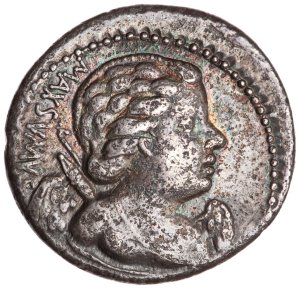
For St. Valentine’s Day: A denarius of the Roman Republic from 75 BC with an obverse featuring “Cupid with quiver and bow over shoulder”.

In Greek mythology, Cupid is known as Eros and is amongst the first gods. Hesiod records the following:

The First Gods

In the beginning there was only Chaos, the Abyss,

But then Gaia, the Earth came into being,

Her broad bosom the ever-firm foundation of all,

And Tartaros, dim in the underground depths

And Eros, loveliest of all the Immortals, who

Makes their bodies (and men’s bodies) go limp,

Mastering their minds and subduing their wills.

Hesiod, Theogony, 116-122

Of course, in contemporary culture, Eros, or Cupid, has become associated with Romantic love, and thus, the modern contrivance of Valentine’s Day.

Image of modern cupid with bow and arrow

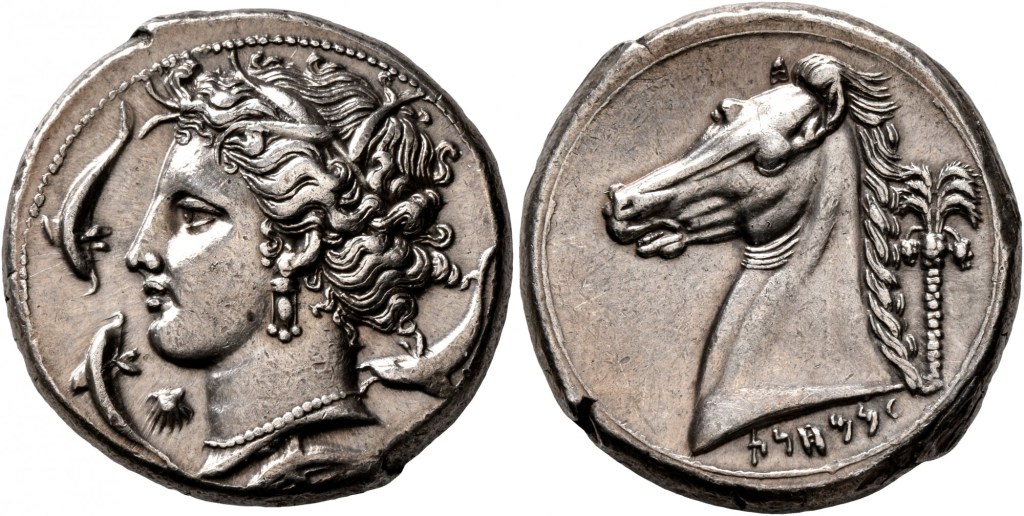
A Stunning SICULO-PUNIC Tetradrachm, circa 320-300 BC

Very few coins are, literally, breathtaking. The above coin is breathtaking. It sold at a Stephen Album Rare Coin auction for well-over its conservative estimate, and deservedly so, on January 20, 2022. It is most reminiscent of the slightly better example of the same type (also Jenkins 161) that sold for slightly less (8500 CHF, approx. $8,485) in Leu Numismatik’s 2019 Auction 4 as Lot 178.

Siculo-Punic AR Tetradrachm, c. 320-300 BC, People of the Camp mint, 17.00g.  Jenkins-161.  Numismatik Leu Auction 4, Lot 178 (2019).   Realized 8500 CHF on 4000 CHF Estimate.
Siculo-Punic AR Tetradrachm, c. 320-300 BC, People of the Camp mint, 17.00g. Jenkins-161. Numismatik Leu Auction 4, Lot 178 (2019). Realized 8500 CHF on 4000 CHF Estimate.

In the final decade of the fifth century BC, the Carthaginians launched a series of invasions of Sicily, conquering much of the western half of the island. The Carthaginian presence lasted for a century and a half, until Rome’s victory in the First Punic War obliged the Carthaginians to withdraw.

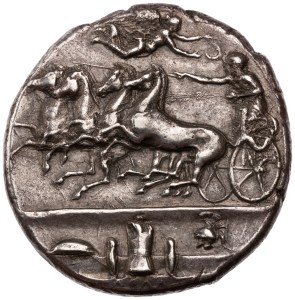
During their occupation of Sicily, the Carthaginians struck an extensive coinage for the purpose of financing their military operations and the maintenance of garrisons. Many of these coins were “military issues” and, surprisingly, labeled as such (i.e., as “camp” issues). The obverse and reverse types of the coins in the military series are mostly influenced by Sicilian prototypes, particularly those of Syracuse. The obverse of the Siculo-Punic Tetradrachm of which I am writing was inspired by the Syracusan AR decadrachm c. 400 BC signed by Euainetos. As noted by N.K. Rutter in Greek Coinages of Southern Italy and Sicily (Spink, London, 1997), it was copied by the Carthaginians because “… the reference to a Syracusan coin-type would have meant something to a Greek mercenary” (p.157).

G. Kenneth Jenkins studied these issues in his Coins of Punic Sicily (Parts I-IV, 1971-1978), and noted that the camp mint, once it was operating in Sicily, was most probably located in Lilybaion (Part III, p.11). This proposed location for the camp mint has been the object of debate for years and other locations have been proposed. For instance, Ian Lee, surveying the literature and reexamining the evidence for the earliest Punic coinage in Sicily, more recently concluded that the camp mint was located at Entella (LEE, IAN. “Entella: The Silver Coinage of the Campanian Mercenaries and the Site of the First Carthaginian Mint 410-409 BC.” The Numismatic Chronicle (1966-), vol. 160, Royal Numismatic Society, 2000, pp. 1–66, http://www.jstor.org/stable/42668259).

Siculo-Punic Tetradrachms, such as the one sold by Stephen Album Rare Coins, were ultimately destined to pay Greek mercenaries. The tetradrachms’ visual familiarity combined with its being struck to the Attic weight standard (c. 17.2 g.) rather than the Phoenician weight standard (c. 14.3 g. to the shekel or tetradrachm) usually used by the Carthaginians would have made it the perfect mechanism for payment to its intended recipients. [See Visonà, Paolo. “CARTHAGINIAN COINAGE IN PERSPECTIVE.” American Journal of Numismatics (1989-), vol. 10, American Numismatic Society, 1998, pp. 1–27, http://www.jstor.org/stable/43580385, p. 4, for discussion regarding adoption of Attic weight standard due to military exigency].

An Attractive Silver Didrachm of the Greek Colony of Selinus in Sicily with a Crane on the Reverse

AR Didrachm from Greek colony of Selinus in Sicily (c. 450BC). Obv: Inscription, Hercules about to club the Cretan bull. Rev: Inscription above, River-god Hypsas sacrifices at altar with serpent coiled around it; at right selinon (celery) leaf above crane.  ANS 1957.172.629. American Numismatic Society.

Yarab is an Anglicized spelling of the Slovak surname Jaráb.  It is a zoonym, which is a name of an animal.  That animal is a crane, for in 19th century Slovak Jaráb is akin to the Czech word jeřáb, which means crane. Accordingly, when I happened across the the above coin from Selinus, depicting a crane on its reverse, I had to learn a little bit more about the history of Selinus and the imagery appearing on this stunning coin.

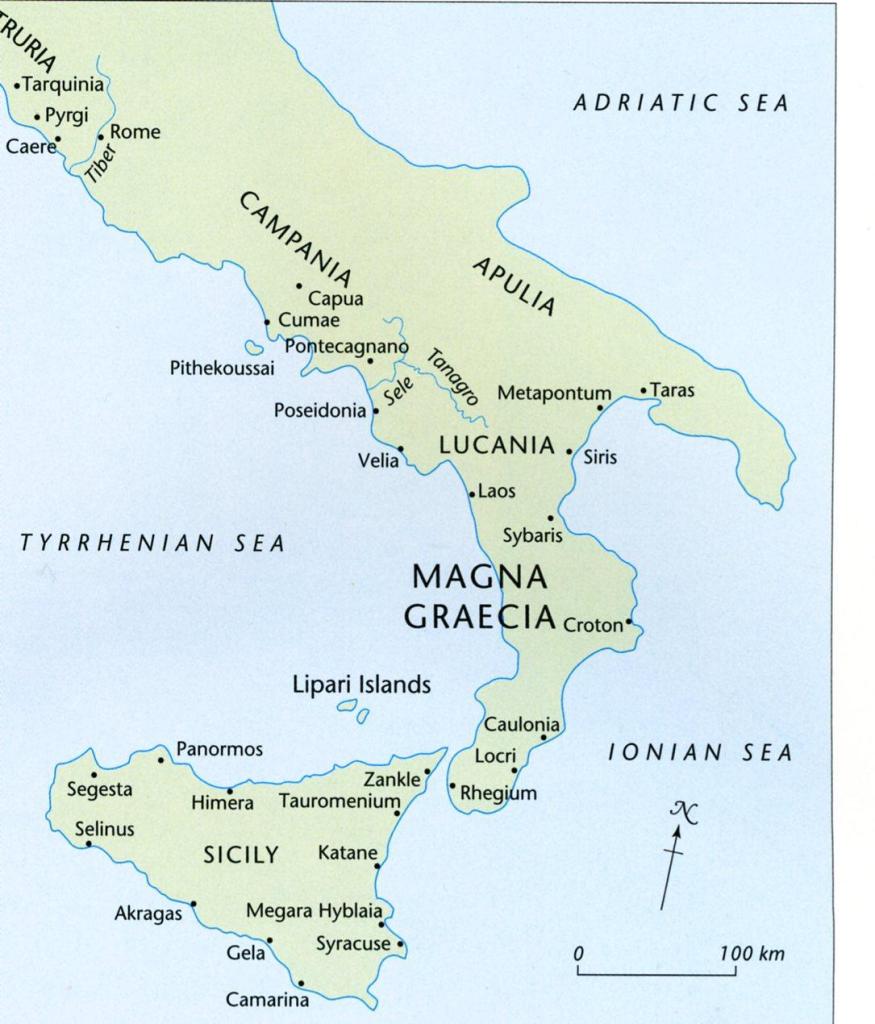
Map of Magna Graecia

Selinus is located on the south-west coast of Sicily and, according to  Thucydides, was founded in 628BC by Greek colonists from Megara Hyblaea, a Greek colony on the eastern side of Sicily. It was the most western Greek colony on Sicily and one of the first Greek colonies in Sicily to issue coins.

The colony covered a large and well-planned urban and sacred area. The sacred area is reputed to have had ten separate temples dating from the 6th to 5th century BC. The Temple of Hera is amongst the city’s most famous ruins.

The World History Encyclopedia article on Selinus records that the city was completely redesigned between 580-570BC and that the city is one of the best examples of ancient town planning. It also notes that indicators of the city’s wealth were the presence of a theatre, its prolific mint, and its satellite colonies (such as Eraclea Minoa, established in 570 BC).

Selinus allied itself with Carthage in 480BC and was often at war with rival city Segesta on the northern coast of the island. Although initially ruled by an oligarchy, Selinus was governed by tyrants throughout the 5th century BC. Selinus was sacked by Carthage in 409BC after Hannibal besieged the city for nine days; some 16,000 of the city’s inhabitants were slain after the city fell. The city was rebuilt by the Syracusan exile Hermocrates, but was under Carthaginian control in the 4th century BC. During the first Punic War (264-241BC), the city was abandoned.

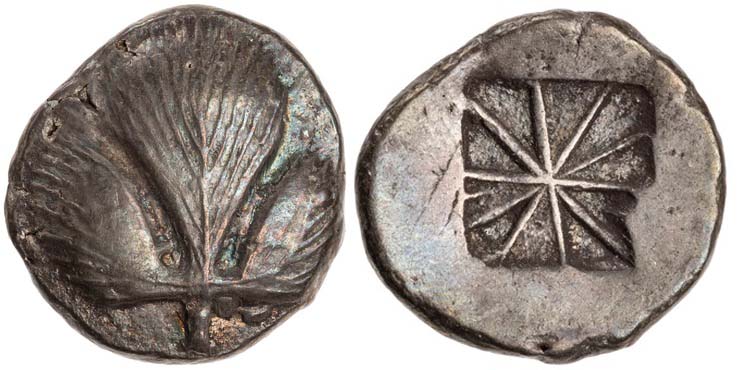
Selinus AR Didrachm of the general type struck between c.570-470BC. Selinus (celery) leaf/incuse square divided. ANS 1987.76.32 American Numismatic Society

As mentioned above, Selinus was among the the first cities to strike coins in Sicily. In Greek Coinages of Southern Italy and Sicily, N.K. Rutter records that “the obverse of the first coins had a canting type represent the name of the city in a visual form: a leaf of the celery plant, selinon in Greek, mostly presented in a stylized way with three parts, a central frond supported by a frond on either side. Later versions of the leaf are more complex. The reverse bears an incuse square, on the earlier issues divided into triangles, usually with raised and depressed sections” (p. 102). These types may have been struck from c. 530 -470BC.

The coin which is of especial interest to this post, however, was struck c.450BC and was of a very different type. Of this type, Rutter says the following (pp. 138-139):

Reverse of Selinus AR didrachm (c. 450BC). Reverse: Hypsas, river-god, standing, sacrificing over altar with entwined serpent, to right selinon (celery) leaf over crane. ANS 1957.172.629 American Numismatic Society

“A little later, perhaps around 450, Selinus revived the minting activity that it seems to have abandoned around the time of the Carthaginian attack in 480 (or perhaps a decade later) with a series of coins rich in religious imagery and references to local cults. … On earlier coins of Selinus a leaf of the celery plant had been the main type, now it is merely a small symbol in the field. The didrachms repeat the theme of sacrifice on the reverse – performed now by Hypsas the other river-god of Selinus – while the obverse shows Heracles fighting the Cretan bull: the hero brandishes his club in his right hand, while with his left he seizes one of the bull’s horns. The cult of Heracles is well-attested at Selinus and had a special interest for its citizens: it linked them to Argos, home of the dynasty that gave birth to Heracles, and also to Cnossos in Crete, where the hero had performed one of his celebrated labors.”

For those unfamiliar, Eurystheus’s demand that Heracles capture and bring the Cretan bull to him alive was the Seventh Labor of Heracles. It was a labor easily accomplished. See Apollodorus. The Library, Volume I: Books 1-3.9. Translated by James G. Frazer. Loeb Classical Library 121. Cambridge, MA: Harvard University Press, 1921. pp. 198-201 or, perhaps more readily available, see The Labors of Hercules.

Regarding the bird appearing on the reverse of this type and identified as a crane (which it is currently identified as in most references and databases (such as the American Numismatic Society’s database) and most trade offerings (see various offerings as recorded in coinarchives.com and acsearch.info), it was first identified as a crane as early as 1876 in the British Museum catalogue. But this identification was not unchallenged, apparently. For a period, numismatists, being uncertain, identified the bird simply as a marsh bird, and then were prone to identify it as a heron or egret. See pp. 90-91 of the following article for a discussion of this issue: Lloyd, A. H. “THE COIN TYPES OF SELINUS AND THE LEGEND OF EMPEDOCLES.” The Numismatic Chronicle and Journal of the Royal Numismatic Society, vol. 15, no. 58, 1935, pp. 73–93. JSTOR, http://www.jstor.org/stable/42664348. Accessed 14 Aug. 2021.

However, cranes have been present in western Sicily recently (e.g. most recently in the Trapani salt marshes, an area not too distant from ancient Selinus), and have been present in western Sicily historically, and there should be no reason to doubt the initial identification of the “marsh bird” on the coin’s reverse as a crane. See Masseti, Marco. “The lost cranes of the island of Lampedusa (Italy).” Rivista Italiana di Ornitologia, vol. 86 (I), 2016, pp. 49-54.

Eucratides I the Great, the Appearance of His Extraordinary Musculature on His Coinage, and Exercise and Working Out in Antiquity

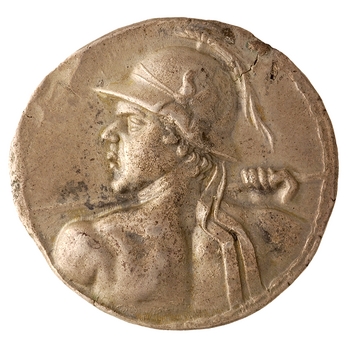
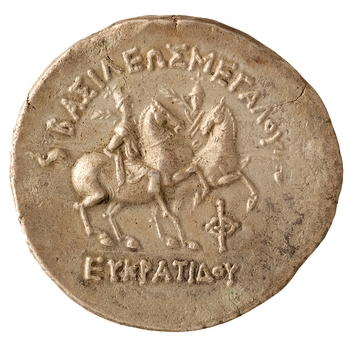
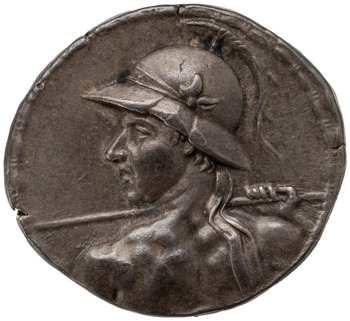
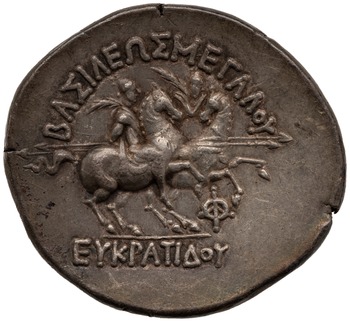
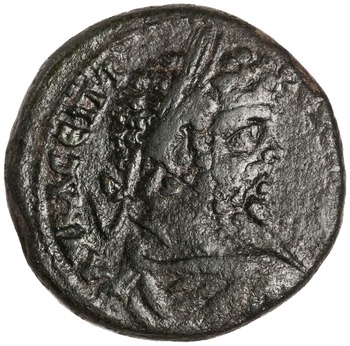
The Silver tetradrachm heading this post features on the obverse a helmeted and diademed bust of Eucratides, bare shoulders, throwing javelin to his left. The tetradrachm’s reverse has the Greek inscription ΒΑΣΙΛΕΩΣ ΜΕΓΑΛΟΥ ΕΥΚΡΑΤΙΔΟΥ (of great king Eucratides) around an image of the dioscuri (the twin brothers and sons of Zeus, Pollux and Castor) charging right holding long lances and palms. Peter Thonemann, commenting on this highly individualist and explicitly martial portraiture opined as follows: “… we may be grateful that not all kings paraded their military credentials in quite so butch a fashion as Eucratides I of Bactria.”

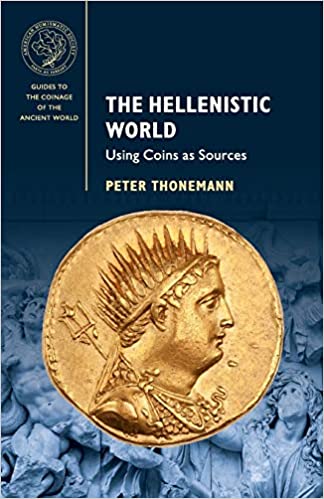
Book Cover of The Hellenistic World by Peter Thonemann
The Hellenistic World: Using Coins as Sources by Peter Thonemann

Peter Thonemann’s wonderful work, The Hellenistic World: Using Coins as Sources, is a superb introductory survey of both the history and coins of the Hellenistic world from c. 323-31BC. It is engagingly written and well-illustrated, often with coins from the collection of the American Numismatic Society. Although many of the coin photographs which are reproduced are slightly disappointing due to being in black and white and produced life size, when enlargements would have been more suitable, the coins selected for the work were well chosen and served the survey and the reader well. And, since the author and publisher were so careful to credit the sources of the photographs, when a particular coin caught my fancy, I was often able to go the the source on the internet, such as the ANS’s online collection database, and see the original color photographs of the coin.

So, after I read about Eucratides I the Great of Bactria (c. 170-145) and his stunning coins in Thonemann’s work, then saw the coins in their glory on the ANS database, and followed up with an interesting conversation about the coins and what type of workout routines were around in the ancient world with my good friend SF (more about the exercise and workout routines of the ancients below), I knew that a post was forthcoming.

First, what do we know about Eucratides I? From the 2nd century AD writer and historian Justin, we have this small snippet of information:

“Almost at the same time that Mithridates ascended the throne among the Parthians, Eucratides began to reign among the Bactrians; both of them being great men. But the fortune of the Parthians, being the more successful, raised them, under this prince, to the highest degree of power; while the Bactrians, harassed with various wars, lost not only their dominions, but their liberty; for having suffered from contentions with the Sogdians, the Drangians, and the Indians, they were at last overcome, as if exhausted, by the weaker Parthians. Eucratides, however, carried on several wars with great spirit, and though much reduced by his losses in them, yet, when he was besieged by Demetrius king of the Indians, with a garrison of only three hundred soldiers, he repulsed, by continual sallies, a force of sixty thousand enemies. Having accordingly escaped, after a five months’ siege, he reduced India under his power. But as he was returning from the country, he was killed on his march by his son, with whom he had shared his throne, and who was so far from concealing the murder, that, as if he had killed an enemy, and not his father, he drove his chariot through his blood, and ordered his body to be cast out unburied.” Epitome of the Philippic History of Pompeius Trogus, XLI 6.1-5

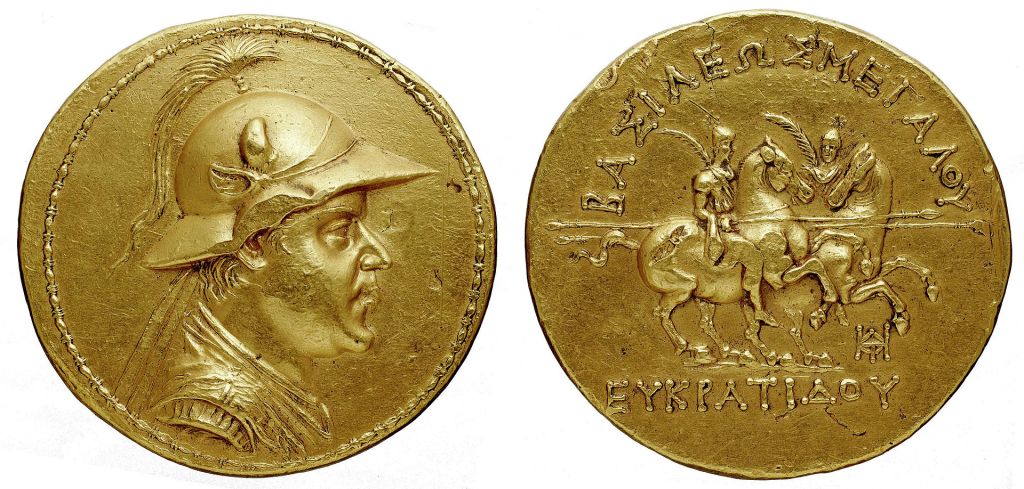
Appropriate to a king assuming the title “the Great” on his coins (a numismatic innovation of Eucratides, Eucratides also is famous for another numismatic feat, as explained by CoinWeek columnist Mike Markowitz in Metal Monsters: The Biggest Ancient Coins (march 18, 2014):

“[Eucratides] commissioned the largest surviving gold coin struck in antiquity: a 20-stater piece, 58 mm in diameter, weighing 169.2 grams. That’s nearly five and a half ounces. The unique example was found in 1867 in Bukhara (Uzbekistan), nearly 300 miles northwest of the Baktrian heartland. Eventually acquired by Napoleon III, it resides today in the Bibliothéque nationale in Paris.

On the obverse we see the king in profile, wearing a plumed cavalry helmet. On the reverse, the twin heroes Castor and Pollux carry long lances and palm branches and ride prancing horses surrounded by a carelessly lettered inscription: ‘Great King Eucratides.’” 

A quick side note before moving on to the portion of the post answering my friend SF’s query about exercise and workout routines in antiquity: as king of Bactria, Eucratides I ruled over the city of Ai Khanoum, which we discussed in an earlier post.

Jack W. Berryman wrote a short essay entitled Motion and rest: Galen on exercise and health published in The Lancet (Vol. 380, Issue 9838, 21 July 2012, pp. 210-211). From the essay is the following relevant quote:

“Exercise was an important component of ancient medical theory and a physician’s duties included the preservation and promotion of health as well as the prevention of disease. In this context, physicians in antiquity emphasised the centrality of exercise and diet, or what was known as regimen, as a key part of one’s way of life.

It was Hippocrates (c 460–370 BC) who wrote three books on regimen and noted that ‘eating alone will not keep a man well; he must also take exercise.’ Galen (c 129–210 AD), who borrowed much from Hippocrates, structured his medical “theory” upon the “naturals” (of, or with nature—physiology), the “non-naturals” (things not innate—health), and the “contra-naturals” (against nature—pathology). Central to Galen’s theory was hygiene (named after the goddess of health Hygieia) and the uses and abuses of Galen’s “six things non-natural”. Galen’s theory was underpinned by six factors external to the body over which a person had some control: air and environment; food (diet) and drink; sleep and wake; motion (exercise) and rest; retention and evacuation; and passions of the mind (emotions). Galen proposed that these factors should be used in moderation since too much or too little would put the body in imbalance and lead to disease or illness.”

Jarrett A. Lobell wrote a short snippet, entitled The Ancient Pursuit of Wellness: Exercise, in the September/October 2021 issue of Archaeology, which explicitly linked exercise to military preparation among the Greeks. I quote more extensively from Lobell:

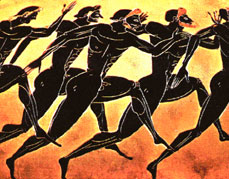
Greek Footrace

“For the ancient Greeks, exercise meant competition, often in organized festivals such as the Olympics—the word “athlete” comes from the ancient Greek athlos, meaning contest. Participation in these events was limited to young men of certain classes. Exercise was also a crucial part of preparation for Greek military service, and thus women were excluded. But in the Roman world, exercise was more universally popular, and both men and women were frequent participants. Romans often exercised at the public baths, where both sexes and most social classes regularly gathered, says classicist Nigel Crowther of Western University. Men might play ball, run, wrestle, box, or lift weights. Women swam, played a hoop-rolling game called trochus, and especially favored ball games. ‘Galen suggests that ball games were good training for the fitness of both body and mind,’ Crowther says.”

Finally, as it summarizes so well many of the ancient sources regarding workouts and exercises, I provide the following lengthy quote from an article entitled The Real Gladiator Workout: Train Like A Gladiator (posted 9/14/14) on RENAISSANCE MAN JOURNAL:

“There is a story that was often told of Milo of Croton. This was an Ancient Greek athlete from the Greek city-state of Croton located in what is now southern Italy. He lived in the 6th century BC and was training for the Olympics.

One of the ways that he was training was by taking a newly born bull, hoisting it up on his shoulders and carrying it for some distance. He would do it every day. As time passed, the bull would grow larger and so Milo kept on hoisting more and more weight. This culminated with him walking into the Olympic stadium with a full grown bull on his shoulders.

So over time he was increasing the weight he was lifting. This is basically the birth of progressive overload. The ancients knew that if you want your muscles to grow and get stronger, you need to lift heavier and heavier weights.

The Greeks had three weighted implements – javelin, discus and halteres. The halteres are hand held weights that they use during jumping exercises and drills. See The Complete History of Fitness: From Paleo to Pole Dancing at the Website Lost In Fitness

Another principle from the ancient world is that of periodization. Many gladiator schools probably used periodization training, which is an organization of training that splits training into blocks of time, each one focusing on different skills. They would be training all day and split their training into units of time during which they would focus on just one skill.

The ancient gladiators also knew about the intensity of training and that you should not go into training full speed at the beginning, but need to warm up first, otherwise you risk injury. Galen wrote that intensity should be increased gradually: “Intensity should be gradually increased, peaking at the end. This should be of special concern in order to avoid injury to competitors.”

The cool-down process was also important. Hippocrates (an Ancient Greek doctor) said that “those who walk after exercising will then have a stronger and more rested body.” This means that there should be a period of cool down after intense training and people should not fall down and lie on the ground immediately, but instead the person should cool down by walking around. Also on rest days, according to Hippocrates, the athlete should not do completely nothing, but instead do something of low intensity.

The ancients were very aware of the dangers of over-training and many of the doctors preached against it. They knew that the body needs rest in order to recover from intense training and also that your body achieves the best results if rest is a part of your routine.

Throughout their training, the gladiators would use different types of equipment and do all kinds of varied exercises.

Modern statue of Galen in his home town, Pergamon. Photograph by Bernard Gagnon.

Galen divided exercises into three types:

Vigorous exercises: These were exercises performed with strength, but without speed. Examples of these include: digging, picking up any kind of heavy load and either standing still with it or walking (especially up a hill), climbing a rope, hanging from rope or beam for as long as possible, holding arms up (with or without weights) while partner tried pushing them in a downwards direction…etc. These exercises show that the Ancient Greeks and Romans had an understanding of overload (including progressive overload) and its positive effects on building strength and muscles.

Speed exercises: Here the primary objective was speed, apart from strength and force. Examples of these include: running, shadow boxing, hitting the punching bag, running around with balls, arm and leg exercises like drill stuff…etc.

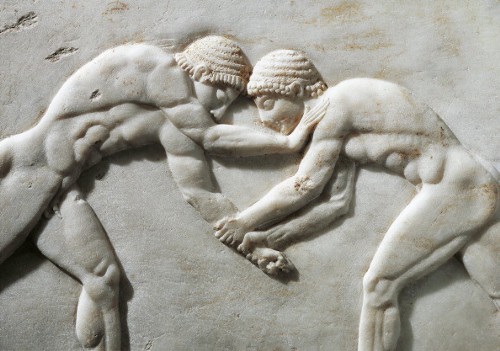
Greek Wrestlers

A particular example of this type of exercise that was performed has the Greek name “pitylysma”. The exercise goes like this: start by standing on tip toes, stretch your arms upwards, move one arm quickly forward, while moving the other one backwards, roll quickly on the ground, quickly come up, stand erect and start jumping up and down, sometimes with a backward kick, sometimes bringing each leg forward in an alternating fashion.

Violent exercises: These combined speed and strength. Exercises classified as vigorous became violent if you increased their speed – jumping continuously without rest, or any speed exercises performed with weight became violent – moving around quickly in heavy armor.

The word ‘violent’ in this context could be better understood if you use it as a synonym for the word ‘power.’ A recommendation of Galen for these types of exercises was to rest between the different individual exercises.”

So, yes, the highly muscled king appearing on those beautiful coins likely had plenty of thoughtful exercise routines behind those sculpted muscles — or he kept buff by throwing lots of javelins while trying to preserve his kingdom.