

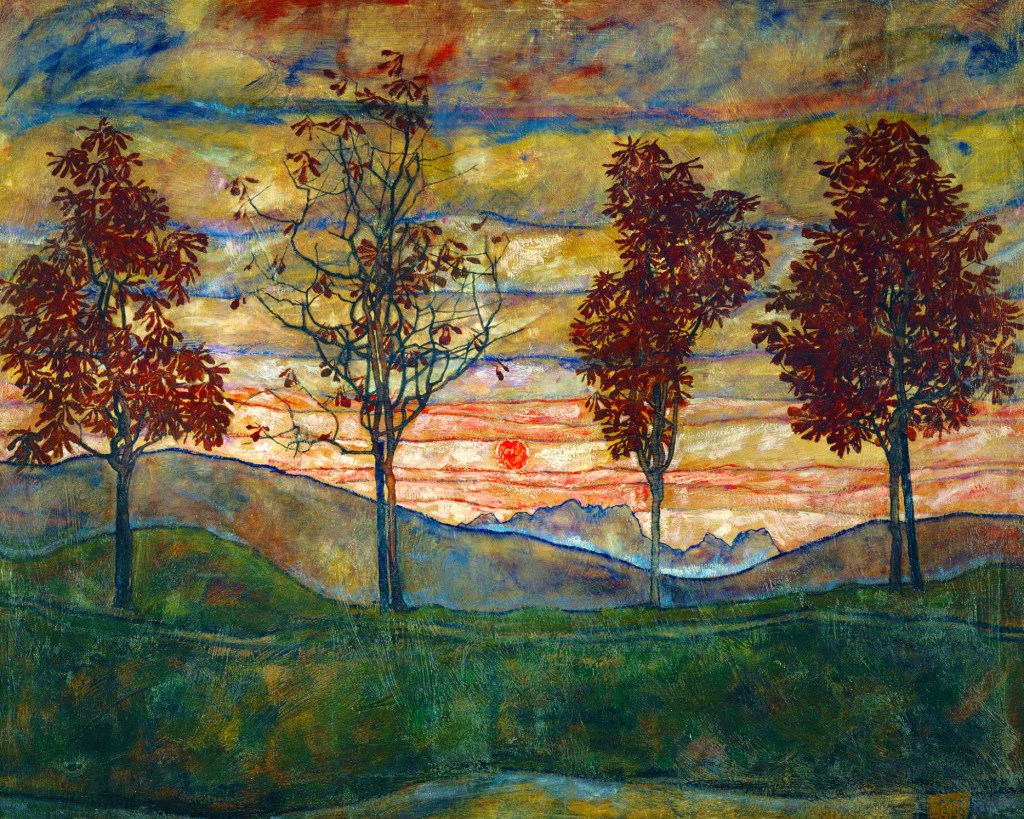
Earlier this week, I took some time to review several hundred works by Egon Schiele (1890–1918), the Austrian Expressionist painter renowned for his intense and raw depictions of the human form. Schiele’s art, with its distinctive distorted body shapes and expressive lines, often explores themes of sexuality and self-examination, particularly in his numerous self-portraits, including nudes. Personally, I am more drawn to his other works—those that portray buildings, landscapes, and more formal sittings—not out of prudishness, but because of his unique ability to capture such scenes with an aesthetic that I appreciate. His mentor, Gustav Klimt, played a significant role in shaping Schiele’s artistic development. A broader collection of his works can be found here: Egon Schiele Overview and at the YouTube video gallery below.
While Schiele’s style is compelling, his biography is troubling, and he is not someone I would have wanted to know personally. Nonetheless, many of his works possess an undeniable aesthetic appeal, although others do not resonate with me as deeply. Two pieces that I find particularly captivating are included in this post—one featured above, and the other below (which reminded me of myself researching for an article or post).

For the record, The Cleveland Museum of Art possesses two works by Schiele, neither on display. The more interesting is below.



 Northcoast Antiquarian