

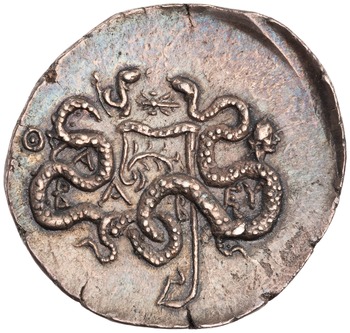
Today, I received and started reading another new book, which I am very much enjoying even if it does not have any notes and the photographs are deficient:
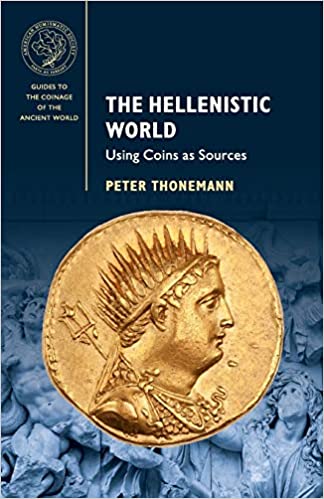
When I finish this work (which is one in a series, of which I obtained three volumes today), I will write a hopefully helpful review. In the meantime, I have been inspired to prepare a quick post about one of the coins referenced in the work on pp. 81-82.
And now, a few words about the Kingdom of Pergamum, Eumenes III, the Citizens of the Sun, their revolt against Rome, and the coin, which inspired this post.
The Kingdom of Pergamum (or Pergamon), in Asia Minor, was ruled by the Hellenistic Attalid Dynasty. The Attalid Dynasty was founded by Philitaerus, who ruled from c. 282-263 B.C. The Kingdom benefitted significantly in 188 B.C. under the treaty of Apamea, when the Roman Senate granted the Kingdom great expanses of territories from the just defeated Seleucid Empire.

In 133 B.C., King Attalus III bequeathed the Kingdom of Pergamum to the Roman people. What happened next is most extraordinary. Rome was in turmoil at the time the bequest was received in Rome, as it is believed to have been delivered while rioting and killings associated with the slaying of the tribune Tiberius Gracchus were occurring. It is likely that the Roman Senate did not turn its attention to addressing the bequest, and formally annexing the Kingdom, until 131 B.C. While the Senate in Rome dithered, however, in the Kingdom of Pergamum, a man named Aristonicus, who claimed to be of royal lineage (the son of Eumenes II), almost immediately proclaimed himself king as Eumenes III.
Although Eumenes III found no support in the major urban centers of Pergamum or Ephesus, he apparently found more than adequate support in many other cities and much of the periphery of the kingdom. Additionally, and most interestingly, he made a bold appeal to the poor and enslaved, which was well-received, as reported by Strabo:
“After Smyrna, one comes to Leucae , a small town, which after the death of Attalus Philometor was caused to revolt by Aristonicus, who was reputed to belong to the royal family and intended to usurp the kingdom. Now he was banished from Smyrna, after being defeated in a naval battle near the Cymaean territory by the Ephesians, but he went up into the interior and quickly assembled a large number of resourceless people, and also of slaves, invited with a promise of freedom, whom he called Heliopolitae [Citizens of the Sun]. Now he first fell upon Thyeira unexpectedly and then got possession of Appolonis, and then set his efforts against other fortresses. But he did not last long; the cities immediately sent a large number of troops against him, and they were assisted by Nicomedes the Bithynian and by the kings of the Cappadocians. Then came five Roman ambassadors, and after that an army under Publius Crassus the consul, and after that Marcus Perpernas, who brought the war to an end, having captured Aristonicus alive and sent him to Rome. Aristonicus ended his life in prison.” Strabo. Geography, Volume VI: Books 13-14. Translated by Horace Leonard Jones. Loeb Classical Library 223. Cambridge, MA: Harvard University Press, 1929, pp. 247-249.
The sources suggest that the attempt by Eumenes III and his Citizens of the Sun to remain independent of Rome required extraordinary efforts by Rome to suppress. Some scholars suggest Eumenes’ primary support may have come from areas with many former mercenaries, which may also explain why he was able to prevail for so long. Additionally, at least one reading of the sources suggest it took upwards of six to seven years for the Romans to quell the “revolt” and fully annex the kingdom as a province.


Regardless, what attracted my interest to this historical incident are the beautiful coins which were issued during Eumenes’ attempt to remain independent of Rome. The coins, called kistophoroi (latinized to cistorphorus) or basket-bearers comes from the obverse type, which features a snake crawling out of a wicker basket (a cista) encircled by an ivy wreath. These unusual coins were the main silver coins of many cities in Asia minor from c. 167 BC through the reign of Augustus. What is unusual about the cistorphori of Eumenes III is that usually the Attalid kings did not mark their issues to indicate that they were royal issues or which king issued them whereas Eumenes III marked his issues on the reverse to indicate that they were issued by him. Additionally, he marked his issues as to the mint location.
The full historical backstory of Eumenes III of Pergamum may be found on pages 47-53 in A History of Pergamum: Beyond Hellenistic Kingship by Richard Evans.

 Northcoast Antiquarian