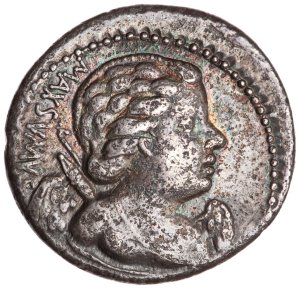
ROME. 75 B.C. AR Denarius. MAXSVMVS – Bust of Cupid right, with bow and quiver over shoulder; before, countermark. Border of dots // C·EGNATIVS·CN·F CN·N III – Distyle temple; within, statues of Libertas and Jupiter (Jupiter holds staff in right hand); above Jupiter on left, thunderbolt; above Libertas on right, pileus ; on left, control mark. Border of dots. ANS 1944.100.1970
In Greek mythology, Cupid is known as Eros and is amongst the first gods. Hesiod records the following:
The First Gods
In the beginning there was only Chaos, the Abyss,
But then Gaia, the Earth came into being,
Her broad bosom the ever-firm foundation of all,
And Tartaros, dim in the underground depths
And Eros, loveliest of all the Immortals, who
Makes their bodies (and men’s bodies) go limp,
Mastering their minds and subduing their wills.
Hesiod, Theogony, 116-122
Of course, in contemporary culture, Eros, or Cupid, has become associated with Romantic love, and thus, the modern contrivance of Valentine’s Day.
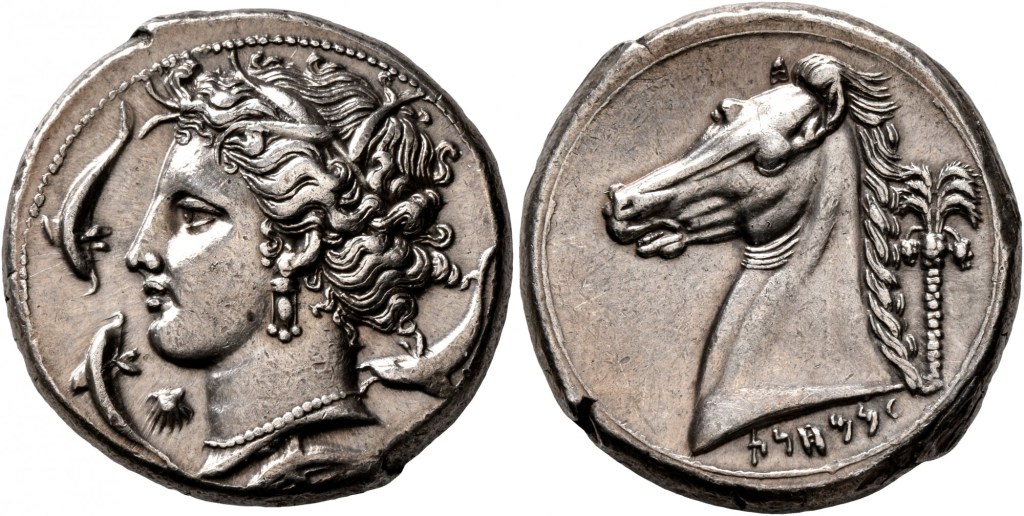
Siculo-Punic AR Tetradrachm, c. 320-300BC, People of the Camp mint, 16.95g. Jenkins-161. Obverse: Head of Arethusa/Tanit left, wearing barley wreath and earring, four dolphins around, small shell below chin. Reverse: Head of horse left, palm tree with dates behind, Phoenician `MMHNT (mint name) below truncation. Stephen Album Rare Coins Auction 42, Lot 45. Realized $11,400 on $1,000-$1,500 Estimate.
Very few coins are, literally, breathtaking. The above coin is breathtaking. It sold at a Stephen Album Rare Coin auction for well-over its conservative estimate, and deservedly so, on January 20, 2022. It is most reminiscent of the slightly better example of the same type (also Jenkins 161) that sold for slightly less (8500 CHF, approx. $8,485) in Leu Numismatik’s 2019 Auction 4 as Lot 178.
Siculo-Punic AR Tetradrachm, c. 320-300 BC, People of the Camp mint, 17.00g. Jenkins-161. Numismatik Leu Auction 4, Lot 178 (2019). Realized 8500 CHF on 4000 CHF Estimate.
In the final decade of the fifth century BC, the Carthaginians launched a series of invasions of Sicily, conquering much of the western half of the island. The Carthaginian presence lasted for a century and a half, until Rome’s victory in the First Punic War obliged the Carthaginians to withdraw.
During their occupation of Sicily, the Carthaginians struck an extensive coinage for the purpose of financing their military operations and the maintenance of garrisons. Many of these coins were “military issues” and, surprisingly, labeled as such (i.e., as “camp” issues). The obverse and reverse types of the coins in the military series are mostly influenced by Sicilian prototypes, particularly those of Syracuse. The obverse of the Siculo-Punic Tetradrachm of which I am writing was inspired by the Syracusan AR decadrachm c. 400 BC signed by Euainetos. As noted by N.K. Rutter in Greek Coinages of Southern Italy and Sicily (Spink, London, 1997), it was copied by the Carthaginians because “… the reference to a Syracusan coin-type would have meant something to a Greek mercenary” (p.157).
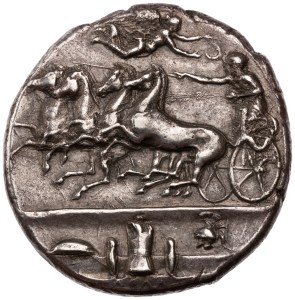
Inspiration for the Siculo-Punic Tetradrachms: Syracuse AR (42.82 g.) Decadrachm by Euainetos, c. 405-400 BC. Obverse: Head of Arethrusa facing left with four dolphins around, ΣΥΡΑΚΟΣΙΩΝ, ΕΥAINE. Reverse: Below AΘΛΑ: Quadriga driven left by charioteer; above, Nike flying right, crowning charioteer; in exergue panoply of weapons. ANS 1997.9.64
G. Kenneth Jenkins studied these issues in his Coins of Punic Sicily (Parts I-IV, 1971-1978), and noted that the camp mint, once it was operating in Sicily, was most probably located in Lilybaion (Part III, p.11). This proposed location for the camp mint has been the object of debate for years and other locations have been proposed. For instance, Ian Lee, surveying the literature and reexamining the evidence for the earliest Punic coinage in Sicily, more recently concluded that the camp mint was located at Entella (LEE, IAN. “Entella: The Silver Coinage of the Campanian Mercenaries and the Site of the First Carthaginian Mint 410-409 BC.” The Numismatic Chronicle (1966-), vol. 160, Royal Numismatic Society, 2000, pp. 1–66, http://www.jstor.org/stable/42668259).
Siculo-Punic Tetradrachms, such as the one sold by Stephen Album Rare Coins, were ultimately destined to pay Greek mercenaries. The tetradrachms’ visual familiarity combined with its being struck to the Attic weight standard (c. 17.2 g.) rather than the Phoenician weight standard (c. 14.3 g. to the shekel or tetradrachm) usually used by the Carthaginians would have made it the perfect mechanism for payment to its intended recipients. [See Visonà, Paolo. “CARTHAGINIAN COINAGE IN PERSPECTIVE.” American Journal of Numismatics (1989-), vol. 10, American Numismatic Society, 1998, pp. 1–27, http://www.jstor.org/stable/43580385, p. 4, for discussion regarding adoption of Attic weight standard due to military exigency].







 Northcoast Antiquarian