

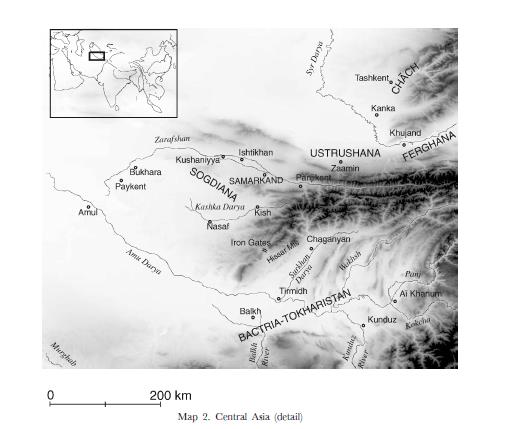
“City of Glory” almost sounds as if it were the appellation for a city in the HBO series “Game of Thrones,” such as Pentos, Qarth, or Astapor. But in reality it was given to a wealthy merchant city in Sogdiana, as attested to by the coin illustrated below.

The coin is a very rare AE cash from the Sogdiana merchant city of Paikend (Paykent), ca. 640-710, which has always fascinated me and is worthy of more research. The obverse features the Bukhara tamgha at top, Chinese yuan below, and Sogdian text to left & right. The reverse features a cross above & below the central hole. The scholar Aleksandr Naymark has read the Sogdian text on the obverse as PRN / KND, “city of glory,” and suggested that this was a local issue under a Christian ruler, in opposition to the kings of Bukhara. The coin illustrated was Lot 133 in Stephen Album Rare Coin Auction 38.

The oasis city of Paikend, which was first inhabited c. the 4th century BC, existed until the Zarafshan River changed its course in the 12th сentury, at which point the city was abandoned by its residents. The abandoned city was subsequently buried over time under the sands of the Kyzylkum Desert, resulting in the city being well preserved for future generations of inquisitive archaeologists. Excavations on the site first started in 1914 by L.A. Zimin, representative of the St. Petersburg school of Asian studies, and continue to this day by the Archaeology Institute, Uzbekistan Academy of Sciences, and Andrey Omelchenko, of the Hermitage Museum in Russia.

 Northcoast Antiquarian