

Exploring Paul Klee’s Rosengarten and Emerson’s Philosophy

Paul Klee, Rose Garden (1920, 44, oil and pen on paper on cardboard, 49 cm x 42.5 cm), Städtische Galerie im Lenbachhaus and Kunstbau Munich, on permanent loan from the Gabriele Münter and Johannes Eichner Foundation, Munich, CC BY-NC-SA.

Periodically, I revisit the essays of Ralph Waldo Emerson. His writing style is sometimes jarring but just as often sublime (Henry James, in Partial Portraits (1888), observed that Emerson “never really mastered the art of composition” (p. 20) while also acknowledging that “he had frequently an exquisite eloquence” (p. 32)). The visit is always profitable.

While rereading Emerson’s perhaps most famous essay, Self-Reliance (1847), I found that after much of my recent reading focusing so heavily on things temporal, especially in the past month (e.g., Carlo Rovelli’s masterful works The Order of Time, Seven Brief Lessons on Physics, and Reality is Not What it Seems and Tom Siegfried’s lyrical The Number of the Heavens: A History of the Multiverse and the Quest to Understand the Cosmos), the following passage resonated in a manner it had not on previous readings of the essay:

“Man is timid and apologetic; he is no longer upright; he dares not say ‘I think,’ ‘I am,’ but quotes some saint or sage. He is ashamed before the blade of grass or the blowing rose. These roses under my window make no reference to former roses or to better ones; they are for what they are; they exist with God to-day. There is no time to them. There is simply the rose; it is perfect in every moment of its existence. Before a leaf-bud has burst, its whole life acts; in the full-blown flower there is no more; in the leafless root there is no less. Its nature is satisfied, and it satisfies nature, in all moments alike. But man postpones or remembers; he does not live in the present, but with reverted eye laments the past, or, heedless of the riches that surround him, stands on tiptoe to foresee the future. He cannot be happy and strong until he too lives with nature in the present, above time.”

Such an extraordinary observation and lesson—that there is no lamentation of the past, or anticipation of the future, only presence for the rose.

Lamentation, or regret more precisely, I have long regarded as the most useless of human endeavors, if it is more than rectification of error, amends to others, and lessons learned. Anticipation, or anxiety about the future, is also too often misplaced and misdirected energy. Yes, we can and should make plans, but when the energy and effort extend beyond the necessary such that the future becomes a thief of reason, serenity, and equanimity, we are perilously close to toppling over.

The image of the rose in the above essay also brought to mind, fortuitously or not, a wonderful piece of art, Rosengarten (1920) by Paul Klee, ensconced in Lenbachhaus, an art museum in Munich.

After reading Helmut Friedel and Annegret Hoberg’s words about Klee from Der Blaue Reiter im Lenbachhaus München (2007) at the Lenbachhaus website, I readily envision Rosengarten as exemplifying the same harmonious integration of presence and timelessness that Emerson attributes to the rose. Created in 1920, the painting merges organic and constructed forms into a rhythmic whole. Klee’s garden unfolds as a grid of irregular, red-tinged rectangles, delicately framed by black lines, with roses—symbols of growth and vitality—scattered like musical notes across the composition. These roses, like Emerson’s, embody the eternal present; their rounded, spiral blooms suggest continuous life and creation. For Klee, as for Emerson, nature’s rhythms transcend human constructs of time.

Interestingly, Klee drew inspiration from music, speaking of “cultural rhythms” in his Bauhaus writings and comparing his visual compositions to musical structures. In Rosengarten, he achieves a polyphony of visual forms, where the temporal becomes spatial, and each element contributes equally to the whole. Just as Emerson’s rose is “perfect in every moment of its existence,” Klee’s garden suggests an infinite unfolding—a melody extending endlessly beyond the canvas.

Both Emerson and Klee challenge us to inhabit the present, to find harmony in life’s rhythms, and to appreciate the completeness inherent in each moment. The rose, whether in prose or paint, invites us to rise above time.

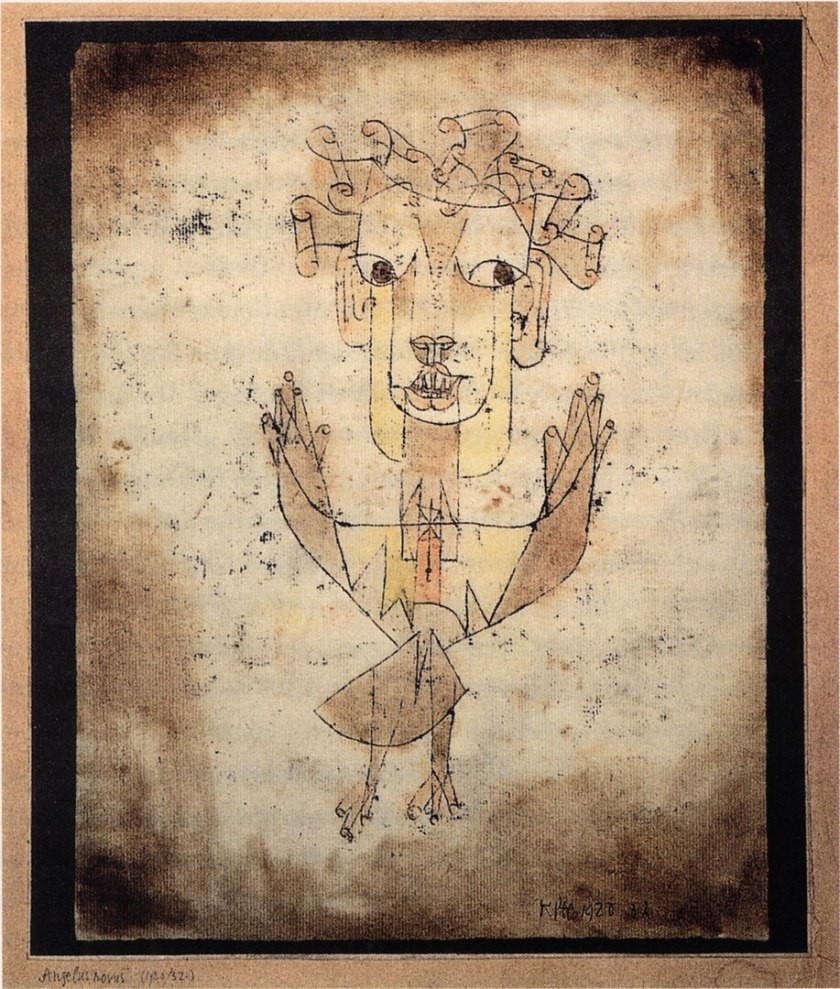
MUSIC AND LYRICS FOR Angelus Novus, Angel of History

Music and lyrics for Angelus Novus, Angel of History. Lyrics inspired by Walter Benjamin’s essay, in which he dubbed Paul Klee’s Angelus Novus the angel of history. Music created through use of udio.com.

Angelus Novus, monoprint, 1920, by Paul Klee.

The Lyrics below were written by D.S. Yarab, and inspired by Walter Benjamin’s 1940 essay, On the Concept of History, in which Walter Benjamin dubbed Paul Klee’s Angelus Novus the Angel of History in the following haunting paragraph: “A Klee painting named Angelus Novus shows an angel looking as though he is about to move away from something he is fixedly contemplating. His eyes are staring, his mouth is open, his wings are spread. This is how one pictures the angel of history. His face is turned toward the past. Where we perceive a chain of events, he sees one single catastrophe which keeps piling wreckage upon wreckage and hurls it in front of his feet. The angel would like to stay, awaken the dead, and make whole what has been smashed. But a storm is blowing from Paradise; it has got caught in his wings with such violence that the angel can no longer close them. The storm irresistibly propels him into the future to which his back is turned, while the pile of debris before him grows skyward. This storm is what we call progress.” The music was created with artful prompts using AI at Udio.com.

It is safe to observe that neither lyricists nor composers are at risk of displacement. For proof, see, at the end of this post, below the transcription of my lyrics, the video of the work by the artist Laurie Anderson, who used the same Benjamin essay for inspiration for her work, “The Dream Before.” I came across her work several days after I posted my video and thought it would make a good addition to the original post so amended my post to include it.

Audio file of Eyes of Stone, an alternative musical setting of the Lyrics below.

Lyrics to “Angelus Novus, Angel of History” by Donald S. Yarab

Verse:

Angelus Novus stands alone,
Gazing back with eyes of stone,
Mouth agape, wings open wide,
Witness to the endless tide.

Chorus:

Angelus, angel of history,
Wreckage piled, a single catastrophe,
Storm from Paradise, wings unfurled,
Propels him onward, to the future hurled.

Verse:

Where we see events unfold,
He sees ruins, stories told,
Wreckage piling at his feet,
Dreams of wholeness, incomplete.

Chorus:

Angelus, angel of history,
Wreckage piled, a single catastrophe,
Storm from Paradise, wings unfurled,
Propels him onward, to the future hurled.

Verse:

Storm of progress, fierce and strong,
Drives him ever, far along,
Backwards facing, forward thrust,
Dreams of past now turned to dust.

Chorus:

Angelus, angel of history,
Wreckage piled, a single catastrophe,
Storm from Paradise, wings unfurled,
Propels him onward, to the future hurled.

Verse:

Angel yearning, dead to wake,
Mend the shattered, for their sake,
But the storm, it will not cease,
Angel’s plight, no sign of peace.

Chorus:

Angelus, angel of history,
Wreckage piled, a single catastrophe,
Storm from Paradise, wings unfurled,
Propels him onward, to the future hurled.

Coda:

Angelus Novus, forward driven,
By the storm, no peace is given,
Angel of history, face of sorrow,
Through the wreckage, towards tomorrow.

Paul Klee’s Angelus Novus

Paul Klee's monoprint Angelus Novus

The past few days I have been researching the muse of History, Clio. That led me to read (and re-read) a highly academic article written by Stephen Bann in 1987 entitled “Clio in Part: On Antiquarianism and the Historical Fragment.” Aside from leading me to then read a wonderful essay by Nietzche entitled “On the Use and Abuse of History,” it led me to view the Paul Klee monoprint above, Angelus Novus. About which:

Walter Benjamin purchased the monoprint in 1921. Mr. Benjamin committed suicide in 1940 to escape the Nazis. In any event, in the ninth thesis of his 1940 essay “On the Concept of History, Walter Benjamin describes Angelus Novus as an image of the angel of history and writes:

“A Klee painting named Angelus Novus shows an angel looking as though he is about to move away from something he is fixedly contemplating. His eyes are staring, his mouth is open, his wings are spread. This is how one pictures the angel of history. His face is turned toward the past. Where we perceive a chain of events, he sees one single catastrophe which keeps piling wreckage upon wreckage and hurls it in front of his feet. The angel would like to stay, awaken the dead, and make whole what has been smashed. But a storm is blowing from Paradise; it has got caught in his wings with such violence that the angel can no longer close them. The storm irresistibly propels him into the future to which his back is turned, while the pile of debris before him grows skyward. This storm is what we call progress.”

A useful explanatory work of scholarship explaining the work which I recommend is Behind the Angel of History: The “Angelus Novus” and Its Interleaf by Annie Bourneuf (University of Chicago Press, 2022). The YouTube video below is also a nice summary of the monoprint and Benjamin’s connection with it.