
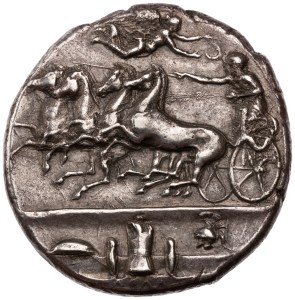
A Stunning SICULO-PUNIC Tetradrachm, circa 320-300 BC

Very few coins are, literally, breathtaking. The above coin is breathtaking. It sold at a Stephen Album Rare Coin auction for well-over its conservative estimate, and deservedly so, on January 20, 2022. It is most reminiscent of the slightly better example of the same type (also Jenkins 161) that sold for slightly less (8500 CHF, approx. $8,485) in Leu Numismatik’s 2019 Auction 4 as Lot 178.
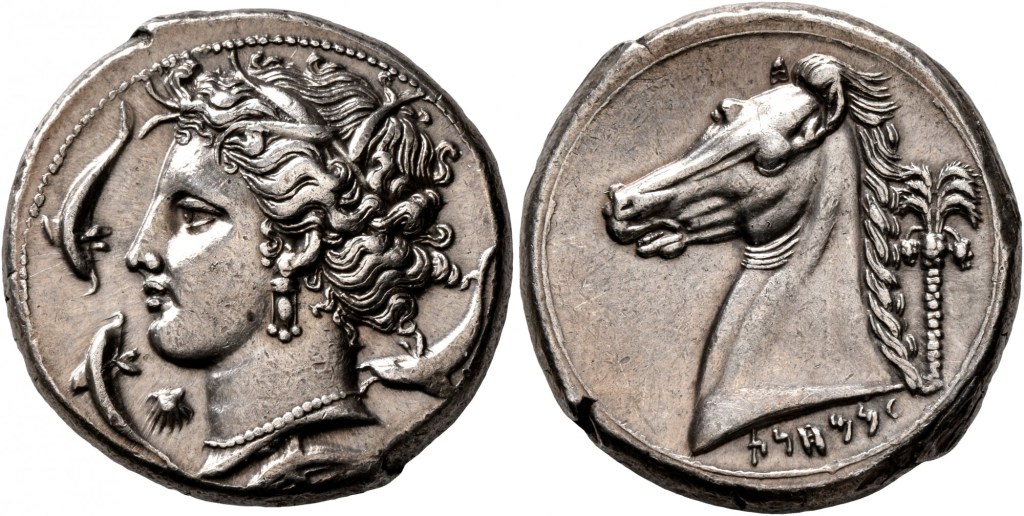
Siculo-Punic AR Tetradrachm, c. 320-300 BC, People of the Camp mint, 17.00g.  Jenkins-161.  Numismatik Leu Auction 4, Lot 178 (2019).   Realized 8500 CHF on 4000 CHF Estimate.
Siculo-Punic AR Tetradrachm, c. 320-300 BC, People of the Camp mint, 17.00g. Jenkins-161. Numismatik Leu Auction 4, Lot 178 (2019). Realized 8500 CHF on 4000 CHF Estimate.

In the final decade of the fifth century BC, the Carthaginians launched a series of invasions of Sicily, conquering much of the western half of the island. The Carthaginian presence lasted for a century and a half, until Rome’s victory in the First Punic War obliged the Carthaginians to withdraw.

During their occupation of Sicily, the Carthaginians struck an extensive coinage for the purpose of financing their military operations and the maintenance of garrisons. Many of these coins were “military issues” and, surprisingly, labeled as such (i.e., as “camp” issues). The obverse and reverse types of the coins in the military series are mostly influenced by Sicilian prototypes, particularly those of Syracuse. The obverse of the Siculo-Punic Tetradrachm of which I am writing was inspired by the Syracusan AR decadrachm c. 400 BC signed by Euainetos. As noted by N.K. Rutter in Greek Coinages of Southern Italy and Sicily (Spink, London, 1997), it was copied by the Carthaginians because “… the reference to a Syracusan coin-type would have meant something to a Greek mercenary” (p.157).

G. Kenneth Jenkins studied these issues in his Coins of Punic Sicily (Parts I-IV, 1971-1978), and noted that the camp mint, once it was operating in Sicily, was most probably located in Lilybaion (Part III, p.11). This proposed location for the camp mint has been the object of debate for years and other locations have been proposed. For instance, Ian Lee, surveying the literature and reexamining the evidence for the earliest Punic coinage in Sicily, more recently concluded that the camp mint was located at Entella (LEE, IAN. “Entella: The Silver Coinage of the Campanian Mercenaries and the Site of the First Carthaginian Mint 410-409 BC.” The Numismatic Chronicle (1966-), vol. 160, Royal Numismatic Society, 2000, pp. 1–66, http://www.jstor.org/stable/42668259).

Siculo-Punic Tetradrachms, such as the one sold by Stephen Album Rare Coins, were ultimately destined to pay Greek mercenaries. The tetradrachms’ visual familiarity combined with its being struck to the Attic weight standard (c. 17.2 g.) rather than the Phoenician weight standard (c. 14.3 g. to the shekel or tetradrachm) usually used by the Carthaginians would have made it the perfect mechanism for payment to its intended recipients. [See Visonà, Paolo. “CARTHAGINIAN COINAGE IN PERSPECTIVE.” American Journal of Numismatics (1989-), vol. 10, American Numismatic Society, 1998, pp. 1–27, http://www.jstor.org/stable/43580385, p. 4, for discussion regarding adoption of Attic weight standard due to military exigency].

An Attractive Silver Didrachm of the Greek Colony of Selinus in Sicily with a Crane on the Reverse

AR Didrachm from Greek colony of Selinus in Sicily (c. 450BC). Obv: Inscription, Hercules about to club the Cretan bull. Rev: Inscription above, River-god Hypsas sacrifices at altar with serpent coiled around it; at right selinon (celery) leaf above crane.  ANS 1957.172.629. American Numismatic Society.

Yarab is an Anglicized spelling of the Slovak surname Jaráb.  It is a zoonym, which is a name of an animal.  That animal is a crane, for in 19th century Slovak Jaráb is akin to the Czech word jeřáb, which means crane. Accordingly, when I happened across the the above coin from Selinus, depicting a crane on its reverse, I had to learn a little bit more about the history of Selinus and the imagery appearing on this stunning coin.

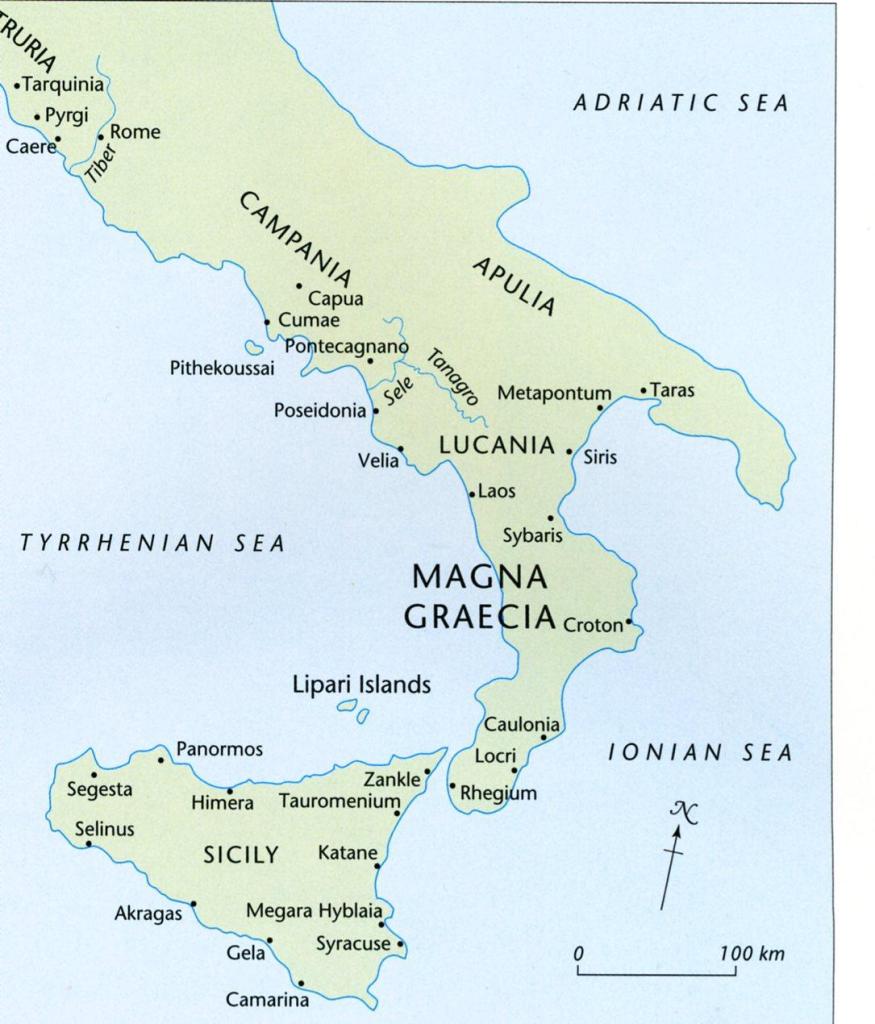
Map of Magna Graecia

Selinus is located on the south-west coast of Sicily and, according to  Thucydides, was founded in 628BC by Greek colonists from Megara Hyblaea, a Greek colony on the eastern side of Sicily. It was the most western Greek colony on Sicily and one of the first Greek colonies in Sicily to issue coins.

The colony covered a large and well-planned urban and sacred area. The sacred area is reputed to have had ten separate temples dating from the 6th to 5th century BC. The Temple of Hera is amongst the city’s most famous ruins.

The World History Encyclopedia article on Selinus records that the city was completely redesigned between 580-570BC and that the city is one of the best examples of ancient town planning. It also notes that indicators of the city’s wealth were the presence of a theatre, its prolific mint, and its satellite colonies (such as Eraclea Minoa, established in 570 BC).

Selinus allied itself with Carthage in 480BC and was often at war with rival city Segesta on the northern coast of the island. Although initially ruled by an oligarchy, Selinus was governed by tyrants throughout the 5th century BC. Selinus was sacked by Carthage in 409BC after Hannibal besieged the city for nine days; some 16,000 of the city’s inhabitants were slain after the city fell. The city was rebuilt by the Syracusan exile Hermocrates, but was under Carthaginian control in the 4th century BC. During the first Punic War (264-241BC), the city was abandoned.

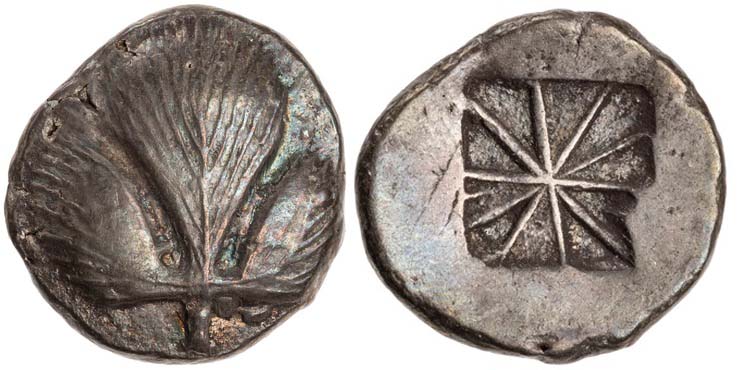
Selinus AR Didrachm of the general type struck between c.570-470BC. Selinus (celery) leaf/incuse square divided. ANS 1987.76.32 American Numismatic Society

As mentioned above, Selinus was among the the first cities to strike coins in Sicily. In Greek Coinages of Southern Italy and Sicily, N.K. Rutter records that “the obverse of the first coins had a canting type represent the name of the city in a visual form: a leaf of the celery plant, selinon in Greek, mostly presented in a stylized way with three parts, a central frond supported by a frond on either side. Later versions of the leaf are more complex. The reverse bears an incuse square, on the earlier issues divided into triangles, usually with raised and depressed sections” (p. 102). These types may have been struck from c. 530 -470BC.

The coin which is of especial interest to this post, however, was struck c.450BC and was of a very different type. Of this type, Rutter says the following (pp. 138-139):

Reverse of Selinus AR didrachm (c. 450BC). Reverse: Hypsas, river-god, standing, sacrificing over altar with entwined serpent, to right selinon (celery) leaf over crane. ANS 1957.172.629 American Numismatic Society

“A little later, perhaps around 450, Selinus revived the minting activity that it seems to have abandoned around the time of the Carthaginian attack in 480 (or perhaps a decade later) with a series of coins rich in religious imagery and references to local cults. … On earlier coins of Selinus a leaf of the celery plant had been the main type, now it is merely a small symbol in the field. The didrachms repeat the theme of sacrifice on the reverse – performed now by Hypsas the other river-god of Selinus – while the obverse shows Heracles fighting the Cretan bull: the hero brandishes his club in his right hand, while with his left he seizes one of the bull’s horns. The cult of Heracles is well-attested at Selinus and had a special interest for its citizens: it linked them to Argos, home of the dynasty that gave birth to Heracles, and also to Cnossos in Crete, where the hero had performed one of his celebrated labors.”

For those unfamiliar, Eurystheus’s demand that Heracles capture and bring the Cretan bull to him alive was the Seventh Labor of Heracles. It was a labor easily accomplished. See Apollodorus. The Library, Volume I: Books 1-3.9. Translated by James G. Frazer. Loeb Classical Library 121. Cambridge, MA: Harvard University Press, 1921. pp. 198-201 or, perhaps more readily available, see The Labors of Hercules.

Regarding the bird appearing on the reverse of this type and identified as a crane (which it is currently identified as in most references and databases (such as the American Numismatic Society’s database) and most trade offerings (see various offerings as recorded in coinarchives.com and acsearch.info), it was first identified as a crane as early as 1876 in the British Museum catalogue. But this identification was not unchallenged, apparently. For a period, numismatists, being uncertain, identified the bird simply as a marsh bird, and then were prone to identify it as a heron or egret. See pp. 90-91 of the following article for a discussion of this issue: Lloyd, A. H. “THE COIN TYPES OF SELINUS AND THE LEGEND OF EMPEDOCLES.” The Numismatic Chronicle and Journal of the Royal Numismatic Society, vol. 15, no. 58, 1935, pp. 73–93. JSTOR, http://www.jstor.org/stable/42664348. Accessed 14 Aug. 2021.

However, cranes have been present in western Sicily recently (e.g. most recently in the Trapani salt marshes, an area not too distant from ancient Selinus), and have been present in western Sicily historically, and there should be no reason to doubt the initial identification of the “marsh bird” on the coin’s reverse as a crane. See Masseti, Marco. “The lost cranes of the island of Lampedusa (Italy).” Rivista Italiana di Ornitologia, vol. 86 (I), 2016, pp. 49-54.