Not a Shepherd but a Wolf

Russian Patriarch Kirill, Non Pastor Sed Lupus

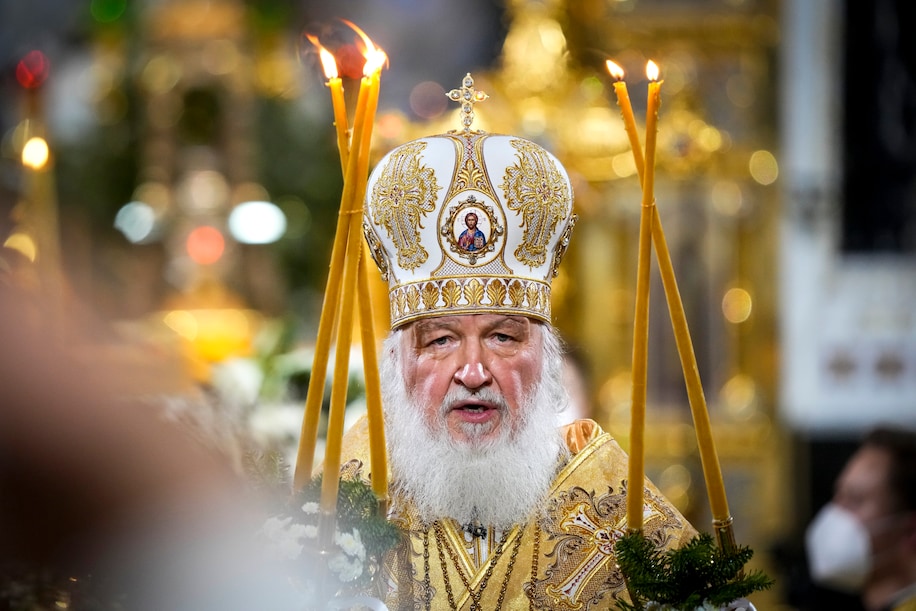
Today, as Russian forces continued to kill Ukrainians during their unprovoked invasion of Ukraine, Russian Orthodox Patriarch Kirill cited Vladimir Putin’s view of a Russian world with ‘one people’ in his sermon at Moscow’s Christ the Savior Cathedral, echoing Putin’s mania that Ukraine belongs to Russia. He said he wanted peace in the “Russian land” — meaning Russia, Ukraine and Belarus — adding “may the Lord protect the peoples that are part of the single space of the Russian Orthodox Church,” warning of “dark and hostile external forces” seeking to divide “our common historical fatherland.” To which the only response can be the medieval formulaic expression “non pastor sed lupus” (not a shepherd but a wolf) wherein the second element of the negation refers to a hireling or Judas. In this instance, clearly Kirill is a hireling of the thug Putin. The formula is based on Christ’s words as narrated in the Gospel of John (10:11–14) and the Sermon on the Mount from the Gospel of Matthew (7:15): “Beware of false prophets, who come to you in the clothing of sheep, but inwardly they are ravening wolves.”

Shakespeare’s Richard II, Kantorowicz’s The King’s Two Bodies, and Catoptromancy

Broken mirror
Photo by Bruno Pires on Pexels.com

Ernst H. Kantorowicz (1895-1963) was a most extraordinary scholar who infused his writings with an almost poetic, soaring aesthetic.  Recently, when re-reading his masterful tome, The King’s Two Bodies: A Study in Mediaeval Political Theology, originally published in 1957, I was reminded of my deep appreciation for his work.  A quick distillation of the work is nigh impossible, but a summarization from The Cambridge History of Medieval Political Thought c. 350- c. 1450 (1988, Ed. J.H. Burns) provides a necessary, if overly simple, foundation for this post: “Germanic custom subjected the prince to the law and limited his authority to govern without the consent of his subjects. Christian thought and classical jurisprudence and philosophy stressed the divine origins of kingship and the sacral nature of political authority. Kantorowicz demonstrated that this tension in the thought of the lawyers led them to distinguish between the prince’s private body that was subject to the law and his public body that was not” (pp. 426-427). 

Early in The King’s Two Bodies, Kantorowicz reminded me of his more than capable aesthetic sensibilities when he so ably demonstrated his theme by discussing Shakespeare’s Richard II and catoptromancy, which is the ancient art of divination using mirrors.

Before quoting the portion of The King’s Two Bodies which inspired today’s post, I provide, for those unfamiliar with the play Richard II, the following summary:  Richard II, who reigned as king of England from A.D. 1377-1399, banished his cousin, Henry Bolingbroke, son of the Duke of Lancaster for his involvement in a dispute with another lord.  While Henry was in exile, his father, the Duke of Lancaster died, and King Richard seized the Duke of Lancaster’s lands and monies, which he then used to help fund his war in Ireland.  While King Richard was waging war in Ireland, Henry Bolingbroke returned to England with an invading force to seize his inheritance.  Many other lords joined Henry in opposition to King Richard so that by the time Richard returned to England from Ireland, he was compelled to relinquish his crown to the usurper Henry Bolingbroke, who had him imprisoned.  After Richard’s supporters conspired to restore Richard, Richard was murdered.

In The King’s Two Bodies, after Kantorowicz has walked us through much of the play, he describes the scene in which Richard is compelled to split his natural body from his public body through words of renunciation and acts of deposition:

The scene in which Richard ‘undoes his kingship’ and releases his body politic into thin air, leaves the spectator breathless.  It is a scene of sacramental solemnity, since the ecclesiastical ritual of undoing the effects of consecration is no less solemn or of less weight than the ritual which has built up the sacramental dignity.  Not to mention the rigid punctilio which was observed at the ousting of a Knight of the Garter or of the Golden Fleece, there had been set a famous precedent by Pope Celestine V who, in the Castel Nuovo at Naples, had ‘undone’ himself by stripping off from his body, with his own hands, the insignia of the dignity which he resigned – ring, tiara, and purple.  But whereas People Celestine resigned his dignity to his electors, the College of Cardinals, Richard, the hereditary king, resigned his office to God – Deo ius suum resignavit.  The Shakespearian scene in which Richard ‘undoes himself with hierophantic solemnity,’ has attracted the attention of many a critic, and Walter Pater has called it very correctly an inverted rite, a rite of degradation and a long agonizing ceremony in which the order or coronation is reversed.  Since none is entitled to lay finger on the Anointed of God and royal bearer of a character indelibilis, King Richard, when defrocking himself, appears as his own celebrant:

Am I both priest and clerk? Well then, amen. (IV.i.173)

Bit by bit he deprives his body politic of the symbols of its dignity and exposes his poor natural body to the eyes of the spectators:

Now mark me how I will undo myself:

I give this heavy weight from off my head,

And this unwieldy sceptre from my hand,

The pride of kingly sway from out my heart;

With mine own tears I wash away my balm,

With mine own hands I give away my crown,

With mine own tongue deny my sacred state,

With mine own breath release all duteous oaths:

All pomp and majesty do I foreswear…. (IV.i.203ff) 

(pp.35-37)

However, as breathless as the scene above was, it is not the most compelling, nor the genesis of today’s post.  Rather, the following is:

The mirror scene is the climax of that tragedy of dual personality.  The looking-glass has the effects of a magic mirror, and Richard himself is the wizard who, comparable to the trapped and cornered wizard in the fairy tales, is forced to set his magic art to work against himself.  The physical face which the mirror reflects, no longer is one with Richard’s inner experience, his outer appearance, no longer identical with inner man. ‘Was this the face?’ The treble question and the answers to it reflect once more the three main facets of the double nature – King, God (Sun), and Fool:

Was this the face

That every day under his household roof

Did keep ten thousand men?

Was this the face

That, like the sun, did make beholders wink?

Was this the face, that faces so many follies,

And was at last outfaced by Bolingbroke? (IV.i.281)

When finally, at the ‘brittle glory’ of his face, Richard dashes the mirror to the ground, there shatters not only Richard’s past and present, but every aspect of a super-world.  His catoptromancy has ended.  The features as reflected by the looking glass betray that he is stripped of every possibility of a second or super-body – of the pompous body politic of king, of the God-likeness of the Lord’s deputy elect, of the follies of the fool, and even of the most human griefs residing in inner man.  The splintering mirror means, or is, the breaking apart of any possible duality. All those facets are reduced to one: to the banal face and insignificant physis of a miserable man, a physis now void of any metaphysis whatsoever.  It is both less and more than Death.  It is the demise of Richard and the rise of a new body natural.

Bolingbroke: Go, some of you, covey him to the Tower .

Richard: O, good! Convey? Conveyers are you all,

That rise thus nimbly by a true king’s fall. (IV.i.316ff)

Plowden: Demise is a word, signifying that there is a Separation of the two Bodies, and that the Body politic is conveyed over from the Body natural, now dead or removed from the Dignity royal, to another Body natural.

(pp.39-40)

The brilliance of the above is Kantorowicz’s allusion to catoptromancy.  It called to mind that art of divination as reportedly practiced at the sanctuary of Demeter at Patras:  

Before the sanctuary of Demeter is a spring at Patras, the spring separated from the temple by a wall of stones.  Here there is an infallible oracle, not for all events, but for the ill only.  They tie a mirror to a fine cord and let it down, judging the distance so that it does not sink deep into the spring, but just far enough to touch the water with its rim.  Then they pray to the goddess and offer incense, after which they gaze into the mirror, which shows them the presage of death or recovery according to the face appearing healthy or ghastly in the reflection.   

Pausanias, Description of Greece, Achaia, Book VII, Ch. 21, lines 12-13.   

For surely, Richard, upon gazing in the mirror, reacted so strongly as to shatter the mirror because he saw a reflection which presaged the death of his natural body, not just the reality of his demise from the body politic. 

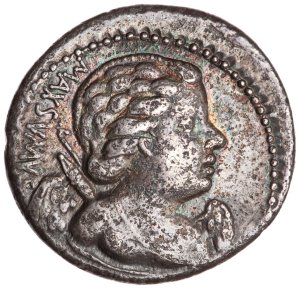
For St. Valentine’s Day: A denarius of the Roman Republic from 75 BC with an obverse featuring “Cupid with quiver and bow over shoulder”.

In Greek mythology, Cupid is known as Eros and is amongst the first gods. Hesiod records the following:

The First Gods

In the beginning there was only Chaos, the Abyss,

But then Gaia, the Earth came into being,

Her broad bosom the ever-firm foundation of all,

And Tartaros, dim in the underground depths

And Eros, loveliest of all the Immortals, who

Makes their bodies (and men’s bodies) go limp,

Mastering their minds and subduing their wills.

Hesiod, Theogony, 116-122

Of course, in contemporary culture, Eros, or Cupid, has become associated with Romantic love, and thus, the modern contrivance of Valentine’s Day.

Image of modern cupid with bow and arrow

Another Słuszków Hoard Discovered Near Kalisz: Continuing to enrich our understanding of the numismatic history of Poland

Cross Denar similar to those found in the Słuszków Hoards
CROSS DENAR: Anonymous, ca. 1070-1100, AR pfennig (0.79g), Gumowski-59; Dannenberg-1341, Bishop’s crozier surrounded by pellets // cross with pellets and crescents in quarters, raised rims of the randpfennig type, possibly struck at Halle-Giebichenstein or Merseberg, Fine to VF, S. The early pfennige of Saxony have seen a number of different attributions over the years. Some were known as “wendenpfennige” from the native Slavic peoples of eastern Germany and Pomerania and others as “randpfennige” (rim pfennigs) from their up-raised edges and attributed to the early Polish bishoprics and kingdoms. More recent studies have concluded they were civic issues of various eastern cities, with places such as Bremen, Halle-Giebichenstein, Meissen, Merseberg, and Naumburg being cited as points of origin. Ex Stephen Album Rare Coins Auction 31, Lot 1309 (2018).

The first hoard from the village of Słuszków near Kalisz was discovered accidentally in 1935. Krzysztof Dąbrowski, head of the archaeological department of the Institute of the History of Material Culture of the Polish Academy of Sciences (Kalisz), and later director of the State Archaeological Museum, secured the hoard for the state, thereby preserving it for study. The hoard, as it currently survives, is presently located in the Muzeum Okręgowe Ziemi Kaliskiej (District Museum of the Kalisz Region). The deposit has over 13,000 pieces, largely comprised of the later varieties of cross denarii, but also large module denars of the palatine Sieciech, Western European coins, and silver ornaments and “silver cakes”. The content and deposit date of this hoard provided scholars with the opportunity to address the issue of the origin of the later types of cross denars, which were the most common circulating coin in eleventh-century Poland.  The reader is encouraged to review the sources linked below for a survey of the advances which the hoard has allowed. I have included an English translation of one of the most important articles for your convenience.  

Surprisingly, the actual discovery location of the 1935 hoard in Słuszków is still unknown, despite repeated efforts by archaeologists to relocate it.  Recently, however, it was reported by Archeologia Żywa (see articles cited below) that archaeologists from Kalisz and Warsaw were successful in finding an additional deposit of 6,500 silver coins in a corn field near the village of Słuszków, arranged in linen pouches, along with silver cakes, fragments of lead, and four gold rings, while searching for the original discovery location in November 2020.

Adam Kędzierski, an extraordinary scholar and archaeologist with the Interdisciplinary Center of Archaeological Research (Kalisz) of the Polish Academy of Sciences, reported the circumstances of the find: “According to the official version, the [original 1935 hoard, Słuszków 1] was hidden at the intersection of the border of three plots, located in the northern part of the village. This information turned out to be false, which is why during this year’s exploration work, attention was focused on the field closer to the road. This place was identified by the Rev. Jan Stachowiak, who obtained the information from the original finders of the hoard in the early 80s.” Kędzierski said the new hoard of denars was found within two days of the commencement of archaeological work in a well-preserved clay vessel “filled to the brim” located about 12 inches below the surface.

Edge of an inscribed gold ring from the Słuszków 2 Hoard. After translation from the Cyrillic, the inscription on one of the ring reads: Lord help your servant Maria.
Photograph by A. Kędzierski ©

From my perspective, one of the gold rings in the recent hoard is most historically intriguing and raises the most interesting questions.  The ring at issue is inscribed, in Cyrillic, Господ]ипомъзи [ра]бесвое[и] Марии. Adrian Jusupović, of the Institute of History (Warsaw) of the Polish Academy of Sciences, translates this inscription to “Lord help your servant Maria.” Kędzierski, after reviewing the coins in the latest hoard, which is now called Słuszków 2, has determined that, as the deposit can be dated to around 1105 A.D., the ring hypothetically can be attributed to the wife of Duke Casimir the Restorer of Poland, Duchess Maria Dobroniega (1010/1016 – 1087 A.D.), daughter of Grand Duke Vladimir of Kiev.

UPDATE: In 2021, Adam Kędzierski published a comprehensive monograph of the Słuszków hoards (see YouTube summary in Polish), which is linked below. It includes an English summary. A copy can also be downloaded directly from this link: https://rcin.org.pl/dlibra/publication/269721/edition/232826?action=ChangeMetaLangAction&id=232826&lang=en#info.

I hope to prepare a comprehensive summary of all the pertinent literature, with appropriate pictures, in the near future, outlining the understanding of the role of cross denars in Polish numismatic history by scholars.

SOURCES/REFERNCES:

Blue buttons are linked to the articles referenced. The first article is a new translation, in English, of the article immediately below it. If you have suggestions for improvements in the translation, please do not hesitate to contact me at nca@northcoastantiquarian.com.

Another Quotable Montaigne Quip

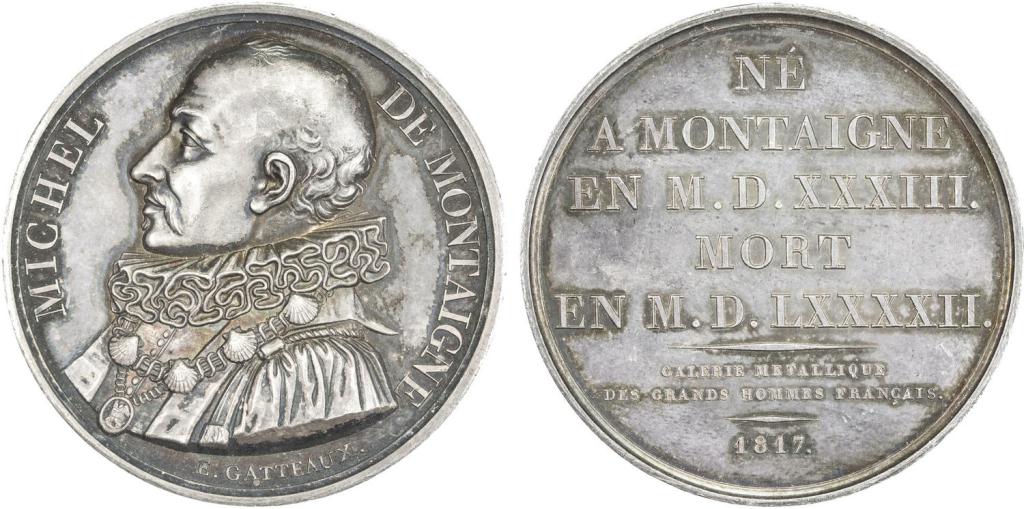
AR medal, 1817, 41mm by E. Gatteaux of Michel De Montaigne. Bust of De Montaigne left, MICHEL DE MONTAIGNE around, engraver E. GATTEAUX below // NE’ / A MONTAIGNE / EN M. D. LXXXIII. / MORT / EN M.D.LXXXXII. / GALERIE METALLIQUE / DES GRANDS HOMMES FRANCAIS. / 1817. Ex: STEPHEN ALBUM RARE COINS, AUCTION 29, LOT 748.
Image and description courtesy Stephen Album Rare Coins.

“I quote others only in order the better to express myself.”

Michel de Montaigne, Les Essais