Celestial Reflections: Twinkle, Twinkle, Little Star Latin Translation

Exploring the translation of “Twinkle, Twinkle, Little Star” into Latin after creating additional stanzas for the rhyme, I was inspired by the contemporary Celtic music sound provided by Udio.com. The resulting creation, “Celestial Reflections,” is set to a Celtic vibe by Udio. This linguistic and musical endeavor is documented in a video titled “Reflexiones Caelestes” on Youtube. The link to the video is provided.

Photo by Felix Mittermeier on Pexels.com

Occasionally attempting to translate simple English into easy Latin (with the assistance of memory, dictionaries, and software), and being quite taken with the contemporary Celtic sound of the music on Udio.com, I thought I would translate Twinkle, Twinkle, Little Star into Latin, adding two additional stanzas of my own creation to the first one, and see what it sounded like when set to a Celtic vibe on Udio. “Celestial Reflections” (“Reflexiones Caelestes”) is the result.

“Celestial Reflections – Twinkle, Twinkle, Little Star”

My Latin is crude and rough, I admit. My first stanza is:

Micat, micat, parva stella,
Quam miror quid sis bella!
Sursum supra mundi alti,
Sicut gemma in caelo.

The American Classical League’s translation of the first stanza, which I looked up after I did my translation, is:

Mica, Mica, parva stella;
Miror quaenam sis tam bella.
Splendens eminus in illo,
Alba velut gemma caelo.

The differences are intriguing, as the second line in my translation, “How I wonder/marvel at what a beauty you are!”, contrasts with the League’s rendering, “I wonder what makes you so beautiful.” My third line, “Up above the world so high,” differs from the League’s “Shining afar in that place.” Similarly, my fourth line, “like a gem in the sky,” contrasts with the League’s “white like a gem in the heavens.” The primary distinction lies in the League’s effort to rhyme the Latin words, a technique I did not employ. Additionally, the League chose to specify the gem as explicitly white, enhancing its resemblance to a diamond. Such nuances underscore the divide between scholars and an amateur such as myself!

For those interested, the English translation of the two additional stanzas I added may be as follows:

Twinkle, twinkle, purest star, Your radiant form, Through the night you give brilliance, You make a path through the darkness.

Twinkle, twinkle, bright star, In the rare celestial path, You shine with eternal light, You tint the night with sweet sleep.

Poetic Reflections: Exploring the Fortress of the Mind

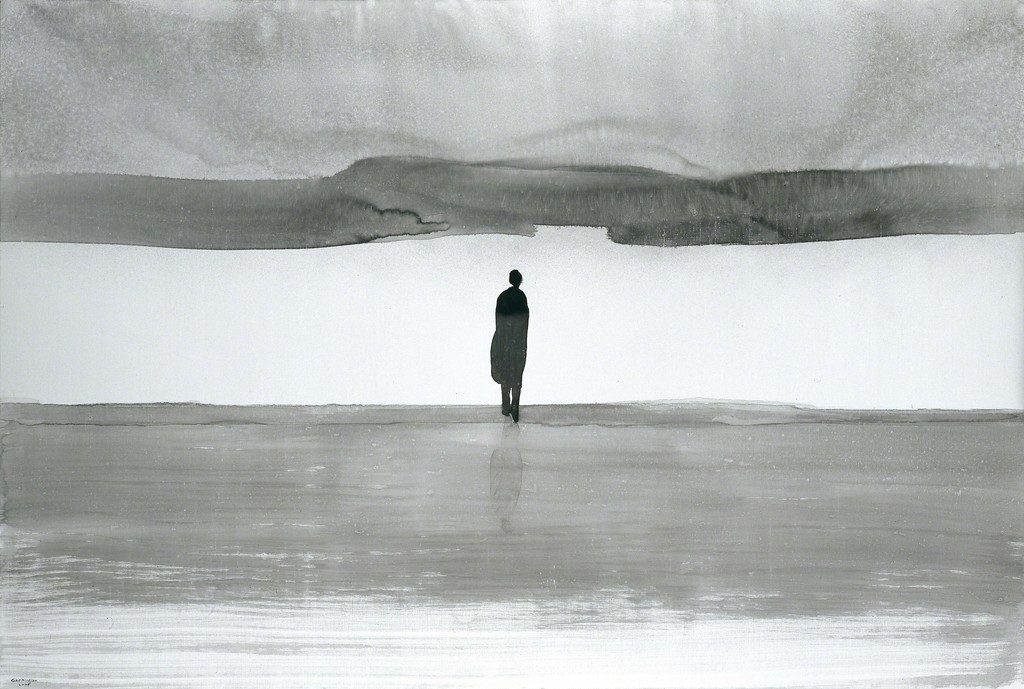
In “L’attente (Waiting) [2004]” by Gao Xingjian, the author finds an appropriate artwork to illustrate his reflections on retreating into a world of words as a sanctuary from the harsh external world, but also as a form of self-imposed isolation. The poem expresses the duality of words as both protection and confinement, shaping the author’s existence, reflecting a life intertwined with letters, sheltered yet constrained by the fortress of his mind.In “L’attente (Waiting) [2004]” by Gao Xingjian, the author finds an appropriate artwork to illustrate his reflections on retreating into a world of words as a sanctuary from the harsh external world, but also as a form of self-imposed isolation. The poem expresses the duality of words as both protection and confinement, shaping the author’s existence, reflecting a life intertwined with letters, sheltered yet constrained by the fortress of his mind.

L’attente (Waiting) [2004] by Gao Xingjian (b. 1940).

As I am confounded by life now, as I was in my youth, I retreat, as always, into a world of words, written on pages and assembled in books. These books surround me, forming walls that at times serve as battlements, the fortifications protecting me from the external perils of an incomprehensible, harsh, and hostile world, or so I tell myself. In other moments, however, these same walls are the confines of a cell, isolating me in solitude, depriving me of the air, sustenance, and human interactions necessary to life and sanity. Thus, the world of words is both my sanctuary and prison.

Of course, playing the poet much of late, and a bad one at that, I transmogrified the above thoughts, into the following:

I retreat, as always, into words,
Pages inked and bound in books,
Encircled by these silent guards,
My fortress walls, my quiet nooks.

At times they stand as battlements,
Shielding me from the world’s disdain,
A citadel where reason reigns,
Against the chaos, fear, and pain.

Yet oft they turn to prison walls,
Confines of a solitary cell,
Where air and sustenance are scarce,
And human warmth does not dwell.

This paradox my soul sustains,
A life in letters intertwined,
Sheltered by and yet constrained,
By the fortress of my mind.

A Crash of Memories on the Sighting of the First Lightning Bug of Summer

On Sunday evening, as the sun had just receded and I returned home, I found myself in my backyard. There, I witnessed the flicker of light from the tail of a lightning bug, the first I had seen this summer. In that instant, a crash of childhood memories, from so many decades ago, flooded my mind. It is remarkable how a single sight, much like a familiar smell, can trigger memories from so long ago.

The next morning, still smiling from the memories elicited by that twinkle in the night, I quickly sketched out the recollections that had cascaded through my mind in that luminous instant. I then spent a little time shaping them into form. For better or for worse, here is the result. I imagine only my siblings can fully appreciate these memories, as they are so deeply family-centric.

Memory Fragments of a Mahoning Valley Childhood

In the heart of summer, lightning bugs glowed bright,
Church festivals thrived, Saint Luke’s, Saint Pat’s in the night.
The Canfield Fair’s grand end of summer delight,
A crush of people, crash-up derby, under starry twilight.

Handel’s Ice Cream, a seasonal treasure so sweet,
A&W root beer floats, a frothy, chilled treat.
Sunday drives through Mill Creek Park’s serene retreat,
Fresh bread’s aroma from Schwebel’s bakery street.

Poulakos donuts after Sunday mass, divine,
Pierogies with butter and onions, St. Stan’s line.
Idora Park’s Wild Cat, Jack Rabbit in summertime,
Learning to swim at the downtown Y, feeling fine.*

Downtown shopping at Woolworth and Strouss, a spree,
Barney Bean, Gilligan’s Island, and more on TV.
Isaly’s chip chop ham sandwiches, more than we’d plea,
Dad’s Friday night football games on AM frequency.

Bowling leagues, Dusi Music, Conti Dance’s beat,
Mom at ceramics studio, weekly meet.
Family dinners nightly when Dad came home to eat,
Vegetable garden’s bounty, homegrown treats so neat.

Bicycles, unicycles, basketballs in the drive,
Chalk drawings, sandboxes, tree forts where dreams thrive.
Imagination abundant, throughout the neighborhood we’d roam,
Mahoning Valley memories, forever our home.

*In truth, I disliked the swimming lessons at the Y, the water was so cold that I shivered incessantly, teeth chattering and lips turning blue, every lesson — oh, and let me tell you that the smell of chlorine was overwhelming!

Humilitatem Initium Sapientiae: Wisdom’s Guiding Light

Throughout my life, two essential sources of guidance have been my personal motto, “Humilitatem Initium Sapientiae,” meaning humility is the beginning of wisdom, and the insightful advice from Thomas à Kempis in De Imitatione Christi. His words inspired the lyrics of my composition, “The Beginning of Wisdom,” recently set to music using Udio.com. The song emphasizes the importance of humility, seeking good examples, and self-correction. It beautifully portrays the idea that through humility, wisdom shines bright, leading us forward even through the darkest nights. The powerful message is conveyed through gentle and reflective lyrics, inspiring listeners to embrace humility as the start of wisdom.

Korea, hanging scroll, ink on paper. Egret and Reeds, late 1800s.
Yang Ki-hun (Seuk-Eun) (Korean, 1843–1919?). In this hanging scroll, an egret walks along the shores of a salt marsh where reeds abundantly grow.
Korea, hanging scroll, ink on paper. Egret and Reeds, late 1800s.
Yang Ki-hun (Seuk-Eun) (Korean, 1843–1919?). In this hanging scroll, an egret walks along the shores of a salt marsh where reeds abundantly grow. Yang treated his subjects of flora and fauna with an observant naturalist’s view, yet his choice of subjects—an egret and reeds—is deeply rooted in traditional symbolic language: the egret stands for the scholarly reclusive life, while reeds indicate humility and modesty. Cleveland Museum of Art.

Two of the most treasured sources of guidance throughout my life, which I frequently call to mind, are my personal motto, Humilitatem Initium Sapientiae, which may be translated as humility is the beginning of wisdom, and the prudential advice offered by the canon, author, and scribe Thomas à Kempis (d. 1471), in De Imitatione Christi: “Study also to guard against and to overcome the faults which in others very frequently displease you. Make the best of every opportunity, so that if you see or hear good example you may be moved to imitate it. On the other hand, take care lest you be guilty of those things which you consider reprehensible, or if you have ever been guilty of them, try to correct yourself as soon as possible. As you see others, so they see you.” These words informed the lyrics of my most recent composition which I then set to music using Udio.com

Humilitatem Initium Sapientiae (Humility, the beginning of Wisdom) – by Donald S. Yarab
Audio file for “The Beginning of Wisdom” (Lyrics by Donald S. Yarab).

Lyrics:

In the quiet dawn, wisdom’s voice we hear,
Whispering softly, drawing us near.
In the humble heart, truth finds its place,
Guiding our steps with gentle grace.

Humilitatem Initium Sapientiae,
Through the shadows, a light to guide our way.
In the path of humility, wisdom shines bright,
Leading us forward through the darkest night.

Guard against the faults that others display,
Seek the good examples, and follow their way.
Correct your own missteps, strive to be true,
For as you see others, they also see you.

Humilitatem Initium Sapientiae,
Through the shadows, a light to guide our way.
In the path of humility, wisdom shines bright,
Leading us forward through the darkest night.

With each humble act, our spirits rise,
Touching the heavens, reaching the skies.
In the silence deep, where the soul is free,
Wisdom’s beginning, in humility.

Humilitatem Initium Sapientiae,
Through the shadows, a light to guide our way.
In the path of humility, wisdom shines bright,
Leading us forward through the darkest night.

In humility, we find our start,
With wisdom’s light, within our heart.
Humilitatem Initium Sapientiae,
A guiding star, forever to stay.