

Three Morning Meditations

When I awoke this morning, I found that I had, as usual, a productive night of contemplation while I slept. Three meditations were ready to write, and write I did. Here are the results.

I. On Being

The contemplation of being—its beginning and its ending—rather than being itself, is humanity’s fascination. We exalt its creation with ceremony, and we weave endless tales of its defeat, as if death might be outwitted by story. We fear its ending with such intensity that we grant it more weight than the fact of life itself.

We revere its beginning with awe, we dread its end with terror, yet the middle—being itself—we profane with neglect.

We curse the day, the hour, the minute, for the slightest disappointment or inconvenience, real or imagined; the weather, our companions, our labor. We curse the brevity of joy, the length of sorrow, the depth of our feelings, the complexity of our thoughts, the idleness of time, the busyness of our brow. All that is given becomes a target of our disdain.

Yet here is the paradox: if we are so careless with being itself, why then do we revere its beginning and tremble at its end? Why fear the loss of what we do not value? Why guard so jealously what we daily scorn?

The truth is simple, if difficult: life deserves more than our curses. If we cannot greet each moment with wonder, let us at least receive it with gratitude. If not embrace it as miracle, then with appreciation. If we cannot bless every hour as holy, let us at minimum acknowledge it as gift. For being itself, squandered though it may be, is all we have.

II. On Equality and Power

Men will not endure the scourge of equality with those they deem beneath them. They will sooner suffer the loss of station and status, wealth and power, even willingly and against their own interests, so long as those they despise remain below them. The humiliation of parity weighs heavier than the burden of deprivation.

The clever puppet masters—those who truly govern—have always known this. They stir enmity where alliance might have been, teaching one man to scorn his neighbor, to measure himself not by his own condition but by the imagined inferiority of another. Thus, the poor man may rejoice in the poverty of one poorer still; the dispossessed may take comfort in the greater dispossession of another.

And so men pit themselves blindly against those who should be their allies. They are content to yield treasure and status to the puppet master, provided only that they may stand athwart the “inferior.” Thus do they squander their strength, mistaking themselves for masters of destiny when in truth they are but marionettes in another’s play.

III. On Tears and Salt

There is salt in tears. Salt—the preservative—preserves remembrance. Even sorrow is instructive to heart and soul, for grief keeps memory alive.

So it was with the wife of Lot, who looked back for love of her daughters, lost to the destruction of divine wrath. Preserved in salt, she became remembrance itself: a monument to sorrow, fidelity, and the peril of divided love.

Thus every tear carries its trace of preservation, holding fast what might otherwise be lost: a fragment of love, a lesson of pain, a reminder that sorrow, too, endures as teacher.

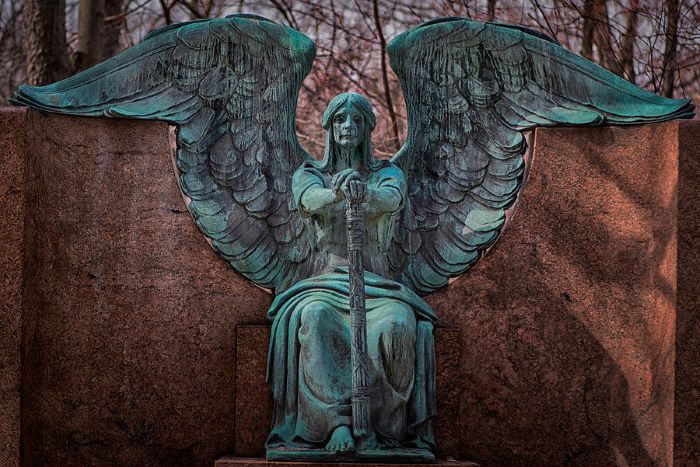
Every Angel is Terrifying

By Donald S. Yarab

The Angel of Death Victorious is a bronze funerary sculpture with a marble base, created in 1923 by Herman Matzen. It was commissioned by Francis Henry Haserot after his wife's passing and is located in Lake View Cemetery, Cleveland Heights, Ohio. The photograph was taken by Rosette Doyle.
The Angel of Death Victorious is a bronze funerary sculpture with a marble base, created in 1923 by Herman Matzen. It was commissioned by Francis Henry Haserot after his wife’s passing and is located in Lake View Cemetery, Cleveland, Ohio.
The photograph was taken by Rosette Doyle.

Yet we keep calling them down,
hoping for comfort,
dreaming of radiance.

They arrive without warning,
bearing weight, not mercy:
the silence that collapses sound,
the gaze that unravels marrow.

We tremble,
for their wings are woven
of light we cannot bear to see,
of shadow we cannot learn to name.

What they touch is never the same.
A tree becomes flame.
A breath becomes prayer.
A man becomes dust.

But is this terror for one heart alone?
No—their shadow falls on cities and nations,
their silence unsettles centuries.

They do not stoop to whisper comfort.
They stride through millennia,
their wings stirring wars and kingdoms,
their silence heavier than empires.

Temples tremble,
mountains bow down,
a bell falls silent in the square,
the proud are unmade
by a glance that knows no compromise.

Still, we call them down,
for without their terror we would never glimpse
the depth of beauty,
nor know that awe and fear
are one.

Awe belongs not to possession,
nor fear to a single soul,
but to the common lot of mortals
who stand together before the unendurable.

The Hollow Trunk’s Flight

The Dream

A dream came last night, which I remembered fully this morning—unusual in itself. And it took place in my back yard, though it was both the yard I inhabit now and the yard of my childhood, merged into one, as dreams are apt to do.

There, an artful arrangement awaited discovery. Tree stumps, limbs, and trunks lay piled upon one another in an interlocking manner that spoke of intention, as if some unseen curator had composed a sculpture from what time and weather had left behind.

When I reached out to touch them, my hands found surprise. These weathered forms, which should have been heavy with the density of wood and years, had been hollowed by time itself. They were rotted through, yet not with decay’s dampness—they were light and dry, transformed into airy vessels rather than solid mass.

Somehow, as dreams permit impossible physics, I found myself propping up a trunk that had been cleft cleanly along its length. It towered above my home, this great hollow half-cylinder, and I leaned it against another tree for support. Yet it was the interior that commanded wonder—not the familiar barked exterior, but the cavernous architecture time had carved within.

The hollow space revealed itself as a cathedral of wood. Veins ran through its walls like ancient rivers frozen in timber. Hollows and chambers formed a geography of absence, more substantial in its emptiness than solidity ever was. Feathery light filtered through, revealing a multitude of dark wooden colors that dazzled the eye—chestnut depths giving way to amber chambers, shadows playing across surfaces smoothed by seasons of patient transformation.

Then came the wind. A sudden gust lifted this towering trunk—this thing that should have weighed hundreds of pounds—and set it sailing. It rose effortlessly over my home, over the neighboring trees, floating like a great wooden vessel through the air. I watched in wonder as it drifted beyond my private yard into the public realm, finally coming to rest in the street where others might behold it: a hollowed vessel that had learned to fly.

Reflection

When I woke, with the image of the trunk carried aloft by wind still vivid and present, I immediately, before any conscious analysis, found myself recalling a verse from Sirach 34:1:

“Vain and deceptive hopes are for the foolish, and dreams lend wings to fools.”

Strange that this verse should surface decades after its first encounter, yet perhaps not strange at all. Since my undergraduate days, I have described my own words as but the “ramblings of a fool.” Yet here was a dream that seemed to insist on meaning, demanding that this particular fool pay attention to what had taken wing.

And so its meaning began to unfold.

What does it mean to be made light by emptiness? In this dream, the trunk had surrendered its solid density to time’s patient carving, and in return had been granted the gift of flight. It was not diminished by its hollowness but transformed by it—its beauty now living in the spaces where wood once was, in the architecture of absence that created room for light to play.

Perhaps this speaks to a deeper truth about how we ourselves are shaped. The experiences that hollow us out—loss, time, the gradual weathering that comes with living—may not be diminishing us but preparing us for a different kind of beauty. What we think of as erosion might actually be revelation, uncovering inner landscapes we never knew existed.

The dream suggests that lightness is not about adding something but about discovering what remains when the unnecessary weight has been worn away. Those veins and chambers within the wood were always there, waiting to be revealed. The capacity for flight was present all along, hidden beneath layers that time knew how to remove.

And there is something profound about how the dream moves from private discovery to public gift. What begins in the intimate space of a backyard—this personal encounter with transformed wood—ultimately takes wing and lands where others might find it. The wind carries our revelations beyond the boundaries we set for them, beyond the fences of our private understanding.

The hollow trunk that sails over houses and trees reminds us that what we think is fixed and earthbound may be preparing for flight. What appears to be ending—the tree’s death, the wood’s decay—may actually be a becoming, a transformation into something lighter, more beautiful, more free.

In the end, perhaps the dream asks me to consider: What in my own life is being hollowed by time? What losses carve space for unexpected beauty? And what within is growing light enough to catch the wind? Sirach warns that dreams lend wings to fools. Yet perhaps even folly bears wisdom, if its wings lift what was thought earthbound into flight.

Between Astonishment and Silence

“When I consider thy heavens, the work of thy fingers,
the moon and the stars, which thou hast ordained;
What is man, that thou art mindful of him?” Psalm 8:3-4

The Psalmist, gazing beneath the vault of stars, marvels aloud:
What is man, that Thou art mindful of him?
The heavens dwarf him, the dust clings to him,
yet he dares believe the Maker bends low, remembers, and grants worth.

But even in that astonishment, the shadow of doubt stirs.
Another voice—the Philosopher’s—finds in the same expanse not remembrance but silence.
The stars speak only of distance,
the void carries no voice.
Armenia and Auschwitz, Hiroshima and Rwanda, Ukraine and Gaza—
the graves of countless innocents cry out:
how can one still say, Thou art mindful?
Likewise, science has stripped the heavens bare:
no angels in the spheres, only galaxies colliding in indifferent law.
Scripture, once oracle, is now artifact, sifted by history.
Thus the question sharpens: not What is man, that Thou art mindful?
but Is Thou mindful at all?

Between astonishment and silence stands the Poet, unable to forsake either.
He reveres the psalm, yet trembles with the Philosopher’s doubt.
Inheritance falters: the words remain precious,
but their certainty slips from them.
Still, he will not cast them aside.
Instead, he holds the fragments as one might hold a candle in the wind:
not enough to illumine the void,
yet enough to keep the darkness from being complete.
He labors to shape language into vigil,
to bind meaning against the scatter of grief,
to weave remembrance into flame so silence is not the final word.

Perhaps mindfulness is only man’s work—
to remember, to wrest coherence from the scatter of loss.
Or perhaps it is more: a presence that waits rather than speaks,
a silence that shelters rather than denies.
The Poet does not resolve the question;
he learns instead to live within it,
to practice reverence without assurance,
until the asking itself becomes our mindfulness.

The Gods in Dust

Once none dared blaspheme their names—
Isis enthroned, Osiris of the underworld,
Amun-Ra blazing in the noon,
Zeus the thunderer, Hera august,
Athena who struck with spear,
Apollo of the lyre and light,
Artemis who loosed her arrows in the shadows of the wood.
Marduk who shattered the dragon,
Ishtar of love and war,
Baal the rider of clouds,
Dagon of the harvest, Chemosh of battle.
All received blood and incense,
bore the weight of kingdoms,
demanded fear.

But now—
their names are ink upon a scholar’s page,
cartoons in a schoolboy’s jest.
Their temples gape as hollow mouths,
stones tumbled like teeth in the earth.
Their rites are rumor,
their mysteries reconstruction,
their fires ashes, their echoes gone.

Behold Karnak, roofless to the sky;
Delphi, once the navel of the world,
silent but for the wind in the laurel.
Eleusis, where mysteries bound gods and men,
is rubble, its rites reduced to speculation.
Uruk, the wall-girt city,
mute in the desert.
Tenochtitlan, where once the sun fed on blood,
now paved by another empire’s stones.

Thus is man mocked by memory:
he built to house the eternal,
yet what he named eternal is gone.
The priest is forgotten with the god,
the hymn with the idol,
the worship with the fear.
All that was called everlasting—
proved mortal as dust.

Yet from these scattered stones, a truth emerges:
temples fall, names fade,
but the hunger endures.
Not the idol, but the yearning;
not the revelation carved in stone,
but the silence men cannot bear.

The divine was never in the image,
but in the need that made it.
This is the immortal truth:
that man longs,
and in the longing is closer to the eternal
than any god he made.

Yet beware:
for the gods that fed on blood
still feed—
only now in other names,
with other temples,
upon the lives of men.