

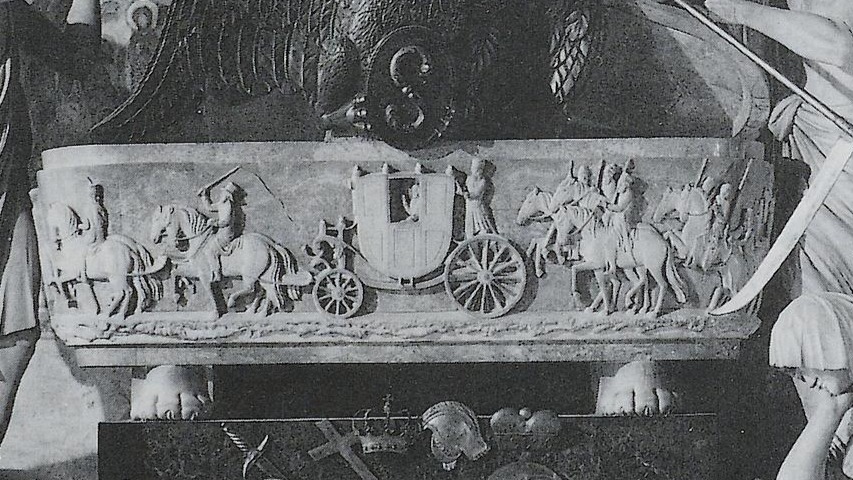
In the Holy Cross Chapel of the Wawel Cathedral in Kraków stands the funerary monument of Kajetan Ignacy Sołtyk, sixty-seventh Bishop of Kraków — a funerary monument commissioned by his nephew Michał in 1790, the year Poland’s second partition reduced what the first, in 1772, had already diminished. On the face of the sarcophagus, rendered in low relief, a carriage moves under cavalry escort along a road that leads, though the stone does not say so, to Kaługa, in the Russian interior. The year was 1767. Sołtyk had been seized by Russian troops by order of the Russian ambassador for opposing Russia’s political and religious program for the Commonwealth during the Sejm, bundled into a carriage, and driven east — a political abduction so brazen that it became, in the decades following, one of the founding outrages of Polish martyrological memory. He would not return for five years. The monument, which the scholar Daranowska-Łukaszewska has shown to be the work of an amateur architect drawing on a Roman Baroque prototype, transforms that enforced journey into the central scene of a man’s significance: not his episcopate, not his theology, not his political career, but the moment he was taken away against his will and transformed into a patriot-martyr — a transformation his later years, marked by mental collapse and withdrawal from public life, would do nothing to complicate in the popular memory.
That is one carriage. There is another.
The memoirist Jędrzej Kitowicz, describing the ceremonial processions that opened each session of the Sejm — the king riding from his palace to the royal castle along the Kraków Road, flanked by the ranked carriages of lords and deputies, each equipage expressing by the number of its liveried attendants the precise degree of its owner’s dignity — notes that the most elaborate display permitted by custom consisted of twelve lackeys and six haiduks (the tall liveried footmen whose Hungarian-style dress and ceremonial bearing made them among the most visible markers of aristocratic magnificence), a number not exceeded even by the king himself. In fact it was exceeded by one participant only. Kajetan Sołtyk, in the first year of his episcopate at Kraków, appeared in the procession of 1760 with twenty-four lackeys, twelve haiduks, and four pages. Already in his second year, Kitowicz adds with characteristic dryness, he had reduced this magnificent display to conventional proportions.
Two carriages, then. One at the height of his career, one at its nadir. One the expression of an ambition so consuming it overreached even the sovereign’s ceremonial precedence; the other the instrument of a foreign power’s contempt for Polish sovereignty and ecclesiastical dignity. And in both, the bishop is being carried — not walking of his own volition, not the autonomous agent of his own movement, but the passenger of forces that exceed his will. In 1760 those forces are internal: the hunger for visibility, for the assertion of precedence, for the world to register the arrival of the greatest episcopal see in the Polish Church under its new occupant. In 1767 they are external and violent. But the structure is identical. He is always at the center of an attended vehicle. What changes is only who commands the escort.
Kitowicz does not moralize. He gives you the numbers — twenty-four, twelve, four — and then simply notes, with characteristic dryness, that already in his second year the bishop had reduced his display to conventional proportions, leaving you to draw the inference yourself: that either someone spoke to Sołtyk, or that he read the reception his immoderate display provoked in the faces of his peers, and retreated. The retreat is its own testimony. It suggests a man periodically capable of social learning, but only after the fact — a man whose interior ran always slightly ahead of his judgment, who always arrived at proportion too late.
What the monument suppresses, and what Kitowicz preserves, is that earlier carriage: the one that moved through Warsaw under twenty-four lackeys, announcing to every observer that the newly installed Bishop of Kraków had arrived and intended to be noticed above all others, including the king. Michał Sołtyk, commissioning the monument in the same year he published his pamphlet seeking to rehabilitate his uncle’s memory after his retreat from public life knew the record. He chose which carriage to put on the sarcophagus.
And the choice, however motivated by familial piety and political calculation, was not wrong — or not simply wrong, though neither was it uncontested. Sołtyk’s historical reputation has never settled into a single image: those who remembered him as a patriot and victim were matched, even in his own lifetime, by those who remembered him as a man whose turbulent ambitions had done as much to destabilize the Republic as the foreign powers that preyed upon it. The martyrological image the monument proposes is one reading of the man — a powerful reading, and one that history has repeatedly ratified — but it is a reading, not a verdict. What it is unquestionably right about is the hinge: the deportation to Kaługa became the organizing fact of Sołtyk’s significance, the event that separates him from the dozens of ambitious, magnificent, occasionally grotesque ecclesiastics who populated the Polish Church in the eighteenth century and left no comparable mark on the national memory. The twenty-four lackeys did not achieve what the cavalry escort did: they made him, for a season, conspicuous; the escort made him, permanently, symbolic.
There is almost a providential grammar to this, if one is inclined to read it that way — and Sołtyk, a Catholic bishop with a pronounced taste for the theatrical and excess, may well have been so inclined. The external force that humiliated him accomplished what his own will had reached for and overreached: the uncontested image of his magnitude, carried now not along the Kraków Road in Warsaw but forward into a posterity that would need, as Poland needed, its martyrs. The monument does not lie, exactly. It simply chooses the carriage that tells the truth it wishes to tell — and leaves the other one, with its twenty-four lackeys, to the mercy of a memoirist who wrote things down and the historians who come across his writings.
Sources
The description of Sołtyk’s funerary monument and the attribution of its design to Father Sebastian Sierakowski draws on Joanna Daranowska-Łukaszewska, “Kto jest autorem nagrobka biskupa Kajetana Sołtyka w katedrze na Wawelu?” (Studia Waweliana, vol. 1, 1992). The account of the Sejm processions and Sołtyk’s ceremonial display is drawn from Jędrzej Kitowicz, Opis obyczajów za panowania Augusta III (Description of Customs in the Reign of Augustus III). Background on Sołtyk’s seizure and deportation draws on Konstanty Rudnicki, Biskup Kajetan Sołtyk (Kraków, 1906), and on the archival and biographical materials assembled in the course of the author’s ongoing biography of the bishop.
Discover more from Northcoast Antiquarian
Subscribe to get the latest posts sent to your email.

 Northcoast Antiquarian