

And to hold back the donkeys, Who has breath for that?

As they say: to stand up, and to sit down,

To protect the king’s son,

And to hold back the donkeys,

Who has breath for that?

Gilgamesh and Akka, Lines 24-27 (trans. Dina Katz)

Gilgamesh and Akka, by Dina Katz (Library of Oriental Texts, Vol. 1, STYX Publications, 1993), explores the short narrative poem in standard literary Sumerian which tells the tale of Gilgamesh of Uruk’s war against Akka of Kish.
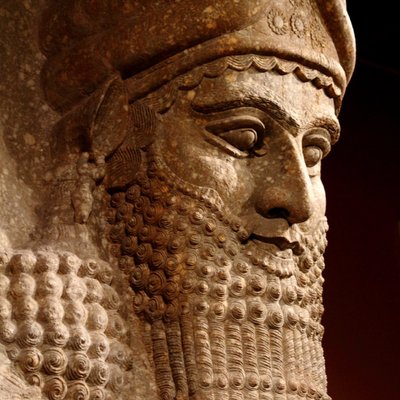
Gilgamesh
GILGAMESH

In the tale, Akka of Kish demanded physical labor from the people of Uruk “to finish the wells, to finish all the wells of the land.” Gilgamesh, in response, asked the elders of Uruk for permission to wage war against Kish. The elders denied Gilgamesh permission to wage war against Kish, at which point Gilgamesh took his case for war to the able-bodied men of Uruk directly:

Since Gilgamesh, the Lord of Kulaba

had placed his trust in Inanna,

He did not take to heart the words of his city’s elders.

Gilgamesh before the able-bodied men of his city again

Laid the matter, seeking for words:

‘To finish the wells, to finish all the wells of the land,

To finish all the shallow wells of the land,

To finish all the deep wells with hoisting ropes,

Let us not submit to the house of Kish,

Let us smite it with weapons.’

The convoked assembly of his city’s able-bodied men answered Gilgamesh:

‘As they say: To stand up, and to sit down,

To protect the king’s son,

And to hold back the donkeys,

Who has breath for that?

Let us not submit to the house of Kish, Let us smite it with weapons.’

Gilgamesh and Akka, Lines 15-29 (Trans. Dina Katz)

The tale records that Gilgamesh and his able-bodied men went on to wage successful war against Akka and Kish.

Katz identified the passage that I am so enamored of, and which I quoted at the beginning of this post, as “puzzling.” She noted that a previous scholar felt that the expression was likely a “common saw” [i.e., a common Sumerian saying] whose meaning was lost to us. She noted, however, that the verbs “to stand” and “to sit” were often associated with the participants of the public assembly. It would appear, from the context, that the expression suggests having no more need or patience for further discussion due to appropriate consideration having been given (as in an assembly), pressing exigent conditions (as in a security situation), or exasperating circumstances (as in corralling or guiding donkeys).

Herman L. J. Vanstiphout, in reviewing Katz’s work in “A New Edition of Gilgamesh and Akka” (Journal of the American Oriental Society, vol. 119, no. 2, American Oriental Society, 1999, pp. 293–96) generally approved of Katz’s scholarly contributions and, with respect to the translation of the particular passage, took exception only with the wording regarding holding back the donkeys. He conceded that translating the line as “to hold back” “might surely be all right in a general sense” but seemed to suggest that something along the lines of “to hold the reins” may have been (more?) appropriate. For my part, I find the translation endearing, and intend to invoke the phrase regarding the donkeys, as translated, however perplexing it may seem, whenever I seek to end a discussion and perhaps give exasperated approval to a request in which I am in agreement.
The Lasting Influence of the Ursuline Sisters on My Writing Style

It is incontrovertible that I abhor beginning a written sentence with a first person personal pronoun. This aversion was engrained in me by Sister Madeleine in the first grade when I attended Saint Luke Catholic School in Boardman, Ohio. As I vaguely recall, fifty years later, Sister explained in age appropriate terms that it was exceedingly narcissistic to begin a sentence centered upon oneself. Thus, to this very day, I twist a sentence to no end to avoid such a sin, though sometimes I cannot avoid such a transgression.

Curious as to whether I was remembering the source of my predilection correctly, I recently conferred with my older sister, who also attended St. Luke Catholic School, to inquire if she had been instructed as I had been, regarding the use of first person personal pronouns at the beginning of sentences by the Ursuline Sisters at St. Luke Catholic School. She quickly confirmed that she had been so instructed and that, like myself, she still avoided beginning sentences with a first person personal pronoun with the result that she often found herself twisting perfectly fine sentences into contorted jumbles for little reason. Laughter ensued as we both recognized the hilarity of the situation.

The Ursuline Sisters who taught us at Saint Luke Catholic School were excellent teachers and role models, and we both remember them fondly. Sister Mary and Sister Madeleine were kind and generous and exemplified the best of both the education profession and the Church. And if on occasion my writing is a bit convoluted because of their slightly misguided effort to teach children to avoid excessive self-centeredness, I can live with that.

City of Glory: The Oasis City of Paikend

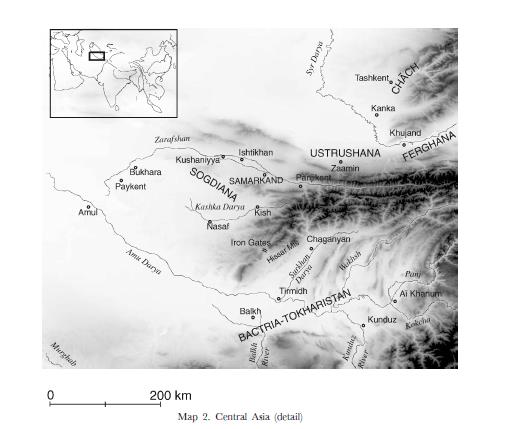
Central Asia: Sogdiana, reproduced after Vaissière, 2005

“City of Glory” almost sounds as if it were the appellation for a city in the HBO series “Game of Thrones,” such as Pentos, Qarth, or Astapor. But in reality it was given to a wealthy merchant city in Sogdiana, as attested to by the coin illustrated below.

Paikend AE Cash, ca. 640-710. Image from Stephen Album Rare Coins, Auction 38, Lot 133

The coin is a very rare AE cash from the Sogdiana merchant city of Paikend (Paykent), ca. 640-710, which has always fascinated me and is worthy of more research. The obverse features the Bukhara tamgha at top, Chinese yuan below, and Sogdian text to left & right. The reverse features a cross above & below the central hole. The scholar Aleksandr Naymark has read the Sogdian text on the obverse as PRN / KND, “city of glory,” and suggested that this was a local issue under a Christian ruler, in opposition to the kings of Bukhara. The coin illustrated was Lot 133 in Stephen Album Rare Coin Auction 38.

Paikend: Fortifications in City Wall. Image by Don Croner

The oasis city of Paikend, which was first inhabited c. the 4th century BC, existed until the Zarafshan River changed its course in the 12th сentury, at which point the city was abandoned by its residents. The abandoned city was subsequently buried over time under the sands of the Kyzylkum Desert, resulting in the city being well preserved for future generations of inquisitive archaeologists. Excavations on the site first started in 1914 by L.A. Zimin, representative of the St. Petersburg school of Asian studies, and continue to this day by the Archaeology Institute, Uzbekistan Academy of Sciences, and Andrey Omelchenko, of the Hermitage Museum in Russia.

Guidance for Life from Ralph Waldo Emerson

Speak what you think now in hard words, and to-morrow speak what to-morrow thinks in hard words again, though it contradicts everything you said today.

Ralph Waldo Emerson, Self-Reliance
Ralph Waldo Emerson (1857)

In an earlier post, I described how, while in junior high school I had written on a piece of paper those quotes which had mightily impressed me and, after folding that paper multiple times, placed it in my wallet and carried it with me faithfully for many years. The quote above, from Ralph Waldo Emerson’s essay, Self-Reliance, is one of the quotes that I scratched in my barely legible adolescent handwriting onto that piece of paper. Those who had the misfortune to work with me over the years, know well that I took the import of that quote to heart.

In truth, as I oft explained to my colleagues, it was my duty, when articulating an idea or position, to defend it with vigorous rationality until reason and evidence had persuaded me of the error of my position. It was also my duty, I advised, to listen carefully to the construct of their opposing arguments, and to present their arguments to myself even more ably than they had, if I were able, so as to ensure the integrity of my position. But, until I was ultimately persuaded of the error of my position, there would be no hint that I was considering the abandonment of my position and I continued to defend it in “hard words.”

My approach to case discussions, in conformity with the quote above, sometimes resulted in what would appear to colleagues as a sudden and inexplicable change in my position on cases: suddenly I was in agreement with them whereas I appeared solidly opposed the day before and unpersuaded by all arguments and reason. Friends, hard words do not mean one is deaf to reason, persuasion, and commitment to duty (e.g., to search for truth). Regardless of my hard words in articulation of my position, I am always listening, persuadable, and picking up the arguments of my interlocutors to make their arguments better than even they so that I may determine if their position should prevail over mine. And if their position, based on reason, should prevail, it will prevail, and I will embrace it without being fearful of the seeming contradiction. For the seeming contradiction is no contradiction at all, in my mind. And this observation leads nicely to the final paragraph.

Some may recognize that the quote above comes from the paragraph in the essay which begins with an even more famous quote – a quote that did not make much of an impression upon me when I first read it over five decades ago: “A foolish consistency is the hobgoblin of little minds, adored by little statesmen and philosophers and divines.” Indeed.