“We are great fools. ‘He has spent his life in idleness,’ we say; ‘I have done nothing today.’ What, have you not lived? That is not only the most fundamental but the most illustrious of your occupations. … To compose our character is our duty, not to compose books, and to win battles and provinces, but order and tranquility in our conduct. Our great and glorious masterpiece is to live appropriately.” – Montaigne, Essays
Portrait of Michel de Montaigne
It is a shame that I have only come of late to begin reading Montaigne’s Essays, in the autumn of my life, as it were. It seems that such a work should have been useful to read early and often throughout the whole of my life. It is, of course, possible to identify dozens of authors and works with which one should hope to be familiar, and from whom one can be inspired, but something about his Essays is so profoundly compelling, that with surety, the work would have been a wellspring that would have been a source of refreshment for a lifetime. The late literary critic Harold Bloom makes a credible stab at explaining the attraction of Montaigne and his Essays in a chapter entitled “Montaigne and Moliere: The Canonical Elusiveness of the Truth” in The Western Canon: The Books and School of Ages. That chapter, perhaps alone, made Bloom’s work a worthwhile read.
Bloom, noting that many admirers of Montaigne found his gift or charisma difficult to explain, included one particular sentence that I cannot resist including if only for the chuckle it elicited from me: The Swiss historian Herbert Luthy thought that all of Montaigne was in one of the most casual of his sentences: ‘When I play with my cat who knows if she does not amuse herself more with me than I with her?'” Although I am not so inclined to agree that all of Montaigne is within that sentence, it does capture nicely the brilliance of the mind whom one engages with when one reads the Essays.
For my part, as I continue to work my way through the work, I note that I am taking copious notes of lines here and there that I wish to revisit. I have an appreciation of Montaigne’s ability to interlace his work with highly appropriate quotations from others. Two that I found to be very memorable from an early essay, Of Sorrow, are the following:
“He who can say how he burns with love, has little fire.” – Petrarca, Sonetto 137.
“Light griefs can speak: deep sorrows are dumb.” – Seneca, Hippolyctus, Act II, Scene 3.
Each of the above expresses truth so pithily that I, as a reader, came to a standstill and reflected in silence on their applicability to certain moments within my life. Then, once I caught my breath, and obtained a certain levity, I wondered if there would be a market for Philosophical Greeting Cards.
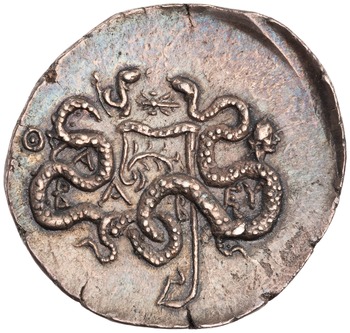
Reverse of AR cistophorus of Eumenes III of Pergamun featuring two coiled serpents between bow-case and bow. BA EY, a winged thunderbolt above the bow-case and a beardless male head in field right.ANS 1944.100.37579 American Numismatic Society
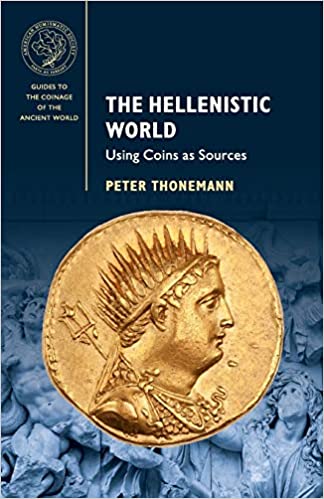
Today, I received and started reading another new book, which I am very much enjoying even if it does not have any notes and the photographs are deficient:
When I finish this work (which is one in a series, of which I obtained three volumes today), I will write a hopefully helpful review. In the meantime, I have been inspired to prepare a quick post about one of the coins referenced in the work on pp. 81-82.
And now, a few words about the Kingdom of Pergamum, Eumenes III, the Citizens of the Sun, their revolt against Rome, and the coin, which inspired this post.
The Kingdom of Pergamum (or Pergamon), in Asia Minor, was ruled by the Hellenistic Attalid Dynasty. The Attalid Dynasty was founded by Philitaerus, who ruled from c. 282-263 B.C. The Kingdom benefitted significantly in 188 B.C. under the treaty of Apamea, when the Roman Senate granted the Kingdom great expanses of territories from the just defeated Seleucid Empire.
Kingdom of Pergamum c. 188 B.C. under the Attalid Dynasty
In 133 B.C., King Attalus III bequeathed the Kingdom of Pergamum to the Roman people. What happened next is most extraordinary. Rome was in turmoil at the time the bequest was received in Rome, as it is believed to have been delivered while rioting and killings associated with the slaying of the tribune Tiberius Gracchus were occurring. It is likely that the Roman Senate did not turn its attention to addressing the bequest, and formally annexing the Kingdom, until 131 B.C. While the Senate in Rome dithered, however, in the Kingdom of Pergamum, a man named Aristonicus, who claimed to be of royal lineage (the son of Eumenes II), almost immediately proclaimed himself king as Eumenes III.
Although Eumenes III found no support in the major urban centers of Pergamum or Ephesus, he apparently found more than adequate support in many other cities and much of the periphery of the kingdom. Additionally, and most interestingly, he made a bold appeal to the poor and enslaved, which was well-received, as reported by Strabo:
“After Smyrna, one comes to Leucae , a small town, which after the death of Attalus Philometor was caused to revolt by Aristonicus, who was reputed to belong to the royal family and intended to usurp the kingdom. Now he was banished from Smyrna, after being defeated in a naval battle near the Cymaean territory by the Ephesians, but he went up into the interior and quickly assembled a large number of resourceless people, and also of slaves, invited with a promise of freedom, whom he called Heliopolitae [Citizens of the Sun]. Now he first fell upon Thyeira unexpectedly and then got possession of Appolonis, and then set his efforts against other fortresses. But he did not last long; the cities immediately sent a large number of troops against him, and they were assisted by Nicomedes the Bithynian and by the kings of the Cappadocians. Then came five Roman ambassadors, and after that an army under Publius Crassus the consul, and after that Marcus Perpernas, who brought the war to an end, having captured Aristonicus alive and sent him to Rome. Aristonicus ended his life in prison.” Strabo. Geography, Volume VI: Books 13-14. Translated by Horace Leonard Jones. Loeb Classical Library 223. Cambridge, MA: Harvard University Press, 1929, pp. 247-249.
The sources suggest that the attempt by Eumenes III and his Citizens of the Sun to remain independent of Rome required extraordinary efforts by Rome to suppress. Some scholars suggest Eumenes’ primary support may have come from areas with many former mercenaries, which may also explain why he was able to prevail for so long. Additionally, at least one reading of the sources suggest it took upwards of six to seven years for the Romans to quell the “revolt” and fully annex the kingdom as a province.
AR Cistorphorus of Eumenes III. Thyateira mint. Cista mystica from which serpent emerges within ivy wreath/two coiled serpents between bow-case and bow. BA EY, a winged thunderbolt above the bow-case and a beardless male head in field right. ANS 1944.100.37579 American Numismatic Society
Regardless, what attracted my interest to this historical incident are the beautiful coins which were issued during Eumenes’ attempt to remain independent of Rome. The coins, called kistophoroi (latinized to cistorphorus) or basket-bearers comes from the obverse type, which features a snake crawling out of a wicker basket (a cista) encircled by an ivy wreath. These unusual coins were the main silver coins of many cities in Asia minor from c. 167 BC through the reign of Augustus. What is unusual about the cistorphori of Eumenes III is that usually the Attalid kings did not mark their issues to indicate that they were royal issues or which king issued them whereas Eumenes III marked his issues on the reverse to indicate that they were issued by him. Additionally, he marked his issues as to the mint location.
One of the books I am currently reading is Peter Frankopan’s The Silk Roads: A New History of the World. I have just begun the work and find it both interesting and irritating. Interesting in that it has much to impart to me and irritating in that too much of the information imparted is highly superficial. Fortunately, there are notes but, alas, they are endnotes rather than footnotes.
Additionally, the information contained in the notes is sparse. The upshot of the foregoing is that when I come across a provocative morsel of information, which occurs with frequency, I am compelled to leap headlong down the proverbial rabbit hole in search of enlightenment. For instance, the following tantalizing appetizer appeared on pages 8-9 of Mr. Frankopan’s tome:
A Roman copy of a Greek statue of Seleucus I Nicator found in Herculaneum. Naples National Archaeological Museum.
“At Ai Khanoum in northern Afghanistan – a new city founded by Seleucus – maxims from Delphi were carved onto a monument, including:
As a child, be well behaved.
As a youth, be self-controlled.
As an adult, be just.
As an elder, be wise.
As one dying, be without pain.”
Being reasonably educated, I may claim general familiarity with Afghanistan, Seleucus, one of the Diadochi who fought for control of Alexander the Great’s empire after his death, and things Delphic; however, I may not claim any familiarity with Ai Khanoum or the particular Delphic maxim cited. Therefore, I immediately looked to the referenced endnote in hopes of being further educated about each of the foregoing as the main text provided only the tease outlined above and nothing more. Alas, a review of the endnote (number 24 in chapter 1) revealed that it only cited two works, one in French which suggested that it was apparently the repository of the original Greek inscription and the other apparently the repository of the English translation of the Greek inscription by F. Holt. The endnote provided no commentary to sate my appetite for context or illumination regarding the city, its founding, or the Delphic maxim.
Immediately putting the book aside, I fired up the mystical engine that facilitates my instantaneous access to sources of knowledge once unfathomable to my imagination, and within minutes I am able to begin to sketch out the missing context for the above tease from Mr. Frankopan.
Let’s begin our tumble down the rabbit hole with an anecdote recorded in an article appearing on the Biblical Archeological Society Website entitled Alexander in the East, which was written by Frank Holt, the translator of the Greek inscription cited in the note above:
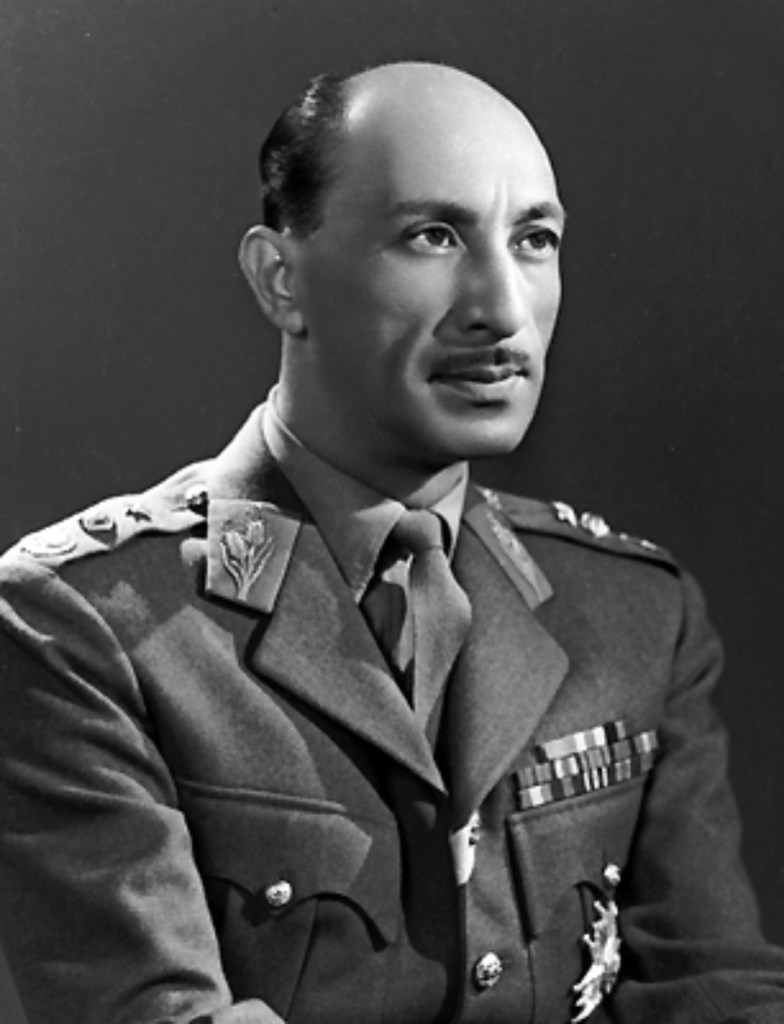
King Muhammad Zahir Shah of Afghanistan in 1963
“On a royal hunt in a remote corner of his realm [in 1961], King Muhammad Zahir Shah of Afghanistan spotted a strange outline in the dry soil between two rivers. Looking down from a hillside at this confluence of the Amu Darya (ancient Oxus) and Kochba rivers, the king could see traces of a well-planned ancient city: A wall and defensive ditch stretched from the hill to the Oxus, broken only by a gateway leading to the main street inside the settlement. The shapes of many large buildings bulged underneath the thin carpet of dirt, and at least one Corinthian column rose up like a signpost of Hellenistic civilization. Here, at last, was Alexander’s elusive legacy in the East.”
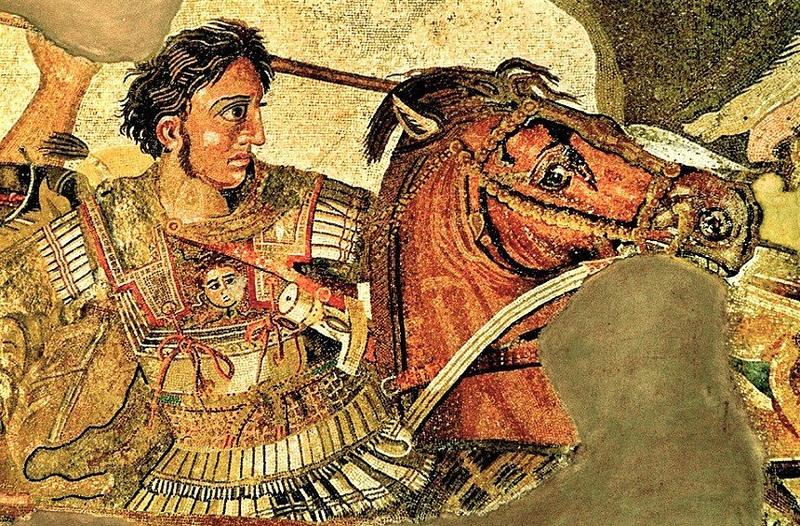
Alexander the Great
And what was this elusive legacy of Alexander’s in the East? Well, to answer this, here we do well to lift generously from another scholar, Jeffrey Lerner, and his article entitled Alexander’s Settlement of the Upper Satrapies in Policyand Practice, which provides ample context for the significance of King Muhammad Zahir Shah’s find:
“Alexander’s plans for maintaining his authority over the region involved the stationing of troops in a system of strategically placed cities and fortifications. A manifestation of Alexander’s authority that was particularly directed at the Upper Satrapies was the founding of settlements denoted by Greek authors as πόλις and by Roman authors as urbs. Justin, for example, notes that Alexander established seven cities in Baktria and Sogdiana. The problem with identifying Alexander foundations is not knowing the number of cities that he or his successors founded. To date no site in Central Asia dating to the Hellenistic period has yielded an inscription bearing its name, whether in Greek or in any other language. For example, there are a number of cities whose foundations are attributed to Alexander, but apart from their names, there is precious little else known about them.”
Lerner goes on in his article to discuss Aï Khanoum, which had been the object of archaeological survey under the direction of French archaeologist Paul Bernard from 1965 until the 1979 Soviet invasion of Afghanistan:
“One particularly illusive foundation that has attracted a great deal of attention is that of Alexandreia on the Oxos, which Ptolemy places in Sogdiana, but whose whereabouts remain highly controversial due to Ptolemy’s placement of the city in relation to the rivers Oxos and Iaxartes, μεταξὺ δὲ καὶ ἀνωτέρω τῶν ποταμῶν. This prompted Bernard to remark that the difficulty of reconciling the whereabouts of the city with its name is that it supposedly existed along the river Oxos, because as a general rule cities named after rivers are located directly on their banks. Apparently, Ptolemy erred in combining data on two different cities in the same description. Nonetheless, several suggestions have been made as to its location. One holds that Alexander had founded the city at Termez on the north bank of the Oxos and, following its destruction by nomads, was refounded by Antiochos I as Antioch-Tarmita, but was subsequently refounded by the Greek-Baktrian king Demetrios I as Demetrias in the second century BCE. The discovery of the site of Aï Khanoum in northeastern Afghanistan south of the river Oxos in Baktria led Bernard to conjecture that this region of Baktria was actually part of Sogdiana. To make this reconstruction work, he further speculated that upon the conquest of Marakanda by nomads, Aï Khanoum became the country’s capital with the Kokcha acting as the border between Baktria and Sogdiana. Rtveladze has argued that Kampyrtepa was Alexandreia Oxiana. Finally, the fortress of Takhti Sangin in modern Tajikistan on the north bank of the Oxos situated between Ai Khanoum and Termez has also been proposed as the ancient city. The site contains the so-called Oxos Temple in which an altar dedicated to the river god Oxos by a certain Atrosokes was recovered.”
A few lengthy paragraphs from Lerner are in order as to why Alexander would have settled some of his men on the farthest fringes of his conquests and how those men were selected and reacted to their selection:
“As a rule, Alexander employed a settlement policy in the regions of the far eastern corridor of the empire as one method of controlling these subjugated states. This practice, like many others that Alexander followed, was initiated by his father, although of course in Alexander’s case on a much larger scale. The role that cities played in achieving this goal was two-fold. First, many were so hastily constructed – literally in the matter of days – that they appear to have been little more than military colonies with names given them to connote a sense of grandeur, like ‘Alexandreia.’ Such was the case of Alexandreia Eskhate that served as no more than a frontier post. On the other hand, Alexander’s propensity for renaming existing cities, usually after himself, seems to have enjoyed longer lasting success, like Alexandreia Arachosia/Alexandropolis, and Alexandreia Areia among others. The key to understanding Alexander’s achievement with this policy was the practice of creating colonies of heterogeneous populations, consisting in the vast majority of cases of indigenous peoples and Greek mercenaries, and only rarely Makedonians. Aside from serving as the king’s direct agents in the satrapies, these settlements also had the benefit of allowing Alexander to rid himself of dissatisfied elements in the army by stationing them in remote places as punishment for their insubordination. Indeed prior to the rebellion of 325 BCE, Koenos states emphatically that Alexander had left behind in Baktria Greeks and Makedonians who had no wish to remain. As a matter of course retired soldiers received land and quite likely economic support to set up a farm. The local population, however, by all appearances did not fare as well as their Greek and Makedonian counterparts. This is especially true in the case of a captured population, such as those who were taken prisoner at the Rock of Ariamazes. The majority of those who had surrendered were given to the newly arrived settlers as slaves of the six towns situated near Alexandreia Margiana. No matter how imperfect this policy of colonizing the conquered regions in the Upper Satrapies may have been in hindsight, it did provide some measure of control, while also safeguarding communication routes, and the king’s borders. The method of founding new cities, deploying garrisons in large old cities, coupled with the creation of military colonies was to a degree based on Alexander’s policy of integration, even if it was compulsory. Yet the garrisons appear to have been generally small, ranging from a few dozen to several hundreds. The overall effect of this policy was that it served as the basis of contact between peoples and the resulting cultural interaction that might otherwise have not occurred.
Throughout his campaign in the further east Alexander established military settlements that later became cities and renamed cities after himself, though the locations of each remains controversial. Yet the veterans he left behind were hostile to his intentions and revolted in 325 and 323 BCE. For those who rebelled wanted no part in living on the fringes of the known world. Rather they passionately desired to return to a polis lifestyle replete with Greek institutions and a citizenry who shared similar values as opposed to the drab settlements in which they found themselves as just one constituent body in an otherwise mixed population. The so-called cities that Alexander constructed in less than three weeks could in no way resemble cities like Aï Khanoum of the future, for they were the products of the next period. Certainly, the numbers of these veterans had seriously declined especially after the revolt of 323 BCE, in which they found themselves a dwindling minority. They were aliens in an alien world. While they helped conquer this part of Alexander’s kingdom, they had no desire to rule it. Nonetheless, the arrangement that Alexander had established by the time of his death generally held firm as Makedonian supremacy throughout the empire existed without any serious challenges, save among the Makedonian generals themselves. The wars of the Diodochi had little effect on the indigenous populations of the empire as this was left to those charged with administering it, particularly the satrapies in the further east.”
All the foregoing suggests, therefore, that Aï Khanoum, attested in the archaeological survey as a splendid Hellenistic city in its heyday (more on this below), was likely “founded” by Alexander in a perfunctory manner with, at best, slightly disaffected veterans from his campaigns. Whether it was founded from scratch or on a pre-existing village that was simply renamed is unclear to me at this stage of my reading. However, it is clear, that after Seleucus acquired his mastery of much of Alexander’s empire, including the Upper Satrapies which included Aï Khanoum, the city acquired a mint (always of interest to this numismatist) and he invested in the city’s development.
At this point, we may return to the ever so brief snippet from Mr. Frankopan which began this entire journey, as the larger context is now set, for the more specific illumination which is now to be provided by an extract from the earlier article cited by Mr. Frank Holt:
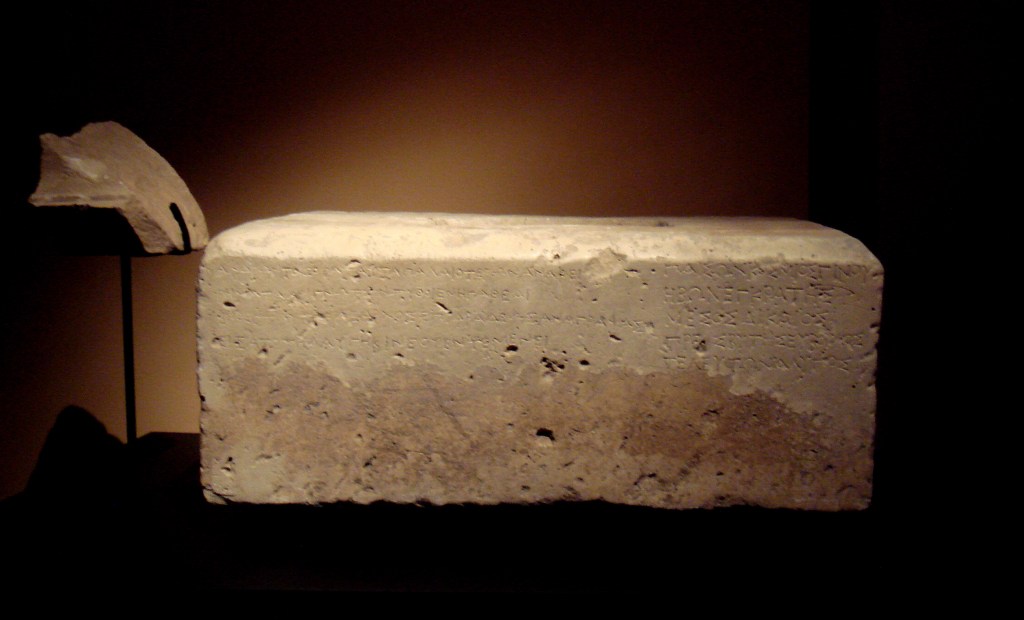
Funerary monument in the tomb of Kineas in northern Afghanistan at Ai Khanoum upon which the Delphic Maxim Cited in this Post is Inscribed.
“The Greek founder of this colony [Ai-Khanoum], which may have been called Alexandria Oxiana, was a man named Kineas, whose fourth-century B.C. shrine and tomb stood in the heart of the city. Kineas may have been one of Alexander’s soldiers, sent to settle this strategic fortress on the frontiers of Bactria. There are indications of an attack on the site soon after Alexander’s demise, perhaps part of the disturbances that took place when Greek settlers attempted to abandon Bactria. Fifty years later, under the aegis of the Seleucid dynasty, a major building phase began. True to Greek cultural traditions, the later citizens of the city enjoyed a large theater, a gymnasium with a pool, and quantities of olive oil and wine. Papyrus for writing was transported from Egypt.
These ancient Greeks built large, luxurious private homes and a great sprawling palace. Their Greek names and political titles appear on tombstones and government records. To preserve Greek values in this alien land, an Aristotelian philosopher copied the Delphic Maxims in Greece and carried them all the way to Bactria. An inscription found at Ai Khanoum explained to the colonists that these maxims were the wise counsel of earlier Greeks as codified by priests at the sacred site of Delphi. Their closing lines convey the idea of this Hellenic creed ‘blazing from afar’:
As a youth, be self-controlled. As an adult, be just. As an elder, be wise, As one dying, be without regrets.”
Mr. Holt makes passing reference above to how the Delphic maxims inscribed on the funerary monument, illustrated above, found there way to the city and the shrine dedicated to Kineas. I note that the funerary monument includes the following inscription on it, explicitly explaining how the Delphic maxims came to be there:
“These wise commandments of men of old- Words of well-known thinkers – stand dedicated in the most holy Pythian shrine. From there Klearchos, having copied them carefully, set them up, shining from afar, in the sanctuary of Kineas.”
Thus, a gentleman name Klearchos traveled from the holy Phythian shrine, the temple of Apollo at Delphi, where he copied the maxims, to Ai Khanoum, to have the maxims engraved on a funerary stone. As to the Delphic maxims, the words of well-known thinkers, that would be another entire post!
Finally, if you have the time and access to the Scientific American, I recommend the following article for more background on this city and its archaeological survey:
Bernard, Paul. “An Ancient Greek City in Central Asia.” Scientific American, vol. 246, no. 1, 1982, pp. 148–159. Another recommended article is linked in the button below and explores, in depth, the literature through 2015.
I also recommend the following American Numismatic Society lecture by Michael Alram (“Money and Power in Ancient Bactria”) which surveys the numismatic history of Bactria, and in a number of places, discusses the coinage found at Ai Khanoum:
Michael Alram: “Money and Power in Ancient Bactria”
Though those of my lineage have no heraldic arms, I have taken as a personal emblem a crane on starry azure field, with a chief charged with three golden dragon flies. As a motto, I have adopted, Humilitatem Initium Sapientiae. A phoenix gold and red crest with gold and black mantling support the shield.
The Personal Emblem of D. S. Y.
The crane was adopted as the central figure of my emblem because of its rich symbolism and because, simply, my Slovak surname translates into crane. The crane was placed on a starry field because I so oft look up in wonderment into the night skies. Indeed, I recall with regularity the beauty of the words from a small little text called the Christianica, which I was given decades ago by Father Richard for serving as a catechist at St. John Catholic Church in Albion, Michigan. In particular, I remember the following lines (a most felicitous juxtaposition of some verses from Psalms and Genesis) that have a particular resonance with me:
Lord, when I look at thy heavens, the work of they fingers, the moon and the stars which thou hast established;/what is man that thou are mindful of him?/ Yet thou has made him little less than the angels and given him dominion over the works of they hands;/ thou has put all things under his feet.
Wonderment at the cosmos. Humility at our place in the cosmos.
“Lord, when I look at thy heavens, the work of thy fingers, the moon and the stars, which thou has established; what is man that thou art mindful of him?”
I was further moved to place the crane on a starry sky when I read the Fable of The Crane and the Peacock by Avianus. Here is the full translation of the fable:
The story goes that Juno’s bird disparaged the Thracian fowl, when she shared their joint feeding ground. For a quarrel had arisen involving their different kinds of beauty and they were protracting a long argument on a case easy to settle. The peacock contended that the parts of his body gleamed in manifold loveliness, but that a dingy back gave the crane a dun colour, and at the word he arrayed about him the canopy of his uplifted tail and shot an arc of light upwards to the sky. The crane, though unable to rival the other in any glory of plumage, is nevertheless said to have used these words in mockery: “Countless may be the array of colours variegating your plumage, yet you, the wearer of the gaudy tail, are for ever kept close to earth. But I soar aloft into the air on my wing for all its ugliness, and am wafted nigh to the stars and heavenly powers.”
Avianus, Hadrian, Florus, Nemesianus, Reposianus, Tiberianus, Phoenix, Rutilius Namatianus. Minor Latin Poets, Volume II: Florus. Hadrian. Nemesianus. Reposianus. Tiberianus. Dicta Catonis. Phoenix. Avianus. Rutilius Namatianus. Others. Translated by J. Wight Duff, Arnold M. Duff. Loeb Classical Library 434. Cambridge, MA: Harvard University Press, 1934, p. 705.
“In another moment down went Alice after it, never once considering how in the world she was to get out again.”
Long ago a doctor observed that, in his opinion, I most certainly had an attention deficit disorder. He in particular noted that my habit of reading three or four or more books (each a few pages or chapters at a time) simultaneously rather than sequentially (one book in its entirety, one after another), sealed the deal, as it were, for his diagnosis. The reality now is even worse than the kind doctor could have imagined for in any book with end notes or foot notes, which I review most assiduously, I am often immediately diverted by the notes to hunt for additional relevant information. I hunt either in my library for the information or on the internet. I describe that hunt, and the ensuing hunts that usually result from the initial hunt, just as a tumble down a rabbit hole. For, you see, I tumble down rabbit holes in pursuit of knowledge almost daily, never considering how in the world I will get out again, just as blithely as Alice tumbled down her rabbit hole.
It happens easily enough, these tumbles. Consider the macro photograph of the AR jeton of Lyon which I posted about earlier. All things considered, the jeton was one of many items I was photographing that particular day merely to practice my photography skills. I was, in point of fact, attempting to develop my skills in lighting the coins which I was photographing with more precision and subtlety. I was not attempting to undertake any particular study of the individual items themselves. However, when I happened to glance at the photograph of the jeton, which is admittedly poorly lit overall (my skills are still inadequate and developing!), I was struck, as I had previously mentioned, by the presence of the lion’s phallus, which I had never noticed previously when viewing the jeton. This was not, in spite of the subject matter, a prurient observation, so much as an amused observation that the engraver would add such fine detail to the piece which is not readily visible to the naked eye. It was also a catalyst to further research (much like those cursed notes in a book). In short, I stumbled into a rabbit hole.
My curiosity was piqued, first and most naturally, as to whether the lion was generally depicted on the arms of Lyon in the 1750s in so anatomically correct a manner. Though my library does contain a number of heraldic works, those works do not include anything that would address French heraldry so, of course, I immediately went to the internet. Much to my pleasure and surprise, Wikipedia has a very robust and well researched entry on the arms of Lyon.
“Down, down, down. Would the fall NEVER come to an end! ‘I wonder how many miles I’ve fallen by this time?’ she said aloud. ‘I must be getting somewhere near the centre of the earth.“
Wikipedia was kind enough to instruct me as to when Lyon was granted its arms and the various forms the arms have taken over the years. I learned many things, including how Lyon sided with the Royalists during the French Revolution and, for its efforts, was officially disestablished. I also learned that, after the restoration of the monarchy, the lion in the shield was shown carrying a sword to signify its combativeness against the revolution. A nice touch, to be sure. And, of course, with each change to the shield, and each twist of history, I went down another rabbit hole to learn the story behind the story. Before I knew it, several hours had gone by. I had learned many interesting things, none of which I had planned on learning that day. Indeed, none of which I would have even planned on learning that day if I had sketched the day out. As I recall, I was working on my photography skills that day and the jeton was merely a tool in that exercise.
My lack of discipline regarding the initial task at hand allowed me to be diverted for an extended period of time, but I learned much about topics that I shall likely never have occasion to visit again or otherwise put to productive use. I confess that I cannot much regret the experience, for it was enjoyable and all knowledge has value. Yet, I am convinced that I must develop a more rigorous schedule, so that even in retirement, I accomplish some of the projects that I have a mind to complete. I can only stumble down so many rabbit holes before the day, then the week, then the month, then the year, is lost.











 Northcoast Antiquarian