Honey Bee alighting on a bloom. Photo by Michelle Reeves on Pexels.com
And the Lord said, “I indeed have seen the abuse of My people that is in Egypt and its outcry because of its taskmasters. I have heard, for I know its pain. And I have come down to rescue it from the hand of Egypt and to bring it up from that land to a goodly and spacious land, to a land flowing with milk and honey, to the place of the Canaanite and the Hittite and the Amorite and the Perizzite and the Hivvite and the Jebusite.”
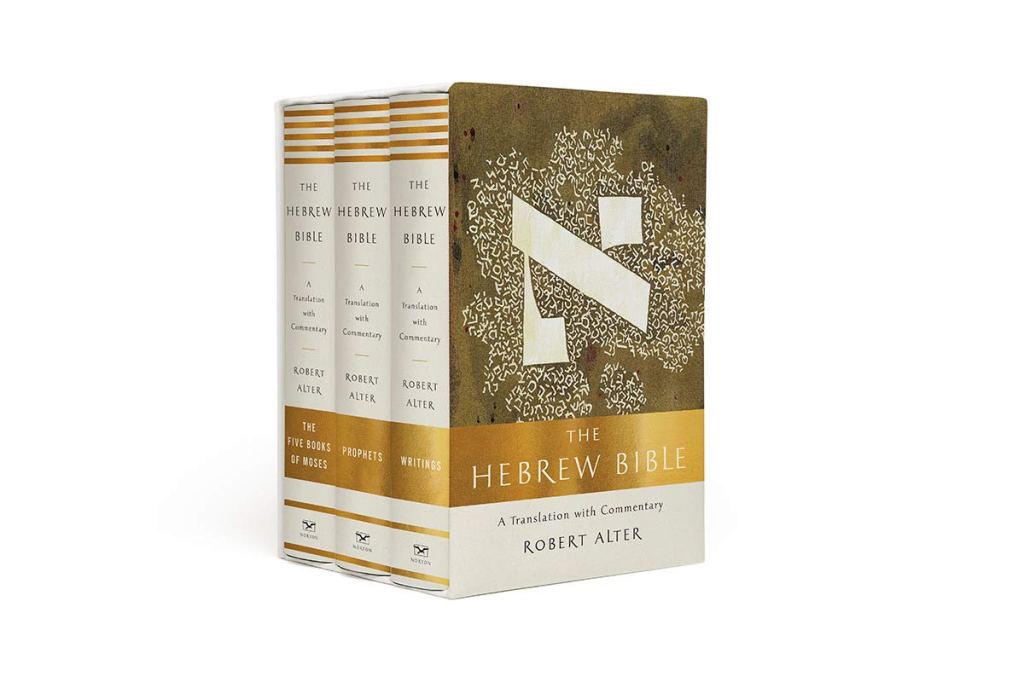
Exodus 3:7-8. From Robert Alter’s The Hebrew Bible : A Translation with Commentary.
What particularly caught my attention after reading this passage was Robert Alter’s commentary on the milk and honey to be found in The Promised Land. He stated the following: “The honey in question is probably not bee’s honey, for apiculture was not practiced in this early period, but rather a sweet syrup extracted from dates. The milk would most likely have been goat’s milk and not cow’s milk. In any case, these two synecdoches for agriculture and animal husbandry respectively become a fixed epithet for the bounty of the promised land” (Alter, Robert (2019). The Hebrew Bible: A Translation with Commentary, v. 1, p. 221, n. 8.).
Immediately upon reading this I was seized with a curiosity to know more about the sweet syrup extracted from dates and apiculture in the Holy Land. Let us begin with a research paper that helps me understand the comment above and discusses the earliest known archaeological apicultural remains in The Promised Land.
The work began by noting that: “[a]lthough texts and wall paintings suggest that bees were kept in the Ancient Near East for the production of precious wax and honey, archaeological evidence for beekeeping has never been found. The Biblical term “honey” commonly was interpreted as the sweet product of fruits, such as dates and figs.” This confirmed Alter’s comment, above. But then the paper proceeded to share its extraordinary findings:
“However, actual evidence for beekeeping in antiquity had not been found before the recent discovery of what appears to be a well-organized apiary at Tel Rehov in the middle Jordan valley in northern Israel. Tel Rehov is one of the largest Iron Age sites in Israel. A city 10 ha in area flourished there between the 12th and 9th centuries Before Common Era (B.C.E.). The apiary includes ≈30 hives (of 100–200 estimated) that were made as unfired clay cylinders. The hives have a small hole on one side for the bees to enter and exit and a lid on the opposite side for the beekeepers to access the honeycomb. Three rows of such hives were located in a courtyard that was part of a large architectural complex that was severely destroyed, most probably at the end of the 10th or beginning of the 9th centuries B.C.E. In terms of Biblical historiography, this period corresponds with the United Monarchy of David and Solomon and the beginning of the kingdom of northern Israel” p. 11240.
What is also extraordinarily interesting is that the authors report the discovery of remains of honey bees and their larvae inside the hives, which allowed them to identify the species of bee. The authors determined that the bees in the hives were A. m. anatoliaca, which currently resides in Turkey. This suggested to them that either Western honeybee subspecies distribution has undergone rapid change during the past 3,000 years or that the ancient beekeepers at Tel Rehov imported bees with a less aggressive temperament and superior honey yield (3 to 8 times more yield than the native species, A. m. syriaca). The possibility of importation cannot be easily dismissed given tantalizing hints of a developed apiculture transport practices, such as the following, cited by the authors:
“There is evidence that beekeeping was practiced in Anatolia during the Late Bronze Age (1); Hittite laws dated to the 14th–13th centuries B.C.E. contain severe punishments for thieves of bee swarms and hives (25). The Zenon papyri from Egypt suggest that transferring bees in portable hives or pottery jars was practiced in the third century B.C.E. (1). An Assyrian memorial stele dated to the mid-eighth century B.C.E. (about 100–150 y later than the beehives at Tel Rehov) describes the importation of honeybees from a country called “Habha,” probably in the Zagros or Taurus mountains (modern day southeastern Turkey or northwestern Iran), about 300–400 km to the north or northeast of the land of Suhu on the Middle Euphrates (the modern border zone between Syria and Iraq)” pp. 11243-11244.
Today, apiculture is flourishing in The Promised Land. The Israeli Honey Production and Marketing Board says that apiculture and the trade in honey produced by honey bees can be traced back to 1882. The Israeli honeybee is actually of Italian origin, and is known as the Apis mellifera ligustica – a subspecies of the western honey bee. There are 529 beekeepers in Israel tending to approximately 120,000 hives. Their bees produce approximately 35 kilograms of honey per hive annually. Fortunately, honeybee populations are reported to be stable in The Promised Land, which serves as a transition to my next “connected” reading.
Newsweek reported earlier this week that the U.S. Fish and Wildlife Service reviewed a petition calling for the the American bumble bee to be listed as an endangered or threatened species and found it “may be warranted.” The petition, which can be found here, was written and submitted by the Center for Biological Diversity and the Bombus Pollinators Association of Law Students. The petition states, in part, in its executive summary, the following:
Bombus pensylvanicus De Geer (American Bumble Bee)
“The American bumble bee (Bombus pensylvanicus De Geer) is one of the most iconic native pollinators in North America. This highly adaptable pollinator once ranged coast to coast, foraging in the grasslands, fields, and open spaces in 47 of the lower 48 states. Like the endangered rusty-patched bumble bee, it is a generalist that provides essential pollination service to a wide variety of plants—including native plants and cultivated crops, across a vast range. Its loss will have considerable consequences to whole ecosystems and to crop production. Once the most commonly observed bumble bee in the United States, the American bumble bee has declined by 89 percent in relative abundance and continues to decline toward extinction due to the disastrous, synergistic impacts of threats including habitat loss, pesticides, disease, climate change, competition with honey bees, and loss of genetic diversity. In the last 20 years, the American bumble bee has vanished from at least eight states, mostly in the Northeast, and it is in precipitous decline in many more. For example, in New York it has suffered a catastrophic decline of 99 percent in relative abundance, and in Illinois it has disappeared from the northern part of the state and is down 74 percent since 2004. In sum, the American bumble bee has become very rare or possibly extripated from 16 states in the Northeast and Northwest; it has experienced declines of over 90 percent in the upper Midwest; and 19 other states in the Southeast and Midwest have seen declines of over 50 percent” p. 8.
That the American Bumble Bee would be so close to extinction, in the land that so many identify as the new promised land, is depressing. Which leads to one final, not bee related but promised land related reading: Charles Taylor’s book review, An America That Could Explain: On Barack Obama’s “A Promised Land.” The reader should read the review but for my purposes, I will share only the concluding thought of the review, as it seemed most appropriate for these troubled times:
In Caste, Isabel Wilkerson quotes Taylor Branch, the author of the magisterial Martin Luther King Jr. biography America in the King Years. “The real question,” Branch asks, “would be if people were given the choice between democracy and whiteness, how many would choose whiteness?” At last count, the answer is 74,222,958.
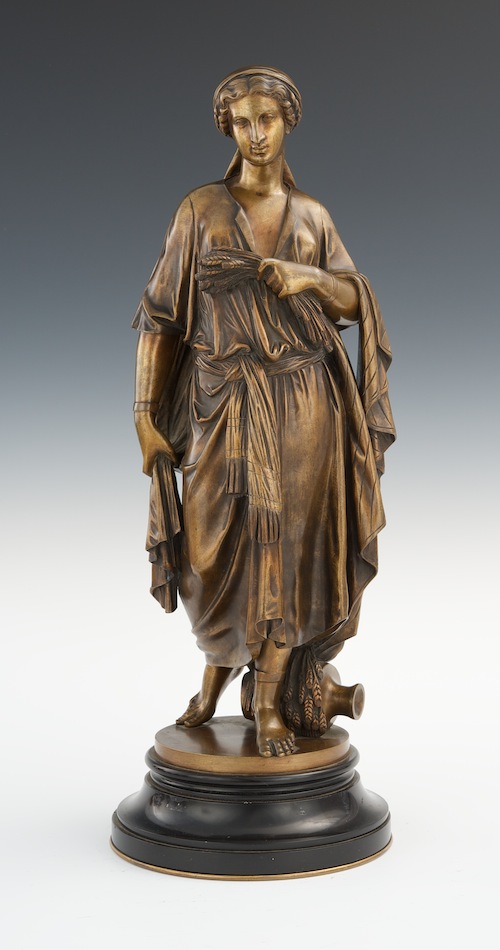
Cast Bronze Statue of Rebekah, whom the servant of Abraham found at the well, as a wife for Isaac. From my collection, Aspire.03.2011.
In the 24th Chapter of Genesis of The Hebrew Bible, Abraham, the Patriarch of the Abrahamic Faiths of Judaism, Christianity, and Islam, calls his servant to him, and bids the servant to swear a most solemn oath, by either holding his, Abraham’s genitals, or placing his hands next to his genitals, a means of oath-taking attested in various ancient cultures, to the following effect:
Put your hand, pray, under my thigh, that I may make you swear by the Lord, God of the heavens and God of the earth, that you shall not take a wife for my son from the daughters of the Canaanite in whose midst I dwell. But to my land and to my birthplace you shall go, and you shall take a wife for my son, for Isaac.”
Genesis, Chapter 24: 1-4
Genesis records in Chapter 24, 9-10, “And the servant put his hand under Abraham’s thigh and he swore to him concerning this thing. And the servant took ten camels from his master’s camels, with all the bounty of his master in his hand, and he rose and went to Aram-Naharaim, to the city of Nahor.”
When the servant arrived outside the city of Nahor by the well, he said:
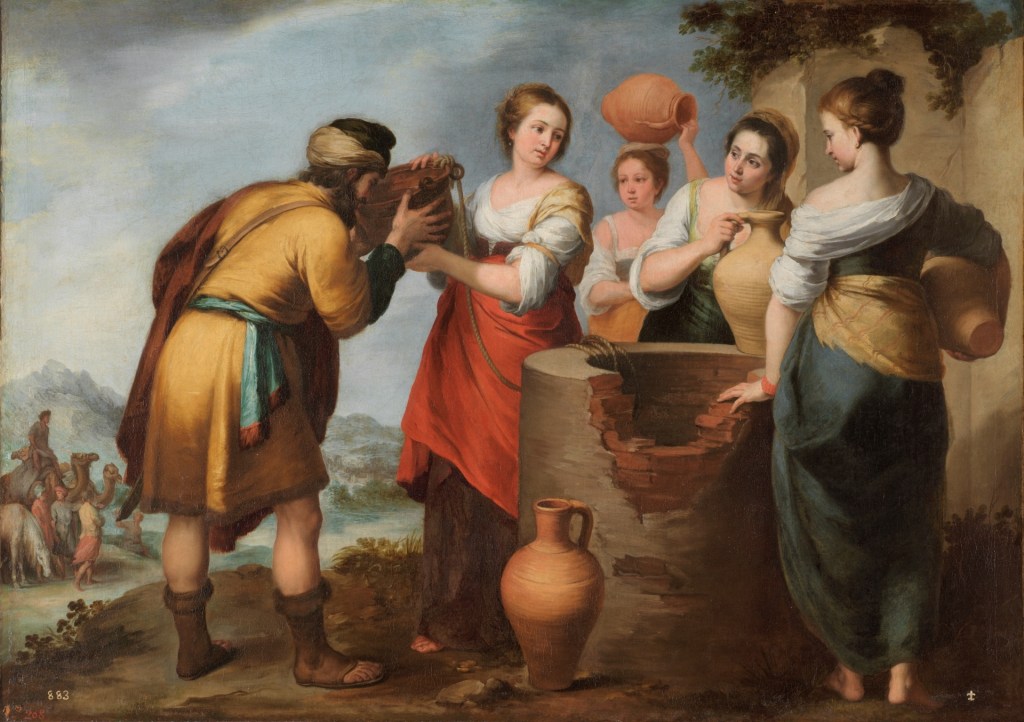
“Lord, God of my master Abraham, pray, grant me good speed this day and do kindness with my master Abraham. Here, I am poised by the spring of water, and the daughters of the men of the town are coming out to draw water. Let it be that the young woman to whom I say, ‘Pray, tip down your jug that I may drink,’ if she says, ‘Drink, and your camels, too, I shall water,’ she it is whom You have marked for Your servant, for Isaac, and by this I shall know that You have done kindness with my master.” He had barely finished speaking when, look, Rebekah was coming out, who was born to Bethuel son of Milcah, the wife of Nahor, Abraham’s brother, with her jug on her shoulder. And the young woman was very comely to look at, a virgin, no man had known her. And she came down to the spring and filled her jug and came back up. And the servant ran toward her and said, “Pray, let me sip a bit of water from your jug.” And she said, “Drink, my lord,” and she hurried and lowered her jug onto her hand and let him drink. And she let him drink his fill and said, “For your camels, too, I shall draw water until they drink their fill.” And she hurried and emptied her jug into the trough and she ran again to the well to draw water for all his camels. And the man was staring at her, keeping silent , to know whether the Lord had granted success to his journey. And it happened, when the camels had drunk their fill, that the man took a gold nose ring, a beqa in weight, and two bracelets for her arms, ten gold shekels in weight. And he said, “Whose daughter are you? Tell me, pray, Is there room in your father’s house for us to spend the night?” And she said to him, “I am the daughter of Bethuel the son of Milcah who she bore to Nahor.” And she said to him, “We have abundance of bran and feed as well and room to spend the night.” And the man did obeisance and bowed to the Lord, and he said, “Blessed be the Lord, God of my master Abraham, Who has not left off His steadfast kindness toward my master – me on this journey the Lord led to the house of my master’s kinsmen.”
Genesis Chapter 24: 12-27
Chapter 24 of Genesis concludes with the servant negotiating the betrothal of Rebekah to Isaac, transporting Rebekah to Isaac, and Isaac taking Rebekah as his wife.
This post was inspired by the gorgeous cast bronze statue of Rebekah in my collection and the recent acquisition of The Hebrew Bible: A Translation with Commentary by Robert Alter for my library. The Hebrew Bible is highly recommend as a sensitive and inspired translation with deeply insightful scholarly commentary.
The Hebrew Bible: A Translation with Commentary by Robert Alter
It is not to be doubted that soon I will be looking for a scholarly paper or two on the solemn oaths which the ancients took that involved the holding of the genitalia of others … as I am most curious as to when such intimate habits were abandoned for less hands on formalities. I can hardly imagine any Muslim, Christian, or Jew not doing other than seeking criminal charges if someone went near their genitalia in the name of an oath these days – even in the name of the Lord with appropriate appeals to Abrahamic precedents.
I am also intrigued by the citation of weights in the Biblical verses of this chapter. I study weights, and the importance of weights to early trade and civilization cannot be overstated.
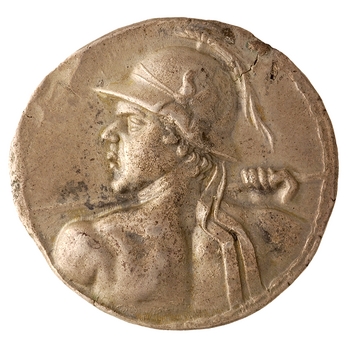
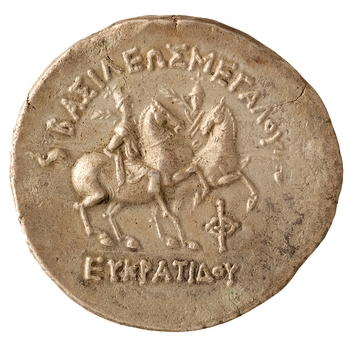
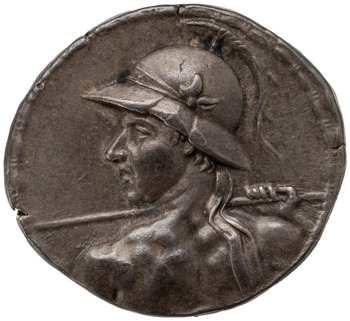
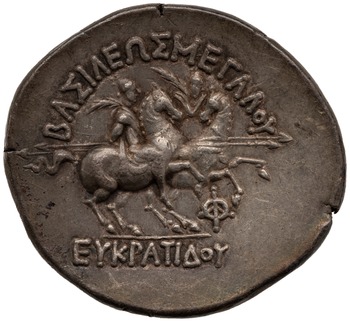
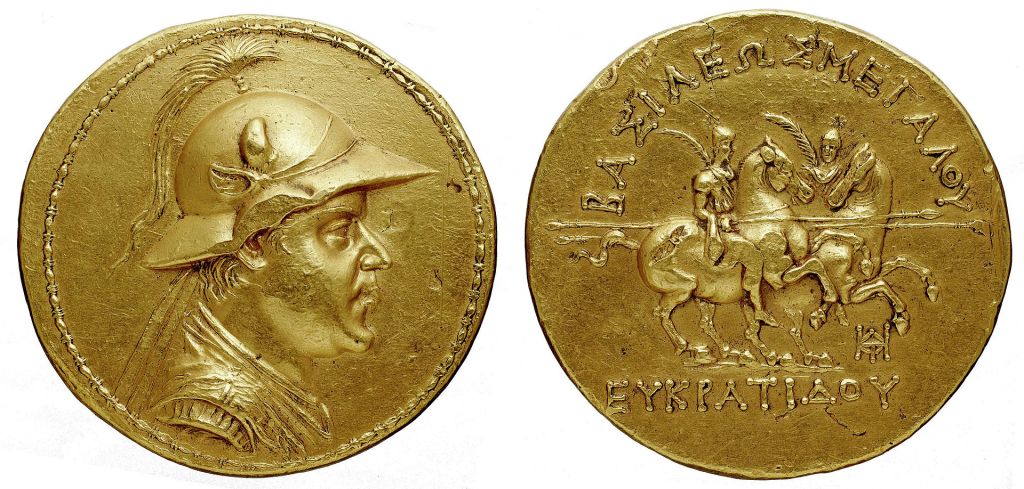
The Silver tetradrachm heading this post features on the obverse a helmeted and diademed bust of Eucratides, bare shoulders, throwing javelin to his left. The tetradrachm’s reverse has the Greek inscription ΒΑΣΙΛΕΩΣ ΜΕΓΑΛΟΥ ΕΥΚΡΑΤΙΔΟΥ (of great king Eucratides) around an image of the dioscuri (the twin brothers and sons of Zeus, Pollux and Castor) charging right holding long lances and palms. Peter Thonemann, commenting on this highly individualist and explicitly martial portraiture opined as follows: “… we may be grateful that not all kings paraded their military credentials in quite so butch a fashion as Eucratides I of Bactria.”
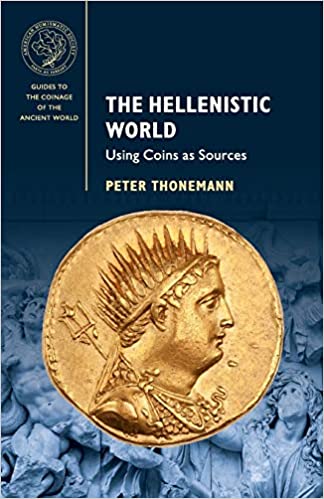
The Hellenistic World: Using Coins as Sources by Peter Thonemann
Peter Thonemann’s wonderful work, The Hellenistic World: Using Coins as Sources, is a superb introductory survey of both the history and coins of the Hellenistic world from c. 323-31BC. It is engagingly written and well-illustrated, often with coins from the collection of the American Numismatic Society. Although many of the coin photographs which are reproduced are slightly disappointing due to being in black and white and produced life size, when enlargements would have been more suitable, the coins selected for the work were well chosen and served the survey and the reader well. And, since the author and publisher were so careful to credit the sources of the photographs, when a particular coin caught my fancy, I was often able to go the the source on the internet, such as the ANS’s online collection database, and see the original color photographs of the coin.
So, after I read about Eucratides I the Great of Bactria (c. 170-145) and his stunning coins in Thonemann’s work, then saw the coins in their glory on the ANS database, and followed up with an interesting conversation about the coins and what type of workout routines were around in the ancient world with my good friend SF (more about the exercise and workout routines of the ancients below), I knew that a post was forthcoming.
First, what do we know about Eucratides I? From the 2nd century AD writer and historian Justin, we have this small snippet of information:
“Almost at the same time that Mithridates ascended the throne among the Parthians, Eucratides began to reign among the Bactrians; both of them being great men. But the fortune of the Parthians, being the more successful, raised them, under this prince, to the highest degree of power; while the Bactrians, harassed with various wars, lost not only their dominions, but their liberty; for having suffered from contentions with the Sogdians, the Drangians, and the Indians, they were at last overcome, as if exhausted, by the weaker Parthians. Eucratides, however, carried on several wars with great spirit, and though much reduced by his losses in them, yet, when he was besieged by Demetrius king of the Indians, with a garrison of only three hundred soldiers, he repulsed, by continual sallies, a force of sixty thousand enemies. Having accordingly escaped, after a five months’ siege, he reduced India under his power. But as he was returning from the country, he was killed on his march by his son, with whom he had shared his throne, and who was so far from concealing the murder, that, as if he had killed an enemy, and not his father, he drove his chariot through his blood, and ordered his body to be cast out unburied.” Epitome of the Philippic History of Pompeius Trogus, XLI 6.1-5
Appropriate to a king assuming the title “the Great” on his coins (a numismatic innovation of Eucratides, Eucratides also is famous for another numismatic feat, as explained by CoinWeek columnist Mike Markowitz in Metal Monsters: The Biggest Ancient Coins (march 18, 2014):
“[Eucratides] commissioned the largest surviving gold coin struck in antiquity: a 20-stater piece, 58 mm in diameter, weighing 169.2 grams. That’s nearly five and a half ounces. The unique example was found in 1867 in Bukhara (Uzbekistan), nearly 300 miles northwest of the Baktrian heartland. Eventually acquired by Napoleon III, it resides today in the Bibliothéque nationale in Paris.
On the obverse we see the king in profile, wearing a plumed cavalry helmet. On the reverse, the twin heroes Castor and Pollux carry long lances and palm branches and ride prancing horses surrounded by a carelessly lettered inscription: ‘Great King Eucratides.’”
A quick side note before moving on to the portion of the post answering my friend SF’s query about exercise and workout routines in antiquity: as king of Bactria, Eucratides I ruled over the city of Ai Khanoum, which we discussed in an earlier post.
Jack W. Berryman wrote a short essay entitled Motion and rest: Galen on exercise and health published in The Lancet (Vol. 380, Issue 9838, 21 July 2012, pp. 210-211). From the essay is the following relevant quote:
“Exercise was an important component of ancient medical theory and a physician’s duties included the preservation and promotion of health as well as the prevention of disease. In this context, physicians in antiquity emphasised the centrality of exercise and diet, or what was known as regimen, as a key part of one’s way of life.
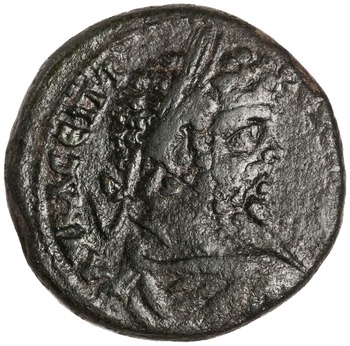
From the time of Galen (c. 129-210AD), a bronze coin (Anchialus mint) of the Roman Emperor Septimus Severus (193-211 AD) featuring Asklepios standing right and and Hygieia standing left on the reverse. Hygieia inspired Galen’s theory of hygiene. ANS 1998.13.10 American Numismatic Society
It was Hippocrates (c 460–370 BC) who wrote three books on regimen and noted that ‘eating alone will not keep a man well; he must also take exercise.’ Galen (c 129–210 AD), who borrowed much from Hippocrates, structured his medical “theory” upon the “naturals” (of, or with nature—physiology), the “non-naturals” (things not innate—health), and the “contra-naturals” (against nature—pathology). Central to Galen’s theory was hygiene (named after the goddess of health Hygieia) and the uses and abuses of Galen’s “six things non-natural”. Galen’s theory was underpinned by six factors external to the body over which a person had some control: air and environment; food (diet) and drink; sleep and wake; motion (exercise) and rest; retention and evacuation; and passions of the mind (emotions). Galen proposed that these factors should be used in moderation since too much or too little would put the body in imbalance and lead to disease or illness.”
Jarrett A. Lobell wrote a short snippet, entitled The Ancient Pursuit of Wellness: Exercise, in the September/October 2021 issue of Archaeology, which explicitly linked exercise to military preparation among the Greeks. I quote more extensively from Lobell:
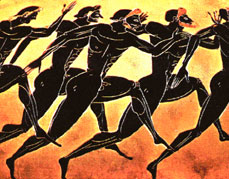
Greek Footrace
“For the ancient Greeks, exercise meant competition, often in organized festivals such as the Olympics—the word “athlete” comes from the ancient Greek athlos, meaning contest. Participation in these events was limited to young men of certain classes. Exercise was also a crucial part of preparation for Greek military service, and thus women were excluded. But in the Roman world, exercise was more universally popular, and both men and women were frequent participants. Romans often exercised at the public baths, where both sexes and most social classes regularly gathered, says classicist Nigel Crowther of Western University. Men might play ball, run, wrestle, box, or lift weights. Women swam, played a hoop-rolling game called trochus, and especially favored ball games. ‘Galen suggests that ball games were good training for the fitness of both body and mind,’ Crowther says.”
“There is a story that was often told of Milo of Croton. This was an Ancient Greek athlete from the Greek city-state of Croton located in what is now southern Italy. He lived in the 6th century BC and was training for the Olympics.
One of the ways that he was training was by taking a newly born bull, hoisting it up on his shoulders and carrying it for some distance. He would do it every day. As time passed, the bull would grow larger and so Milo kept on hoisting more and more weight. This culminated with him walking into the Olympic stadium with a full grown bull on his shoulders.
So over time he was increasing the weight he was lifting. This is basically the birth of progressive overload. The ancients knew that if you want your muscles to grow and get stronger, you need to lift heavier and heavier weights.
Another principle from the ancient world is that of periodization. Many gladiator schools probably used periodization training, which is an organization of training that splits training into blocks of time, each one focusing on different skills. They would be training all day and split their training into units of time during which they would focus on just one skill.
The ancient gladiators also knew about the intensity of training and that you should not go into training full speed at the beginning, but need to warm up first, otherwise you risk injury. Galen wrote that intensity should be increased gradually: “Intensity should be gradually increased, peaking at the end. This should be of special concern in order to avoid injury to competitors.”
The cool-down process was also important. Hippocrates (an Ancient Greek doctor) said that “those who walk after exercising will then have a stronger and more rested body.” This means that there should be a period of cool down after intense training and people should not fall down and lie on the ground immediately, but instead the person should cool down by walking around. Also on rest days, according to Hippocrates, the athlete should not do completely nothing, but instead do something of low intensity.
The ancients were very aware of the dangers of over-training and many of the doctors preached against it. They knew that the body needs rest in order to recover from intense training and also that your body achieves the best results if rest is a part of your routine.
Throughout their training, the gladiators would use different types of equipment and do all kinds of varied exercises.
Vigorous exercises: These were exercises performed with strength, but without speed. Examples of these include: digging, picking up any kind of heavy load and either standing still with it or walking (especially up a hill), climbing a rope, hanging from rope or beam for as long as possible, holding arms up (with or without weights) while partner tried pushing them in a downwards direction…etc. These exercises show that the Ancient Greeks and Romans had an understanding of overload (including progressive overload) and its positive effects on building strength and muscles.
Speed exercises: Here the primary objective was speed, apart from strength and force. Examples of these include: running, shadow boxing, hitting the punching bag, running around with balls, arm and leg exercises like drill stuff…etc.
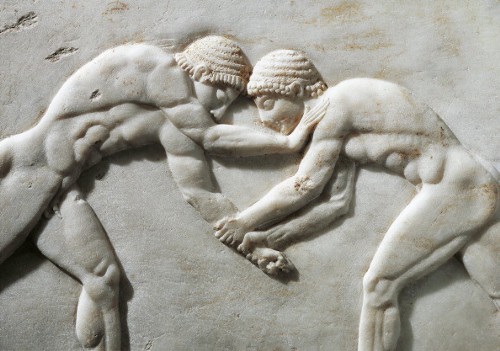
Greek Wrestlers
A particular example of this type of exercise that was performed has the Greek name “pitylysma”. The exercise goes like this: start by standing on tip toes, stretch your arms upwards, move one arm quickly forward, while moving the other one backwards, roll quickly on the ground, quickly come up, stand erect and start jumping up and down, sometimes with a backward kick, sometimes bringing each leg forward in an alternating fashion.
Violent exercises: These combined speed and strength. Exercises classified as vigorous became violent if you increased their speed – jumping continuously without rest, or any speed exercises performed with weight became violent – moving around quickly in heavy armor.
The word ‘violent’ in this context could be better understood if you use it as a synonym for the word ‘power.’ A recommendation of Galen for these types of exercises was to rest between the different individual exercises.”
So, yes, the highly muscled king appearing on those beautiful coins likely had plenty of thoughtful exercise routines behind those sculpted muscles — or he kept buff by throwing lots of javelins while trying to preserve his kingdom.
Reverse of the portrait medal of Scaramuccia di Gianfermo Trivulzio, Bishop of Como, and Cardinal (died 1527). Cast bronze, 5.6 cm diam., wt. 56.84 g., c. 1517. The reverse features an allegorical figure of Prudence, who holds a mirror in her left hand and compasses in her right. The mirror symbolizes not vanity but the wise man’s capacity to see himself honestly, and the compasses in her other hand represent measured judgment. The dragon at her feet represents a substitution for the serpent referred to in Matthew 10:16: “Be ye wise as serpents.” The Metropolitan Museum of Art, New York. From the Robert Lehman Collection, 1975.1.1253. (public domain)
A little over a year ago, I complained to my friend Dr. JW about the imprudent tendency of all too many archaeologists and historians to do too much with too little. As I recall I may have actually bellowed in exasperation at the time that these scholars fabricate too much history out of wisps of little more than air. For in truth, the paucity of material available to many archaeologists and historians is so slight, and the edifices that they build upon the available material is so seemingly profound, that Prudence herself, our auriga virtutum (charioteer of the virtues), cannot but be offended.
I entered into the discussion with Dr. JW after having read several dozens of scholarly articles related to Slavic pre-history and early Slavic history. It was not surprising to see how ideology affected the historical and archeological scholarship, but it was surprising to see how compromised much of the work was and how it was negatively impacted by other more mundane influences. Such influences, as near as I could divine, were related to ego (look at me!), the need to publish (publish or perish), and/or the desire to publish (agenda driven) even when the evidentiary material did not support the conclusions ultimately being proffered.
Time and time again I read articles where all the factual statements were true, but the conclusions drawn from those facts bore little to no relation to those facts. Similarly, I read articles where some of the factual statements were true, and some were mostly true, and some gray, and then some were outright suppositions. And finally, I read articles where scholars of great authority engaged in combat with other scholars of great authority … and its seemed to me that the weapons were nothing other than opinion for I noted that facts and evidence were nowhere to be seen. Such combat must be exhilarating but it is certainly not illuminating.
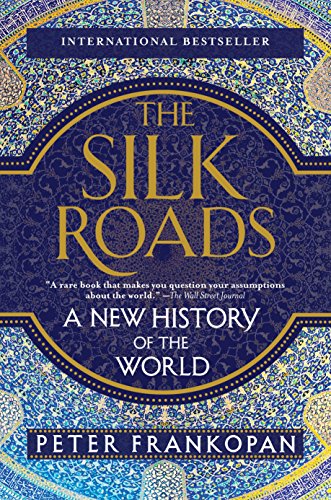
Frankopan’s The Silk Roads: A New History of the World
This post is occasioned by my reading, or rather by my decision to stop reading, Peter Frankopan’s The Silk Roads: A New History of The World. I should have known better than to have engaged a “popular history,” an international best seller at that, endorsed by The Wall Street Journal as “[a] rare book that makes you question your assumptions about the world.” I find that, rather than questioning my assumptions about the world, I am questioning my assumptions about the competency of the scholar-author of this particular work. Mr. Frankopan, whom I suspect is a very able scholar generally, has failed in the specifics of this work. Although the work is engaging on the macro level, and the broad narrative and theme is both agreeable and correct, it is unacceptable on the micro level to such a degree that he has offended my scholarly sensibilities to such an extent that I would implore him to be more prudent when attempting such popular works in the future. I shall provide a few examples in support of my position.
Frankopan , on page 82, when discussing the Muslim conquest of the Middle East, acknowledges that “[t]he sources for this period are notoriously difficult to interpret because they are complicated and contradictory, but also because many were written long after the events.” That was a very prudent acknowledgement and should have guided his writing and presentation throughout the chapters. [See James Howard -Johnston’s Witnesses to A World Crisis: Historians and Histories of the Middle East in the Seventh Century for a superb exploration and autopsy of the complexity of this topic.] But, alas, it did not. Rather, we encounter sentences such as this on p. 83: “In fact, it appears that the Arab conquests were neither as brutal nor as shocking as the commentators make out, for example, there is little evidence of violent conquest in the archaeological record” and these equivocating muddles of sentences on p. 84: “The fact that new churches were built at the same time, in North Africa, Egypt and Palestine, suggests that a modus vivendi quickly established itself where religious tolerance was normative. This seems to have been echoed in lands taken from the Sasanians, where at least to start with Zoroastrians were either ignored or left alone. In the case of Jews and Christians, it is not impossible that this was even formalised.” From my vantage point, the need to pepper an analysis with the words “suggests that,” “seems,” and especially “it is not impossible that” make for a profoundly shoddy historical analysis. I, myself, could write some wildly interesting historical works if I seasoned them with “it is not impossible that.”
The above examples – just a few of many that the author included in the relevant chapters – were intended, I believe, to set an appeasing tone for a gentle Muslim conquest as a theme to comfort the reader. But it was the sin of creating history from wisps. Fortunately, Frankopan did atone for this sin by including, here and there, information contradicting the theme such as that found on p.89: “The cities of Central Asia were picked off one by one, the loose links between them sealing their downfall: without an organizational structure to co-ordinate defences, each awaited its fate in turn. The inhabitants of Samarkand were pressured into paying a huge sum of money for the Muslim commander to withdraw, though in time it had to surrender anyway. At least the city’s governor was spared the fate of Dewashtich, ruler of Panjikent (in modern Tajikistan) who styled himself King of Sogdia; he was deceived, trapped and crucified in front of his own people. The governor of Balkh (in what is now northern Afghanistan) suffered a similar fate.” So much for the gentle Muslim conquest. Of course, I will not abandon a book for a theme if the author is kind enough to include, and not suppress, evidence, contradictory to the theme.
So, why, dear reader, have I abandoned Frankopan’s tome? The answer is simple: imprudence. On page 86, he imprudently embraced a numismatic speculation that I, and I believe all knowledgeable scholars, adjudge to be wildly provocative and simply beyond supportable. Here are the relevant arguments. First, the offending embrace from Mr. Frankopan:
“After the Caliph began to issue coins with the legend ‘There is no God but God alone; Muhammad is the messenger of God’ in the early 690s, Constantinople retaliated. Coins were struck which no longer had the image of the Emperor on the front (the obverse), but put it on the reverse instead. In its place on the obverse was a dramatic new image: Jesus Christ. The intention was to reinforce Christian identity and to demonstrate that the empire enjoyed divine protection.
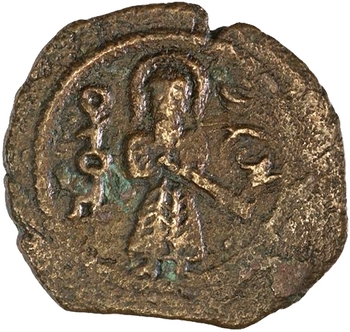
In an extraordinary development, the Islamic world now matched the Christians like with like. Remarkably, the initial response to the issuing of coins with Jesus and the Emperor on them was to respond with an image on coins minted for a few short years of a man in the parallel role to that played by Jesus – as the protector of the lands of the faithful. Although this image is usually presumed to be that of the Caliph ‘Abd al-Malik, it is entirely possible that this is none other that Muhammad himself. He appears in a flowing tunic, which a lustrous beard and holding a sword in a scabbard. If this is the Prophet, then it is the earliest-known image of him, and remarkably one that those who knew him during his lifetime were aware of and saw for themselves. … The coins did not stay in circulation long, for by the end of the 690s the currency circulating in the Islamic world was completely redesigned: all images were removed and were replaced by verses from the Quran on both sides of the coin.”
Above is a handsome representation of the Standing Caliph type from the collection of the American Numismatic Society. According to an in-depth study entitled The Standing Caliph Coins of Jerusalem published in 2015 by Ingrid and Wolfgang Schulze, Standing Caliph coins are characterized by an obverse that features the standing caliph with a sword and a reverse featuring a column on steps or an m (the Byzantine mark of value for 40 nummi). As of 2015, there were 18 mint names identified for the Standing Caliph coins, which included the following: ‛Ammān (Philadelphia), Anṭākiya (Antioch), Ba‛albak, (Heliopolis), Dimashq (Damascus), Ḥalab (Aleppo), Ḥarrān (Carrhae), Ḥimṣ (Emesa), Īliyā (Jerusalem), Jibrīn, Ludd (Diospolis), Ma‛arrat Miṣrīn, Manbij (Hierapolis), Qinnasrīn (Chalcis), Qūrus (Cyrrhus), al-Ruhā (Edessa), Sarmīn, Tanūkh (a tribal name) and Yubnā (Yavne). Additionally, there are countless mintless types and it is sometimes doubted whether mint names written on the coins point to an actual mint place.
Returning to the controversy, the notion that the standing figure on the coin type may have been Muhammad is, at best, generously described as a minority position within the scholarship. It is, perhaps, more accurately described as wild speculation. In either event, it was imprudent to present the position so prominently in a popular history outside of an endnote, where such a minority position or speculation would more properly reside.
So, you may ask, how did scholars arrive at the position that the image was a Standing Caliph and not the Prophet? Below, I share, in rather more detail than usual, the positions of the the proponents of both positions. I begin with Writing the Biography of the Prophet Muhammed: Problems and Solutions, by Robert Hoyland. Mr. Hoyland argued in his tract that the standing image was the image of the Prophet:
“This is generally assumed to be a representation of the caliph himself and so the coins are known as the ‘standing caliph’ coins. However, there are a number of reasons to doubt this:
Firstly, it ignores the war in visual and verbal propaganda going on between Justinian II and ‘Abd al-Malik and the wider issue of the use of religious images and slogans that was being hotly debated at this time. If, in response to Justinian’s demotion of himself to the reverse of Byzantine coins in favour of Christ’s effigy on the front, ‘Abd al-Malik had merely put this own image on the front of Muslim coins, it would have seemed a very feeble reply in the view of Christians; rather, the obvious move for him would have been to put an image that would challenge that of the image of Christ, which could only be that of the Prophet Muhammad himself. The very dramatic nature of these changes, their closeness in time, their evidently polemical overtones and enormous propaganda impact (coins circulate very widely) at a time of great tension (in particular, the Byzantines suffered a major defeat at Sebastopolis in 73/692–93) make it essential for these two innovations to be considered together.
Secondly, it ignores the context of the Arab civil war of 685–92 in which religion had played a major role for diverse groups clamouring for greater social justice, and ‘Abd al-Malik saw the chance to steal their thunder and to heal the divisions among the Muslim community by putting Islam at the heart of the state. Henceforth, the name of the Prophet Muhammad, which had been absent from all state media (i.e. administrative documents, monumental inscriptions, etc.), became de rigeur on every official text and became pretty much standard in epitaphs and graffiti. This makes it unlikely that the image on the front of ‘Abd al-Malik’s new coins was himself, which would have been condemned by Muslims as an imitation of infidel kings, and much more likely that it is a religious personage, again most obviously Muhammad himself.
Thirdly, the iconography of the person on ‘Abd al-Malik’s coinage is closer to that of Justinian II’s Christ figure than to an emperor figure: both have long, flowing hair and are bearded, and both are without headgear (i.e. no turban or crown).
Fourthly, the standing-figure coins of Jerusalem, Harran and al-Ruha (Edessa) do not, unlike those of other mints, name the Prophet Muhammad and the Caliph ‘Abd al-Malik, but only mention Muhammad. As Clive Foss has remarked, ‘ever since the inception of portrait coinage in the Hellenistic period, the image and superscription had gone together, that is, the inscription names the figure portrayed . . . I know of no coin where the obverse inscription refers to someone different from the figure portrayed.'”
Mr. Hoyland’s arguments, though worthy of consideration at first blush, easily fall, when considered even momentarily. In 2010 Ingrid and Wolfgang Schulze did consider the arguments, and responded fairly, in an article published in The Numismatic Chronicle entitled The Standing Caliph Coins of al-Jazīra: some problems and suggestions. Here are the relevant portions of their response:
“There are still a number of unsolved problems concerning the iconography of the Standing Caliph coinage. The first question is, does the sword bearing person really represent the caliph or is it the representation of the governor of the jund where the coins were minted? In our opinion it is probably the caliph, ‘Abd al-Malik. There is a statue, found in Khirbet near Jericho, and now in the Rockefeller Museum in Jerusalem, and dated 720, showing the caliph in a similar way. Also, the caliph’s name is written on about half the coins. This suggests their designation as ‘Standing Caliph coins’ is correct. Sometimes the standing figure is regarded as the prophet Muhammad. We will come back to this question when discussing the coins of Harrân. On one obverse die of some coins of Sarmīn a certain Abd al-Rahman is named, but his identity is unknown.”
Thus, they acknowledged that the identification of the standing figure as Muhammad had been raised, and promised to address it, which they did as follows:
“In Harrân the use of the isolated Muhammad is striking. Starting from the idea that ‘whenever an inscription with a name accompanies the image, it identifies the portrait’ Clive Foss and Robert Hoyland draw the conclusion that the ‘Muhammad’ coins struck in Palestine and Mesopotamia do not portray the caliph but the prophet Muhammad.
We do not agree with this suggestion. The consequence would be that one would have to interpret the figure on the coins bearing the name of ‘Abd al-Malik as the caliph himself and the ‘Muhammad’ coins as showing the prophet. How would one interpret the coin with the name of ‘Abd al-Rahman? Finally, how are the anonymous coins to be interpreted? Should we interpret the shahāda of the legend as a reference to the figure?
Proceeding from the premise that the design of the figure was ordered by the central administration in Dimashq, and this was followed in all the Standing Caliph mints, the figure must have had a uniform meaning. It is hardly imaginable that an identical picture on coins in daily use would have carried different messages.
Taking into consideration that about 50% of the Standing Caliph coins bear the name of ‘Abd al-Malik, we are all the more convinced that we have to regard the figure as that of the caliph.
Nevertheless it is very odd to find Muhammadwritten twice on the coins of Harrân. It is also remarkable to see it written in different styles of Kufic. This could lead to the suggestion that Muhammad, written in standard Kufic, refers to the prophet, whileMuhammad, written in unusual Kufic, refers to Muhammad b. Marwān, governor of al-Jazīra at that time. This interpretation can only be regarded as provisional.”
Tony Goodwin and Rika Gyselen, writing in Arab Byzantine Coins from the Irbid Hoard (London 2015), while consistently referring to the coin type as the Standing Caliph type, also addressed the issue. They wrote as follow :”For many years the Standing Caliph image has created considerable interest as it is our only record of the appearance of ʿAbd al-Malik. There has been much written about details of his dress. The question has also arisen from time to time of whether the image was based to some extent on the image of Justinian II on his gold solidi or on already existing depictions of the caliph. Given the legend naming the caliph which usually appears around the image there has been little doubt about the identity of the individual depicted. However, the coins of Jund Filastīn … never name the caliph and always have the obverse legend Muhammad Rasûl Allāh. Furthermore the images are very unlike those found on coins naming ʿAbd al-Malik, and at Yubnā there is a remarkable variety of images. In a study of the Yubnā mint Goodwin suggested that some of these could possibly be based on images of Christ or Muhammad, but more recently Foss has gone further and proposed that the figure depicted on Jund Filastīn coins probably is intended as Muhammad. He argued that where a coin has an image of an individual and a legend including a name, the two always match, so it is logical to regard the individual depicted as Muhammad. We do not know whether the proscription on depictions of the Prophet was in place at this early date, so Foss’ proposal is certainly not as far-fetched as it might at first appear” (pp. 36-37). It is worth noting, however, that Stephen Album, who wrote the Sylloge of Islamic Coins in the Ashmolean. Vol. I: the Pre-reform Coinage of the Early Islamic Period (2002) with Goodwin, and is perhaps the world’s foremost authority on Islamic coins, has no compunction whatsoever about identifying the image on the coins as the Standing Caliph and is not distracted by the argument as to whether the image may be Muhammed or Christ in his Checklist of Islamic Coins (3rd Edition, 2015)(see pp. 36-38).
This, given the lack of iconographical support for interpreting the image as being the Prophet, there really is little argument to support that the standing figure should be understood now, or was supposed to be understood at the time, as Muhammad. And it does compel the conclusion that it was imprudent to dedicate so much space outside an endnote, in a general work, for a mass audience, that Muhammad appeared on a coin when not only is the proposition highly debatable, but most unlikely.
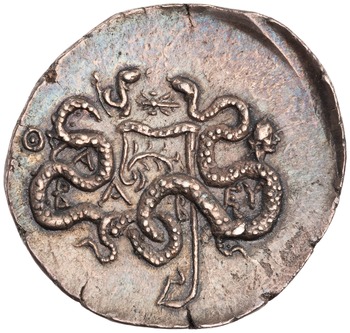
Reverse of AR cistophorus of Eumenes III of Pergamun featuring two coiled serpents between bow-case and bow. BA EY, a winged thunderbolt above the bow-case and a beardless male head in field right.ANS 1944.100.37579 American Numismatic Society
Today, I received and started reading another new book, which I am very much enjoying even if it does not have any notes and the photographs are deficient:
When I finish this work (which is one in a series, of which I obtained three volumes today), I will write a hopefully helpful review. In the meantime, I have been inspired to prepare a quick post about one of the coins referenced in the work on pp. 81-82.
And now, a few words about the Kingdom of Pergamum, Eumenes III, the Citizens of the Sun, their revolt against Rome, and the coin, which inspired this post.
The Kingdom of Pergamum (or Pergamon), in Asia Minor, was ruled by the Hellenistic Attalid Dynasty. The Attalid Dynasty was founded by Philitaerus, who ruled from c. 282-263 B.C. The Kingdom benefitted significantly in 188 B.C. under the treaty of Apamea, when the Roman Senate granted the Kingdom great expanses of territories from the just defeated Seleucid Empire.
Kingdom of Pergamum c. 188 B.C. under the Attalid Dynasty
In 133 B.C., King Attalus III bequeathed the Kingdom of Pergamum to the Roman people. What happened next is most extraordinary. Rome was in turmoil at the time the bequest was received in Rome, as it is believed to have been delivered while rioting and killings associated with the slaying of the tribune Tiberius Gracchus were occurring. It is likely that the Roman Senate did not turn its attention to addressing the bequest, and formally annexing the Kingdom, until 131 B.C. While the Senate in Rome dithered, however, in the Kingdom of Pergamum, a man named Aristonicus, who claimed to be of royal lineage (the son of Eumenes II), almost immediately proclaimed himself king as Eumenes III.
Although Eumenes III found no support in the major urban centers of Pergamum or Ephesus, he apparently found more than adequate support in many other cities and much of the periphery of the kingdom. Additionally, and most interestingly, he made a bold appeal to the poor and enslaved, which was well-received, as reported by Strabo:
“After Smyrna, one comes to Leucae , a small town, which after the death of Attalus Philometor was caused to revolt by Aristonicus, who was reputed to belong to the royal family and intended to usurp the kingdom. Now he was banished from Smyrna, after being defeated in a naval battle near the Cymaean territory by the Ephesians, but he went up into the interior and quickly assembled a large number of resourceless people, and also of slaves, invited with a promise of freedom, whom he called Heliopolitae [Citizens of the Sun]. Now he first fell upon Thyeira unexpectedly and then got possession of Appolonis, and then set his efforts against other fortresses. But he did not last long; the cities immediately sent a large number of troops against him, and they were assisted by Nicomedes the Bithynian and by the kings of the Cappadocians. Then came five Roman ambassadors, and after that an army under Publius Crassus the consul, and after that Marcus Perpernas, who brought the war to an end, having captured Aristonicus alive and sent him to Rome. Aristonicus ended his life in prison.” Strabo. Geography, Volume VI: Books 13-14. Translated by Horace Leonard Jones. Loeb Classical Library 223. Cambridge, MA: Harvard University Press, 1929, pp. 247-249.
The sources suggest that the attempt by Eumenes III and his Citizens of the Sun to remain independent of Rome required extraordinary efforts by Rome to suppress. Some scholars suggest Eumenes’ primary support may have come from areas with many former mercenaries, which may also explain why he was able to prevail for so long. Additionally, at least one reading of the sources suggest it took upwards of six to seven years for the Romans to quell the “revolt” and fully annex the kingdom as a province.
AR Cistorphorus of Eumenes III. Thyateira mint. Cista mystica from which serpent emerges within ivy wreath/two coiled serpents between bow-case and bow. BA EY, a winged thunderbolt above the bow-case and a beardless male head in field right. ANS 1944.100.37579 American Numismatic Society
Regardless, what attracted my interest to this historical incident are the beautiful coins which were issued during Eumenes’ attempt to remain independent of Rome. The coins, called kistophoroi (latinized to cistorphorus) or basket-bearers comes from the obverse type, which features a snake crawling out of a wicker basket (a cista) encircled by an ivy wreath. These unusual coins were the main silver coins of many cities in Asia minor from c. 167 BC through the reign of Augustus. What is unusual about the cistorphori of Eumenes III is that usually the Attalid kings did not mark their issues to indicate that they were royal issues or which king issued them whereas Eumenes III marked his issues on the reverse to indicate that they were issued by him. Additionally, he marked his issues as to the mint location.


















 Northcoast Antiquarian

