Paul Klee, Rose Garden (1920, 44, oil and pen on paper on cardboard, 49 cm x 42.5 cm), Städtische Galerie im Lenbachhaus and Kunstbau Munich, on permanent loan from the Gabriele Münter and Johannes Eichner Foundation, Munich, CC BY-NC-SA.
Periodically, I revisit the essays of Ralph Waldo Emerson. His writing style is sometimes jarring but just as often sublime (Henry James, in Partial Portraits (1888), observed that Emerson “never really mastered the art of composition” (p. 20) while also acknowledging that “he had frequently an exquisite eloquence” (p. 32)). The visit is always profitable.
While rereading Emerson’s perhaps most famous essay, Self-Reliance (1847), I found that after much of my recent reading focusing so heavily on things temporal, especially in the past month (e.g., Carlo Rovelli’s masterful works The Order of Time, Seven Brief Lessons on Physics, and Reality is Not What it Seems and Tom Siegfried’s lyrical The Number of the Heavens: A History of the Multiverse and the Quest to Understand the Cosmos), the following passage resonated in a manner it had not on previous readings of the essay:
“Man is timid and apologetic; he is no longer upright; he dares not say ‘I think,’ ‘I am,’ but quotes some saint or sage. He is ashamed before the blade of grass or the blowing rose. These roses under my window make no reference to former roses or to better ones; they are for what they are; they exist with God to-day. There is no time to them. There is simply the rose; it is perfect in every moment of its existence. Before a leaf-bud has burst, its whole life acts; in the full-blown flower there is no more; in the leafless root there is no less. Its nature is satisfied, and it satisfies nature, in all moments alike. But man postpones or remembers; he does not live in the present, but with reverted eye laments the past, or, heedless of the riches that surround him, stands on tiptoe to foresee the future. He cannot be happy and strong until he too lives with nature in the present, above time.”
Such an extraordinary observation and lesson—that there is no lamentation of the past, or anticipation of the future, only presence for the rose.
Lamentation, or regret more precisely, I have long regarded as the most useless of human endeavors, if it is more than rectification of error, amends to others, and lessons learned. Anticipation, or anxiety about the future, is also too often misplaced and misdirected energy. Yes, we can and should make plans, but when the energy and effort extend beyond the necessary such that the future becomes a thief of reason, serenity, and equanimity, we are perilously close to toppling over.
The image of the rose in the above essay also brought to mind, fortuitously or not, a wonderful piece of art, Rosengarten (1920) by Paul Klee, ensconced in Lenbachhaus, an art museum in Munich.
After reading Helmut Friedel and Annegret Hoberg’s words about Klee from Der Blaue Reiter im Lenbachhaus München (2007) at the Lenbachhaus website, I readily envision Rosengarten as exemplifying the same harmonious integration of presence and timelessness that Emerson attributes to the rose. Created in 1920, the painting merges organic and constructed forms into a rhythmic whole. Klee’s garden unfolds as a grid of irregular, red-tinged rectangles, delicately framed by black lines, with roses—symbols of growth and vitality—scattered like musical notes across the composition. These roses, like Emerson’s, embody the eternal present; their rounded, spiral blooms suggest continuous life and creation. For Klee, as for Emerson, nature’s rhythms transcend human constructs of time.
Interestingly, Klee drew inspiration from music, speaking of “cultural rhythms” in his Bauhaus writings and comparing his visual compositions to musical structures. In Rosengarten, he achieves a polyphony of visual forms, where the temporal becomes spatial, and each element contributes equally to the whole. Just as Emerson’s rose is “perfect in every moment of its existence,” Klee’s garden suggests an infinite unfolding—a melody extending endlessly beyond the canvas.
Both Emerson and Klee challenge us to inhabit the present, to find harmony in life’s rhythms, and to appreciate the completeness inherent in each moment. The rose, whether in prose or paint, invites us to rise above time.
In this piece, the author reflects on the interconnected nature of language and life, using the evolution of the Proto-Indo-European root “skei-” as a lens. This root gave rise to words like “science” and “shit,” which represent opposing concepts but share a common origin. The author explores how this linguistic duality mirrors broader philosophical and religious themes of light and shadow, good and evil. By drawing parallels to Jungian psychology, Christian theology, and the works of Dante and Rumi, the author highlights the interplay between knowledge and waste, creation and rejection, light and shadow as essential to the human condition.
Vitruvian Man (Pen, brown ink, and watercolor over metalpoint on paper, c. 1490) by Leonardo da Vinci (1452–1519). Gallerie dell’Accademia, Venice.
Language, much like life itself, often reveals the interplay of opposites—light and shadow, creation and destruction, knowledge and ignorance. The study of etymology, the history of words, can uncover surprising connections between concepts that seem worlds apart, offering us profound insights into the human condition. One such connection is found in the shared origin of the words science and shit. Though these words have come to represent vastly different ideas, they both trace their lineage back to the same ancient root: the Proto-Indo-European (PIE) root skei-, meaning “to cut” or “to split.” This essay explores how these seemingly disparate words, rooted in the same ancient origin, serve as powerful metaphors for the light and shadow inherent in the human condition and the perennial quest for understanding.
Proto-Indo-European Roots: The Seeds of Language
Proto-Indo-European (PIE) is not a language we have direct evidence of—it is a reconstructed ancestor, a theoretical framework derived from comparing the languages that descended from it, such as Latin, Greek, Sanskrit, and Old English. PIE roots, like skei-, are the conceptual building blocks from which countless words in these descendant languages evolved. These roots are not words in the modern sense but rather represent basic, primal ideas—actions like cutting or splitting, states of being, or essential objects.
In PIE, the root skei- originally meant “to cut” or “to split.” From this simple, physical concept, a remarkable range of words has emerged across different languages, each bearing the imprint of its original meaning while branching out into diverse semantic fields. This evolution offers us a window into how the same fundamental idea can develop in different directions, leading to words that are as disparate in meaning as science and shit.
The Evolution of Skei- in the Romance Languages
In Latin, skei- evolved into scire, meaning “to know,” which later gave rise to the word scientia and eventually science in English. This path reflects the metaphorical extension of “cutting” as a process of discernment, a way of separating truth from falsehood, knowledge from ignorance.
Beyond scientia, the influence of skei- in the Romance languages is extensive. Consider the Latin word secare, meaning “to cut,” which directly inherits the original sense of the PIE root. From secare stem a multitude of words in the Romance languages associated with cutting, division, and distinction. For example, the English word section derives from the Latin sectio, meaning “a cutting” or “division.” Similarly, segment, from Latin segmentum, refers to something that has been cut off or separated from the whole.
In French, the verb scier (to saw) also traces its lineage back to skei-, emphasizing the physical act of cutting. Meanwhile, the word ciseau (chisel), though phonetically and morphologically transformed, ultimately connects to the same root, representing a tool used to cut or shape materials. Italian retains the word secare (to cut), giving us sezione (section) and segmento (segment), maintaining the connection to division and separation.
Even more abstractly, the root skei- gave rise to words that convey the notion of separating or distinguishing in non-physical ways. The Latin discernere (to discern), combining dis- (apart) and cernere (to sift, to separate), encapsulates the mental process of distinguishing between different ideas or concepts. This term evolved into the French discerner and the Italian discernere, both of which continue to convey the act of intellectual separation and judgment.
The linguistic journey of skei- culminates in the English word science, derived from the Latin scientia. Here, science encapsulates the essence of skei-, as the pursuit of knowledge is fundamentally about separating truth from falsehood, understanding from ignorance. Science, in its most basic form, is the practice of discernment—of cutting through the noise to reveal the underlying principles that govern our world.
The Germanic Branch: From Skei- to Shit
In the Germanic languages, the PIE root skei- also left its mark, though in a different form. The sense of “cutting” or “separating” was preserved, but the focus shifted towards more physical, often bodily, processes. In Old High German, the word scīzan meant “to defecate,” directly preserving the sense of separation as it applies to bodily waste. This verb gave rise to similar terms in other Germanic languages: scheiden in Middle Dutch and skita in Old Norse, all of which convey the idea of separating waste from the body.
The Old English word scitan developed from this same root, referring to the act of defecation. Over time, scitan evolved into shit in Middle English, a term that has persisted into modern English with its meaning largely unchanged. Unlike its Latin counterpart, which evolved into abstract notions of knowledge and discernment, the Germanic branch retained a more literal, physical interpretation of skei-, focusing on the act of excretion.
This divergence is emblematic of the broader thematic dichotomy explored in this essay. The PIE root skei- gave rise to science—the disciplined pursuit of knowledge, marked by precision and intellectual rigor. Yet it also gave us shit—a word rooted in the most basic, physical processes, often associated with what is discarded or deemed unworthy.
A Metaphor for Life’s Duality
The linguistic journey of the PIE root skei- culminates in a profound metaphor for life’s duality: science, the pursuit of knowledge and enlightenment, represents the light, while shit, the rejected and discarded, embodies the shadow. This dichotomy between light and shadow is a theme that resonates deeply across various philosophical and religious traditions, each grappling with the tension between what is revered and what is reviled, what is illuminated and what remains in darkness.
Sassanid-era relief at Nassqsh-e Rostam depicting Ahura Mazda presenting the diadem of sovereignty to Ardashir I (180-242AD). Photograph by Wojciech Kocot / CC BY-SA 4.0.
In many philosophies and religions, light is associated with truth, purity, and the divine. In ancient Zoroastrianism, one of the oldest dualistic religions, the eternal battle between Ahura Mazda (the god of light) and Angra Mainyu (the spirit of darkness) symbolizes the cosmic struggle between good and evil. Here, light is knowledge, order, and goodness—concepts closely aligned with what we might associate with science, the disciplined pursuit of understanding that seeks to illuminate the mysteries of the universe. In contrast, Angra Mainyu is associated with the physical world’s corrupt and defiled aspects, bringing death, decay, and moral corruption—elements metaphorically aligned with shit, representing what is base, impure, and rejected.
However, it is important to note that while mainstream Zoroastrianism presents Ahura Mazda and Angra Mainyu as distinct and opposing forces without a common origin, a divergent tradition within Zoroastrianism, known as Zurvanism, offers a different perspective. Zurvanism posits Zurvan (Time) as the primordial deity, the ultimate source from which both Ahura Mazda and Angra Mainyu emerged. Just as the words science and shit diverge from the same linguistic root to embody opposing concepts, Zurvanism’s narrative suggests that the duality of light and darkness, good and evil, originates from a single, primordial source. This perspective mirrors the linguistic evolution we see with skei-, where a single root gives rise to words with vastly different meanings.
Just as the duality of light and darkness is central to Zoroastrian thought, Christianity presents its own understanding of these forces, offering a distinct yet parallel exploration of the tension between good and evil. Although Zurvanism was influential for a time, it was eventually deemed heretical by mainstream Zoroastrianism, which maintained a strict dualism without a common origin for good and evil. This divergence in religious thought parallels the Christian perspective on light and shadow, good and evil.
In Christianity, light is often used as a metaphor for God’s presence, truth, and divine guidance. The creation story in Genesis begins with God’s command: “Let there be light” (Genesis 1:3), bringing light into the void and establishing the foundation of the universe. However, it is essential to recognize that God is also the creator of darkness and shadow. Isaiah 45:7 affirms this: “I form the light and create darkness, I bring prosperity and create disaster; I, the Lord, do all these things.” This verse underscores that both light and shadow, good and evil, are within God’s dominion.
An illustration from “Milton’s Paradise Lost illustrated by Gustave Dore.”
God is also the creator of Satan, originally an angel named Lucifer, who rebelled against God’s authority. According to Christian tradition, as depicted in Paradise Lost by John Milton, Satan’s rebellion leads to his expulsion from Heaven and his fall into Hell. Milton vividly describes Satan’s fall, portraying him as a once-glorious being who becomes the ruler of a realm of darkness and despair, a place of punishment that is also part of God’s creation. In Paradise Lost, Hell is depicted as a kingdom of “darkness visible,” where Satan and his fallen angels are condemned to eternal torment.
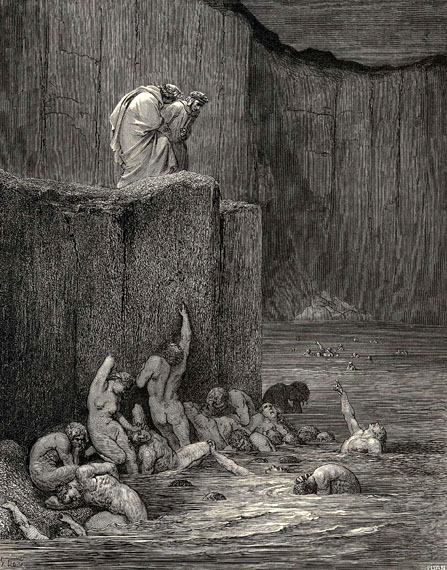
This depiction of Hell is further elaborated in Dante Alighieri’s Divine Comedy, particularly in the Inferno. Dante places Satan at the very center of Hell, a realm of perpetual darkness and despair. Here, the damned suffer in various circles filled with filth and excrement, symbolizing the moral corruption that led them to their fate. Especially vivid is his articulation of the fate of flatterers, recounted in Canto XVIII:
“Here we heard people whine in the next chasm, and knock and thump themselves with open palms, and blubber through their snouts as if in a spasm.
Steaming from that pit, a vapour rose over the banks, crusting them with a slime that sickened my eyes and hammered at my nose.
That chasm sinks so deep we could not sight its bottom anywhere until we climbed along the rock arch to its greatest height.
Once there, I peered down; and I saw long lines of people in a river of excrement that seemed the overflow of the world’s latrines.
I saw among the felons of that pit one wraith who might or might not have been tonsured— one could not tell, he was so smeared with shit.”
Illustration for Inferno Canto XVIII by Gustave Doré (1832–1883), from The Divine Comedy: The Vision of Hell by Dante Alighieri, translated by H. F. Cary, M.A., 1892. Cassell and Company.
The image of Satan presiding over a kingdom of darkness and filth powerfully illustrates the connection between evil, rejection, and waste—concepts intimately tied to the notion of shit. In Dante’s vision, Hell’s filth is not merely a punishment but a reflection of the inner corruption of the soul, manifesting physically in the environment of the damned.
Darkness and shadow, therefore, are not merely the absence of light but are active forces within the world, created by God to fulfill His divine plan. Just as light reveals and guides, shadow obscures and challenges, reminding humanity of the consequences of straying from the path of righteousness.
The shadow—represented here by shit—carries connotations of what is hidden, ignored, or rejected. In Jungian psychology, the “shadow” represents the unconscious mind, the darker, hidden parts of ourselves that we “cut off,” deny or repress. Jung’s concept of the shadow is not just an abstract idea; it is a fundamental aspect of the psyche that influences behavior, decisions, and self-perception. The shadow is composed of all the aspects of our personality that we do not wish to acknowledge, the traits and impulses that are contrary to our conscious self-image. These elements are not necessarily evil, but they are often perceived as such because they conflict with the ideals and norms of society or our personal moral compass.
Jungian psychology teaches that the shadow must be confronted and integrated into our conscious awareness to achieve psychological wholeness. This process, known as individuation, involves bringing the shadow to light, recognizing it as part of ourselves, and reconciling it with our conscious identity. The failure to do so can result in projection, where we see our own shadow traits in others, or in the shadow manifesting in destructive behaviors.
In a similar vein, Samuel Beckett’s wayfarers in Waiting for Godot find themselves mired in a cyclical existence, often lying in ditches—literal and metaphorical—beset by a sense of futility and degradation. These ditches, filled with the mire of their own making, symbolize the excremental realities that we, too, must navigate. Here, the clash between our lofty aspirations and the baseness of our condition becomes starkly apparent. It is in such moments, where the struggle between light and shadow is most palpable, that the human quest for understanding reaches its existential depths.
A critical part of Carl Gustav Jung’s own journey involved confronting what might be considered the ultimate shadow: the filth and shit inherent in life itself. In a pivotal dream, which Jung described in his autobiography, he saw God defecating on a cathedral. This shocking image challenged his previously held religious beliefs and led him to a deeper understanding that both the sacred and the profane, light and shadow, are intrinsic to the truth of human experience. For Jung, recognizing and integrating these elements was essential to achieving psychological and spiritual wholeness.
The Christian concept of sin and the Jungian shadow share significant parallels. Just as sin is what separates humanity from God, the shadow is what separates the conscious self from the full realization of the psyche’s potential. In both cases, the shadow or sin must be acknowledged and transcended to achieve a higher state of being. The metaphor of shit, then, becomes a powerful symbol for the shadow—something that must be expelled or transformed if one is to attain spiritual or psychological clarity.
Just as the light of science allows us to discern truth, the exploration of the shadow—be it in Dante’s dark realms, Jung’s psychological depths, or the moral struggles depicted in Christian theology—reveals the complexity of the human condition. It challenges us to confront what we might prefer to ignore, to recognize that the pursuit of purpose or truth is not only about enlightenment but also about grappling with the darkness within.
In addition to the psychological insights provided by Jung, the teachings of the 13th-century Persian poet and mystic Jalāl Al-Dīn Muḥammad Rūmī offer a profound perspective on integrating the shadow. Rūmī, known for his deeply spiritual and allegorical tales, explores themes of love, transformation, and the human journey toward divine understanding.
In one tale from his Masnavi, the Prophet Mohammed encounters a man known as the Huge Eater, who, after a night of excessive eating, defecates in his bed. Rather than chastising him, Mohammed quietly cleans the soiled bedclothes. This act of humility and compassion profoundly moves the man, leading to his spiritual awakening.
Rūmī’s tale symbolizes the cleansing of the shadow—what Jung might metaphorically describe as the basest parts of our psyche—transforming what is impure within us into something pure. As Rūmī writes, “When the body empties and stays empty, God fills it with musk and mother of pearl. That way a man gives his dung and gets purity.” This stanza underscores the transformative process, where acknowledging and cleansing these shadow elements leads to spiritual growth. It also subtly alludes to the idea of “cutting off” or removing what is impure to make room for the divine.
Just as Muḥammad’s act of dealing with literal shit in Rūmī’s tale leads to the man’s transformation, so too does the integration of our shadow lead to deeper knowledge and understanding. This mirrors the duality discussed throughout the essay: the interplay between science and shit, light and shadow, and the continuous process of transformation that defines the human experience.
But this exploration of light and shadow, science and shit, extends beyond the mere experience of these dualities. It speaks to the human quest—the relentless search for truth that drives our existence. This quest is fraught with tension, as illustrated in the imagined dialogue I recently wrote between da Vinci and Beckett. Da Vinci, the archetypal figure of the Renaissance, represents the light of reason, the pursuit of knowledge through science and art. Beckett, on the other hand, embodies the existential struggle, the shadow of doubt, despair, and the acknowledgment of the absurdities that define human existence.
Their dialogue captures the essence of this tension: the push and pull between the desire to illuminate the world with knowledge and the recognition of the inherent limitations and darker aspects of that pursuit. It is within this tension that the human search for truth takes place, a journey that is neither straightforward nor devoid of shadow.
In their imagined conversation, continued anew here, Leonardo da Vinci, the Renaissance polymath, questions Beckett about the purpose of his work, Waiting for Godot. Da Vinci, who devoted his life to the pursuit of knowledge and the perfection of art, sees in Beckett’s work an unsettling reflection of the human condition—a world stripped of certainty, where meaning is elusive and the quest for truth is often met with silence.
Da Vinci: “Your characters wait endlessly, in vain, for something—or someone—that never arrives. Is this the conclusion of your inquiry? That we are condemned to wait, to search without hope?”
Beckett: “Leonardo, your works capture the beauty and order of the world, but what of the chaos, the emptiness? My work reflects the shadow, the nothingness that underlies our existence. The quest for meaning is not always met with light; often, it is swallowed by the void. Yet, in the waiting, in the recognition of the absurdity, there is a truth—perhaps not the truth we desire, but a truth nonetheless.”
Da Vinci: “Yet, to acknowledge the void is not to surrender to it. Even in the shadow, there is form, there is structure. My studies of anatomy, of light and shadow, reveal the underlying patterns of life. Can we not find meaning even in the darkness?”
Beckett: “Perhaps. But meaning in darkness is not the same as light. It is ambiguous, fleeting, and it demands a confrontation with the parts of ourselves we’d rather not see—the shadow, as Jung might call it. We cannot have one without the other, can we?”
Da Vinci: “No, we cannot. My work has always sought to unify—to bring together the light and the dark, the known and the unknown. Your work, in its starkness, Samuel, reminds us that this unity is not easily achieved, that the search for truth is fraught with difficulties, and that sometimes, the answers we seek lie in the very questions we ask.”
Beckett: “And so we continue, each in our own way. You with your light, me with my shadow. Both necessary, both incomplete without the other.”
This dialogue between da Vinci and Beckett reflects the core of the human experience—the pursuit of knowledge and meaning, which inevitably involves grappling with both light and shadow, science and shit. It is through this dialectic, this ongoing tension between opposites, that we inch closer to understanding the complex reality of our existence.
Yin and Yang motif featured at the center of the reverse side of the silver fifty-cent piece from Kirin Province, Empire of China, issued during the reign of the Guangxu Emperor (1875-1908). Coin image courtesy of Stephen Album Rare Coins.
The Taoist concept of Yin and Yang further encapsulates this duality, with Yin representing the shadowy, passive, and receptive aspects of the universe, and Yang symbolizing the bright, active, and creative forces. Unlike the Western dichotomies of good and evil, light and darkness, Taoism teaches that these forces are not in opposition but are interdependent and interconnected. Yin and Yang exist in a dynamic balance, each necessary to the other—just as science and shit both derive from the same linguistic root, and just as light and shadow originate from the same source. This balance reflects a more holistic understanding of duality, one where opposites are seen not as conflicting entities but as complementary forces that together create a unified whole.
Thus, from a single ancient root, we derive two words that reflect this timeless duality: science, the light guiding us toward knowledge and understanding, and shit, the shadow symbolizing what is cast aside, hidden, or ignored. This divergence serves as a powerful metaphor for the duality inherent in human experience and our ongoing quest for truth. Just as light and shadow originate from the same source, so too do our highest ideals and our basest realities emerge from the same fundamental force.
Recall that Dante’s journey in The Divine Comedy culminates in the Paradiso, where the pilgrim is ultimately united with the divine light, a symbol of ultimate truth and understanding. This final vision represents the fulfillment of the human quest for knowledge and the transcendence of earthly shadows. While Dante’s Paradiso offers an idealized conclusion—one that many might consider beyond the reach of human experience—it underscores the universal journey through light and shadow, science and shit, a path marked by both striving and imperfection.
Indeed, in exploring the relationship between science and shit, we confront the uncomfortable truth that both are essential parts of the human condition—two sides of the same coin, each reflecting different aspects of our quest to understand and navigate the world. The light of science allows us to discern, to separate truth from falsehood, illuminating the path ahead. But the shadow of shit reminds us of the inevitable waste, the parts of our existence that we might prefer to forget but which are nonetheless integral to the whole.
Tracing the evolution of skei- from PIE to modern English deepens our understanding of the intertwined nature of knowledge and waste, creation and rejection, light and shadow. This exploration reveals that these seemingly opposite concepts are, in truth, two sides of the same coin—each essential to the human condition, each a reflection of the complex interplay of light and shadow that defines our existence, and each a testament to the perpetual human quest for truth.
Bibliography
Beckett, S. (2011). Waiting for Godot. Grove Press.
Beekes, R. S. P. (2011). Comparative Indo-European Linguistics: An Introduction (2nd ed.). John Benjamins Publishing Company.
Boyce, M. (2001). Zoroastrians: Their Religious Beliefs and Practices (2nd ed.). Routledge.
Dante Alighieri. (2003). The Divine Comedy. Trans. John Ciardi. New American Library.
De Vaan, M. (2008). Etymological Dictionary of Latin and the Other Italic Languages. Brill.
Fortson, B. W. (2010). Indo-European Language and Culture: An Introduction (2nd ed.). Wiley-Blackwell.
Graver, L. (2004). Beckett: Waiting for Godot (2nd ed.). Landmarks of World Literature. Cambridge University Press.
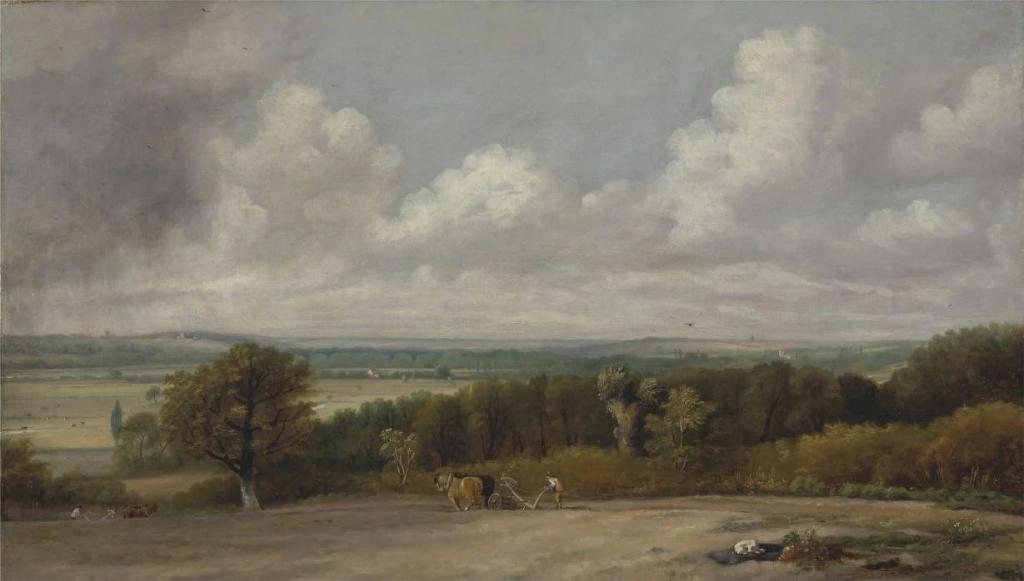
Ploughing scene in Suffolk (oil on canvas, 1824-1825) by John Constable (1776-1837). Yale Center for British Art, New Haven.
In a quiet village, there lived a diligent farmer who worked tirelessly on his land. He took great pride in the crops he grew, ensuring that each seed was planted with care and nurtured with patience. His fields were always bountiful, feeding not only his family but also the entire village.
One day, as he was plowing a new field, the farmer unearthed a strange, dark seed. It was unlike any seed he had ever seen, and though he was curious, he was also wary. The farmer considered casting the seed aside, fearing it might bring misfortune, but a voice within urged him to plant it.
After much deliberation, the farmer decided to plant the seed in a secluded corner of his field, where it could grow without disturbing his other crops. He tended to it with the same care as his other plants, watching as it sprouted and grew into a tall, sturdy tree, its leaves a deep, rich green.
As the seasons passed, the tree bore fruit—small, round, and gleaming like gold. The farmer, unsure of the fruit’s nature, hesitated to taste it. But one day, during a terrible drought that withered his other crops, he had no choice. He bit into the fruit, and to his surprise, it was not only delicious but also quenched his thirst and filled him with strength.
The farmer shared the fruit with the villagers, and soon they all marveled at its miraculous properties. The tree continued to bear fruit, regardless of the weather, and the village never again knew hunger or thirst. The farmer realized that by trusting in the unknown and nurturing it with care, he had uncovered a hidden blessing.
Moral of the Fable
Sometimes the greatest rewards come from taking risks and nurturing what is unknown or unexpected. The fable emphasizes the value of curiosity, patience, and the willingness to embrace uncertainty.
Recently, I mentioned that I had read Friedrich Nietzsche’s “On the Use and Abuse of History.” My rough and tumble summary is as follows:
In “On the Uses and Abuses of History,” Nietzsche delineates three principal approaches to history: monumental, antiquarian, and critical. He argues that each methodology serves distinct purposes and carries unique implications for the perception and utilization of historical knowledge.
Monumental History: This approach venerates history as a continuum of extraordinary deeds and eminent individuals, offering inspiration for present and future endeavors. It emphasizes the perpetuity of greatness, encouraging individuals to aspire to the achievements of historical giants. Nietzsche asserts that by demonstrating what was once attainable remains within the realm of possibility that monumental history acts as a powerful motivational force.
Antiquarian History: Antiquarian history esteems the past for its own intrinsic value, driven by reverence and loyalty. It concentrates on the preservation of customs, traditions, and artifacts, fostering a sense of continuity and belonging. Nietzsche argues that this approach is indispensable for cultivating a collective memory and identity and providing comfort and a sense of rootedness within a historical continuum.
Critical History: Critical history is characterized by its evaluative and interrogative stance towards the past. It enables individuals and societies to extricate themselves from outdated or oppressive traditions, serving as a liberating force that facilitates progress. Nietzsche states that by challenging and reassessing historical narratives, critical history promotes a dynamic and progressive engagement with the past.
Balancing These Approaches: Nietzsche stresses that equilibrium among these historical approaches is essential for an appropriate engagement with history. An overemphasis on monumental history may lead to the undue glorification of the past, which stifles innovation. Conversely, an excessive focus on antiquarian history risks engendering a stagnant conservatism resistant to necessary change and progress. Additionally, overreliance on critical history can result in destructive cynicism and a disconnection from one’s heritage. A balanced historical perspective integrates the aspirational qualities of monumental history, the conserving virtues of antiquarian history, and the emancipatory critique of critical history. This synthesis fosters a society that respects its past, cherishes its heritage, and remains receptive to change and improvement.
My introduction to Nietzsche’s characterizations of historical approaches was revelatory, as it revealed much about my own approaches and reactions to history and historical objects. It also clarified the occasional disconnect I experience when engaging with contemporary historical studies, methodologies, and historians. In brief, I perceive that the current academic climate exhibits a pronounced imbalance, favoring critical history.[1] This predominance serves the interests of individual academicians and ideologues, rather than the broader objectives of history or society. Conversely, within the realm of political society, there is a noticeable tilt towards monumental history, almost entirely neglecting antiquarian and critical perspectives, which poses significant risks. Interestingly, I find myself slightly imbalanced in the Nietzschean sense, perhaps excessively favoring antiquarian history, thereby rendering myself somewhat out of step with both the Academy and political society. The quest for balance is imperative.
However, the aforementioned observations merely serve as a prelude to the more profound enlightenment I experienced while delving into Nietzsche’s concept of antiquarian history. In a particularly insightful article by Stephen Bann, entitled “Clio in Part: On Antiquarianism and the Historical Fragment,” published in 1987, I encountered a truly remarkable quote from Marcel Proust. This quotation elucidated, with striking clarity, my perspectives on literature, history, historical artifacts (including coins), and my self-identification as an antiquarian. It profoundly articulated the essence of what this self-identification entails and reinforced my understanding of my approach to these fields.
To provide a fitting introduction for individuals unfamiliar with the work from which I take Proust’s quote, which is to follow, it is essential to contextualize Proust’s reflections on the imaginative power of antiquities. In “Contre Sainte-Beuve,” a collection of essays in which Marcel Proust critiques the method of literary criticism employed by Charles Augustin Sainte-Beuve, he vividly describes how historical imagination can transform our perception of ancient sites, such as the fictional estate of Guermantes. Guermantes, a recurring symbol in Proust’s magnum opus “In Search of Lost Time,” represents an idealized vision of the past, embodying the timelessness and continuity of history. The following excerpt from “Contre Sainte-Beuve” beautifully captures the essence of this transformation, illustrating how the past and present converge through the lens of imagination:
“And if Guermantes does not disappoint one as all imagined things do when reduced to reality; this is undoubtedly because at no time is it a real place, because even when one is walking about in it, one feels that the things one sees there are merely the wrappings of other things, that reality lies, not in this present but far elsewhere, that the stone under one’s hand is no more than a metaphor of Time; and the imagination feeds on Guermantes visited as it fed on Guermantes described because all these things are still only words, everything is a splendid figure of speech that means something else…. As for the castle towers, I tell you they are not only of that date, they are still in it. This is what stirs one’s heart when one looks at them. People always account for the emotional quality of old buildings by saying how much they must have seen in their time. Nothing could be more untrue. Look at the towers of Guermantes; they still look down on Queen Matilda’s cavalcade, on their dedication by Charles the Bad. They have seen nothing since. The moment when things exist is determined by the consciousness that reflects them; at that moment, they become ideas and are given their form; and their form, in its perpetuity, prolongs one century through the midst of others.”[2]
That final sentence resonates with me profoundly, both emotionally and instinctively. It elucidates why I have often conveyed to friends and family that, despite not having physically traversed great distances in my lifetime, I have, in truth, journeyed to more places and temporalities than almost anyone I know. This has been achieved through my extensive readings and the curation of my collections.
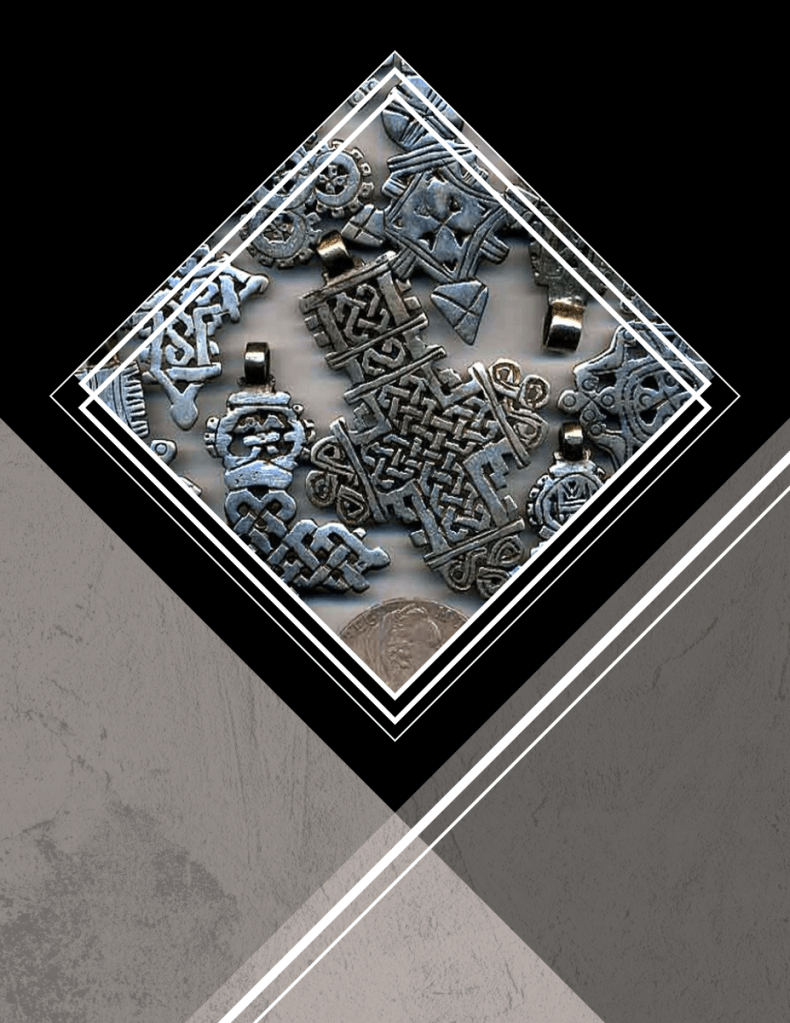
It also illuminates why, nearly twenty-five years ago, when a beloved friend and colleague faced a life-threatening health condition, I found it fitting to send her an antique silver Ethiopian Coptic Cross from my collection. This cross, approximately a century old, was likely crafted from silver originating from a Maria Theresa Trade Thaler. Accompanying the cross was a note explaining that, although it resided in my collection as an antiquarian item, it was made by the Faithful, for the Faithful, to aid the Faithful in prayer. Thus, the aura of its origin and use still imbued it with a sacred presence, which she, as one of the Faithful seeking prayer, would find comforting during that critical time. The words of Proust, I believe, provide a more cogent explanation of what I, ever the antiquarian, attempted to convey in my letter.
[1] A powerful discussion of the current imbalance in the Academy, with its excessive favoring of critical history and the attendant detrimental societal affects, is found in an essay by Julian Young. Unfortunately, the essay, which has a convincing introduction and general analysis of the situation, suffers horribly from poor analysis in the section entitled The Anxieties of Youth and fails absolutely in the particulars of its conclusion, which approaches an ideological agenda despite its disclaimers. The essay is still recommended for it strong beginnings as it only goes off the rails towards the very end. Young, J. (2023). The Uses and Misuses of History: Reflections on Nietzsche’s Second Untimely Meditation. Society, 60(670-683). https://doi.org/10.1007/s12115-023-00879-0
[2] Bann, S. (1987). Clio in Part: On Antiquarianism and the Historical Fragment. Perspecta, 23, 37, quote is cited in fn25 to Proust, M. (1984). By way of Sainte-Beuve (S. Townsend Warner, Trans.). London: Hogarth. 182-183.
Clay tablets. Story of Gilgamesh and Aga. Old Babylonian period, 2003-1595 BC. Sulaymaniyah Museum, Iraqi Kurdistan. (CC-BY SA 4.0. Dr. Osama Shukir Muhammed Amin).
Homer, even if the fictive creator of the Iliad and the Odyssey, is inseparable in the mind from those masterful and inspiring works of literature. Equally inseparable should be Sin-lēqi-unninni from the Epic of Gilgamesh.
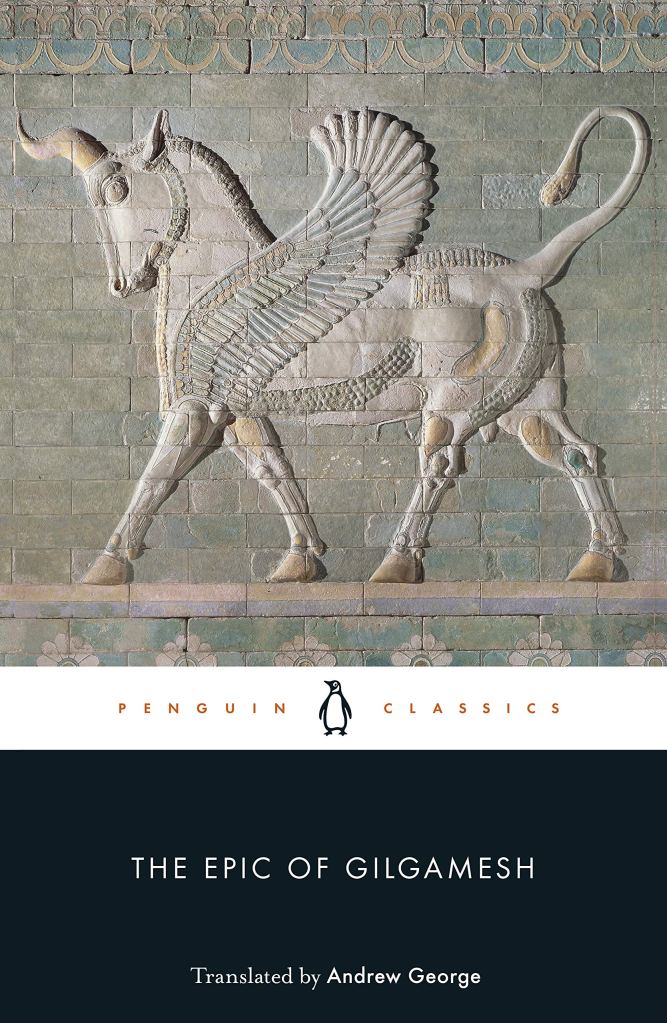
Andrew George, whose engaging translation of the Epic of Gilgamesh is readily acknowledged by later translators of the epic as “a master class in philological precision and ingenuity,” has this to say about Sin-lēqi-unninni:
According to Babylonian tradition the [Epic of Gilgamesh] was the work of a certain Sîn-lēqi-unninni, a scholar from Uruk who was believed to have been a contemporary of Gilgamesh himself. However, Sîn-lēqi-unninni bears a name of a kind not found before the second millennium, so the tradition clearly preserved an anachronism. Instead, there is little doubt that Sîn-lēqi-unninni’s name was associated with the epic because he was the man who gave it its final, fixed form. Sîn-lēqi-unninni is thus one of the earliest editors in recorded history. From a comparison of the standard version of the first millennium with the older fragments we know that the person responsible for the standard version remodeled the poem. He provided it with a new prologue and recast the story to emphasize the theme of wisdom gained through suffering. Probably he was responsible for interpolating a version of the flood story, adapted from the old poem of Atra-hasis, and for appending to the epic as Tablet XII the rump of one of the Sumerian poems of Bilgames in an Akkadian prose translation. He left his mark also on the prosody, reducing variation in parallel and similar passages by combining their lines and repeating them verbatim to produce a text characterized by long sections of repetition where older versions had none. For this he often stands accused of damaging the poem’s literary qualities, but at the same time it can be argued that he introduced a profundity of thought that was probably lacking in the older versions.
Though the editorship of Sîn-lēqi-unninni probably changed the poem so radically that it is no wonder the Babylonians later named him as its author, it is clear from the multiple versions of the second millennium and from the existence of textual variants in the standard version of the first millennium, that he was not the only individual to leave his mark on the written epic. However, we know nothing of these others.
George, Andrew (2008) ‘Shattered tablets and tangled threads: Editing Gilgamesh, then and now.’ Aramazd. Armenian Journal of Near Eastern Studies, 3 (1). pp. 11-12.
George, perhaps, does an injustice to Sin-lēqi-unninni, by relegating him to the role of editor alone. Sin-lēqi-unninni was not mere scribe, nor compilator, nor even editor; rather, because of the number and weight of the substantive additions and structural changes he made to the epic, we may rightly view him as an ingenious co-creator of the ever-inspiring epic, such that modern publications could have a title page reading Sin-lēqi-unninni’s Epic of Gilgamesh.
The life that you seek you will never find: when the gods created mankind, death they dispensed to mankind, life they kept for themselves.
The Epic of Gilgamesh (2020), A. George, p. xlv
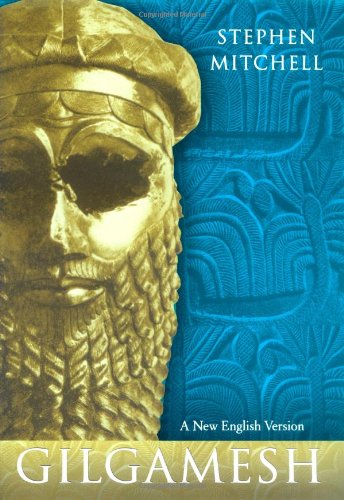
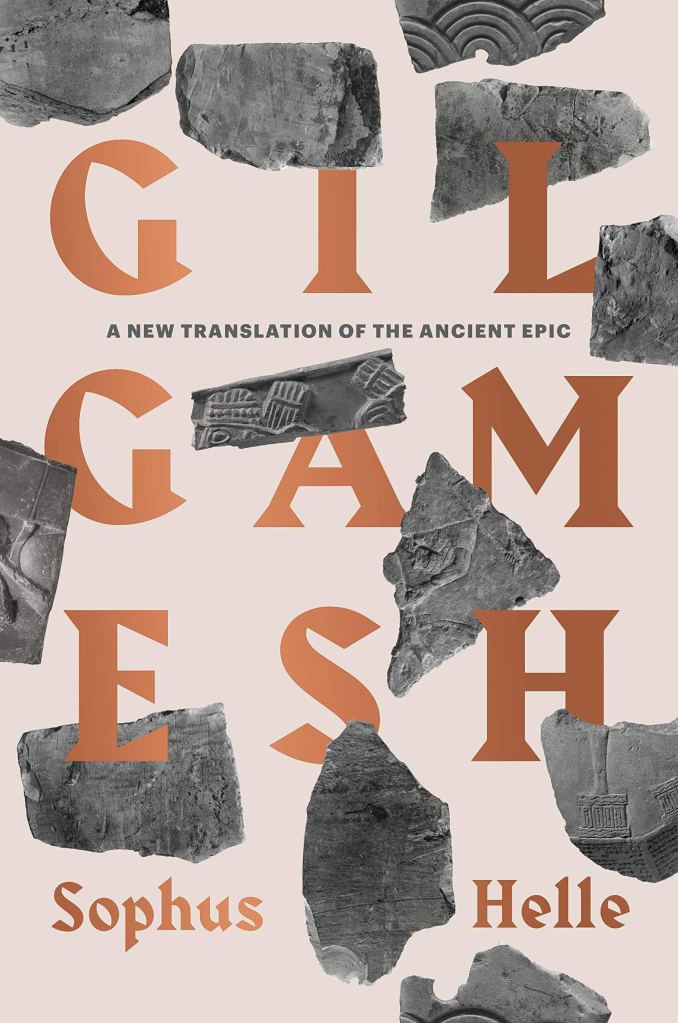
Two other translations of the poem in my library, both meritorious and worthy of note, include the recently published Gilgamesh: A New Translation of the Ancient Epic, by Sophus Helle (2021), which sought to strike a middle ground between George’s scholarly translation and the “translations of translations,” which can be used to described the other work in my library, Stephen Mitchell’s Gilgamesh (2004). Harold Bloom described Mitchell’s version of Gilgamesh as the “best I have seen in English” at the time it was published.
Gilgamesh is a well I go to for reflection and creative thought repeatedly. This is not surprising, as The New York Review of Books concisely notes that Gilgamesh inspires reflection and creativity on a multiplicity of levels:
In the century and a half since its rediscovery, however, and especially since World War II, Gilgamesh has made up for lost time. It has been translated into at least two dozen languages and been the inspiration for countless works of theater, film, poetry, fiction, and visual art. Musical responses to Gilgamesh include several operas, a ballet, hip-hop, jazz fusion, and an ear-pummeling track called “Gilgameš” by the Greek extreme metal band Rotting Christ.
Gilgamesh has also been acclaimed as the earliest work of ecological literature and included in The Columbia Anthology of Gay Literature as a founding text of queer writing, for its treatment of the relationship between Gilgamesh and his wild-man friend, Enkidu. The cultural energy of Gilgamesh shows no sign of dimming; the novelist Naja Marie Aidt describes it as a “fireball” that “has torn through time,” constantly in a process of reentry to the present.
New York Review of Books (October 20, 2022), “A Fireball from the Sands,” by Robert Macfarlane.
Some of my favorite more recent creative endeavors include two musical works. The first is a Lament on the Death of Enkidu, set to music and sung in Akkadian, based on the poetry of the epic. Peter Pringle, the creator, notes that he was helped along in his pronunciation of the Akkadian by Dr. George. It is simply stunning. Take a moment to listen and reflect on your mortality.
Gilgamesh’s Lament for the Death of Enikidu
The second is a nod to the ecological message that many find in the epic related to the consequences of the indiscriminate felling of the cedar forest in Lebanon. As explained in the New York Review of Books:
During the UK’s pandemic lockdown, [Robert] Macfarlane cowrote an album with the singer-songwriter and actor Johnny Flynn, Lost in the Cedar Wood. They collaborated on lyrics, sharing photos of notebook pages while in their respective homes, and Flynn would set them to music. “It felt like a wild wonder, to be able to feed words into the Johnny Flynn Song Machine and get a demo back a few days later!”
In addition to daily life in lockdown, the album is inspired by the Epic of Gilgamesh: “We wanted to write something both ancient and urgent,” said Macfarlane. “At the heart of Gilgamesh is the story of an unwise ruler, Gilgamesh himself, taking his axe to the Sacred Cedar Wood and felling these extraordinary trees. A few months after we began work on it, the Fairy Creek calamity started to unfold on Vancouver Island, with the premier of British Columbia, John Horgan, allowing the logging of the old-growth cedar forest there, including trees up to 2,000 years old.” Lines like “It was the first of the tellings/Of all of the fellings” (from the song “Tree Rings”), while unfortunately evergreen, took on a particular significance.
New York Review of Books (July 10, 2021), Ramblin’ Man. Robert Macfarlane, interviewed by Willa Glickman.
Johnny Flynn and Robert Macfarlane’s Tree Rings
To circle back to the beginning, this remarkable creativity is very much, I believe, the result of the creativity and authorship of the ancient editor of the Epic of Gilgamesh, Sîn-lēqi-unninni. He deserves more credit for the depth and reflection which is inspired by the ancient epic in its most familiar form. Let us celebrate his memory every time we read the epic or enjoy any of its derivative inspirational works.










 Northcoast Antiquarian