Four Trees, (1917. Oil on canvas) by Egon Schiele. Belvedere, Vienna.
Earlier this week, I took some time to review several hundred works by Egon Schiele (1890–1918), the Austrian Expressionist painter renowned for his intense and raw depictions of the human form. Schiele’s art, with its distinctive distorted body shapes and expressive lines, often explores themes of sexuality and self-examination, particularly in his numerous self-portraits, including nudes. Personally, I am more drawn to his other works—those that portray buildings, landscapes, and more formal sittings—not out of prudishness, but because of his unique ability to capture such scenes with an aesthetic that I appreciate. His mentor, Gustav Klimt, played a significant role in shaping Schiele’s artistic development. A broader collection of his works can be found here: Egon Schiele Overview and at the YouTube video gallery below.
While Schiele’s style is compelling, his biography is troubling, and he is not someone I would have wanted to know personally. Nonetheless, many of his works possess an undeniable aesthetic appeal, although others do not resonate with me as deeply. Two pieces that I find particularly captivating are included in this post—one featured above, and the other below (which reminded me of myself researching for an article or post).
Dr. Hugo Koller (1918, Oil on canvas) by Egon Schiele. Belvedere, Vienna.
For the record, The Cleveland Museum of Art possesses two works by Schiele, neither on display. The more interesting is below.
Portrait of a Child (Anton Peschka, Jr.), [1916, gouache, watercolor, and graphite] by Egon Schiele. The Cleveland Museum of Art, Cleveland.
Early on I warned that I would occasionally use this website as my sandbox to post my ramblings. My apologies for this rambling, as it is not a good story, scholarship, poetry, or even an interesting quote. Rather, it is just a post-it note in the ether, preserving a moment in time of an exploration of a thought that I found interesting.
The Block Universe and the Multiverse have increasingly become areas of scholarly inquiry for me. In recent months, I have been reading academic papers and books to deepen my understanding of both concepts. However, I must acknowledge that, while I find them fascinating, they lie largely outside my area of competency, except perhaps in a philosophical context. Despite this, I am undeniably drawn to both models, though many questions remain unanswered. To explore my ideas, I often turn to AI as a starting point for my inquiries, a way to clarify my inchoate thoughts and ideas.
This evening, I found myself particularly curious about the theoretical interaction between two individuals in the Block Universe model, specifically when they are not in “conscious alignment” but still interacting at the same point in time. Below is the inquiry I posed to ChatGPT and the response I received. I share this as yet another example of how ChatGPT can significantly enrich my exploration of ideas, particularly when I am surrounded by papers, books, and my computer without a similarly interested friend to discuss my ideas – and more importantly, my questions with – at length.
I will not burden you with the followup queries I made and the responses I received that refined the question below to include the Multiverse, migrating consciousnesses, etc., as factors. I will only note that the “discussion,” as it were, became rather heady.
My Inquiry to ChatGPT:
In the Block Universe model, where time is static and every moment exists simultaneously, if Individual A is conscious and interacting with Individual B at a particular point in time (let’s call it ABC on the time axis), can A’s conscious interaction with B be considered a “resurrection” of B, even if B’s consciousness has moved away from that moment? In other words, does A’s present consciousness revive B’s existence, or is B reduced to a mere memory? If time is static and both A and B exist at point ABC, how can we dismiss B’s presence as simply a memory? Wouldn’t A’s conscious perception of B bring B fully into the present, regardless of B’s own conscious awareness at that moment?
ChatGPT’s Response:
Your inquiry touches on a deeply philosophical and metaphysical problem: in a Block Universe, where time is static and every moment exists simultaneously, what happens to individual B if individual A is presently conscious and interacting with them, but B’s consciousness is not at the same point of present awareness? Does A’s conscious interaction with B “resurrect” B, making them fully present, or is B reduced to a mere memory?
1. The Nature of the Present in the Block Universe:
In the Block Universe model, all events—past, present, and future—are equally real and exist at once. Time, much like space, is laid out as a four-dimensional “block” where every point in time is a fixed coordinate. In this framework, “now” is relative—one individual’s present moment might not align with another’s, but both moments exist eternally within the same spacetime.
This leads to the question: if A’s consciousness is at a certain point on the time axis (let’s call it ABC), and B was at ABC at some point, can A’s current awareness bring B back into present existence, or is B simply an imprint of a past moment?
2. The Role of Perception and Consciousness:
Your suggestion, which draws on the nature of perception, implies that A’s perception of B in the present moment might “revive” or “resurrect” B in a meaningful way. In essence, the act of A’s awareness or consciousness interacting with B might not merely render B a memory, but instead fully re-engage B in the present moment. This raises a few key possibilities:
Relational Reality: The philosopher Martin Buber, in his work I and Thou, argued that the world is not made up of isolated individuals but of relationships. In the context of the Block Universe, this suggests that the relationship between A and B could make B fully real in A’s consciousness. Even if B is not consciously aware in that moment, A’s engagement could create a present relational reality where B exists in full presence within the scope of their interaction.
Revival through Observation: In quantum theory, the act of observation plays a crucial role in defining the state of particles (the observer effect). Although you are not suggesting quantum mechanics applies directly here, your analogy suggests that A’s conscious awareness might act as a kind of observer, bringing B’s reality into the present moment. This is not merely memory, but a revival of B’s full presence through A’s perception, even if B’s own consciousness is “elsewhere.”
Dynamic Engagement with Static Time: Although time in the Block Universe is static, conscious interaction with others might create dynamic pockets of reality within that framework. In this view, A’s consciousness “animates” the static reality of B at the point ABC, reviving B’s presence from the past and bringing it into the shared present. B’s full self, even if no longer conscious in that specific moment, becomes “resurrected” in the relational present through A’s engagement.
3. Memory vs. Resurrection of Existence:
The distinction between memory and resurrection is crucial here. If we think of B’s past presence at point ABC as a fixed event in spacetime, it is tempting to reduce B to a memory once their consciousness moves away from that moment. However, the idea that A’s conscious interaction with B resurrects B goes beyond mere memory. In this sense:
Memory involves a one-sided recollection of B’s past existence, a mental reconstruction.
Resurrection (in your context) implies a re-engagement of B’s full presence at point ABC, facilitated by A’s perception. Even though B is not consciously aware at that moment, their existence in spacetime is reactivated through A’s perception, making B as fully present as when their consciousness was originally at that moment.
4. Perception and Shared Realities:
This idea also ties into theories of shared reality, where the perception of one individual shapes the reality of another. In phenomenology, especially in the work of Edmund Husserl, the experience of the “other” plays a key role in how reality is constructed. When A interacts with B, A’s perception of B might revive B’s presence in a way that transcends mere memory. In this sense, even if B’s consciousness has moved on to a different moment in spacetime, their presence in that specific interaction is made “alive” again through A’s experience.
5. Implications for Consciousness and Existence:
Philosophically, this raises profound questions about the nature of existence:
Does existence depend on consciousness, or is it enough for consciousness to engage with an event to resurrect it?
Can we exist fully in the minds of others, even if our consciousness is not directly present in a given moment?
In a Multiverse Block Universe model, the potential for repeated instances of engagement between A and B across different versions of reality might amplify this effect, allowing for multiple points of resurrection or engagement in different universes.
Conclusion:
In the Block Universe, where time is static and every moment is fixed, A’s conscious perception of B in a present moment might indeed revive B’s existence, making B fully present again within the framework of that specific interaction. This is more than memory; it is a resurrection of B’s presence in a meaningful, relational way. The interaction creates a shared reality, where B’s existence at point ABC is reanimated by A’s conscious engagement, even if B’s consciousness is no longer at that same point.
Because of my ongoing work on an essay tentatively titled Endless Horizons: Theories of the End of Time in a Multiverse of Block Universes, I woke early this morning with a question about the nature of memory and whether it, like physical systems, is subject to entropy. To deepen my understanding of this topic, I decided to engage ChatGPT in a research query. This also presented an opportunity to demonstrate how I ethically use ChatGPT as a research tool.
The experiment was straightforward: I formulated a fairly simple (complex?) philosophical and scientific question and asked ChatGPT for a response. ChatGPT, as previously instructed, provided authoritative sources to accompany its answer. This approach allowed me to gain immediate, well-rounded insights while ensuring I had reliable sources for further book research, should I choose to explore the topic more deeply. In addition to my own well-stocked library, I have access to resources through the local city and county libraries, as well as one of the local universities, where I am an alumnus. I also have access to other libraries associated with organizations of which I am a longstanding member. Moreover, through these libraries and their subscription databases, I have online access to a wide range of books and scholarly materials.
This process reflects my commitment to using AI as a tool to aid my scholarly inquiries—never as a replacement for rigorous research, but rather as a way to generate new questions, gather preliminary information, and identify potential sources for more thorough study.
Below is the question I posed and the response ChatGPT provided. It provides ample information for me to reflect upon and good sources for follow-up if I wanted to pursue the topic further.
My Question To ChatGPT:
Is memory merely the present attempting to retrieve the past, albeit fragmentally? This retrieval process, often redundant and incomplete, may not capture the same fragments of the past on each attempt. Alarmingly, the mind can create new memory fragments to bridge gaps, make sense of discontinuities, or even improve or alter alienating memories. However, might the past itself—the objective past we are striving to retrieve—be subject to its own form of deterioration or entropy over time, making it inherently more difficult to access as time flows forward?
ChatGPT’s Response:
The notion that memory is a fragmented, partial reconstruction of the past has long been recognized in cognitive science and philosophy. Memory, by its nature, is fallible, prone to alteration with each retrieval, and influenced by present emotions and experiences. As you rightly point out, the process of memory retrieval is often redundant, incomplete, and subject to creative interpolations by the mind to make sense of what is forgotten or unclear. This invites the deeper inquiry: Is the “objective past” itself subject to entropy, rendering it less retrievable over time?
To explore this question, we must examine both subjective memory—the internal representation of past events—and the objective past—the events themselves as they occurred in time.
Memory and Reconstruction:
Cognitive science has demonstrated that human memory is reconstructive rather than reproductive. Each retrieval is a dynamic process, during which the brain reassembles fragments of stored information to form a coherent narrative of the past. This phenomenon is supported by work from Elizabeth Loftus, a pioneer in the study of false memories, who demonstrated how suggestibility and the passage of time can alter or create new memories. Her research suggests that memory is not merely a passive storage but an active process subject to distortion (Loftus, 1997).
The brain’s capacity to fill gaps in memory, to “improve” or distort unpleasant recollections, can be seen as a kind of psychological entropy, where the once-clear memory of an event becomes increasingly disordered with each retrieval. As you suggest, this process can indeed make it difficult to capture the same fragment of the past with each attempt.
The Objective Past and Entropy:
Your inquiry into whether the “objective past” itself is subject to entropy requires an exploration of philosophical and scientific thought. In one sense, the past, as it existed in time, is immutable. It has occurred and is fixed in the timeline of the universe. This perspective aligns with the Block Universe theory in physics, where all points in time—past, present, and future—exist simultaneously in a four-dimensional spacetime continuum. Under this model, the past is not subject to degradation; it simply is (Callender, 2010).
However, while the objective past may remain fixed, our access to it is mediated by subjective memory, which is indeed subject to entropy. Neurological studies, such as those by Karl Lashley in his research on engrams, suggest that memory retrieval is dependent on the integrity of neural circuits. Over time, these circuits degrade due to aging, injury, or disease, making it more difficult to retrieve specific memories (Lashley, 1950).
This entropic degradation in the brain mirrors the second law of thermodynamics, which states that systems naturally progress toward disorder. Just as physical systems decay, so too do the biological systems that support memory, causing retrieval to become more fragmented, incomplete, and distorted over time.
Philosophical Considerations on Memory and Entropy:
Philosophically, the question of whether the past itself is subject to entropy touches on deep metaphysical issues. The philosopher Henri Bergson proposed that memory is not a simple retrieval of static information but an active synthesis of the past and present. Bergson argued that our experience of time is fluid, and memory plays an essential role in shaping that experience. As such, memory’s entropic decay may reflect our subjective relationship with time rather than any inherent deterioration in the past itself (Bergson, 1896).
In cognitive psychology, Daniel Schacter explored the “seven sins of memory,” one of which is transience—the natural decay of memory over time. Schacter’s work highlights how memories fade and distort as they become more distant from the present. While the events of the past remain fixed, our mental representation of them becomes increasingly subject to entropy, making retrieval more challenging as time passes (Schacter, 2001).
Conclusion:
In conclusion, while the objective past may remain untouched by time’s passage, existing as a fixed point in the spacetime continuum, our access to it through memory is undeniably subject to entropy. Neurological and cognitive processes that support memory deteriorate over time, rendering our recollections increasingly fragmentary, incomplete, and prone to distortion. Memory’s entropic nature reflects the broader theme of disorder and decay that governs all physical systems. Thus, while the past itself remains fixed, our ability to access it diminishes with time—a poignant reminder of the impermanence of human cognition.
References:
Bergson, H. (1896). Matter and Memory. Swan Sonnenschein & Co.
Callender, C. (2010). The Oxford Handbook of Philosophy of Time. Oxford University Press.
Lashley, K. (1950). In Search of the Engram. Cold Spring Harbor Symposia on Quantitative Biology, 15, 1-24.
Loftus, E. (1997). Creating False Memories. Scientific American, 277(3), 70-75.
Schacter, D. L. (2001). The Seven Sins of Memory: How the Mind Forgets and Remembers. Houghton Mifflin Harcourt.
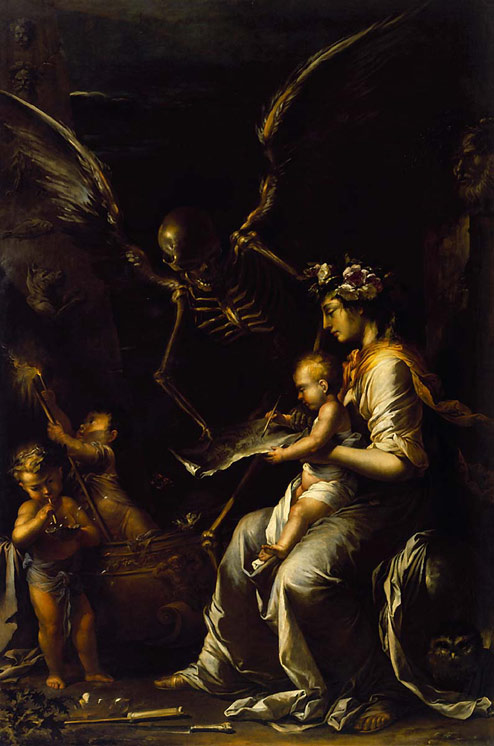
L’Umana Fragilita (Human Frailty, oil on canvas, 1656) by Salvator Rosa. Fitzwilliam Museum, Cambridge.
“O glorious day when I shall retire from this crowd, this turmoil, and join that divine council and assembly of souls” — Cicero
Cicero reflects on death as a natural and not to be feared part of life. One of his most famous passages reads: “Death is not a matter of sorrow, because it releases us from the prisons of the body and brings us to our natural rest. If death is an end to consciousness, it is like a deep and eternal sleep. If, however, the soul lives on, we have nothing to fear, for we will join those who have already passed.”
Here, Cicero expresses two possibilities for death: either it brings a peaceful, eternal sleep or allows the soul to join those who have passed before, both of which alleviate the fear of death. The first possibility, that death brings the end of consciousness and a restful, eternal sleep, presents death as a final release from the burdens of mortal life. In this scenario, time ceases for the individual, as their consciousness no longer experiences its passage. The second possibility, in which the soul lives on, imagines a continued existence where the soul joins the company of others who have passed, in a realm beyond the constraints of earthly time.
Building on this latter idea, Cicero envisions the soul departing from the mortal world and entering a “divine council” of virtuous souls. He writes: “O glorious day when I shall retire from this crowd, this turmoil, and join that divine council and assembly of souls, and when I shall depart from this life to live with them!” In this vision, the soul is no longer bound by the physical limitations of the body or the linear progression of time. It enters a state of peace, free from the turmoil of earthly life, and becomes part of an eternal realm where time as we know it no longer applies. This divine assembly offers a vision of death as a transition into a timeless existence, where the soul continues without the burdens of decision-making, moral struggles, or the passage of time.
This vision aligns remarkably well with modern cosmological theories, particularly the Block Universe model, which arises from Einstein’s theory of relativity. In this model, time is viewed not as something that flows but as a static dimension. The Block Universe posits that past, present, and future all exist simultaneously within a four-dimensional spacetime continuum. Every moment—whether in the past, present, or future—exists eternally and is as real as any other moment. The flow of time, as we perceive it, is an illusion generated by our consciousness. In this framework, time does not move; rather, we, as conscious beings, experience it as though we are moving through it.
When Cicero speaks of the soul’s release from the turmoil of earthly life and its subsequent joining with other souls, he touches on a concept that can be reconciled with the Block Universe. In his vision, the soul continues to exist, but it is no longer bound by the temporal constraints of human existence. It no longer perceives time as a sequence of moments passing one after another. Instead, the soul becomes part of an eternal now—much like the fixed moments in the Block Universe model. In this state, the soul experiences the peace of being embedded in time’s eternal structure without the torment of consciousness or the burden of decision-making.
In both Cicero’s philosophical framework and the Block Universe model, time continues to exist objectively, but for the individual, time’s significance vanishes with the cessation of perception. This alignment suggests that the end of time, in a subjective sense, is not the end of the universe’s temporal structure, but the end of an individual’s experience of time. The soul, in Cicero’s understanding, remains part of the universe, but without the active engagement of temporal consciousness.
What makes this comparison particularly compelling is the shift from seeing death as a terrifying end to perceiving it as a transition into a timeless existence. For Cicero, death frees us from the burdens of morality and decision-making—tasks that are so deeply tied to our experience of time. Similarly, in the Block Universe, once consciousness fades, we are no longer participants in the dynamic flow of time but become part of the static, eternal structure of existence.
In essence, both Cicero and the Block Universe propose that the end of time is not a destruction or cessation of reality, but rather the cessation of our perception of time’s flow. While the soul may continue to exist in an ethereal state, it does so in a manner detached from the sequential experience of time. Thus, the soul’s existence in this eternal now is one of peace, free from the weight of decisions and the suffering caused by the relentless march of time.
Through this lens, we might reinterpret Cicero’s contemplation of death and the soul’s journey as a profound early philosophical insight into a truth later echoed by modern physics: the possibility of eternal existence within a timeless framework, where the flow of time is merely a byproduct of human perception. In death, the soul may continue within the Block Universe—no longer tormented by the passage of time, but instead, eternally present in the cosmic order.
Works Relied Upon While Preparing This Essay:
Cicero, Marcus Tullius. De Senectute. Translated by William Armistead Falconer. Harvard University Press, 1923.
Cicero, Marcus Tullius. Tusculan Disputations. Translated by J. E. King. Harvard University Press, 1927.
Einstein, Albert. Relativity: The Special and the General Theory. Translated by Robert W. Lawson. Crown Publishers, 1961.
Hawking, Stephen. A Brief History of Time: From the Big Bang to Black Holes. Bantam Books, 1988.
Rovelli, Carlo. The Order of Time. Riverhead Books, 2018.
The Human Condition (oil on canvas, 1933) by Rene Magritte (1898-1967). National Gallery of Art, Washington, D.C.
In my previous essay, I explored the notion that all possibilities, all moments, and all realities exist simultaneously within a vast, interconnected multiverse. This concept, while intellectually stimulating, takes on a profound emotional resonance when applied to personal experiences—whether contemplating career disappointments, unrequited love, or any other singular failure or life regret (the latter being the most futile and barren of life’s emotions).
For example, when faced with the pain of unrequited love, it is comforting, albeit briefly, to consider that in another universe, within one of the countless alternative realities encoded within the infinite expansion of π, that love was indeed requited. In that universe, the longing is fulfilled, the relationship blossoms, and the story takes a different, happier course. In that reality, whatever I was lacking in the eyes and heart of the other was not missing. This thought can provide solace, suggesting that somewhere, in some version of reality, the relationship blossomed, at least initially.
However, this comforting idea quickly gives way to a more troubling realization: if the multiverse contains all possible versions of me and my life, and if time itself is a dimension where past, present, and future coexist, then these possibilities are not just spread across different universes—they are all occurring simultaneously. There must be a multiplicity of universes where I am an unkind, unfortunate, or even malignant version of myself, embodying traits and actions that I would find abhorrent morally, philosophically, ethically, and physically in this reality, and they exist now, just as the kinder, better versions of myself do. In such universes, the unrequited love would be more than amply justified.
The Multiverse and the Dark Mirror
The multiverse, in its infinite possibility, is not merely a repository of our dreams fulfilled but also of our nightmares realized, all existing within the single, eternal now. For every universe where I am kinder or more fortunate, there must exist countless others where I am less so. These darker versions of myself reflect all the potential for cruelty, malice, and misfortune that I might carry within me, amplified and realized in ways that are profoundly unsettling, and they are just as real as I am in this moment.
This raises significant moral and philosophical questions. What does it mean for me, here and now, if these other versions of myself exist elsewhere, simultaneously? Am I, in some way, responsible for them? Do they diminish the value of the person I strive to be in this reality, knowing that versions of me exist that embody the very qualities I abhor?
Confronting the Other Selves
To confront these darker selves is to engage in a kind of ethical introspection. If I acknowledge that these malignant versions of myself exist in the same temporal space as I do, I must also confront the reality that the potential for such traits exists within me, even if they are not realized in this particular universe. This recognition forces a deeper reflection on the choices I make and the values I uphold. It challenges me to consider what it means to be a “good” person when the multiverse ensures that somewhere, at this very moment, I am not.
Moreover, this reflection touches on the concept of identity. How much of who I am is defined by my choices, and how much is determined by the random twists of fate that, in another universe, could have led me down a darker path? The block universe theory suggests that the line between who I am and who I could be is much thinner than we might like to believe, with all these versions of myself existing simultaneously.
The Crisis of Unfulfilled Potential
After confronting the darker versions of myself, another, perhaps equally unsettling realization emerges: the crisis of unfulfilled potential. If there are better versions of myself in the multiverse—versions that have succeeded where I have failed, who have become the person I wish to be—why am I unable to align with them here and now? Why can I not bridge the gap between who I am and who I could be?
This crisis forces me to confront the reasons why I fall short of these better versions of myself in this reality. It challenges me to understand why, despite the infinite possibilities of the multiverse, I am bound by the limitations of this particular existence. Is it a matter of circumstance, fate, or something within myself that holds me back? The knowledge that better versions of myself exist elsewhere only amplifies the sense of failure and inadequacy I might feel in this reality.
Reconciling with the Multiverse Self
Reconciling with the fact that I am not the best version of myself here and now requires a deep and difficult reflection. It demands that I acknowledge my limitations and the factors that prevent me from achieving the potential I know exists within me. This is not an easy task, as it involves confronting uncomfortable truths about my abilities, decisions, and the circumstances that shape my life.
Moreover, this crisis forces me to grapple with the idea that, despite my best efforts, I may never fully align with those better versions of myself. The multiverse, in its infinite complexity, suggests that there are always paths not taken, choices not made, and potential left unrealized. This can lead to a sense of existential despair, knowing that no matter how hard I strive, there are versions of myself who have succeeded where I have failed, who have become the person I wish to be.
The Ethical and Philosophical Implications
The existence of these darker and better selves also has ethical and philosophical implications. If I am aware of these versions of myself that exist elsewhere, does this knowledge impose a greater responsibility on me to strive for improvement? Or does it merely highlight the futility of such efforts, knowing that I am constrained by the limits of this reality? The awareness of my shortcomings, in light of the better versions of myself, can be both motivating and paralyzing, creating a tension between aspiration and resignation.
This tension reflects a deeper philosophical struggle: the conflict between the ideal and the real, between who I am and who I could be. It challenges me to reconsider what it means to live a meaningful life in a universe where infinite versions of myself exist, each navigating different paths, making different choices, and realizing different potentials.
Embracing the Complexity of the Multiverse Self
In contemplating these better and darker realities, I am reminded of the complexity of existence within the multiverse and block universe. The comforting thought that somewhere, my love is requited, the unsettling knowledge that elsewhere, I am capable of things I would rather not imagine, and the crisis of knowing that better versions of myself exist but elude me in this reality—all force a more nuanced understanding of what it means to exist in a timeless, all-encompassing reality.
This reflection brings to mind Friedrich Nietzsche’s profound directive: “What does your conscience say? — ‘You shall become the person you are.'” Yet, in confronting the multitude of selves that exist within the multiverse, I am also reminded of Jean-Paul Sartre’s existential assertion: “Man is condemned to be free; because once thrown into the world, he is responsible for everything he does. It is up to you to give [life] a meaning.”
Together, these insights capture the duality of my existential challenge: the imperative to become the best version of myself, as Nietzsche suggests, and the burden of freedom that Sartre describes—the responsibility to define and realize that version amidst infinite possibilities. It is not merely about recognizing these potential selves but actively striving to shape the one that truly aligns with who I am meant to be.
Ultimately, the exploration of these themes leads to a humbling realization: that within the infinite possibilities of the multiverse, all existing simultaneously in the block universe, I am not simply a passive observer but an active participant in a reality that is as much defined by what I am as by what I could be. This awareness, coupled with the existential challenges posed by both Nietzsche and Sartre, should guide my actions and choices in this universe, encouraging me to strive for the best version of myself, even knowing that other, darker, and better versions exist. In doing so, I contribute to the ongoing discourse on existence, identity, and morality—both in this reality and, perhaps, in others.