Standing Caliph Dinars and Prudentia

Reverse of the portrait medal of Scaramuccia di Gianfermo Trivulzio, Bishop of Como, and Cardinal (died 1527). Cast bronze, 5.6 cm diam., wt. 56.84 g., c. 1517. The reverse features an allegorical figure of Prudence, who holds a mirror in her left hand and compasses in her right. The mirror symbolizes not vanity but the wise man’s capacity to see himself honestly, and the compasses in her other hand represent measured judgment. The dragon at her feet represents a substitution for the serpent referred to in Matthew 10:16: “Be ye wise as serpents.” The Metropolitan Museum of Art, New York. From the Robert Lehman Collection, 1975.1.1253. (public domain)

A little over a year ago, I complained to my friend Dr. JW about the imprudent tendency of all too many archaeologists and historians to do too much with too little. As I recall I may have actually bellowed in exasperation at the time that these scholars fabricate too much history out of wisps of little more than air. For in truth, the paucity of material available to many archaeologists and historians is so slight, and the edifices that they build upon the available material is so seemingly profound, that Prudence herself, our auriga virtutum (charioteer of the virtues), cannot but be offended.

I entered into the discussion with Dr. JW after having read several dozens of scholarly articles related to Slavic pre-history and early Slavic history. It was not surprising to see how ideology affected the historical and archeological scholarship, but it was surprising to see how compromised much of the work was and how it was negatively impacted by other more mundane influences. Such influences, as near as I could divine, were related to ego (look at me!), the need to publish (publish or perish), and/or the desire to publish (agenda driven) even when the evidentiary material did not support the conclusions ultimately being proffered.

Time and time again I read articles where all the factual statements were true, but the conclusions drawn from those facts bore little to no relation to those facts. Similarly, I read articles where some of the factual statements were true, and some were mostly true, and some gray, and then some were outright suppositions. And finally, I read articles where scholars of great authority engaged in combat with other scholars of great authority … and its seemed to me that the weapons were nothing other than opinion for I noted that facts and evidence were nowhere to be seen. Such combat must be exhilarating but it is certainly not illuminating.
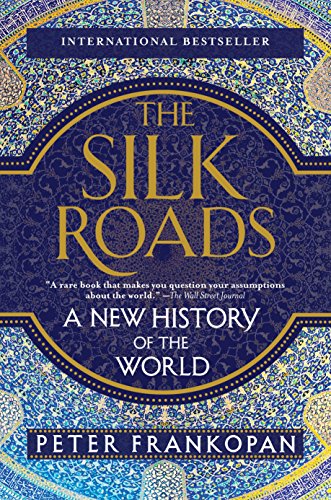
Frankopan’s The Silk Roads: A New History of the World

This post is occasioned by my reading, or rather by my decision to stop reading, Peter Frankopan’s The Silk Roads: A New History of The World. I should have known better than to have engaged a “popular history,” an international best seller at that, endorsed by The Wall Street Journal as “[a] rare book that makes you question your assumptions about the world.” I find that, rather than questioning my assumptions about the world, I am questioning my assumptions about the competency of the scholar-author of this particular work. Mr. Frankopan, whom I suspect is a very able scholar generally, has failed in the specifics of this work. Although the work is engaging on the macro level, and the broad narrative and theme is both agreeable and correct, it is unacceptable on the micro level to such a degree that he has offended my scholarly sensibilities to such an extent that I would implore him to be more prudent when attempting such popular works in the future. I shall provide a few examples in support of my position.

Frankopan , on page 82, when discussing the Muslim conquest of the Middle East, acknowledges that “[t]he sources for this period are notoriously difficult to interpret because they are complicated and contradictory, but also because many were written long after the events.” That was a very prudent acknowledgement and should have guided his writing and presentation throughout the chapters. [See James Howard -Johnston’s Witnesses to A World Crisis: Historians and Histories of the Middle East in the Seventh Century for a superb exploration and autopsy of the complexity of this topic.] But, alas, it did not. Rather, we encounter sentences such as this on p. 83: “In fact, it appears that the Arab conquests were neither as brutal nor as shocking as the commentators make out, for example, there is little evidence of violent conquest in the archaeological record” and these equivocating muddles of sentences on p. 84: “The fact that new churches were built at the same time, in North Africa, Egypt and Palestine, suggests that a modus vivendi quickly established itself where religious tolerance was normative. This seems to have been echoed in lands taken from the Sasanians, where at least to start with Zoroastrians were either ignored or left alone. In the case of Jews and Christians, it is not impossible that this was even formalised.” From my vantage point, the need to pepper an analysis with the words “suggests that,” “seems,” and especially “it is not impossible that” make for a profoundly shoddy historical analysis. I, myself, could write some wildly interesting historical works if I seasoned them with “it is not impossible that.”

The above examples – just a few of many that the author included in the relevant chapters – were intended, I believe, to set an appeasing tone for a gentle Muslim conquest as a theme to comfort the reader. But it was the sin of creating history from wisps. Fortunately, Frankopan did atone for this sin by including, here and there, information contradicting the theme such as that found on p.89: “The cities of Central Asia were picked off one by one, the loose links between them sealing their downfall: without an organizational structure to co-ordinate defences, each awaited its fate in turn. The inhabitants of Samarkand were pressured into paying a huge sum of money for the Muslim commander to withdraw, though in time it had to surrender anyway. At least the city’s governor was spared the fate of Dewashtich, ruler of Panjikent (in modern Tajikistan) who styled himself King of Sogdia; he was deceived, trapped and crucified in front of his own people. The governor of Balkh (in what is now northern Afghanistan) suffered a similar fate.” So much for the gentle Muslim conquest. Of course, I will not abandon a book for a theme if the author is kind enough to include, and not suppress, evidence, contradictory to the theme.

So, why, dear reader, have I abandoned Frankopan’s tome? The answer is simple: imprudence. On page 86, he imprudently embraced a numismatic speculation that I, and I believe all knowledgeable scholars, adjudge to be wildly provocative and simply beyond supportable. Here are the relevant arguments. First, the offending embrace from Mr. Frankopan:

“After the Caliph began to issue coins with the legend ‘There is no God but God alone; Muhammad is the messenger of God’ in the early 690s, Constantinople retaliated. Coins were struck which no longer had the image of the Emperor on the front (the obverse), but put it on the reverse instead. In its place on the obverse was a dramatic new image: Jesus Christ. The intention was to reinforce Christian identity and to demonstrate that the empire enjoyed divine protection.

In an extraordinary development, the Islamic world now matched the Christians like with like. Remarkably, the initial response to the issuing of coins with Jesus and the Emperor on them was to respond with an image on coins minted for a few short years of a man in the parallel role to that played by Jesus – as the protector of the lands of the faithful. Although this image is usually presumed to be that of the Caliph ‘Abd al-Malik, it is entirely possible that this is none other that Muhammad himself. He appears in a flowing tunic, which a lustrous beard and holding a sword in a scabbard. If this is the Prophet, then it is the earliest-known image of him, and remarkably one that those who knew him during his lifetime were aware of and saw for themselves. … The coins did not stay in circulation long, for by the end of the 690s the currency circulating in the Islamic world was completely redesigned: all images were removed and were replaced by verses from the Quran on both sides of the coin.”

Above is a handsome representation of the Standing Caliph type from the collection of the American Numismatic Society. According to an in-depth study entitled The Standing Caliph Coins of Jerusalem published in 2015 by Ingrid and Wolfgang Schulze, Standing Caliph coins are characterized by an obverse that features the standing caliph with a sword and a reverse featuring a column on steps or an m (the Byzantine mark of value for 40 nummi). As of 2015, there were 18 mint names identified for the Standing Caliph coins, which included the following: ‛Ammān (Philadelphia), Anṭākiya (Antioch), Ba‛albak, (Heliopolis), Dimashq (Damascus), Ḥalab (Aleppo), Ḥarrān (Carrhae), Ḥimṣ (Emesa), Īliyā (Jerusalem), Jibrīn, Ludd (Diospolis), Ma‛arrat Miṣrīn, Manbij (Hierapolis), Qinnasrīn (Chalcis), Qūrus (Cyrrhus), al-Ruhā (Edessa), Sarmīn, Tanūkh (a tribal name) and Yubnā (Yavne). Additionally, there are countless mintless types and it is sometimes doubted whether mint names written on the coins point to an actual mint place.

Returning to the controversy, the notion that the standing figure on the coin type may have been Muhammad is, at best, generously described as a minority position within the scholarship. It is, perhaps, more accurately described as wild speculation. In either event, it was imprudent to present the position so prominently in a popular history outside of an endnote, where such a minority position or speculation would more properly reside.

So, you may ask, how did scholars arrive at the position that the image was a Standing Caliph and not the Prophet? Below, I share, in rather more detail than usual, the positions of the the proponents of both positions. I begin with Writing the Biography of the Prophet Muhammed: Problems and Solutions, by Robert Hoyland. Mr. Hoyland argued in his tract that the standing image was the image of the Prophet:

“This is generally assumed to be a representation of the caliph himself and
so the coins are known as the ‘standing caliph’ coins. However, there are
a number of reasons to doubt this:

Firstly, it ignores the war in visual and verbal propaganda going on between Justinian II and ‘Abd al-Malik and the wider issue of the use of religious images and slogans that was being hotly debated at this time.  If, in response to Justinian’s demotion of himself to the reverse of Byzantine coins in favour of Christ’s effigy on the front, ‘Abd al-Malik had merely put this own image on the front of Muslim coins, it would have seemed a very feeble reply in the view of Christians; rather, the obvious move for him would have been to put an image that would challenge that of the image of Christ, which could only be that of the Prophet Muhammad himself. The very dramatic nature of these changes, their closeness in time, their evidently polemical overtones and enormous propaganda impact (coins circulate very widely) at a time of great tension (in particular, the Byzantines suffered a major defeat at Sebastopolis in 73/692–93) make it essential for these two innovations to be considered together.

Secondly, it ignores the context of the Arab civil war of 685–92 in which religion had played a major role for diverse groups clamouring for greater social justice, and ‘Abd al-Malik saw the chance to steal their thunder and to heal the divisions among the Muslim community by putting Islam at the heart of the state. Henceforth, the name of the Prophet Muhammad, which had been absent from all state media (i.e. administrative documents, monumental inscriptions, etc.), became de rigeur  on every official text and became pretty much standard in epitaphs and graffiti. This makes it unlikely that the image on the front of  ‘Abd al-Malik’s new coins was himself, which would have been condemned by Muslims as an imitation of infidel kings, and much more likely that it is a religious personage, again most obviously Muhammad himself.

Thirdly, the iconography of the person on ‘Abd al-Malik’s coinage is closer to that of Justinian II’s Christ figure than to an emperor figure: both have long, flowing hair and are bearded, and both are without headgear (i.e. no turban or crown).
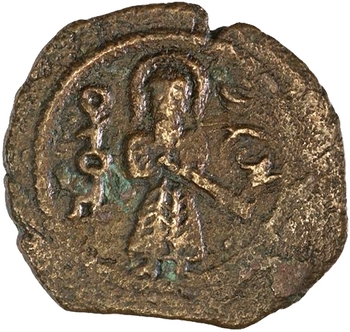
Fourthly, the standing-figure coins of Jerusalem, Harran and al-Ruha (Edessa) do not, unlike those of other mints, name the Prophet Muhammad and  the Caliph ‘Abd al-Malik, but only mention Muhammad.  As Clive Foss has remarked, ‘ever since the inception of portrait coinage in the Hellenistic period, the image and superscription had gone together, that is, the inscription names the figure portrayed . . . I know of no coin where the obverse inscription refers to someone different from the figure portrayed.'”

Mr. Hoyland’s arguments, though worthy of consideration at first blush, easily fall, when considered even momentarily. In 2010 Ingrid and Wolfgang Schulze did consider the arguments, and responded fairly, in an article published in The Numismatic Chronicle entitled The Standing Caliph Coins of al-Jazīra: some problems and suggestions. Here are the relevant portions of their response:

“There are still a number of unsolved problems concerning the iconography of the Standing Caliph coinage. The first question is, does the sword bearing person really represent the caliph or is it the representation of the governor of the jund where the coins were minted? In our opinion it is probably the caliph, ‘Abd al-Malik. There is a statue, found in Khirbet near Jericho, and now in the Rockefeller Museum in Jerusalem, and dated 720, showing the caliph in a similar way. Also, the caliph’s name is written on about half the coins. This suggests their designation as ‘Standing Caliph coins’ is correct. Sometimes the standing figure is regarded as the prophet Muhammad. We will come back to this question when discussing the coins of Harrân. On one obverse die of some coins of Sarmīn a certain Abd al-Rahman is named, but his identity is unknown.”

Thus, they acknowledged that the identification of the standing figure as Muhammad had been raised, and promised to address it, which they did as follows:

“In Harrân the use of the isolated Muhammad  is striking. Starting from the idea that ‘whenever an inscription with a name accompanies the image, it identifies the portrait’ Clive Foss and Robert Hoyland draw the conclusion that the ‘Muhammad’ coins struck in Palestine and Mesopotamia do not portray the caliph but the prophet Muhammad.

We do not agree with this suggestion. The consequence would be that one would have to interpret the figure on the coins bearing the name of ‘Abd al-Malik as the caliph himself and the ‘Muhammad’ coins as showing the prophet. How would one interpret the coin with the name of ‘Abd al-Rahman? Finally, how are the anonymous coins to be interpreted? Should we interpret the shahāda of the legend as a reference to the figure?

Proceeding from the premise that the design of the figure was ordered by the central administration in Dimashq, and this was followed in all the Standing Caliph mints, the figure must have had a uniform meaning. It is hardly imaginable that an identical picture on coins in daily use would have carried different messages.

Taking into consideration that about 50% of the Standing Caliph coins bear the name of ‘Abd al-Malik, we are all the more convinced that we have to regard the figure as that of the caliph. 

Nevertheless it is very odd to find Muhammad written twice on the coins of Harrân. It is also remarkable to see it written in different styles of Kufic. This could lead to the suggestion that Muhammad, written in standard Kufic, refers to the prophet, while Muhammad, written in unusual Kufic, refers to Muhammad b. Marwān, governor of al-Jazīra at that time. This interpretation can only be regarded as provisional.”

Tony Goodwin and Rika Gyselen, writing in Arab Byzantine Coins from the Irbid Hoard (London 2015), while consistently referring to the coin type as the Standing Caliph type, also addressed the issue. They wrote as follow :”For many years the Standing Caliph image has created considerable interest as it is our only record of the appearance of ʿAbd al-Malik. There has been much written about details of his dress. The question has also arisen from time to time of whether the image was based to some extent on the image of Justinian II on his gold solidi or on already existing depictions of the caliph. Given the legend naming the caliph which usually appears around the image there has been little doubt about the identity of the individual depicted. However, the coins of Jund Filastīn … never name the caliph and always have the obverse legend Muhammad Rasûl Allāh. Furthermore the images are very unlike those found on coins naming ʿAbd al-Malik, and at Yubnā there is a remarkable variety of images. In a study of the Yubnā mint Goodwin suggested that some of these could possibly be based on images of Christ or Muhammad, but more recently Foss has gone further and proposed that the figure depicted on Jund Filastīn coins probably is intended as Muhammad. He argued that where a coin has an image of an individual and a legend including a name, the two always match, so it is logical to regard the individual depicted as Muhammad. We do not know whether the proscription on depictions of the Prophet was in place at this early date, so Foss’ proposal is certainly not as far-fetched as it might at first appear” (pp. 36-37). It is worth noting, however, that Stephen Album, who wrote the Sylloge of Islamic Coins in the Ashmolean. Vol. I: the Pre-reform Coinage of the Early Islamic Period (2002) with Goodwin, and is perhaps the world’s foremost authority on Islamic coins, has no compunction whatsoever about identifying the image on the coins as the Standing Caliph and is not distracted by the argument as to whether the image may be Muhammed or Christ in his Checklist of Islamic Coins (3rd Edition, 2015)(see pp. 36-38).

This, given the lack of iconographical support for interpreting the image as being the Prophet, there really is little argument to support that the standing figure should be understood now, or was supposed to be understood at the time, as Muhammad. And it does compel the conclusion that it was imprudent to dedicate so much space outside an endnote, in a general work, for a mass audience, that Muhammad appeared on a coin when not only is the proposition highly debatable, but most unlikely.

Eumenes III and Citizens of the Sun Rise Against Rome

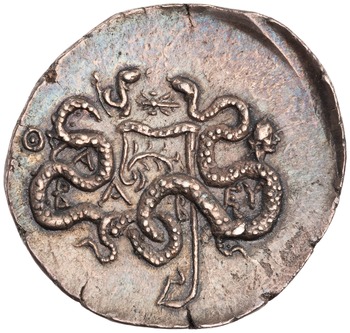
Reverse of AR cistophorus of Eumenes III of Pergamun featuring two coiled serpents between bow-case and bow. BA EY, a winged thunderbolt above the bow-case and a beardless male head in field right. ANS 1944.100.37579 American Numismatic Society

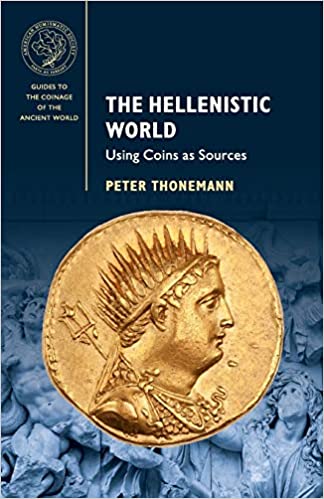
Today, I received and started reading another new book, which I am very much enjoying even if it does not have any notes and the photographs are deficient:

When I finish this work (which is one in a series, of which I obtained three volumes today), I will write a hopefully helpful review. In the meantime, I have been inspired to prepare a quick post about one of the coins referenced in the work on pp. 81-82.

And now, a few words about the Kingdom of Pergamum, Eumenes III, the Citizens of the Sun, their revolt against Rome, and the coin, which inspired this post.

The Kingdom of Pergamum (or Pergamon), in Asia Minor, was ruled by the Hellenistic Attalid Dynasty. The Attalid Dynasty was founded by Philitaerus, who ruled from c. 282-263 B.C. The Kingdom benefitted significantly in 188 B.C. under the treaty of Apamea, when the Roman Senate granted the Kingdom great expanses of territories from the just defeated Seleucid Empire.

Kingdom of Pergamum c. 188 B.C. under the Attalid Dynasty

In 133 B.C., King Attalus III bequeathed the Kingdom of Pergamum to the Roman people. What happened next is most extraordinary. Rome was in turmoil at the time the bequest was received in Rome, as it is believed to have been delivered while rioting and killings associated with the slaying of the tribune Tiberius Gracchus were occurring. It is likely that the Roman Senate did not turn its attention to addressing the bequest, and formally annexing the Kingdom, until 131 B.C. While the Senate in Rome dithered, however, in the Kingdom of Pergamum, a man named Aristonicus, who claimed to be of royal lineage (the son of Eumenes II), almost immediately proclaimed himself king as Eumenes III.

Although Eumenes III found no support in the major urban centers of Pergamum or Ephesus, he apparently found more than adequate support in many other cities and much of the periphery of the kingdom. Additionally, and most interestingly, he made a bold appeal to the poor and enslaved, which was well-received, as reported by Strabo:

“After Smyrna, one comes to Leucae , a small town, which after the death of Attalus Philometor was caused to revolt by Aristonicus, who was reputed to belong to the royal family and intended to usurp the kingdom. Now he was banished from Smyrna, after being defeated in a naval battle near the Cymaean territory by the Ephesians, but he went up into the interior and quickly assembled a large number of resourceless people, and also of slaves, invited with a promise of freedom, whom he called Heliopolitae [Citizens of the Sun]. Now he first fell upon Thyeira unexpectedly and then got possession of Appolonis, and then set his efforts against other fortresses. But he did not last long; the cities immediately sent a large number of troops against him, and they were assisted by Nicomedes the Bithynian and by the kings of the Cappadocians. Then came five Roman ambassadors, and after that an army under Publius Crassus the consul, and after that Marcus Perpernas, who brought the war to an end, having captured Aristonicus alive and sent him to Rome. Aristonicus ended his life in prison.” Strabo. Geography, Volume VI: Books 13-14. Translated by Horace Leonard Jones. Loeb Classical Library 223. Cambridge, MA: Harvard University Press, 1929, pp. 247-249.

The sources suggest that the attempt by Eumenes III and his Citizens of the Sun to remain independent of Rome required extraordinary efforts by Rome to suppress. Some scholars suggest Eumenes’ primary support may have come from areas with many former mercenaries, which may also explain why he was able to prevail for so long. Additionally, at least one reading of the sources suggest it took upwards of six to seven years for the Romans to quell the “revolt” and fully annex the kingdom as a province.

Regardless, what attracted my interest to this historical incident are the beautiful coins which were issued during Eumenes’ attempt to remain independent of Rome. The coins, called kistophoroi (latinized to cistorphorus) or basket-bearers comes from the obverse type, which features a snake crawling out of a wicker basket (a cista) encircled by an ivy wreath. These unusual coins were the main silver coins of many cities in Asia minor from c. 167 BC through the reign of Augustus. What is unusual about the cistorphori of Eumenes III is that usually the Attalid kings did not mark their issues to indicate that they were royal issues or which king issued them whereas Eumenes III marked his issues on the reverse to indicate that they were issued by him. Additionally, he marked his issues as to the mint location.

The full historical backstory of Eumenes III of Pergamum may be found on pages 47-53 in A History of Pergamum: Beyond Hellenistic Kingship by Richard Evans.

Silk Roads, Rabbit Holes, and Delphic Maxims

One of the books I am currently reading is Peter Frankopan’s The Silk Roads: A New History of the World. I have just begun the work and find it both interesting and irritating. Interesting in that it has much to impart to me and irritating in that too much of the information imparted is highly superficial. Fortunately, there are notes but, alas, they are endnotes rather than footnotes.

Additionally, the information contained in the notes is sparse. The upshot of the foregoing is that when I come across a provocative morsel of information, which occurs with frequency, I am compelled to leap headlong down the proverbial rabbit hole in search of enlightenment. For instance, the following tantalizing appetizer appeared on pages 8-9 of Mr. Frankopan’s tome:

 A Roman copy of a Greek statue of Seleucus I Nicator found in Herculaneum. Naples National Archaeological Museum.

“At Ai Khanoum in northern Afghanistan – a new city founded by Seleucus – maxims from Delphi were carved onto a monument, including:

As a child, be well behaved.

As a youth, be self-controlled.

As an adult, be just.

As an elder, be wise.

As one dying, be without pain.”

Being reasonably educated, I may claim general familiarity with Afghanistan, Seleucus, one of the Diadochi who fought for control of Alexander the Great’s empire after his death, and things Delphic; however, I may not claim any familiarity with Ai Khanoum or the particular Delphic maxim cited. Therefore, I immediately looked to the referenced endnote in hopes of being further educated about each of the foregoing as the main text provided only the tease outlined above and nothing more. Alas, a review of the endnote (number 24 in chapter 1) revealed that it only cited two works, one in French which suggested that it was apparently the repository of the original Greek inscription and the other apparently the repository of the English translation of the Greek inscription by F. Holt. The endnote provided no commentary to sate my appetite for context or illumination regarding the city, its founding, or the Delphic maxim.

Immediately putting the book aside, I fired up the mystical engine that facilitates my instantaneous access to sources of knowledge once unfathomable to my imagination, and within minutes I am able to begin to sketch out the missing context for the above tease from Mr. Frankopan.

Let’s begin our tumble down the rabbit hole with an anecdote recorded in an article appearing on the Biblical Archeological Society Website entitled Alexander in the East, which was written by Frank Holt, the translator of the Greek inscription cited in the note above:

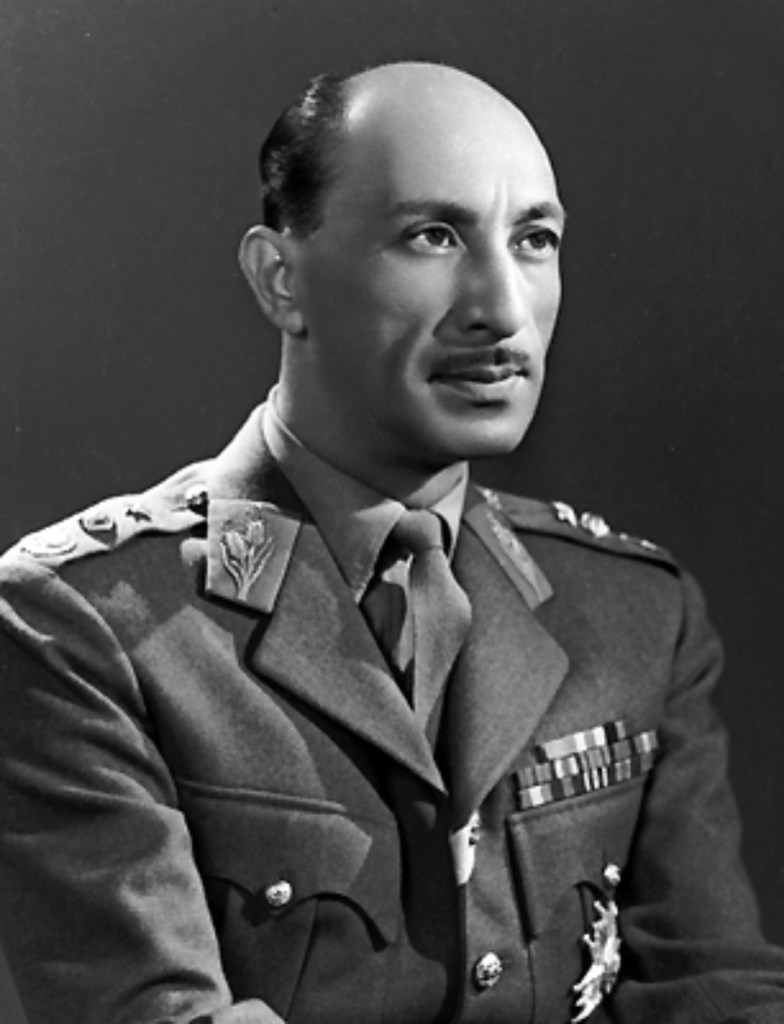
King Muhammad Zahir Shah of Afghanistan in 1963

“On a royal hunt in a remote corner of his realm [in 1961], King Muhammad Zahir Shah of Afghanistan spotted a strange outline in the dry soil between two rivers. Looking down from a hillside at this confluence of the Amu Darya (ancient Oxus) and Kochba rivers, the king could see traces of a well-planned ancient city: A wall and defensive ditch stretched from the hill to the Oxus, broken only by a gateway leading to the main street inside the settlement. The shapes of many large buildings bulged underneath the thin carpet of dirt, and at least one Corinthian column rose up like a signpost of Hellenistic civilization. Here, at last, was Alexander’s elusive legacy in the East.”

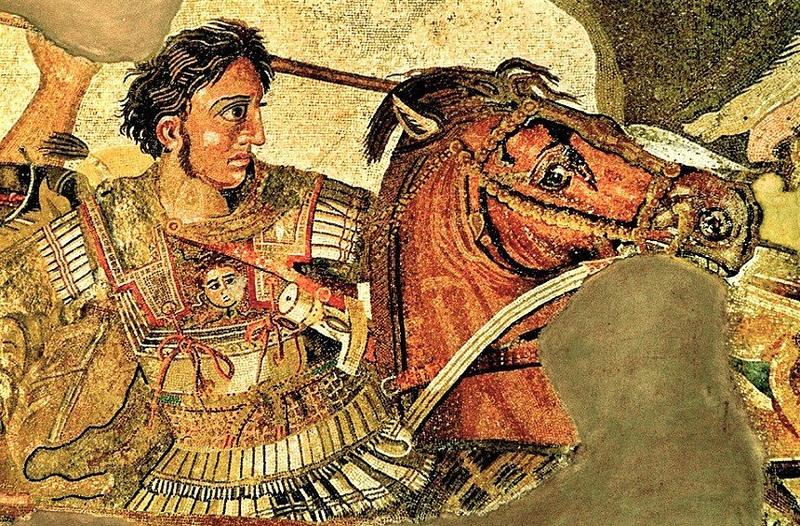
Alexander the Great

And what was this elusive legacy of Alexander’s in the East? Well, to answer this, here we do well to lift generously from another scholar, Jeffrey Lerner, and his article entitled Alexander’s Settlement of the Upper Satrapies in Policy and Practice, which provides ample context for the significance of King Muhammad Zahir Shah’s find:

“Alexander’s plans for maintaining his authority over the region involved the stationing of troops in a system of strategically placed cities and fortifications. A manifestation of Alexander’s authority that was particularly directed at the Upper Satrapies was the founding of settlements denoted by Greek authors as πόλις and by Roman authors as urbs.  Justin, for example, notes that Alexander established seven cities in Baktria and Sogdiana.  The problem with identifying Alexander foundations is not knowing the number of cities that he or his successors founded.  To date no site in Central Asia dating to the Hellenistic period has yielded an inscription bearing its name, whether in Greek or in any other language. For example, there are a number of cities whose foundations are attributed to Alexander, but apart from their names, there is precious little else known about them.”

Lerner goes on in his article to discuss Aï Khanoum, which had been the object of archaeological survey under the direction of French archaeologist Paul Bernard from 1965 until the 1979 Soviet invasion of Afghanistan:

“One particularly illusive foundation that has attracted a great deal of attention is that of Alexandreia on the Oxos, which Ptolemy places in Sogdiana, but whose whereabouts remain highly controversial due to Ptolemy’s placement of the city in relation to the rivers Oxos and Iaxartes, μεταξὺ δὲ καὶ ἀνωτέρω τῶν ποταμῶν.  This prompted Bernard to remark that the difficulty of reconciling the whereabouts of the city with its name is that it supposedly existed along the river Oxos, because as a general rule cities named after rivers are located directly on their banks. Apparently, Ptolemy erred in combining data on two different cities in the same description.  Nonetheless, several suggestions have been made as to its location. One holds that Alexander had founded the city at Termez on the north bank of the Oxos and, following its destruction by nomads, was refounded by Antiochos I as Antioch-Tarmita, but was subsequently refounded by the Greek-Baktrian king Demetrios I as Demetrias in the second century BCE.  The discovery of the site of Aï Khanoum in northeastern Afghanistan south of the river Oxos in Baktria led Bernard to conjecture that this region of Baktria was actually part of Sogdiana. To make this reconstruction work, he further speculated that upon the conquest of Marakanda by nomads, Aï Khanoum became the country’s capital with the Kokcha acting as the border between Baktria and Sogdiana.  Rtveladze has argued that Kampyrtepa was Alexandreia Oxiana.  Finally, the fortress of Takhti Sangin in modern Tajikistan on the north bank of the Oxos situated between Ai Khanoum and Termez has also been proposed as the ancient city. The site contains the so-called Oxos Temple in which an altar dedicated to the river god Oxos by a certain Atrosokes was recovered.”

A few lengthy paragraphs from Lerner are in order as to why Alexander would have settled some of his men on the farthest fringes of his conquests and how those men were selected and reacted to their selection:

“As a rule, Alexander employed a settlement policy in the regions of the far eastern corridor of the empire as one method of controlling these subjugated states. This practice, like many others that Alexander followed, was initiated by his father, although of course in Alexander’s case on a much larger scale. The role that cities played in achieving this goal was two-fold. First, many were so hastily constructed – literally in the matter of days – that they appear to have been little more than military colonies with names given them to connote a sense of grandeur, like ‘Alexandreia.’ Such was the case of Alexandreia Eskhate that served as no more than a frontier post. On the other hand, Alexander’s propensity for renaming existing cities, usually after himself, seems to have enjoyed longer lasting success, like Alexandreia Arachosia/Alexandropolis, and Alexandreia Areia among others.  The key to understanding Alexander’s achievement with this policy was the practice of creating colonies of heterogeneous populations, consisting in the vast majority of cases of indigenous peoples and Greek mercenaries, and only rarely Makedonians. Aside from serving as the king’s direct agents in the satrapies, these settlements also had the benefit of allowing Alexander to rid himself of dissatisfied elements in the army by stationing them in remote places as punishment for their insubordination.  Indeed prior to the rebellion of 325 BCE, Koenos states emphatically that Alexander had left behind in Baktria Greeks and Makedonians who had no wish to remain.  As a matter of course retired soldiers received land and quite likely economic support to set up a farm. The local population, however, by all appearances did not fare as well as their Greek and Makedonian counterparts. This is especially true in the case of a captured population, such as those who were taken prisoner at the Rock of Ariamazes.  The majority of those who had surrendered were given to the newly arrived settlers as slaves of the six towns situated near Alexandreia Margiana.  No matter how imperfect this policy of colonizing the conquered regions in the Upper Satrapies may have been in hindsight, it did provide some measure of control, while also safeguarding communication routes, and the king’s borders. The method of founding new cities, deploying garrisons in large old cities, coupled with the creation of military colonies was to a degree based on Alexander’s policy of integration, even if it was compulsory. Yet the garrisons appear to have been generally small, ranging from a few dozen to several hundreds. The overall effect of this policy was that it served as the basis of contact between peoples and the resulting cultural interaction that might otherwise have not occurred.

Throughout his campaign in the further east Alexander established military settlements that later became cities and renamed cities after himself, though the locations of each remains controversial. Yet the veterans he left behind were hostile to his intentions and revolted in 325 and 323 BCE.  For those who rebelled wanted no part in living on the fringes of the known world. Rather they passionately desired to return to a polis lifestyle replete with Greek institutions and a citizenry who shared similar values as opposed to the drab settlements in which they found themselves as just one constituent body in an otherwise mixed population. The so-called cities that Alexander constructed in less than three weeks could in no way resemble cities like Aï Khanoum of the future, for they were the products of the next period.  Certainly, the numbers of these veterans had seriously declined especially after the revolt of 323 BCE, in which they found themselves a dwindling minority.  They were aliens in an alien world. While they helped conquer this part of Alexander’s kingdom, they had no desire to rule it. Nonetheless, the arrangement that Alexander had established by the time of his death generally held firm as Makedonian supremacy throughout the empire existed without any serious challenges, save among the Makedonian generals themselves. The wars of the Diodochi had little effect on the indigenous populations of the empire as this was left to those charged with administering it, particularly the satrapies in the further east.”

All the foregoing suggests, therefore, that Aï Khanoum, attested in the archaeological survey as a splendid Hellenistic city in its heyday (more on this below), was likely “founded” by Alexander in a perfunctory manner with, at best, slightly disaffected veterans from his campaigns. Whether it was founded from scratch or on a pre-existing village that was simply renamed is unclear to me at this stage of my reading. However, it is clear, that after Seleucus acquired his mastery of much of Alexander’s empire, including the Upper Satrapies which included Aï Khanoum, the city acquired a mint (always of interest to this numismatist) and he invested in the city’s development.

At this point, we may return to the ever so brief snippet from Mr. Frankopan which began this entire journey, as the larger context is now set, for the more specific illumination which is now to be provided by an extract from the earlier article cited by Mr. Frank Holt:

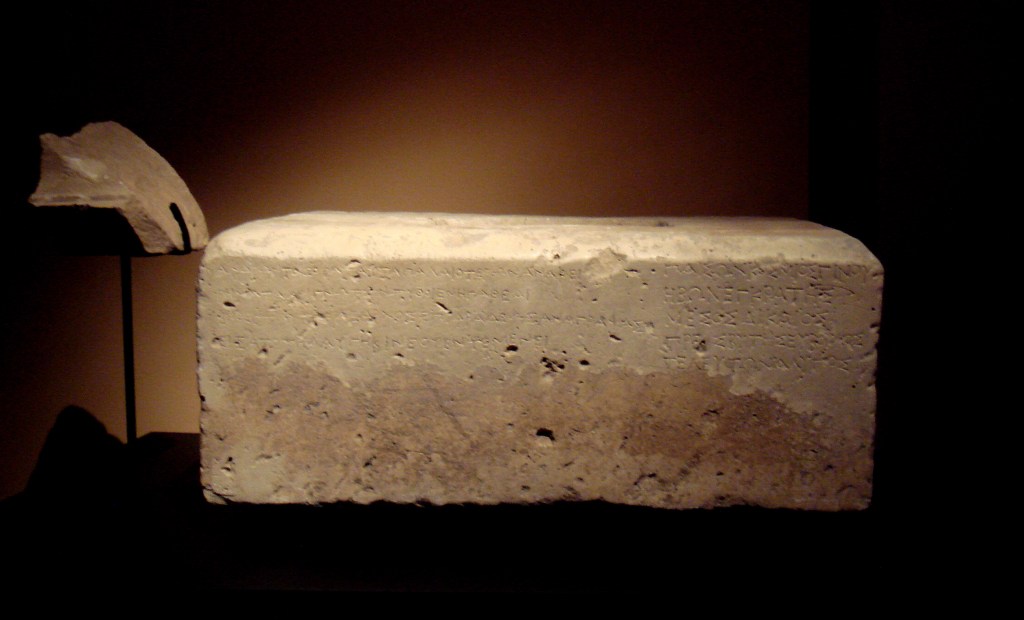
Funerary monument in the tomb of Kineas in northern Afghanistan at Ai Khanoum upon which the Delphic Maxim Cited in this Post is Inscribed.

“The Greek founder of this colony [Ai-Khanoum], which may have been called Alexandria Oxiana, was a man named Kineas, whose fourth-century B.C. shrine and tomb stood in the heart of the city. Kineas may have been one of Alexander’s soldiers, sent to settle this strategic fortress on the frontiers of Bactria. There are indications of an attack on the site soon after Alexander’s demise, perhaps part of the disturbances that took place when Greek settlers attempted to abandon Bactria. Fifty years later, under the aegis of the Seleucid dynasty, a major building phase began. True to Greek cultural traditions, the later citizens of the city enjoyed a large theater, a gymnasium with a pool, and quantities of olive oil and wine. Papyrus for writing was transported from Egypt.

These ancient Greeks built large, luxurious private homes and a great sprawling palace. Their Greek names and political titles appear on tombstones and government records. To preserve Greek values in this alien land, an Aristotelian philosopher copied the Delphic Maxims in Greece and carried them all the way to Bactria. An inscription found at Ai Khanoum explained to the colonists that these maxims were the wise counsel of earlier Greeks as codified by priests at the sacred site of Delphi. Their closing lines convey the idea of this Hellenic creed ‘blazing from afar’:

As a youth, be self-controlled.
As an adult, be just.
As an elder, be wise,
As one dying, be without regrets.”

Mr. Holt makes passing reference above to how the Delphic maxims inscribed on the funerary monument, illustrated above, found there way to the city and the shrine dedicated to Kineas. I note that the funerary monument includes the following inscription on it, explicitly explaining how the Delphic maxims came to be there:

“These wise commandments of men of old- Words of well-known thinkers – stand dedicated in the most holy Pythian shrine. From there Klearchos, having copied them carefully, set them up, shining from afar, in the sanctuary of Kineas.”

Thus, a gentleman name Klearchos traveled from the holy Phythian shrine, the temple of Apollo at Delphi, where he copied the maxims, to Ai Khanoum, to have the maxims engraved on a funerary stone. As to the Delphic maxims, the words of well-known thinkers, that would be another entire post!

Finally, if you have the time and access to the Scientific American, I recommend the following article for more background on this city and its archaeological survey:

Bernard, Paul. “An Ancient Greek City in Central Asia.” Scientific American, vol. 246, no. 1, 1982, pp. 148–159. Another recommended article is linked in the button below and explores, in depth, the literature through 2015.

I also recommend the following American Numismatic Society lecture by Michael Alram (“Money and Power in Ancient Bactria”) which surveys the numismatic history of Bactria, and in a number of places, discusses the coinage found at Ai Khanoum:

Michael Alram: “Money and Power in Ancient Bactria”

Recommended Reading: