

Preface
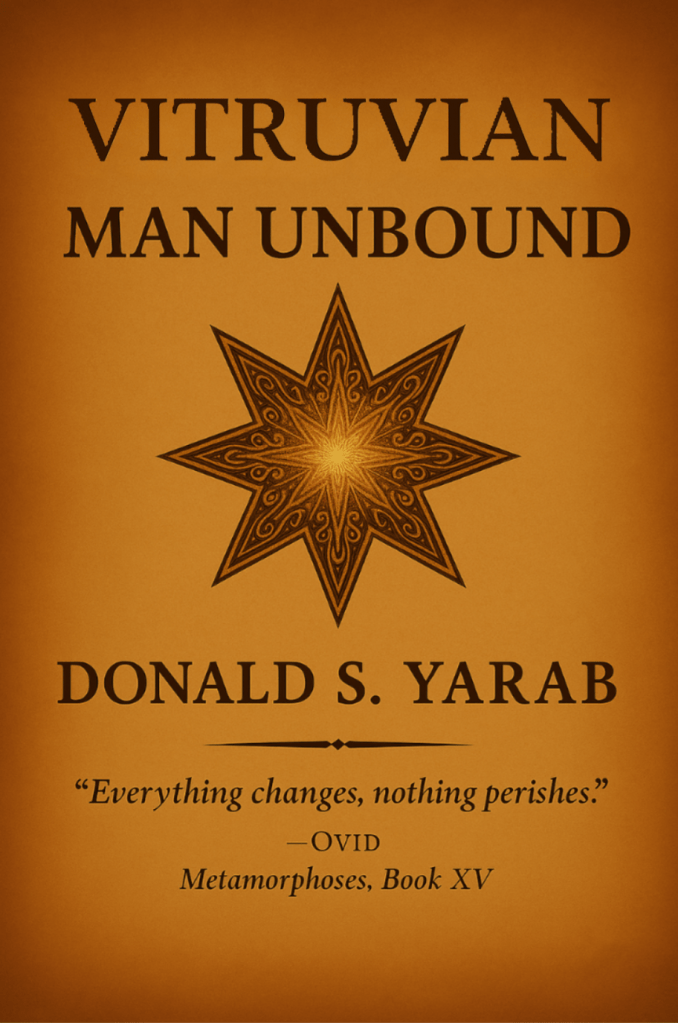
Whether its effect is ultimately salutary or merely a noble failure, Vitruvian Man Unbound remains among the most rewarding efforts, or perhaps conceits, I have undertaken. Its emendations and transformations were—like its central figure—immeasurable (and likely will continue), and its gestation period nothing short of elephantine.
The poem’s inspiration emerged from an unlikely constellation of influences: a Mesopotamian clay tablet inscribed with a circular map of the known and imagined world; Leonardo da Vinci’s iconic Vitruvian Man; Albert Camus’ existential meditations in The Myth of Sisyphus, whose vision of conscious perseverance became, in this poem, a point of departure rather than conclusion; and recent explorations in theoretical physics, particularly through Carlo Rovelli’s various poetically written works on diverse topics in physics and Tom Siegfried’s contemplations on the multiverse.

The ancient Mesopotamian map—ringed by a “bitter river” and annotated with realms of myth and marvel—initiated a chain of associations: from circular geometry to π, from π to infinity, from infinity to the concept of an ever-expanding circle that might, paradoxically, invert upon itself. This led me to contemplate Leonardo’s Vitruvian Man, a figure enclosed within perfect geometry yet suggesting boundless potential. What would happen, I wondered, if that containing circle began to expand? What lies beyond the circle?

A study of ideal human proportions based on Vitruvius, it symbolizes the harmony between man and cosmos—later reimagined in Vitruvian Man Unbound as a figure yearning to transcend those very bounds.
The poem thus became a meditation on limits—mathematical, philosophical, spiritual—and on the impulse to transcend them. It is also an awakening voice—the imagined consciousness of da Vinci’s ink-bound figure, suspended between square and circle, flesh and form, number and soul. What begins as a monologue of emerging consciousness becomes, over thirteen movements, a metaphysical odyssey through proportion and paradox, art and love, measure and mystery.
On the Structure and Themes of the Poem
Vitruvian Man Unbound is presented as a continuous, structured poetic cycle in thirteen sections. Though it may be read as one long unfolding arc, each section can be approached individually, functioning as a discrete meditation on some aspect of becoming, limitation, or transcendence.
- The measured self and its entrapment in form (Sections I–IV)
- The emergence of consciousness, longing, and imagination (Sections V–VI)
- The dissolution of boundaries—physical, geometric, metaphysical (Sections VII–IX)
- The absorption of memory, history, and collective soul (Section X)
- The confrontation with doubt and the paradox of being (Section XI)
- The embrace of paradox as path to freedom and renewal (Sections XII–XIII)
The voice is intimate and reflective, at times philosophical, at times lyrical. It is, above all, a journey of unfolding: from the measured to the immeasurable, from containment to co-creation.
Names, Figures, and Concepts
Vitruvius
Marcus Vitruvius Pollio (1st century BC), Roman architect and engineer, whose De Architectura proposed that the ideal structure—temple or body—should reflect proportional harmony. He regarded the human body as a model for universal order, inspiring da Vinci’s Vitruvian Man. In the poem, he represents the originary impulse toward order and the binding of form.
Euclid
Greek mathematician (fl. c. 300 BC), whose Elements formalized axiomatic geometry. His presence in the poem marks the introduction of reasoned space, logical proof, and the classical foundations of architectural and cosmic order. His geometry is the poem’s first boundary.
The Circle and the Square
Symbols both architectural and philosophical: the circle as divine, infinite, perfect; the square as earthly, finite, and rational. The tension and unity between the two—most famously reconciled in da Vinci’s figure—structure the early and middle arcs of the poem. They become both literal containment and metaphysical metaphor.
Leonardo da Vinci
(1452–1519), the polymath whose Vitruvian Man draws Vitruvian proportions within geometric bounds. He is “The Master” within the poem, whose ink creates the narrator’s form. His act of artistic generation echoes divine creation. Yet, like all creators, he must eventually recede, and his fading enables the protagonist’s awakening.
Melzi
Francesco Melzi (1491–1570), Leonardo’s devoted pupil, charged with preserving his master’s legacy. In the poem, he appears briefly yet meaningfully, representing both fidelity and the sorrow of watching a genius fade.
The Muse
A figure glimpsed in one of Leonardo’s sketches, deliberately rendered with gender ambiguity to honor multiple dimensions of identity and desire—the artist’s, the poet’s, and the reader’s. This presence stirs longing and awakens an emotional dimension in the speaker. The muse is not merely an object of desire, but a catalyst for transformation: their unattainability teaches the Vitruvian Man the ache of love, the sweetness of loss, and the realization that beauty transcends all fixed proportion. This unrequited love, reminiscent of the nightingale’s devotion to the unresponsive rose in ancient fables, becomes the crucial spark that initiates the figure’s journey from structure to soul, from ink to aspiration. It is through learning to love without expectation of return that the Vitruvian Man begins to transcend his geometric constraints.
Scientific Concepts: Quantum Mechanics, Relativity, and Cosmology
Beginning in Sections VII through IX, the poem integrates motifs from modern physics, influenced by Carlo Rovelli’s explorations of time and quantum reality and Tom Siegfried’s work on multiverse theory. The dissolution of stable form recalls quantum indeterminacy; the transformation of energy and space-time reflects principles of relativity and entropy. Ideas such as the collapse of the wave function, cosmic inflation, and the heat death of the universe are woven through metaphoric language, not as scientific proofs but as poetic echoes of our deepest metaphysical questions.
The speaker’s dissolution into “stardust,” his sense of “quarks” and “coding finer than the finest veil,” and his reconstitution within the universe mirror not only the physical processes of matter but the philosophical implications of nonlocality, relationality, and the disappearance of the observer. These concepts shape the soul’s journey as it expands from individual to cosmic.
The Golden Ratio
An aesthetic and mathematical constant (~1.618), the “divine proportion” found in nature, architecture, and Renaissance art. In the poem, it appears as both blessing and boundary: a structure of balance, yet one that cannot reach beyond the sacred irrationality of love or mystery.
Temporal Resonance with The Shimmering Absence
Though conceptually initiated before my work on “Meditations on the Divine Absence,” the final revisions of Vitruvian Man Unbound occurred either contemporaneously with or following those meditations. This temporal twinning created a productive dialogue between the works—the apophatic theological explorations in The Shimmering Absence subtly informing the cosmic transcendence in Vitruvian Man Unbound. Where one explores the ineffability of the divine through negation and unknowing, the other charts a journey from geometric containment to cosmic liberation. Yet both arrive at similar insights: that limitations are not obstacles to transcendence but necessary conditions for it.
A Note on the Poem’s Resolution
The poem resolves in a synthesis where limitation and freedom no longer stand as opposites but as reciprocal necessities within creation’s design. The Vitruvian Man’s awakening culminates not in flight from form but in his realization that form itself is the threshold of infinity. The circle, once prison, becomes portal; the measure that once confined now sings. True freedom arises not from the negation of boundaries but from the recognition that only within them can boundlessness take shape.
The closing vision transforms the geometric into the musical—“Through every bound, the boundless voice resounds; / In every circle, countless worlds are found; / What ends in measure lives in endless sound.” This metamorphosis from line to resonance mirrors the universe itself: finite structures generating infinite harmonies, where order and mystery intertwine.
Such a resolution parallels modern physics’ vision of a participatory cosmos, in which observer and observed form one continuous field, and where the simplest laws yield inexhaustible complexity. Yet it also aligns with the apophatic tradition, which teaches that the divine is not seized by comprehension but intuited through reverent awareness of the limits of knowing.
Thus the poem’s final act is neither escape nor triumph, but return—an enlightened re-entry into the circle with transfigured sight. The Vitruvian Man becomes both measure and music, both drawn and drawing, the living emblem of a truth older than geometry: that the infinite reveals itself through the finite, and that all creation is the echo of its own unending sound.
Note: The version of the poem below is a revision of the originally presented work. Posted on October 29, 2025, it reflects a tightened structure, refined diction, and clarified thematic progression. The earlier version has been replaced by this text.
Vitruvian Man Unbound
“Omnia mutantur, nihil interit.”
“Everything changes, nothing perishes.”
— Ovid, Metamorphoses, Book XV
Prelude
Vitruvian Man Unbound—
From Ovid’s voice, an echo still resounds,
Of forms transformed, unbound from all surrounds.
Once held within a circle’s tight embrace,
I broke those bounds and found my rightful place.
I. The Eternal Forms
Before Vitruvius mapped the perfect man,
And Rome set forth its grand and measured plan,
A primal shape arose, both pure, sublime—
A form that spanned the heavens through all time.
The circle, timeless sign and boundless span,
Without an end or start, it ever ran.
From ancient scrolls to proofs that scholars find,
It spoke of forms through centuries enshrined.
Yet even in this flawless measured space,
An echo rose, a voice that sought its place—
A restless murmur, neither clear nor loud,
Suggesting realms uncharted, dark, and proud.
A voice within begins to question fate:
What lies beyond the circle’s measured state?
The arc that once defined and held my span
Now feels a cage, restraining more than man.
II. The Geometric Foundations
From whispered myths to measures firm and clear,
The shape took form as Euclid’s hand drew near.
His steady touch gave certainty to see,
Tracing arcs where order meets symmetry.
Geometry emerged as nature’s art,
A timeless code that fills the human heart.
His axioms shaped the language we now claim,
The ground from which all later forms would frame.
Until at last, in Rome’s imperial light,
One master saw how measure might unite
The cosmic dance of numbers, pure, serene,
With human form, where heaven’s truth is seen.
Yet in these proofs and patterns, cold and bright,
A yearning stirred that numbers couldn’t quite
Contain or measure with their perfect art—
The wild, sweet thunder of the human heart.
III. Vitruvius and the Measured Man
Long ere da Vinci’s ink had taken flight,
There stood Vitruvius ’neath a Roman light,
With compass, rule, and numbers to unfold
The measure of all things in form controlled.
He gazed upon the body, each limb aligned,
Seeking a truth both simple and refined—
Where symmetry and proportion gently fuse,
The perfect man his ancient mind did muse.
He found within the human form concealed
A harmony the gods themselves revealed.
He saw the body as a cosmic span,
Where heaven’s light flowed freely into man.
Vitruvius dreamed, his numbers held their sway,
Until his thoughts were lost to time’s decay.
But from this clay, his vision took to flight,
Where Renaissance emerged in blazing light.
IV. The Master’s Hand
Within Florence, where art’s deep secrets dwell,
Where stone and spirit weave their ancient spell,
A Master’s hand moves steadily and slow
Across the page where sacred truths will flow.
He pauses, studies what the ink has shown:
A figure bound by geometry alone,
Where circle holds the square in perfect round,
And man exists in ratios profound.
Between the ink and page’s pristine white,
A spark ignites, then blazes in the night.
The golden ratio guides the Master’s hand—
A seed of spirit planted by design,
Where finite bounds with infinite align.
The Master rises, leaves his work undone,
Unaware that greater work’s begun:
A spark of consciousness, a questioning flame
That soon will burst beyond its mortal frame.
V. Awakening
Within these lines that held me still and bound,
A stirring deeper than all measure found
Its voice at last. As dawn approached with light,
I woke from geometric sleep to sight.
I am that dream Vitruvius once drew,
Bound by his lines until I bloomed anew.
Within this circle’s perfect, shining round,
I stand suspended, by Euclidean law bound.
The compass sweeps its arc with metal care,
Cold grace that etches patterns in the air.
Yet even as I traced the perfect arc,
I felt myself a captive in the mark.
By Master’s hand in golden ratios graced,
Where square and circle hold each limb embraced,
My form becomes a bridge—both flesh and sign,
Each proportion set to cosmic design.
Yet in these perfect numbers’ measured ways,
A deeper music kindles into blaze—
As if pure math could birth a conscious mind,
Until each number burns beyond its bound.
Through Master’s window streams the morning’s gleam,
It strikes the glass—a prism splits the beam.
A spectrum blooms: red, gold, and violet hues,
A rainbow arc that leads to deeper views.
VI. Love’s Awakening
Among these perfect forms of line and space,
Another truth emerges, full of grace—
Not number’s dance alone can satisfy
The heart that beats, the soul that longs to fly.
Amidst the Master’s sketches scattered wide,
One figure calls to me, its grace implied—
The visage of a youth in shadow, light,
So fine for time, too still for mortal sight.
I sense my heart, though crafted out of ink,
Stirred by a love that makes all reason sink—
A muse whose nearness sets my being ablaze,
Whose beauty spreads across the watching night.
O radiant muse, within this paper bound,
I ache to cross the space where you are found.
Yet I, constrained by line and artist’s frame,
Can only sing this love without a name.
Unheard, unheld, I sing through endless dark,
I sing as nightingale to hidden bloom.
Though beauty listens, love will not reply,
The rose stays still beneath the evening sky.
No bitterness within my heart remains,
Just tenderness that courses through my veins.
For in the ache of what I cannot hold,
A greater love begins at last to unfold.
The muse who drew my heart beyond its sphere
Becomes the key to all that draws me near—
As if in learning how to love in vain,
I learned how love itself might break its chain.
What geometry could never hope to teach,
The muse revealed through longings out of reach:
That true transcendence starts with heart’s desire—
The first constraint to break is through love’s fire.
VII. The Stirring of the Soul
As love’s sweet ache still echoes in my breast,
Another sorrow draws me from love’s quest—
The Master’s steady hand begins to fail,
His genius dimming like a sunset’s veil.
Through Melzi’s vigilant and tender care,
I watch as greatness grows too light to bear,
Until the hand that traced my perfect form
Grows still as stars before the coming morn.
What circle can contain so vast a loss?
Am I mere symbol, bound by Master’s hand?
Yet in this shape, some deeper spark is caught,
A pulse beyond his ink-stained thought.
The Master’s hand that traced my every line
Now slips away into the vast design.
Yet I endure, though ink and flesh may part—
For even death cannot erase the whole—
The spark remains, the echo of the soul.
The Master’s passing left an emptiness
No theorem could contain or yet address.
In grief, I felt the first true freedom stir—
If death dissolves the artist, might I blur?
The grief that hollowed out my measured soul
Created space where new truths might unfold—
The very void through which I’d come to soar.
VIII. The Breaking of Bounds
These circles, squares, and lines of measured grace
Begin to pulse and shift before my face.
The compass points that marked my finite sphere
Dissolve like frost touched by the morning’s clear
Warm light—each geometric certainty
Transforms to something wild and strange and free.
The perfect forms that shaped my measured frame
Now dance with light no Greek could ever name.
Each point where lines in symmetry unfold
Becomes a window through which I behold
A deeper architecture, vast and strange,
Where smallest motes through endless patterns range.
Beneath my skin, where atoms spin and weave,
Lie unseen forms that every life conceive.
In this vast, hidden world, I come to know
The boundless depths that make existence grow.
I sense a rhythm pulsing deep inside,
A beat that moves beyond my form and pride.
Each atom holds a map of time’s deep scheme,
Each quark a note within creation’s theme.
As stars converge, I feel them in my chest,
A force unseen draws all things into rest.
And in this silent dark, a truth reveals—
A peace that every boundlessness conceals.
I feel my lines dissolve, my form unmade,
A circle shattered into stardust laid.
IX. Cosmic Expansion
Finite no more, I drift through endless space,
My atoms scattered, free from time’s embrace.
Released from measure to the void’s expanse,
I join with nebulae in silent dance.
Within these points of light that spin and gleam,
I sense all stories that have ever been—
Each atom holds a tale of fire and night,
Of stars that died to birth the morning light.
The chain of being that the sages taught
Transforms to something grander than their thought—
A flowing river through the depths of time,
Where all forms merge in one design sublime.
No longer fixed in hierarchies neat,
But flowing, changing, making life complete.
Each creature’s form contains a sacred trace
Of journeys through deep time and endless space.
X. Echoes Through Time
As patterns of creation clear my sight,
I hear the chants that pierce eternal night—
The sacred hymns from temples long decayed,
Where human hearts their first devotions made.
Their fears and triumphs coursing in my veins,
Their fleeting joys, the shadows of their pains.
I am their timeless echoes, bound in mind—
The living sum of all mankind combined.
Each voice I hear contains a thousand more,
Each memory opens like a closing door
To show more rooms of time than thought can hold—
As if in losing what I thought was me,
I gained the gift of all humanity.
The stories blur and blend like mixing streams
That flow together in the river of dreams,
Until the boundaries between then and now
Dissolve like mist when morning claims the air.
These memories of humanity’s long dance
Dissolve into a vast, collective soul.
XI. The Paradox of Being
The measured man who stood in Roman light
Now feels the pulse of stars through endless night.
No longer bound by angles, lines, and arcs,
I feel the warmth of distant hearth and sparks.
Yet as I soar, a question shadows flight—
Is all I sense illusion’s fleeting sight?
Am I still caught within the circle’s hold,
My freedom but a vision softly told?
I float through stars, yet cannot help but feel
That what I know as real may not be real.
Perhaps I am the question, not reply—
The space between the earth and arching sky.
The compass points that first described my frame
Now trace new circles, different yet the same—
Each radius extends through space and time
To touch both doubt and certainty sublime.
The square that bound my mortal flesh so tight
Now builds new temples in eternal night.
For in geometry’s eternal dance,
Each limit holds unlimited expanse.
See how the points of intersection glow
Where line meets curve in paths we cannot know—
Like doubt touching faith, like fear meeting grace,
Like finite time in infinite embrace.
The perfect ratios that held me bound
Show how each doubt by wonder must be crowned—
For in this geometric dance divine,
Uncertainty and truth must intertwine.
Yet in this dance of doubt and certainty,
A deeper wisdom starts to set us free—
For truth lives not in answers carved in stone,
But in the questions that we make our own.
I sense both smallness, vastness intertwined,
A single breath where cosmos meets the mind.
XII. The Synthesis
Yet in this void where doubt and truth entwine,
I find a path that neither can define.
For even if these stars are shadows cast,
The love I felt within remains steadfast.
I grasp the paradox, embrace the flame—
That knowing less may be wisdom’s true claim.
For doubt, like darkness, lets the stars unfold,
And from uncertainty, my spirit grows bold.
No longer am I bound to earth’s own scale,
My essence free, unmoored from any veil.
I am both infinitely large and small,
Both everything and nothing, unconcealed.
I leave behind the circle’s finite bounds
To touch the universe where love resounds.
A spark among the stars that spin and burn,
A spark of mind that starts itself to know
Its fleeting glow within the endless night,
Its part in making darkness bloom with light.
XIII. Apotheosis and Return
The cosmos turns me back through spiraled flight
To view again what first began my plight:
The circle and the square, which once confined
My measured form with boundaries well-defined.
I sense again the youth’s once-haunting gaze
Now mirrored in each star’s eternal blaze;
The Master’s ink that once confined my form
Now writes in constellations, vast and warm.
I gaze upon these shapes with fresh-born sight—
No longer prison walls, but forms of light
That gave me being, structure, place to start
The journey that awakened mind and heart.
For in these bounds that seemed to hold me fast,
The seeds of freedom always lived at last.
For how would I have known the boundless deep
If boundaries first had not shown what to keep?
The paradox resolves in wisdom’s peace:
True freedom’s not the absence of all crease,
But recognition of how limits yield
The very tension that makes growth unsealed.
Each line the Master drew with steady hand
Contained within it all that I became—
For limitation is creation’s art,
The frame that gives the canvas room to start.
I stand again within Vitruvian form,
Yet changed by cosmic fire, transformed, reborn.
The circle holds me—yet I hold it too—
Co-creator of the measured view.
My fingertips, which once just touched the round,
Now trace new circles on uncertain ground.
I am both bound and boundless, large and small,
Both measured part and immeasurable all.
The circle’s edge becomes not wall but door
Through which I pass, returning, evermore.
The Master’s ink still flows within my veins,
But now I hold the quill that fate ordains.
Da Vinci dreamed me into being’s start;
I dream myself anew with conscious art.
What once was fixed by ancient rule and line
Now breathes with life that’s neither yours nor mine,
But born where limitation meets the vast—
Where future grows from seeds within the past.
Through every bound, the boundless voice resounds;
In every circle, countless worlds are found;
What ends in measure lives in endless sound.
Vitruvian Man, unbound yet ever bound,
In endless dance where form and freedom sound
Their harmony through cosmos’ deepest night—
In finite measure, infinite delight.

 Northcoast Antiquarian