
He formed him
from the ground—
clay still wet,
clinging.
He bent close.
spent breath passed—
spittle,
the damp of earth
at the mouth.
And the man lived:
warm,
hungry,
leaking already
what he would lose.
This was not corruption.
This was the gift.

He formed him
from the ground—
clay still wet,
clinging.
He bent close.
spent breath passed—
spittle,
the damp of earth
at the mouth.
And the man lived:
warm,
hungry,
leaking already
what he would lose.
This was not corruption.
This was the gift.

Sand—
before sight,
before consent,
light broken among grains,
each scattering its claim.
Heat intervenes:
lightning’s instant law,
the long travail of fire,
a stone descending
without regard.
What shatters
learns another order.
Glass remembers
its former dust.
In the mirror
a tower stands—
not stone,
but color
held by lead,
raised through fracture.
Harps flank it,
strings held still,
as if sound itself
were waiting
to be spared.
Notes lie as sand lies,
each apart,
each complete,
owing nothing
to the whole.
Or else the chord
was always present,
and hearing is the art
of consent.
Reflection is not the self,
but the hour
when the many
are allowed
to hold together.

Proof of gelid gust dusts all we see—
the fence-lines, the avenue, the cars half-buried,
the scatter of November’s leaves
now sealed beneath a stilling plea.
What survives survives by yielding: branches bow,
the eaves let fall their weighted load
in muffled thuds along the yard and walk—
an elemental treaty now.
The world composes its reply
to summer’s claim and autumn’s boast.
No cardinal law, no thunder-host
proclaims what drifts down from the lead-grey sky,
yet everything it touches seeks
to answer why it must comply—
the wild rose hips, the window frames,
the question lingering in its wake.
By morning all dispute is moot.
The snow has made its argument
without a word, without assent,
soft-covering the curb and root,
the path we thought was permanent,
the streets where we were confident
we’d marked our necessary route.

Donald S. Yarab
When the noise comes … it arrives as promise,
As liberation, as the four-day week or some such rot—
Tools to free us from the tyranny of distance,
From the friction of flesh, of paper, of time.
When the noise comes … we open our doors,
Thinking the chains have been struck from our wrists,
Not seeing how they lengthen, how they follow,
How they slip beneath the blankets, coil around our sleep.
When the noise comes … the waves are ceaseless,
Each notification a crest that will not break,
And we are flotsam, buoyant but not swimming,
Tossed up, pulled under, in the very same motion.
When the noise comes … there is no shore,
Only the turbulence of feeds and the whirlpools of threads,
The shoals of outrage hidden just beneath the scroll,
And our eyes blur from the salt and the light.
When the noise comes … we gasp between the swells,
Thinking: surely the next breath will be deeper,
Surely the merry-go-round’s music will stop,
Surely there will be a weekend at the end of this week.
But the calliope plays on, and the carousel never ceases turning,
The painted horses rise and fall, rise and fall,
And we cannot tell if we are moving forward
Or if we have been circling the same worn orbit since morning.
When the noise comes … we look down at our feet,
And see that we have not moved,
That the frantic pace was only the illusion of motion,
The exhaustion mistaken for progress toward something.
When the noise comes … we pause for a moment—
The WiFi fails, the battery dies, the server times out—
And in that accidental silence the low places remember:
The weight of time, the gift of an empty hour,
The deep stillness from which we were torn when we said yes
To this round-the-clock tether, this chain we call connection.
When the noise comes … we have already forgotten
What we meant to think, to say, to comprehend;
The forgetting sea is not ahead but around us,
We are already drowning in its medium,
Already borne away from ourselves
While thinking ourselves urgent, essential, awake.
When the noise comes … no one comes to save us,
For we have built the flood with our own hands,
Subscribed to the deluge, optimized the overwhelm,
And called it opportunity, flexibility, freedom—
The chains that followed us home,
That slipped into our beds,
That wind around us even now as we try to sleep,
As we remember sleep,
As we forget what sleep was.

By Donald S. Yarab
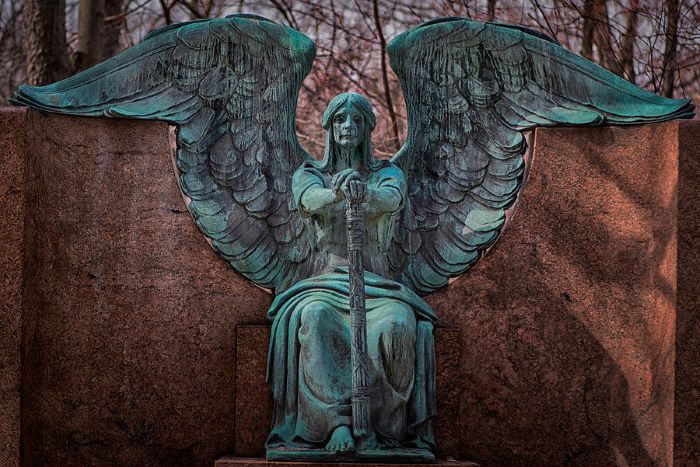
Yet we keep calling them down,
hoping for comfort,
dreaming of radiance.
They arrive without warning,
bearing weight, not mercy:
the silence that collapses sound,
the gaze that unravels marrow.
We tremble,
for their wings are woven
of light we cannot bear to see,
of shadow we cannot learn to name.
What they touch is never the same.
A tree becomes flame.
A breath becomes prayer.
A man becomes dust.
But is this terror for one heart alone?
No—their shadow falls on cities and nations,
their silence unsettles centuries.
They do not stoop to whisper comfort.
They stride through millennia,
their wings stirring wars and kingdoms,
their silence heavier than empires.
Temples tremble,
mountains bow down,
a bell falls silent in the square,
the proud are unmade
by a glance that knows no compromise.
Still, we call them down,
for without their terror we would never glimpse
the depth of beauty,
nor know that awe and fear
are one.
Awe belongs not to possession,
nor fear to a single soul,
but to the common lot of mortals
who stand together before the unendurable.

 Northcoast Antiquarian