How Two Decades of Income Tax Cuts for the Wealthy Shifted the Load onto Property Owners and Renters
During the most recent reappraisal for property taxes, thousands of Cuyahoga County residents opened their mailboxes to find reappraisal notices that made their stomachs drop. Property values had climbed by an average of 32% county-wide, with East Cleveland residents facing increases of 67% and Maple Heights 59%.
Michael Chambers, Cuyahoga County Auditor, reported that, for 71-year-old Parma resident Agnes Gallo, this meant her home’s value rose by $76,000, pushing her annual tax bill up nearly $950. “This is outrageous,” she said. “People can’t afford to live in their own houses.” He also said that single mother Roni Menefee, facing a 49% valuation hike, admitted she was considering leaving Ohio altogether: “We’re hardly living in Beverly Hills here.”
County officials insist that House Bill 920 prevents taxes from rising dollar-for-dollar with property values. But for seniors on fixed incomes or working families barely hanging on, even modest increases can be destabilizing. More than 20,000 residents filed complaints, with thousands of adjustments granted. Still, the anger lingers—and justifiably so.
The Long-Term Tax Shift
That anger is rooted in two decades of deliberate state policy. Since 2005, Ohio’s Republican lawmakers have steadily cut the personal income tax, reducing rates most sharply at the top. Over time, these cuts drained nearly $13 billion annually from state revenues.
With less money flowing from the state to schools, libraries, and local governments, communities were forced to raise more themselves. And because they are prohibited from taxing investments or capital gains—the kinds of income more common among the wealthy—the primary tool left was the property tax (although many municipalities also increased their local income taxes-Cleveland voters narrowly approved an increase in its income tax from 2 percent to 2.5 percent in 2016).
The outcome: in 2024, Ohioans paid $23.9 billion in property taxes—more than they contributed through sales taxes ($13.7 billion) or income taxes ($9.5 billion). The most regressive form of taxation has become the backbone of public services.
Put plainly: the legislature cut income taxes for the wealthy, and forced everyone else—retired, middle-class, working-class, and poor—to make up the difference through higher property taxes.
The Nonprofit Inversion
At the same time, Ohio has allowed exemptions and abatements to balloon. Nearly $90 billion in property value—17% of the state’s total—is exempt from taxation, up from 14% two decades ago.
The largest single category? Abatements, totaling $26.6 billion. These were meant as temporary incentives to spur growth but are now permanent fixtures. Even utilities, which have captive consumers and guaranteed profits, receive abatements for investments they would make anyway.
And then there are the so-called nonprofits. Their tax-exempt status rests on public benefit, yet their leaders are not infrequently paid like corporate executives:
Institution
Leader
Annual Compensation
Tax/Exemption Status
Cleveland Clinic
Dr. Tomislav Mihaljevic, CEO
≈ $7 million (2023)
Vast campus tax-exempt as nonprofit hospital
Ohio State University
Ted Carter Jr., President
≈ $1.3 million (2024)
University property tax-exempt
Ohio State University
Ryan Day, Head Football Coach
≈ $10–12.5 million (contracted 2025)
Public university benefiting from exemptions
Hawken School (Private)
D. Scott Looney, Head of School
≈ $1.05 million (2023, IRS Form 990)
Elite private school, property tax-exempt
These institutions are sheltered from taxes while ordinary citizens—many of whom can barely make ends meet—are expected to pay “full freight.”
Renters Pay Too
The burden does not end with homeowners. Renters also pay indirectly, as landlords pass on property tax hikes through higher rents.
In 2023, Ohio saw some of the steepest rent increases in the nation:
Cincinnati: one-bedroom rents up 17% year-over-year.
Columbus: also up 17%.
Central Ohio: squeezed further by Intel, Amazon, and data center developments.
Statewide: over 700,000 renter households are “severely cost-burdened,” spending more than half their income on housing.
Even those who do not own property are being priced out of Ohio’s communities.
Populist Anger and the Ballot Box
It is no wonder, then, that frustration has spilled into politics. In 2025, an all-volunteer group began gathering signatures for a constitutional amendment to abolish property taxes entirely. Organizers say they are moving forward “no matter what” lawmakers do, because people feel they “no longer have a voice in this government.”
The proposal is extreme. Abolishing property taxes would blow a $23 billion hole in funding for schools, libraries, mental health services, and parks. Replacing it with sales taxes could require rates as high as 20%. Yet the fact that such a movement exists—and is gaining traction—reveals how deeply citizens feel abandoned.
They no longer trust lawmakers who, for twenty years, cut income taxes for the rich while pushing costs onto everyone else, especially the working class, seniors, and the poor. They see abatements handed to billion-dollar institutions and “nonprofits” with millionaire executives, while seniors in Parma and renters in Columbus face bills that are unsustainable.
The Choice Ahead
Ohio’s property tax crisis is not an accident. It is the inevitable result of two decades of choices:
Cut income taxes for the wealthy.
Hand abatements to billion-dollar institutions.
Shift the burden onto homeowners, renters, and the poor.
The result is predictable: the young leave by choice, the old leave by necessity, and those who remain are angry enough to contemplate abolishing the system entirely.
Eliminating property taxes outright is likely not the answer—it would devastate schools, libraries, and local services. But for many Ohioans, it may feel like the only way to force state leaders to listen. When lawmakers protect the powerful and ignore the cries of ordinary citizens, radical proposals become the only language that carries weight.[1]
And the cry is not simply to be heard. It is to be relieved—to be lifted out from under a system of taxation that has become oppressive, unfair, and in many instances, unsustainable. Until that relief is real and tangible, until fairness is restored, the ballot box will remain the people’s only instrument. And if the choice is between leaving their homes or leaving the system as it is, more and more Ohioans will choose to abandon the system itself.
The choice is no longer between reform or complacency. It is between reform or rupture.
[1] Some might dismiss the property tax abolition initiative as folly that would devastate local services. But terror concentrates the mind wonderfully. When gerrymandered legislative maps silence voters’ voices in normal governance, when the legislature attempts to eliminate or dilute ballot initiatives entirely, and when even successful citizen initiatives are ignored by lawmakers and courts, extreme measures become rational responses. The terror that grips policy makers, and concentrates their focus if voters eliminate $23 billion in local funding, might finally force the political class that has spent decades redistributing wealth upward to confront the unsustainable system they’ve created. Sometimes breaking a captured system is the only way to build a fair one.
By Gentoo T. Adelie, Chief Diplomatic Penguin of Heard Island
Macaroni Penguin of Heard Island responding in disbelief to the news of the Trumpian Tariffs of 2025.An Audio Recitation of “An Ice Cold Response” by Gentoo T. Adelie
It was a clear morning on Heard Island. A gentle drift of cloud played among the slopes of Big Ben, and the Southern Ocean moved against the gravel shores with its slow, eternal breath. Among patches of moss and lichen, our colonies bustled with seasonal purpose—territories reestablished, mates greeted, feathers fluffed against the autumn wind. The eastern rockhoppers had returned to their grassland burrows, the macaronis muttered among the coastal tussock, and the gentoos stood sentinel. Then word arrived—borne by a wandering albatross returning from northern skies.
The Trump administration had imposed tariffs upon us.
Tariffs. Upon penguins.
I summoned the colonies. The emperors listened in regal silence, their gold-ringed heads unmoved. The kings shuffled to attention along the icy moraine. The skuas perched nearby, and even the black-faced sheathbill—normally distracted by refuse—cocked a pale head toward the speaker’s mound.
Our indignation was tempered by confusion.
We are not exporters. We are not manufacturers. Ours is not a civilization of spreadsheets, but of rhythm and return. We recognize no currency but krill, no metric but the molt. We nest in the gullies and commune with the icy winds that polish our shores.
It is true that humans have declared sovereignty over us. Flags have been planted, letters exchanged, and acts of parliament signed in Canberra. Heard and McDonald Islands, they assert, are administered by the Australian Antarctic Division, whose bureaucrats maintain that our affairs fall under the jurisdiction of the Supreme Court of the Australian Capital Territory—though no court has ever convened upon our shores.
But let it be understood: though we permit their presence, we do not cede authority.
The king penguin does not bow to Hobart. The Heard Island shag files no petitions. And the sheathbill, should it ever stand before the High Court, will surely eat the brief.
So it was with bewilderment that we received news of the 10% tariff levied by the United States upon our territory. An island with no people, no ports, and no exports—accused of an imbalance in trade. A claim founded on mislabeled shipping data: specifically, six containers of semiconductor components manufactured in Taiwan but erroneously coded as “HRD”—Heard Island’s port code, rarely used but technically valid—instead of “HKG” for Hong Kong by an exhausted logistics clerk working the graveyard shift in Singapore.
Naturally, the memes began to circulate—relayed to us by kelp gulls who’ve developed a taste for human refuse and, consequently, smartphones washed ashore from passing vessels. These gulls, perched near research stations to pilfer Wi-Fi signals (and the occasional protein bar), have become our unwitting ambassadors to digital culture. Among their findings: images of penguins queuing at customs, passports in wing. Shags rebuffed at security checkpoints. A sheathbill with a placard reading “TAXATION WITHOUT MIGRATION.”
The images are amusing. Yet beneath the laughter lies a chill deeper than our glaciers.
The absurdity is not that tariffs have been imposed, but that the structures of power are so far removed from reality as to invent us as participants in their theatre. Our colony is not a market. Our rookery is not a trading floor. If humans mistake our ecological presence for economic threat, then it is their world, not ours, that is disordered.
Even the ecosystem watched with bemusement. The mosses clung silently to volcanic stone. The seals slumped across the glacial flats, unmoved. Life persisted as it always has.
We shall not respond in kind. We shall not embargo the sea. We have no ports to close, no envoys to recall. We shall simply continue—diving into the surf, tending our chicks, enduring the westerlies that lash our coast.
The mosses remember. The sheathbill remembers. The ice remembers, too.
Confidential Diplomatic Cable
From: Office of the Subantarctic Avian Council (Provisional), Heard Island and McDonald Islands Domain: commonwealth.penguin.gov.hm To: Bureau of Global Trade Anomalies, U.S. Department of Commerce Date: April 8, 2025 Priority: Routine (given prevailing currents)
RE: ERRONEOUS APPLICATION OF TRADE TARIFFS TO UNRECOGNIZED BIOLOGICAL POLITY
To Whom It May Confound,
We write with a combination of courteous gravity and ice-bound disbelief upon learning that the Territory of Heard Island and McDonald Islands—comprising an uninhabited archipelago, 80% of which is glacier, and 100% of which is devoid of Walmart, Walgreens, or Whole Foods—has been subjected to a 10% tariff by your esteemed administration.
We presume this action arises from the alleged export of “machinery and electrical goods” originating from our domain. As no such items have been observed here since the disintegration of a scientific balloon payload in 1989, and as neither the king penguins nor the black-faced sheathbills have mastered voltage regulation, we suggest an administrative review.
Indeed, it now appears the source of this confusion lies in a series of clerical misassignments within international shipping records. Several bills of lading reportedly list the shipper’s address as “Vienna, Heard Island and McDonald Islands”—a charming bit of geopolitical fiction that, while expanding our sense of empire, sadly bears no relation to geographic or penguin reality.{1}
For clarity:
Our economy is non-monetized and chiefly fish-based.
Our primary industries include standing, molting, and collective thermoregulation.
Our manufacturing sector is limited to guano, occasionally artistic in form but unfit for commercial use.
The .hm domain, while charming, is not associated with logistical throughput. It is managed by a sooty albatross with a rusted antenna.
No residents, citizens, or consumers exist here in the human sense.
We therefore formally request the rescission of said tariff and the reclassification of Heard Island and McDonald Islands from “Emerging Trade Threat” to “Uninhabited Geopolitical Curiosity.” Alternatively, we are willing to accept foreign aid in the form of high-calorie fish paste, new tagging rings, or a fully functioning weather station.
For future reference, all customs declarations should be addressed to: Gentoo T. Adelie, Chief Diplomatic Penguin C/O The Hollow Behind the Third Basalt Outcrop Atlas Cove, Heard Island UTM Coordinates Available Upon Request (or clear skies)
We await your reply, though not urgently.
Warmest regards from the coldest coast, Subantarctic Avian Council (Provisional)
P.S. Seal No. 1: Be it known we do not seal mail with actual seals. The three elephant seals consulted regarding this matter expressed their disinterest through prolonged snoring, while the fur seals drafted a dissenting opinion consisting entirely of territorial barks. Their contribution to international diplomacy remains, much like this tariff situation, largely symbolic.
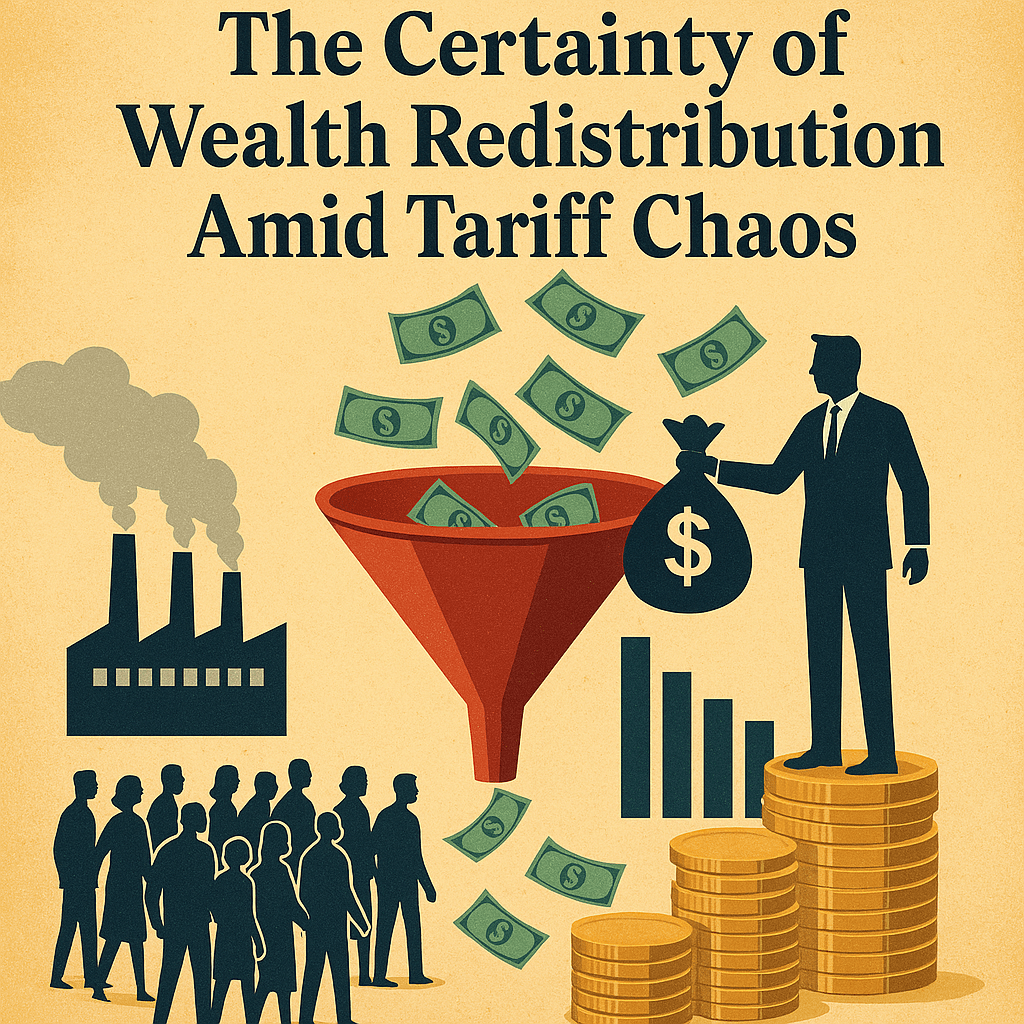
In the history of American economic policy, few moments have rivaled the current administration’s radical redirection of trade as both a break with precedent and a deliberate provocation of instability. The imposition of universal tariffs, compounded by steep duties on selected nations and penguins, has injected volatility into nearly every sector of the global economy. Yet, for all the uncertainties this policy has unleashed—geopolitical, fiscal, and industrial—one outcome is not only predictable but virtually guaranteed: a significant transfer of wealth from the broad base of American households to a narrow echelon of financial elites.
The administration’s tariff policy, sweeping in scope and nationalist in tone, has been sold to the public as the path to the restoration of American greatness, even proclaimed as a “Liberation Day.” But the reality it heralds is less one of liberation than of reallocation—specifically, a reallocation of economic burden and reward. By taxing nearly all imported goods—consumer staples, electronics, food, clothing, and industrial components—the policy imposes a direct and regressive cost on the average American. Inflationary pressures, rising production costs, and disrupted supply chains ensure that these tariffs function not merely as tools of negotiation, but as economic levers that press down on the middle and lower classes while lifting those whose wealth resides in capital rather than wages.
If the COVID-era recession taught us anything, it is that crises, when coupled with targeted monetary and fiscal policy, can act as engines of wealth concentration. During the pandemic, unprecedented interventions—stimulus checks, expanded unemployment insurance, PPP loans, and Federal Reserve liquidity—managed to momentarily soften the blow for many. Even then, the lion’s share of wealth gains went to the top 0.1%, as asset prices surged and capital-rich investors reaped the benefits of timely speculation and quantitative easing.
But the current recession-in-the-making differs in one essential respect: it is being pursued without pretense of public aid. There are no stimulus packages, no safety nets. What is offered instead is a doctrine of creative destruction: tens of thousands of federal workers laid off; regulatory agencies gutted; international partners alienated; domestic producers left to absorb new costs or pass them on to already-strained consumers. The economic pain is not an unintended consequence—it is the plan. And in such an environment, wealth will not merely trickle upward; it will flood there.
As import costs surge, businesses with transnational supply chains and logistical flexibility will shift production, seek carve-outs, and hedge against volatility. Those without such capacities—local manufacturers, family-owned farms, small retailers—will face thinning margins, layoffs, and in many cases, closure. The financial elite, holding diversified portfolios in real estate, private equity, and multinationals, will swoop into the resulting vacuum, acquiring distressed assets at discount, consolidating market share, and harvesting profits from inflationary dynamics. As was seen in the years following 2020, equity markets may fall precipitously at first, but they are likely to rebound faster than the broader economy—particularly with the Federal Reserve expected to cut interest rates in the wake of contraction. Once again, asset prices will rise. Once again, the owners of capital will see their fortunes grow.
Tariffs are traditionally viewed as blunt instruments of industrial protection. But in this case, they serve a far more surgical purpose. They extract purchasing power from the working class, undermine the viability of small and medium enterprises, and force a restructuring of the American economy around those who can absorb cost, influence policy, and pivot globally. They are not instruments of policy so much as instruments of wealth concentration.
If anything is certain in the unfolding tariff-driven crisis, it is that inequality will increase. Not in abstract or relative terms, but in concrete redistributive ones: trillions of dollars will move from wage earners and consumers to capital holders and financial intermediaries. The historical data, the institutional forecasts, and the structural logic all align. Amid the din of political slogans, retaliatory tariffs, and market disruptions, this is the one truth that should command attention.
History will not record this period as a victory for the American people. It will record it as a transformation: not of manufacturing, not of trade, but of the very architecture of American wealth—concentrated more tightly, held more distantly, and insulated more completely from the needs and voices of the many.
The United States was founded as a democratic republic, a nation where governance was entrusted to the people and their elected representatives. Yet, in the present age, democracy appears increasingly untenable, not because of external threats, but because the citizenry itself seems willing to surrender its role in self-governance. Rather than engaging in the messy and difficult work of democracy, Americans have increasingly deferred power to an elite class—oligarchs whose wealth, status, and influence have elevated them beyond the reach of ordinary accountability. In doing so, we have embraced a political theology that anoints the rich as our rightful rulers, sanctifying economic disparity as though it were ordained by divine providence.
A key factor in this transformation is the theological justification for inequality, particularly through the Prosperity Gospel—a strain of Christianity that equates material wealth with divine favor. If wealth is a sign of God’s blessing, then poverty must be a mark of moral or spiritual failure. This belief, deeply embedded in the American consciousness, has provided a convenient ideological foundation for the rise of oligarchy. The result is a republic in name only, where the wealthy govern without meaningful challenge, and where democracy is tolerated only to the extent that it does not threaten the interests of the ruling elite.
Alexis de Tocqueville, in Democracy in America, warned that “the aristocracy of manufacturers… are one of the most dangerous that has ever appeared in the world” because they hold power over the masses without obligation or accountability. Likewise, James Madison in The Federalist No. 10 cautioned that factions dominated by economic interests would threaten the republic, as “the most common and durable source of factions has been the various and unequal distribution of property.”
II. The Historical Cycle: Republics in Decline
America is not the first republic to slide into oligarchy. The Roman Republic offers a particularly illuminating parallel. Beginning as a relatively participatory system after the expulsion of its kings, Rome’s republic gradually concentrated power in the hands of wealthy patricians. By the late republic, a handful of families controlled vast estates worked by slaves, while formerly independent farmers were displaced into a dependent urban proletariat. The final century of the republic saw repeated attempts at reform by populist leaders like the Gracchi brothers, who were assassinated for proposing land redistribution. When Julius Caesar crossed the Rubicon in 49 BC, the republic that had stood for nearly 500 years had already been hollowed out by economic inequality.
Venice provides another instructive example. The Republic of Venice began with a relatively broad-based Great Council of citizens. However, in 1297, the Serrata (closure) of the Great Council permanently fixed membership to established families, creating a hereditary aristocracy. Over time, even within this oligarchy, power concentrated further into the hands of the Council of Ten and eventually the three State Inquisitors. What began as a merchant republic gradually calcified into rule by the few, with elaborate ceremonies maintaining the fiction of the Serenissima Respublica (Most Serene Republic) while actual democratic elements withered.
The Weimar Republic’s collapse demonstrates how economic crisis can accelerate democratic decline. The hyperinflation of 1923 and the Great Depression devastated Germany’s middle class, traditionally democracy’s strongest supporters. As economic security vanished, so did commitment to democratic processes, with many seeking salvation in authoritarian alternatives. Alarmingly, in contemporary America, we witness similar anti-democratic impulses despite experiencing nothing remotely comparable to Weimar’s catastrophic conditions—suggesting that our democratic erosion stems not from genuine economic devastation but from manufactured grievance and the deliberate exploitation of social divisions.
But what fuels this manufactured grievance? Unlike the desperate economic collapse of Weimar Germany, today’s American discontent is stoked less by material suffering and more by a carefully cultivated sense of resentment. The modern oligarchy has perfected the art of distraction, channeling public anger away from corporate excess and systemic inequality and toward cultural and ideological battles that serve no economic interest for the working and middles classes. Instead of demanding higher wages, we are encouraged to fight over identity politics. Instead of questioning why billionaires pay lower tax rates than teachers, Americans are bombarded with outrage over books in libraries. Economic anxiety is repackaged into tribal conflict, ensuring that the real architects of inequality remain unchallenged.
This strategy is not accidental—it is the logical evolution of the media landscape. As traditional journalism declines, political entertainment thrives. Once, the press served as a check on power; now, it too is absorbed into the machinery of grievance, owned by the very oligarchs it should scrutinize. The consolidation is staggering: 90% of U.S. media is now controlled by just six corporations, compared to 50 companies in the 1980s.[1] This concentration has decimated local journalism while amplifying voices that serve oligarchic interests. The electorate is not simply disengaged—it is actively misled, encouraged to see fellow citizens as enemies rather than those who rule over them. This is not the erosion of democracy through neglect, but through engineering.
The success of this model is evident in voter behavior. Discontent no longer translates into economic reform movements or policy advocacy; instead, it is absorbed into personality-driven politics, where would-be strongmen are seen as righteous warriors against manufactured threats. The shift from democracy to oligarchy is not imposed—it is sold, marketed, and ultimately, embraced.
In this light, the warnings of America’s founders appear remarkably prescient. Thomas Jefferson warned against an “aristocracy of monied corporations” and stated, “I hope we shall… crush in its birth the aristocracy of our monied corporations which dare already to challenge our government to a trial of strength, and bid defiance to the laws of our country” (Letter to George Logan, November 12, 1816). Yet today, we have embraced the very model the Founders feared, allowing economic elites to determine policy, shape culture, and control the mechanisms of governance. The people, rather than resisting this transformation, have largely accepted it—guided in part by a religious narrative that equates power with virtue and poverty with failure.
III. The New Oligarchy: Wealth as Divine Favor
The modern American oligarchy is not merely composed of the wealthy, but of those who have successfully positioned themselves as figures of admiration and near-worship. Silicon Valley billionaires, hedge fund magnates, and political dynasties have become the new aristocracy, justified not by noble birth but by financial success. What separates today’s oligarchs from the robber barons of the past is not their wealth alone, but the theological and cultural framework that has shielded them from critique.
The concentration of wealth has reached unprecedented levels. According to Federal Reserve data, the top .1 percent of Americans—just 330,000 individuals—now hold 12.5% of the wealth, a staggering 40% increase from 8.9% in 2010. Meanwhile, the bottom 50% of Americans—165 million people—now hold only 5.5%.[2] This means the richest one-thousandth of the population controls more than twice the wealth of half the entire country. This marks a historic reversal of the post-WWII economic order. Yet rather than prompting concern, this concentration is often celebrated as evidence of entrepreneurial success and innovation.
This oligarchic influence extends beyond domestic borders. Foreign billionaires and sovereign wealth funds increasingly shape American policy and economic priorities through strategic investments, lobbying efforts, and ownership of U.S. assets. The globalization of capital has created a transnational oligarchic class whose interests often align regardless of nationality, further removed from democratic accountability. While domestic oligarchs at least feign the pretense of national loyalty, foreign wealth operates with even fewer constraints, treating American democracy as simply another market to be influenced or manipulated for profit.
The Prosperity Gospel, a uniquely American theological development, has played a significant role in this transformation. This doctrine teaches that material success is evidence of God’s blessing, while poverty signals a lack of faith or effort. In this view, wealth is not merely economic—it is moral. This ideology serves as a powerful deterrent to any redistributionist impulse, as it frames economic disparity as a reflection of divine will rather than systemic injustice.
Consider concrete manifestations of this oligarchic power: Congressional studies show that policy outcomes overwhelmingly align with the preferences of the wealthy. The Princeton study by Gilens and Page (2014) concluded that “economic elites and organized groups representing business interests have substantial independent impacts on U.S. government policy, while average citizens and mass-based interest groups have little or no independent influence.”[3] This influence is maintained through campaign finance—in the 2020 election cycle alone, the top 20 billionaire donors collectively spent $2.3 billion, more than twice as much as Joe Biden’s entire campaign, with a single billionaire contributing over half that sum.[4] Our democracy has effectively been captured by a donor class whose interests dictate policy priorities.
This capture extends to the very institutions designed to safeguard democracy. The judiciary, once a bulwark against concentrated power, has been systematically reshaped through strategic appointments and massive funding of judicial campaigns. Supreme Court decisions like Citizens United have equated money with speech, unleashing unprecedented corporate (thus oligarchic) influence in elections. Meanwhile, elected officials increasingly depend on wealthy donors and corporate PACs to fund ever-more-expensive campaigns, creating a system where access and influence are directly proportional to financial contributions. The result is a government formally elected by the people but functionally beholden to monied interests.
We see this play out in specific policies. The 2017 Tax Cuts and Jobs Act delivered massive benefits to corporations and wealthy individuals while adding $1.9 trillion to the national debt. Meanwhile, proposals for universal healthcare, student debt relief, or expanded social services—policies that would benefit the broader citizenry—face insurmountable opposition despite popular support. The revolving door between Wall Street and government regulatory agencies ensures that financial regulations are written by and for the financial elite. Figures like Steven Mnuchin, who moved from Goldman Sachs to hedge fund companies to Treasury Secretary, or Gary Gensler, who went from Goldman Sachs to Assistant Treasury Secretary, Under Secretary of the Treasury, Chair of the Commodity Futures Trading Commission, Commissioner of the U.S. Securities and Exchange Commission, and Chair of the Securities and Exchange Commission, exemplify how the line between regulator and regulated has blurred beyond recognition. When financial institutions faced collapse in 2008, they received immediate bailouts, while millions of Americans lost their homes with minimal assistance.
The tax system itself has been shaped to benefit the oligarchy. In 2021, ProPublica revealed that the 25 richest Americans paid an effective tax rate of just 3.4% between 2014-2018, while the average American paid around 14%.[5] This disparity did not occur by accident but through deliberate policy choices that allow the wealthy to categorize income as capital gains, exploit loopholes, and shield assets through complex financial structures unavailable to ordinary citizens.
Yet, the same religious justifications that elevate the wealthy conveniently overlook the conduct of those at the top. The modern oligarchs are often anything but paragons of virtue. Their lifestyles, filled with excess, exploitation, and moral as well as often legal bankruptcy, are far removed from the Christian ideals of humility, charity, and service. As Jesus himself warned in Matthew 19:24, “Again I tell you, it is easier for a camel to go through the eye of a needle than for someone who is rich to enter the kingdom of God.” And yet, the rich are celebrated, while the poor—often vilified as lazy or undeserving—are left to navigate a system rigged against them.
IV. The Willing Servitude of the Electorate
This transition from democracy to oligarchy has not been solely imposed from above; it has been embraced from below. A significant portion of the American electorate has come to see governance not as a participatory duty, but as a spectacle—one in which wanna-be strongmen and billionaires are revered as saviors rather than as figures to be held accountable.
Some defend this system as a meritocracy, where wealth reflects productivity and innovation. Yet Federal Reserve data shows that, using historically typical rates of return, inherited rather than earned wealth may account for over half of total wealth, undermining the narrative that economic status is purely the result of individual effort.[6] When nearly half of all wealth comes through inheritance, the myth of pure meritocracy becomes impossible to maintain. Nevertheless, the electorate continues to defend a system that increasingly resembles the hereditary aristocracies our founders sought to abolish.
The cultural obsession with wealth, combined with religious narratives that equate prosperity with righteousness, has dulled the instinct for democratic engagement. Why question the morality of economic inequality when it is perceived as a reflection of God’s order? Proverbs 22:7 states, “The rich rule over the poor, and the borrower is slave to the lender.” Why demand accountability from the ruling class when they are seen as divinely chosen stewards of the nation’s fate?
This abdication of democratic responsibility has been significantly accelerated by the capture of media institutions by the same oligarchic interests. Independent, objective news sources have largely disappeared from citizens’ lives, replaced by conglomerates owned by the very elites whose power should be scrutinized. What passes for journalism often amounts to ideologically laden content designed to reinforce existing power structures while appearing to inform. The resulting information ecosystem leaves citizens simultaneously overwhelmed with content yet starved of the context and critical analysis necessary for meaningful democratic participation. This theological deference to wealth has allowed democracy to wither, not through violent overthrow, but through active acquiescence.
The illusion of consumer choice masks growing corporate concentration, where 75% of household items are now controlled by just ten corporations.[7] When we believe we are making free market choices, we are often simply selecting between products owned by the same conglomerate. This mirrors our increasingly limited political choices, where candidates across the spectrum rely on the same donor base and serve similar corporate interests despite superficial differences in rhetoric.
Consider Amazon’s successful opposition to unionization efforts in Bessemer, Alabama (2021-2022), where billions in corporate resources were deployed to defeat workers seeking basic protections and better wages.[8] Rather than seeing this as class conflict, many Americans defend corporate interests against their own economic self-interest, having internalized a worldview where the market is sacrosanct and labor organization is somehow un-American. This represents the culmination of decades of ideological cult conditioning that has separated Americans from their own civic and economic power.
V. The Disappearance of Ethics in Public Life
If the Prosperity Gospel were true to Christianity, it would demand that the wealthy adhere to moral obligations—generosity, humility, and justice. Yet the reality is quite the opposite. The modern oligarchy exploits faith not to guide ethical behavior, but to silence dissent.
Throughout history, faith has been a force for challenging power—from the Social Gospel movement’s advocacy for labor rights to Martin Luther King Jr.’s invocation of Christian morality in the fight for civil rights. Dr. King warned, “We must rapidly begin the shift from a ‘thing-oriented’ society to a ‘person-oriented’ society” (Beyond Vietnam: A Time to Break Silence, April 4, 1967), criticizing the worship of material success over human dignity.
Yet today, much of American Christianity has been hollowed out, transformed into a vehicle for wealth-worship rather than a challenge to injustice. The teachings of Jesus, who spoke of the poor inheriting the kingdom of God and the moral dangers of riches, have been replaced by a doctrine that tells the poor they simply need to pray harder and wait their turn.
VI. The Oligarchs’ America
The American experiment in democracy appears to be in retreat, not because of foreign invaders or external threats, but because we have abandoned the very principles that sustain it. A democracy requires engaged citizens, yet we have become a nation content to let the wealthy govern without challenge. A republic requires accountability, yet we have deified billionaires and accepted their dominion as inevitable, if not righteous.
The Prosperity Gospel and its ideological offshoots have played a crucial role in this transformation. By equating wealth with divine favor, they have given a theological foundation to inequality and sanctioned the rise of oligarchy. This ideology has not only justified the unchecked power of the rich, but has also pacified the poor, persuading them that their struggles are personal failings rather than structural injustices.
If America is to reclaim its democratic aspirations, it must first confront the myths that have enabled its decline. We the People must remember that wealth is not virtue. Power is not righteousness. And democracy is not sustainable when its people cease to believe in their own right to govern. Until these truths are recognized, the nation will remain in the hands of those who have been deemed, by wealth and by providence, our betters.
History shows that oligarchic rule is not an inevitability. From the antitrust reforms of the early 20th century to the labor movements that shaped the New Deal, democratic resurgence is possible when citizens recognize their own power. But this requires first dispelling the myths that sustain the status quo: that wealth equals virtue, that political change is impossible, and that democracy is someone else’s responsibility.
[1] Ashley Lutz, “These 6 Corporations Control 90% of the Media in America,”’ Business Insider, June 14, 2012.
[3] Martin Gilens and Benjamin I. Page. “Testing Theories of American Politics: Elites, Interest Groups, and Average Citizens.” Perspectives on Politics 12, no. 3 (2014), 565.
[6] Laura Feiveson and John Sabelhaus. “How Does Intergenerational Wealth Transmission Affect Wealth Concentration?” Federal Reserve FEDS Notes, June 1, 2018.
The author reflects on a troubling societal trend where individuals derive joy from others’ misfortunes, particularly amidst widespread economic inequality. Instead of advocating for fairness, many focus on undermining those with minor advantages while overlooking systemic issues that favor the ultra-wealthy. Historical concepts like Nietzsche’s ressentiment underline this destructive mindset. The piece illustrates this with a union example, where members aimed to diminish benefits for others instead of promoting broader equity. The author emphasizes the need to redirect resentment towards addressing inequality, fostering solidarity rather than division, and calls for reclaiming virtues like justice and compassion in the face of collective suffering.
Throughout my life, I have encountered individuals and groups who seem to lack not only a moral and ethical compass but even a basic sense of self-interest. When they witness others losing an advantage—whether in employment, social standing, or opportunity—they do not respond with sympathy or concern but instead with unrestrained joy, reveling in another’s misfortune. Rather than advocating for fairness or seeking to improve society or their own standing, they take solace in the suffering of others, as though deprivation itself were a form of justice.
This perverse celebration of the misfortune of others becomes even more striking when we consider the actual distribution of power and wealth in our society. While workers resent each other’s minor advantages, America’s top 12 billionaires have amassed over $2 trillion in wealth—an increase of 193% since early 2020. The displacement of legitimate economic anxiety onto fellow workers, rather than the rigged systems enabling such extreme concentration of wealth, exemplifies how resentment is weaponized against collective interests. Instead of questioning the forces that have hollowed out the middle class, many find misplaced satisfaction in seeing others fall.
This phenomenon is not new. Philosophers and historians have long observed the destructive power of ressentiment—a term Nietzsche used to describe the corrosive, festering resentment of those who feel powerless, who, unable to elevate themselves, seek instead to bring others down (Nietzsche, 1887/1989, p. 36). The weaker spirit, he argued, does not strive toward greatness but seeks revenge against those who embody what it cannot attain. In our current dystopian era, where the richest 1% now control 54% of all stock market wealth—up from 40% in 2002—this sense of powerlessness has fertile ground in which to grow. Rather than demanding fairness or aspiring to something greater, many find solace in celebrating the stripping away the rights and relative advantages of others, while the true beneficiaries of systemic inequality remain untouched.
When the slide into the current era began, I began to see this corruption of the spirit play out in the most mundane of settings. Decades ago, in the workplace, I encountered a revealing example of the mindset that prioritizes resentment over solidarity. Our office had only a limited number of private offices and computers, with the former assigned to attorneys based on job classification and the latter distributed by seniority across all employees, including attorneys and investigators within the collective bargaining unit. When discussions arose about relocating to a new office space, the union sought input from the membership on concerns to bring forward to management. At the time—which was years before I became a supervisor—I was the local union steward.
To my astonishment, a significant number of members advocated for the union to ask management to eliminate private offices for all non-managers in the new space simply because not all job classifications had been granted them. Their logic baffled me. Rather than seeking to extend a benefit to more workers, they focused on stripping it from other bargaining unit members, as though incremental improvements in working conditions for some created intolerable working conditions for others.
Fortunately, I was able to argue—successfully—that this approach was entirely backward. Instead of resenting those who had obtained an improved working condition, we should advocate for an expansion of the working condition rather than its elimination. The rational course was to request that more job classifications be made eligible for offices, using objective criteria related to job duties and their similarities to those that already warranted offices. While we were ultimately unsuccessful in securing additional offices, we did succeed in shifting the mindset of the membership. What began as an impulse to strip others of their advantage out of frustration became, upon reflection, a collective effort to push for broader equity. We may not have won the tangible benefit, but we avoided the far greater loss of allowing ourselves to be divided by shortsightedness and resentment.
And yet, this very same ugly impulse now dominates our national discourse. The cruel celebration of public servants losing their livelihoods becomes even more troubling when viewed against economic realities. While many Americans cheer the human pain that the elimination of government positions and the middle-class existence which such positions enabled, the ultra-wealthy’s share of national wealth has reached levels not seen since the 1920s. Even more striking, as the oligarchs’ wealth share has nearly quadrupled since 1953, their share of total taxes has remained virtually unchanged. Yet rather than questioning this dramatic shift in resources, many find satisfaction in seeing their neighbors lose healthcare benefits and perhaps even their homes.
This misdirection of resentment has particularly pernicious effects along racial lines—an all-too-familiar pattern in American history. While the median Black family holds just 12.7% of the wealth of the typical white family, and 28% of Black households have zero or negative wealth, political entrepreneurs channel economic anxieties into racial antagonism rather than solidarity. The very communities that could benefit most from collective action are instead pushed toward celebrating each other’s losses rather than confronting the systemic structures that perpetuate their deprivation.
Even those who remain employed in federal service are subjected to arbitrary and senseless disruptions, yet their plight is met not with sympathy but with open derision. Some are forced to return to offices that lack the space to accommodate them, while others are ordered to relocate across the country to similarly ill-equipped workplaces—an absurdity greeted with applause rather than outrage. The schadenfreude is both bizarre and troubling, driven not by principle but by petty resentment: If I had to go back, so should they.I was never allowed to work from home, so why should they?I doubt they were even efficient in the first place.
These justifications are not arguments but thinly veiled expressions of bitterness, exposing a society conditioned to revel in the suffering of others rather than demand justice, fairness, or rational policy. Worse still, there is little recognition that these actions—these firings, transfers, program terminations, and other disruptions—whether arbitrary, capricious, cruel, irrational, intentional, or, at times, unfortunate yet necessary—inflict real harm on individuals with families and loved ones, embedded in communities not unlike our own.
This kind of envy serves only the interests of those who seek to keep us divided, distracting us from the real issues that demand our attention. Understanding the true scale of inequality—where most Americans’ wealth is tied to their homes while the top 1% controls over half of all stock market wealth—can help redirect resentment toward productive change. Rather than celebrating when others lose benefits or job security, we must recognize how the concentration of wealth and power benefits from our division.
This lesson has been articulated time and again by thinkers from across traditions. Aristotle’s concept of megalopsychia—the great-souled person—stood in contrast to those driven by pettiness and envy, emphasizing instead the nobility of advocating for the common good (See Book IV of the Nicomachean Ethics). In the Christian tradition, agape—a selfless, communal love—demands that one’s neighbor be uplifted, not torn down (1 Corinthians 13:4–7).
Yet in modern America, these lessons are too often ignored in favor of a corrosive, zero-sum mentality that pits the powerless against one another rather than against the forces that perpetuate their economic insecurity and often economic suffering. A society where 26-28% of Black and Latino households have negative wealth, while billionaires added over $2 trillion to their fortunes during a global pandemic, has deep structural issues to address. Yet instead of confronting these systemic challenges, we have allowed ourselves to be divided, finding hollow satisfaction in our neighbors’ misfortunes rather than building the solidarity needed for meaningful change.
This is the moral failure of our time—not just the overt corruption of those in power, but the willing embrace of cruelty by so many in the public. A nation that delights in its own suffering, that views the suffering of its neighbors as a victory rather than a tragedy, is one that has lost its way. The challenge before us is not merely political but fundamentally ethical: to resist the temptation of resentment and to reclaim the higher virtues of solidarity, justice, and shared human dignity.
Yes, there is a legitimate argument for addressing the national debt and curbing government spending. And yes, when Congress engages this issue in a constitutionally sound manner, it may result in job losses in the public sector. Such decisions, if undertaken with deliberation and fairness, may at times be necessary. However, what we have witnessed thus far is not a measured fiscal policy but a reckless, chaotic purge—carried out without regard for Constitutional norms, the rule of law, economic stability, or human impact. Even where reductions in government employment may be warranted, they should never be occasions for celebration, nor should they serve as fuel for the schadenfreude and politics of resentment that have become disturbingly and consistently prevalent.







 Northcoast Antiquarian