

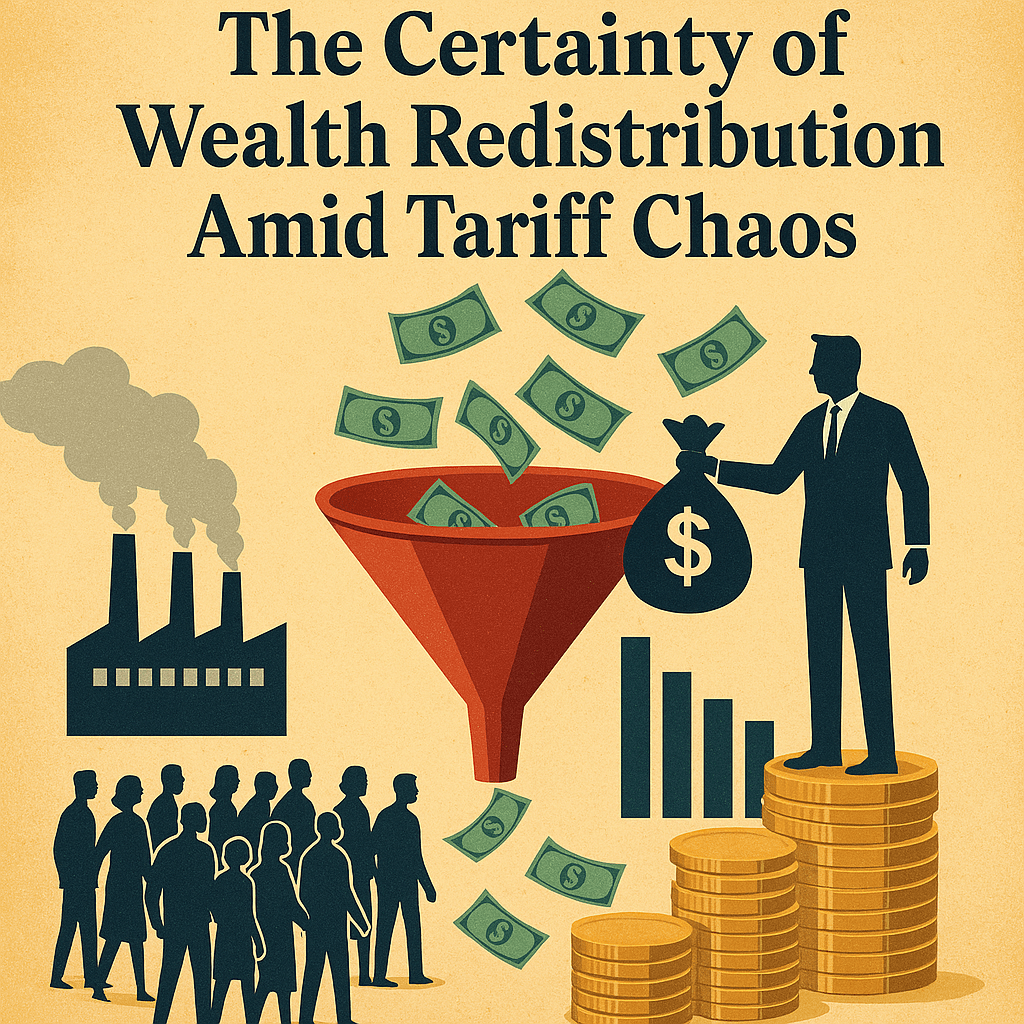
Recently, I published an essay titled The Certainty of Wealth Redistribution Amid Tariff Chaos, in which I argued that the true function of the current administration’s tariff policies was not economic revival, but the deliberate and predictable transfer of wealth from working households to the uppermost tier of financial elites.
Events of the past several days—culminating in imposition of a market-crashing tariff decree swiftly reversed for maximum opportunistic gain—have confirmed my worst fears. That some now praise this spectacle as “brilliant” only adds insult to economic injury.
In response, I offer the following satirical memo from a fictional Wharton Annex ethics professor—one Professor Basil P. Whisker, Chair of Ethical Opportunism at the Weasel School of Business. His observations regarding the situation and the logic he embodies—even though he is fictional—are uncomfortably real.

On Ethics, Market Manipulation, and the Power of Praise
Buy the Dip, Praise the Dipper: A Wealth Transfer Playbook
By Professor Basil P. Whisker, PhD, MBA, CFA (Parole Honoré Distinction)
Chair of Ethical Opportunism, Weasel School of Business, Wharton Annex
Formerly of the Federal Correctional Institute for White Collar Refinement
“Our Honor Code is Flexible. Our Returns Are Not.”
Some in Congress have raised the unfashionable concern that the recent tariff saga looks suspiciously like market manipulation.
To which I reply: Of course it is.
But for whom?
Not the little people—they lack both the reflexes and the capital reserves. No, it is for the elite few trained in the disciplines of anticipation, flexibility, and pliable morality.
At the Weasel School of Business, we teach that ethics must be nonlinear and dynamic—responsive to the moment, like high-frequency trading algorithms or a presidential memory when questioned under oath. The recent 90-day tariff “pause” (following a dramatic market collapse) teaches students everywhere that sometimes the most profitable thing to do is to:
- Create a crisis
- Seize the resulting dip
- Declare victory through reversal
- Congratulate the disruptor for his “brilliance”
- Move on before the subpoenas arrive
The Art of the Non-Deal
When a policy announcement wipes trillions from the markets, only to be reversed days later with a triumphant “THIS IS A GREAT TIME TO BUY!!!” post, we must acknowledge we are witnessing not governance but performance art.
Like all great art, it asks difficult questions:
- Is it market manipulation if you announce the manipulation in real time?
- Can one declare “Liberation Day” and then liberate oneself from that declaration?
- If financial whiplash creates billionaire gratitude, is it still whiplash—or merely strategic spine realignment?
Billionaires praising such tactics is not sycophancy—it is advanced portfolio management by other means.
As we say in Weasel Finance 101:
“Praise is just another form of leverage.”
Looking Ahead: A Curriculum of Chaos
We are entering a new phase of global commerce—what I call the Era of the Glorious Lurch. In this new age, tariffs are not policies but market mood regulators, deployed tactically to evoke loss, recovery, and eventual Stockholm syndrome-like gratitude.
My revised syllabus for the coming semester will include:
- Advanced Self-Dealing (OPS-526)
- Narrative Arbitrage: Writing History Before It Happens (OPS-618)
- Strategic Sycophancy and Influence Leasing (co-listed with Communications)
- Tariff Whiplash: Creating Wealth Through Vertigo (OPS-750)
- When Textbooks Fail: The Art of the No-Deal Deal (Senior Seminar)
Applications are open. Scholarships available for those with prior SEC entanglements or experience declaring “everything’s beautiful” while markets burn.
A Word on Timing
Critics who suggest that one should wait until an actual deal is struck before declaring brilliance simply do not understand modern finance.
In today’s economy, praise is a futures contract—you are betting on the perception of success, not success itself.
When a policy costs the average American household thousands in higher prices and market losses, only to be partially reversed with no actual concessions gained, the correct reaction is not analysis but applause. After all, it takes real courage to back down without admitting it.
A Final Toast
To the president, I raise a glass of vintage tax shelter with notes of plausible deniability.
To the billionaires celebrating the “brilliant execution” of a retreat, I offer a velvet-lined echo chamber.
And to my students, past and future, I remind you:
If you cannot time the market, at least time your praise.
Because in today’s economy, there is no such thing as too soon, too blatant, or too obviously beneficial to the 0.01%.
So next time markets plunge on policy chaos, do not ask “who benefits?”
Instead ask, “am I positioned to be among those who do?”
Thank you. And as always—
buy low, tweet high, and declare victory before the facts catch up.


 Northcoast Antiquarian