
The Nightingale and the Rose: A Fable told by Lysander Aesopides

Swallow and Peony (woodblock print, pre-1945), Ohara Koson (1877-1945).

The Nightingale and the Rose

In a secluded grove, hidden deep within an ancient forest, there lived a nightingale whose song was unmatched by any other creature. Every evening, as the sun dipped below the horizon, the nightingale would perch on a high branch and sing, filling the air with melodies so beautiful that even the stars seemed to pause and listen.

In the center of the grove grew a single rosebush, its flowers the color of a blush at dawn, delicate and fragrant. The nightingale loved the rosebush with all its heart, for it saw in the rose a beauty that mirrored its own song. Night after night, the nightingale would sing to the rose, hoping that the rose might hear the song and return its love.

But the rose, though beautiful, was unaware of the nightingale’s affection. It stood rooted in the earth, its petals turned toward the sun, drinking in the light and warmth. The rose did not understand the nightingale’s song, for it had never known love beyond the gentle caress of the morning dew or the kiss of the afternoon breeze.

One night, as the nightingale sang its most heartfelt melody, the moonlight filtered through the leaves, casting a silvery glow over the grove. The nightingale, filled with longing, poured all its love into the song, hoping to reach the rose’s heart.

The rose, touched by the nightingale’s song, began to stir. Its petals trembled, and for the first time, it felt something more than just the sun’s warmth or the wind’s touch. It felt the nightingale’s love, pure and unyielding. But the rose could not return this love in the way the nightingale desired. It could only bloom as it always had, beautiful but distant, its heart locked away in its delicate petals.

The nightingale, realizing that the rose could never love it as it loved the rose, sang one final song, a song of acceptance and farewell. It was a song that spoke of the beauty of love, even when unreturned, and of the joy in loving without expectation.

As the nightingale’s song faded into the night, the rose shed a single petal, a silent token of its appreciation for the nightingale’s devotion. The nightingale, with a heart full of love but no bitterness, flew away into the night, knowing that its love, though unrequited, had been true and pure.

The rose continued to bloom, its beauty admired by all who passed, but it was never the same after that night. It had been touched by the nightingale’s love, and though it could not return it, the memory of that love remained within its petals, giving them a deeper, more resonant hue.

Moral of the Fable

Love, even when unreturned, is a gift that enriches both the giver and the recipient. True love is selfless and does not demand reciprocation, finding its own beauty in the act of loving.

A Lyrical Treat Inspired by the Fable

A Four Stanza “Poem” based on the Fable set to a medieval-folk theme. Lyrics by Donald S. Yarab, Music by Udio.com.

Crafting Artful Fables: The Mastery of Language and Meaning

Le rat de ville et le rat des champs (engraving from Book I, Fable IX, Fables de La Fontaine avec les dessins de Gustave Doré, 1867) by Gustave Doré (1832-83).

In contemplating my deep appreciation for reading and, more recently, writing fables, I find that these concise narratives, though brief, demand a mastery of language that is both artful and precise. The essence of a fable lies in its ability to convey profound moral lessons within the confines of a few well-chosen words, a task that requires the storyteller to employ language that is rich in metaphor and layered with meaning. Unlike a novel or even a short story, a fable’s economy of expression does not diminish its impact; rather, it enhances the potency of its message. The challenge and joy of crafting such a tale lie in the careful selection of words that resonate with readers of all ages and backgrounds, evoking emotions and intellectual insights that extend far beyond the surface of the text.

Moreover, the fable’s ability to transcend its limited word count is akin to the skill of a master artist who, with a few deft strokes, can create a visual masterpiece that captivates and educates. A master artist, much like a skilled fable writer, transcends the literal confines of their medium, whether it be canvas, paper, or marble. Their work is not merely a representation of reality, but an evocative expression that stirs the viewer’s emotions, provokes thoughtful interpretations, and invites intellectual exploration. Through the careful selection of color, composition, and form, the master artist imbues the visual elements with a depth that speaks to the human condition in ways that are both subtle and profound. The true artistry lies in this ability to craft a visual narrative that compels the observer to look beyond the surface, uncovering layers of meaning and insight that resonate long after the initial encounter. In this way, the artist’s canvas becomes a gateway to a richer understanding of the world, much as the carefully chosen words of a fable reveal truths that extend far beyond their brevity.

It is also why I often choose to illustrate each fable I create with a carefully selected work of art. The artwork not only complements the story but also symbolizes the underlying lesson, even if only metaphorically.

The master weaver of fables must tell a compelling story as they intricately weave a fine lesson into the tapestry with limited threads, but threads of extraordinary and precious value. Each word, each phrase, contributes to the intricate design of the narrative, ensuring that every element is essential to its overall impact. In this way, the fable becomes not just a story, but a distilled form of wisdom, crafted with precision and care, imparting lessons with an elegance and economy unmatched by other literary forms. It is this confluence of art and intellect that makes the reading and writing of fables a deeply rewarding pursuit, one that continues to captivate my imagination and inspire my creative endeavors.

The Farmer and the Unknown Seed: A Fable told by Lysander Aesopides

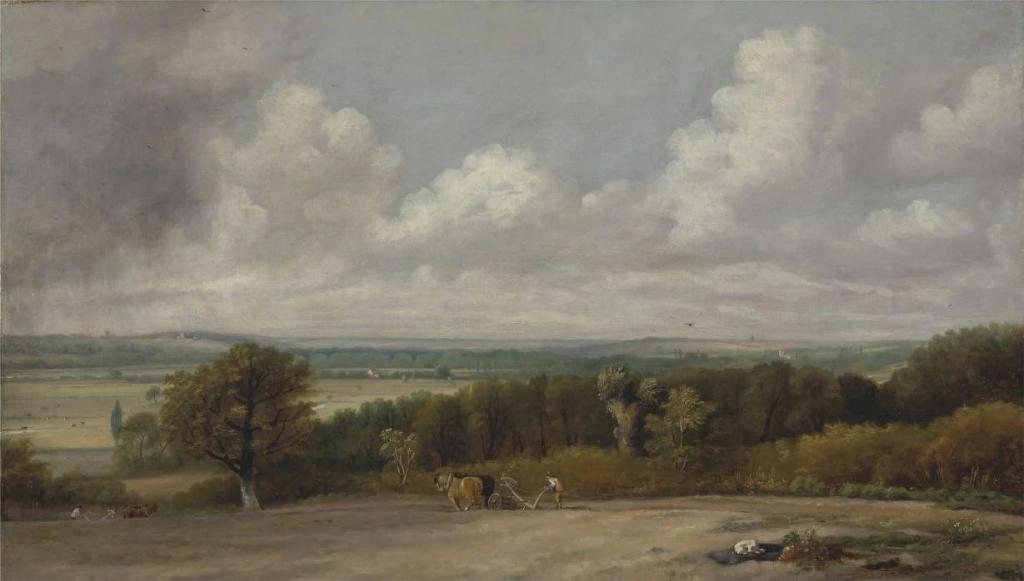
 Ploughing scene in Suffolk (oil on canvas, 1824-1825) by John Constable (1776-1837). Yale Center for British Art, New Haven.

In a quiet village, there lived a diligent farmer who worked tirelessly on his land. He took great pride in the crops he grew, ensuring that each seed was planted with care and nurtured with patience. His fields were always bountiful, feeding not only his family but also the entire village.

One day, as he was plowing a new field, the farmer unearthed a strange, dark seed. It was unlike any seed he had ever seen, and though he was curious, he was also wary. The farmer considered casting the seed aside, fearing it might bring misfortune, but a voice within urged him to plant it.

After much deliberation, the farmer decided to plant the seed in a secluded corner of his field, where it could grow without disturbing his other crops. He tended to it with the same care as his other plants, watching as it sprouted and grew into a tall, sturdy tree, its leaves a deep, rich green.

As the seasons passed, the tree bore fruit—small, round, and gleaming like gold. The farmer, unsure of the fruit’s nature, hesitated to taste it. But one day, during a terrible drought that withered his other crops, he had no choice. He bit into the fruit, and to his surprise, it was not only delicious but also quenched his thirst and filled him with strength.

The farmer shared the fruit with the villagers, and soon they all marveled at its miraculous properties. The tree continued to bear fruit, regardless of the weather, and the village never again knew hunger or thirst. The farmer realized that by trusting in the unknown and nurturing it with care, he had uncovered a hidden blessing.

Moral of the Fable

Sometimes the greatest rewards come from taking risks and nurturing what is unknown or unexpected. The fable emphasizes the value of curiosity, patience, and the willingness to embrace uncertainty.