



Clay tablets. Story of Gilgamesh and Aga. Old Babylonian period, 2003-1595 BC. Sulaymaniyah Museum, Iraqi Kurdistan. (CC-BY SA 4.0. Dr. Osama Shukir Muhammed Amin).
Homer, even if the fictive creator of the Iliad and the Odyssey, is inseparable in the mind from those masterful and inspiring works of literature. Equally inseparable should be Sin-lēqi-unninni from the Epic of Gilgamesh.
Andrew George, whose engaging translation of the Epic of Gilgamesh is readily acknowledged by later translators of the epic as “a master class in philological precision and ingenuity,” has this to say about Sin-lēqi-unninni:
According to Babylonian tradition the [Epic of Gilgamesh] was the work of a certain Sîn-lēqi-unninni, a scholar from Uruk who was believed to have been a contemporary of Gilgamesh himself. However, Sîn-lēqi-unninni bears a name of a kind not found before the second millennium, so the tradition clearly preserved an anachronism. Instead, there is little doubt that Sîn-lēqi-unninni’s name was associated with the epic because he was the man who gave it its final, fixed form. Sîn-lēqi-unninni is thus one of the earliest editors in recorded history. From a comparison of the standard version of the first millennium with the older fragments we know that the person responsible for the standard version remodeled the poem. He provided it with a new prologue and recast the story to emphasize the theme of wisdom gained through suffering. Probably he was responsible for interpolating a version of the flood story, adapted from the old poem of Atra-hasis, and for appending to the epic as Tablet XII the rump of one of the Sumerian poems of Bilgames in an Akkadian prose translation. He left his mark also on the prosody, reducing variation in parallel and similar passages by combining their lines and repeating them verbatim to produce a text characterized by long sections of repetition where older versions had none. For this he often stands accused of damaging the poem’s literary qualities, but at the same time it can be argued that he introduced a profundity of thought that was probably lacking in the older versions.
Though the editorship of Sîn-lēqi-unninni probably changed the poem so radically that it is no wonder the Babylonians later named him as its author, it is clear from the multiple versions of the second millennium and from the existence of textual variants in the standard version of the first millennium, that he was not the only individual to leave his mark on the written epic. However, we know nothing of these others.
George, Andrew (2008) ‘Shattered tablets and tangled threads: Editing Gilgamesh, then and now.’ Aramazd. Armenian Journal of Near Eastern Studies, 3 (1). pp. 11-12.
George, perhaps, does an injustice to Sin-lēqi-unninni, by relegating him to the role of editor alone. Sin-lēqi-unninni was not mere scribe, nor compilator, nor even editor; rather, because of the number and weight of the substantive additions and structural changes he made to the epic, we may rightly view him as an ingenious co-creator of the ever-inspiring epic, such that modern publications could have a title page reading Sin-lēqi-unninni’s Epic of Gilgamesh.
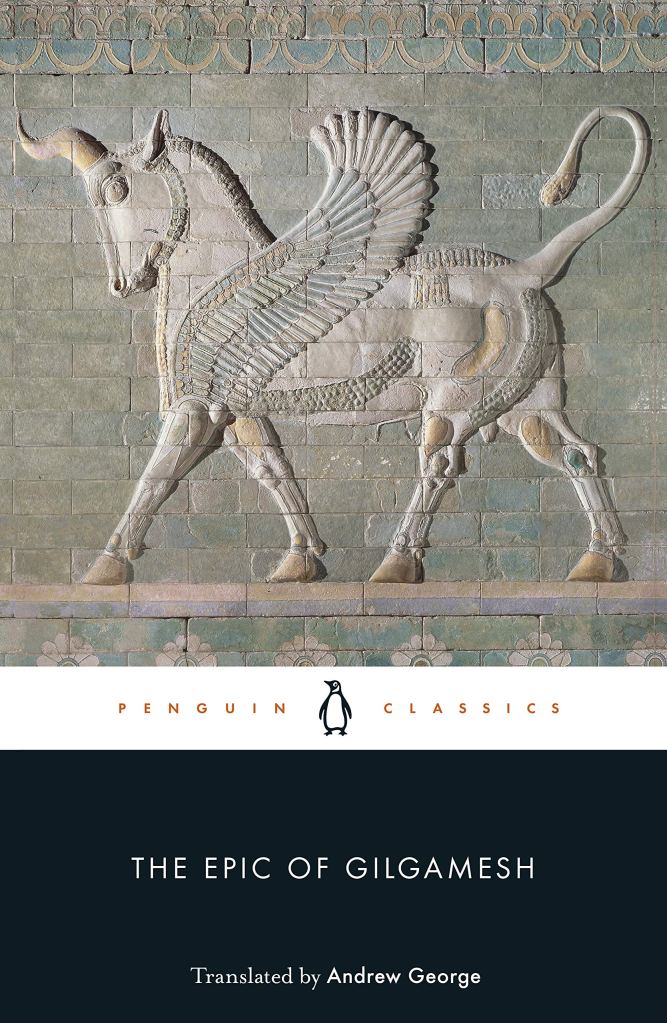
Like George, my first introduction to Gilgamesh was the narrative prose synthesis by N.K. Sandar, The Epic of Gilgamesh. George read the 1960 copyrighted version in the Penguin Book series whereas I read the 1972 revised copyrighted version (reprinted in 1981). Also, like George, I have been enthralled by the epic ever since; although, admittedly, he more so since he devoted his life to Assyriology and teaching the Akkadian and Sumerian language and literature. Indeed, his inspired, scholarly translation of the work, The Epic of Gilgamesh, referenced above, was also published by Penguin Books (©1999, 2003, 2020), and is likely my favorite translation.
The life that you seek you will never find:
The Epic of Gilgamesh (2020), A. George, p. xlv
when the gods created mankind,
death they dispensed to mankind,
life they kept for themselves.
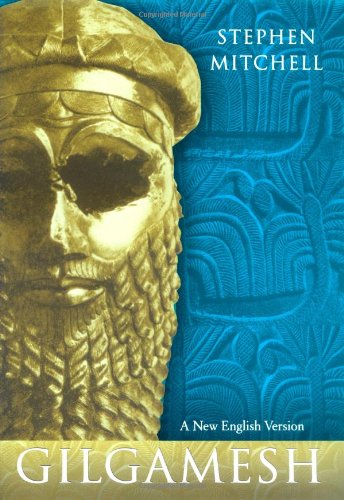
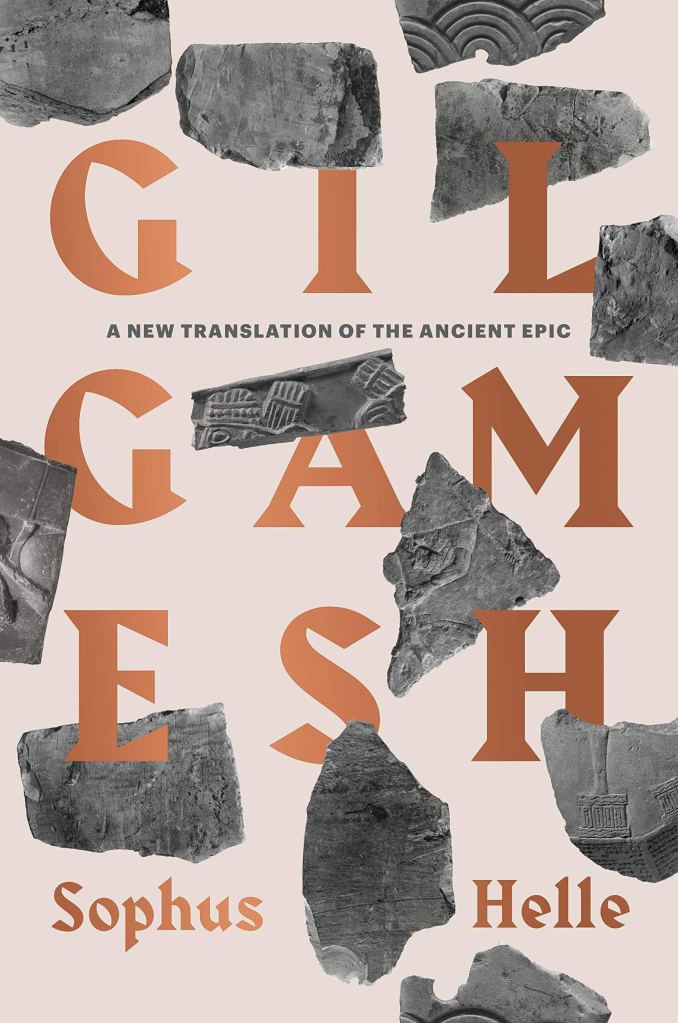
Two other translations of the poem in my library, both meritorious and worthy of note, include the recently published Gilgamesh: A New Translation of the Ancient Epic, by Sophus Helle (2021), which sought to strike a middle ground between George’s scholarly translation and the “translations of translations,” which can be used to described the other work in my library, Stephen Mitchell’s Gilgamesh (2004). Harold Bloom described Mitchell’s version of Gilgamesh as the “best I have seen in English” at the time it was published.
Gilgamesh is a well I go to for reflection and creative thought repeatedly. This is not surprising, as The New York Review of Books concisely notes that Gilgamesh inspires reflection and creativity on a multiplicity of levels:
In the century and a half since its rediscovery, however, and especially since World War II, Gilgamesh has made up for lost time. It has been translated into at least two dozen languages and been the inspiration for countless works of theater, film, poetry, fiction, and visual art. Musical responses to Gilgamesh include several operas, a ballet, hip-hop, jazz fusion, and an ear-pummeling track called “Gilgameš” by the Greek extreme metal band Rotting Christ.
Gilgamesh has also been acclaimed as the earliest work of ecological literature and included in The Columbia Anthology of Gay Literature as a founding text of queer writing, for its treatment of the relationship between Gilgamesh and his wild-man friend, Enkidu. The cultural energy of Gilgamesh shows no sign of dimming; the novelist Naja Marie Aidt describes it as a “fireball” that “has torn through time,” constantly in a process of reentry to the present.
New York Review of Books (October 20, 2022), “A Fireball from the Sands,” by Robert Macfarlane.
Some of my favorite more recent creative endeavors include two musical works. The first is a Lament on the Death of Enkidu, set to music and sung in Akkadian, based on the poetry of the epic. Peter Pringle, the creator, notes that he was helped along in his pronunciation of the Akkadian by Dr. George. It is simply stunning. Take a moment to listen and reflect on your mortality.
The second is a nod to the ecological message that many find in the epic related to the consequences of the indiscriminate felling of the cedar forest in Lebanon. As explained in the New York Review of Books:
During the UK’s pandemic lockdown, [Robert] Macfarlane cowrote an album with the singer-songwriter and actor Johnny Flynn, Lost in the Cedar Wood. They collaborated on lyrics, sharing photos of notebook pages while in their respective homes, and Flynn would set them to music. “It felt like a wild wonder, to be able to feed words into the Johnny Flynn Song Machine and get a demo back a few days later!”
In addition to daily life in lockdown, the album is inspired by the Epic of Gilgamesh: “We wanted to write something both ancient and urgent,” said Macfarlane. “At the heart of Gilgamesh is the story of an unwise ruler, Gilgamesh himself, taking his axe to the Sacred Cedar Wood and felling these extraordinary trees. A few months after we began work on it, the Fairy Creek calamity started to unfold on Vancouver Island, with the premier of British Columbia, John Horgan, allowing the logging of the old-growth cedar forest there, including trees up to 2,000 years old.” Lines like “It was the first of the tellings/Of all of the fellings” (from the song “Tree Rings”), while unfortunately evergreen, took on a particular significance.
New York Review of Books (July 10, 2021), Ramblin’ Man. Robert Macfarlane, interviewed by Willa Glickman.
To circle back to the beginning, this remarkable creativity is very much, I believe, the result of the creativity and authorship of the ancient editor of the Epic of Gilgamesh, Sîn-lēqi-unninni. He deserves more credit for the depth and reflection which is inspired by the ancient epic in its most familiar form. Let us celebrate his memory every time we read the epic or enjoy any of its derivative inspirational works.

 Northcoast Antiquarian