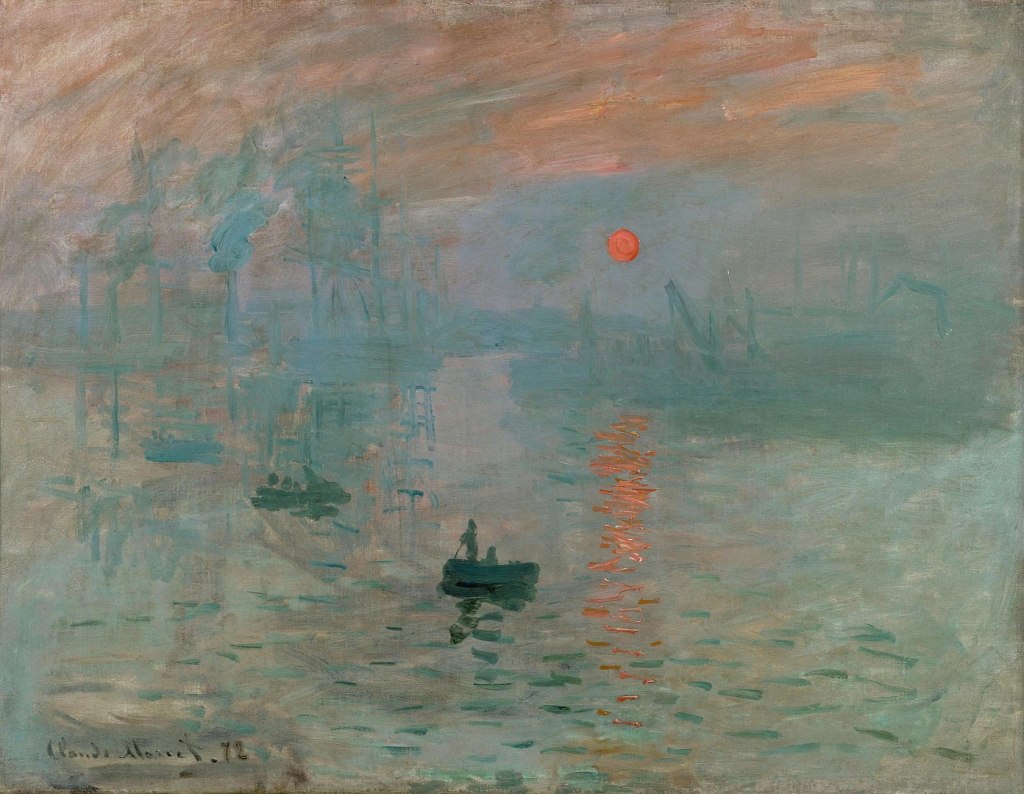
Impression, Sunrise (oil on canvas, 1872) by Claude Monet. The painting’s subtle interplay of light, color, and form mirrors the delicate balance required in crafting a well-written sentence, paragraph, or tale. The art of communication on canvas.
Language is beautiful. Every language, I imagine, holds within it a unique splendor, a symphony of sounds and meanings that resonate with the human experience. It is a medium of endless subtlety and flexibility, capable of expressing the most nuanced thoughts and the deepest emotions. A single word or phrase can carry extraordinary weight, encapsulating the full spectrum of human expression, from the profound to the mundane.
Language is a vessel for wisdom, humor, and frivolity alike. With just a few well-chosen words, one can impart lessons that echo through time, evoke laughter that lightens the heart, or create moments of joy that linger in the memory. It is delicate, yet strong—able to convey the lightest touch of affection or the heaviest burden of sorrow.
Yet, the true power of language lies in the words themselves. Words are the building blocks of language, each one a gem with its own distinct hue, tone, and resonance. While some may not give much thought to their choice of words, and are indifferent or careless in their selection, I hold that choosing the right word is an art of the utmost consequence. Every word carries its own timbre, a unique vibration that justifies its existence in a sentence, distinguishing it from others that may seem similar on the surface but convey subtly different meanings.
To me, words are not mere vessels of communication, but carefully chosen notes in the symphony of expression. The nuances between synonyms are not trivial; they are the very essence of precision in language. It is this precision that breathes life into writing, allowing it to resonate with readers in the way that only the perfect word can. In the delicate interplay of vocabulary, each word plays its part, contributing to a harmony that is richer and more meaningful than the sum of its parts. This meticulous selection is not just a preference but a necessity for the craft, as it ensures that the language not only conveys a message but does so with the exact emotion, clarity, and impact intended.
My particular fondness lies with the written word, for I find that I am no longer the extemporaneous orator I once was, no longer as quick in constructing or articulating speech. Above all, I aspire to become more artful in the crafting and presentation of my writing, so that it may be more pleasing both when read and recited. In this pursuit, I seek to imbue each phrase with the perfect blend of sound and meaning, creating a text that is not only clear but also resonant—a true expression of the beauty that language, at its best, can achieve. To be sure, I shall often falter in this endeavor, particularly after having written daily primarily as an attorney for over thirty years, but it is my earnest hope that, with continued practice, the failures will diminish and the successes will grow more frequent.
Swallow and Peony (woodblock print, pre-1945), Ohara Koson (1877-1945).
The Nightingale and the Rose
In a secluded grove, hidden deep within an ancient forest, there lived a nightingale whose song was unmatched by any other creature. Every evening, as the sun dipped below the horizon, the nightingale would perch on a high branch and sing, filling the air with melodies so beautiful that even the stars seemed to pause and listen.
In the center of the grove grew a single rosebush, its flowers the color of a blush at dawn, delicate and fragrant. The nightingale loved the rosebush with all its heart, for it saw in the rose a beauty that mirrored its own song. Night after night, the nightingale would sing to the rose, hoping that the rose might hear the song and return its love.
But the rose, though beautiful, was unaware of the nightingale’s affection. It stood rooted in the earth, its petals turned toward the sun, drinking in the light and warmth. The rose did not understand the nightingale’s song, for it had never known love beyond the gentle caress of the morning dew or the kiss of the afternoon breeze.
One night, as the nightingale sang its most heartfelt melody, the moonlight filtered through the leaves, casting a silvery glow over the grove. The nightingale, filled with longing, poured all its love into the song, hoping to reach the rose’s heart.
The rose, touched by the nightingale’s song, began to stir. Its petals trembled, and for the first time, it felt something more than just the sun’s warmth or the wind’s touch. It felt the nightingale’s love, pure and unyielding. But the rose could not return this love in the way the nightingale desired. It could only bloom as it always had, beautiful but distant, its heart locked away in its delicate petals.
The nightingale, realizing that the rose could never love it as it loved the rose, sang one final song, a song of acceptance and farewell. It was a song that spoke of the beauty of love, even when unreturned, and of the joy in loving without expectation.
As the nightingale’s song faded into the night, the rose shed a single petal, a silent token of its appreciation for the nightingale’s devotion. The nightingale, with a heart full of love but no bitterness, flew away into the night, knowing that its love, though unrequited, had been true and pure.
The rose continued to bloom, its beauty admired by all who passed, but it was never the same after that night. It had been touched by the nightingale’s love, and though it could not return it, the memory of that love remained within its petals, giving them a deeper, more resonant hue.
Moral of the Fable
Love, even when unreturned, is a gift that enriches both the giver and the recipient. True love is selfless and does not demand reciprocation, finding its own beauty in the act of loving.
A Lyrical Treat Inspired by the Fable
A Four Stanza “Poem” based on the Fable set to a medieval-folk theme. Lyrics by Donald S. Yarab, Music by Udio.com.
Le rat de ville et le rat des champs (engraving from Book I, Fable IX, Fables de La Fontaine avec les dessins de Gustave Doré, 1867) by Gustave Doré (1832-83).
In contemplating my deep appreciation for reading and, more recently, writing fables, I find that these concise narratives, though brief, demand a mastery of language that is both artful and precise. The essence of a fable lies in its ability to convey profound moral lessons within the confines of a few well-chosen words, a task that requires the storyteller to employ language that is rich in metaphor and layered with meaning. Unlike a novel or even a short story, a fable’s economy of expression does not diminish its impact; rather, it enhances the potency of its message. The challenge and joy of crafting such a tale lie in the careful selection of words that resonate with readers of all ages and backgrounds, evoking emotions and intellectual insights that extend far beyond the surface of the text.
Moreover, the fable’s ability to transcend its limited word count is akin to the skill of a master artist who, with a few deft strokes, can create a visual masterpiece that captivates and educates. A master artist, much like a skilled fable writer, transcends the literal confines of their medium, whether it be canvas, paper, or marble. Their work is not merely a representation of reality, but an evocative expression that stirs the viewer’s emotions, provokes thoughtful interpretations, and invites intellectual exploration. Through the careful selection of color, composition, and form, the master artist imbues the visual elements with a depth that speaks to the human condition in ways that are both subtle and profound. The true artistry lies in this ability to craft a visual narrative that compels the observer to look beyond the surface, uncovering layers of meaning and insight that resonate long after the initial encounter. In this way, the artist’s canvas becomes a gateway to a richer understanding of the world, much as the carefully chosen words of a fable reveal truths that extend far beyond their brevity.
It is also why I often choose to illustrate each fable I create with a carefully selected work of art. The artwork not only complements the story but also symbolizes the underlying lesson, even if only metaphorically.
The master weaver of fables must tell a compelling story as they intricately weave a fine lesson into the tapestry with limited threads, but threads of extraordinary and precious value. Each word, each phrase, contributes to the intricate design of the narrative, ensuring that every element is essential to its overall impact. In this way, the fable becomes not just a story, but a distilled form of wisdom, crafted with precision and care, imparting lessons with an elegance and economy unmatched by other literary forms. It is this confluence of art and intellect that makes the reading and writing of fables a deeply rewarding pursuit, one that continues to captivate my imagination and inspire my creative endeavors.
The act of writing for others is often fundamentally narcissistic, driven by the desire to impress or profit. Academic scholars and artists are cited as examples of this tendency, with their use of language and prose serving to elevate their own status rather than effectively communicate with diverse audiences. This points to a broader issue within academic and artistic discourse, reflecting a deeper narcissism that pervades all writing and creative work. The challenge lies in balancing inherent self-focus with a genuine commitment to clarity and accessibility, ultimately creating works that are intellectually enriching and broadly impactful.
Writing for others is, except in the most exigent of circumstances, a fundamentally narcissistic act. The words we compose for others may be necessary, convenient, expedient, pleasing to the reader, and otherwise desirable. However, ultimately, writing for others is an act of narcissism, akin to all creative endeavors by which we seek to express ourselves, profit, or impress others.
If one writes with style, erudition, clarity, and aplomb, while simultaneously instilling a semblance of humility within that writing, one has grasped a technique that few have contemplated and fewer still have mastered. In a previous posting, it was noted that the Ursuline sisters early on admonished me and the other students at St. Luke Elementary School to avoid the perpendicular pronoun, and other first-person personal pronouns, at or near the beginning of sentences. Thus, contemplation of humility in writing persists, though I am fairly confident that I have not grasped this technique with any modicum of success.
The above is a precursor to commentary on some academic writing that I have observed in the past several weeks.
The first example is the most recent I have encountered and served as motivation to write this post. The text reads as follows:
“Or consider Matthäus Schwarz of Augsburg, who while still a child, at the age when the young Dürer painted his first known self-portrait, conceived the ambition of writing an autobiography, an ambition that would become a reality fifteen years later, after he had become chief financier for the Fuggers at age twenty-five. At that time he wrote an account of his private life entitled The Way of the World and simultaneously painted watercolors of himself in various costumes. A more narcissistic project can hardly be imagined. This brilliant mind, this confidant of one of the most powerful men of his time, led a full life yet deliberately chose to indulge himself by concentrating his attention on appearances and frivolities. Having achieved success, the adult cast an eye back on his childhood. His sentimental and mordant commentary suggests what feelings the men of the Renaissance, after generations of self-absorbed literature, harbored toward their youth.” (Braunstein, P. (1988). Towards intimacy: The fourteenth and fifteenth centuries. In G. Duby & P. Ariès (Eds.), A history of private life: Revelations of the medieval world (A. Goldhammer, Trans., Vol. II, pp. 555-556). Harvard University Press.)
How extraordinary it is that Professor P. Braunstein, a Frenchman writing in an age dominated by photography, high couture fashion, vapid celebrities, and best-selling autobiographies of such celebrities, could pen such a paragraph while seemingly unaware that his own writing—signed, no less—in the liberal arts, particularly medieval history, could likewise be called a frivolous indulgence and a narcissistic undertaking. Today, many would label the good professor an unproductive idler while viewing Schwarz of Augsburg as critical to economic prosperity as the accountant for one of the most important merchant and financier families of the era.
The second example, in two parts from another professor, comes from the first volume of the work cited above. After noting the Roman urban nobility’s preference for idleness and its adherence to rigid class distinctions, the author observes:
“True, we believe that work is respectable and would not dare to admit to idleness. Nevertheless, we are sensitive to class distinctions and, admit it or not, regard workers and shopkeepers as people of relatively little importance. We would not want ourselves or our children to sink to their station, even if we are a little ashamed of harboring such sentiments.” (Veyne, P. (1987). The Roman Empire. In P. Ariès & G. Duby (Eds.), A History of Private Life: From Pagan Rome to Byzantium (Vol. I, pp. 118). Harvard University Press. (A. Goldhammer, Trans.).)
The same author, reflecting the peculiarities of his class and profession, later indulges in sweeping generalizations, as evidenced by this statement:
“Apart from this proverbial wisdom of the people, Rome had an oral tradition of common sense, a tradition shared by all classes of society and pertinent to every sort of problem. It was a veritable philosophy, like Marxism or psychoanalysis, the two varieties of common sense most prevalent in the West today.” (Veyne, P. (1987), p. 178.)
Professor Veyne displays remarkable narcissism in both extracted statements, presuming that the reader shares his class prejudices against shopkeepers and workers, and embraces his social biases favoring Marxism and psychoanalysis. He scarcely considers that the reader may come from a different class or social background than his own, which is likely the case for the volumes translated into English. This vanity is compounded further when these assumptions are inserted without thought or hesitation into a scholarly work, which should strive to reflect objectivity rather than the exclusivity of social and class status, bias, and prejudice.
The third, and final, example is of a different sort—academic jargonistic exclusionist vocabulary. Or perhaps it is just muddled, unedited writing. In any event, the Cleveland Museum of Art (CMA) issues Cleveland Art: The Cleveland Museum of Art Members Magazine quarterly to communicate information about its exhibits and calendar events. Curators with appropriate academic backgrounds write many of the articles. One such article recently caught my attention due to the density and near inaccessibility of its prose for the average reader. The article discussed an art project which will be exhibited in the CMA’s atrium, which has been “activated with contemporary art at various points.” The latest project, and the artist selected for it, was discussed by the curator:
“Her signature ceramic figures represent a bold intervention in colonial legacies of dependency, erasure, and assimilation. The influence of her identity as a Native woman is evident in her work, but she balances her deep rootedness in her heritage with modern methods, materials, and processes, incorporating elements like metal and Pumice-Crete along with clay.” (Fellah, N. R. (2024). Rose B. Simpson’s Strata. Cleveland Art: The Cleveland Museum of Art Members Magazine, 65(2), 9.)
Academic concepts such as dependency, erasure, and assimilation within colonial legacy are not self-explanatory, and those with different educational experiences than the curator or artist may not grasp the meaning of the above, though they could hope to understand it were the presentation less muddled. For my undergraduate honors thesis, I researched and wrote on the socio-political-economic theory of dependency, and I found myself tripping over the excerpt, rereading it at least three times to discern the intent.
Given that the Cleveland Museum of Art has among its organizational values the statement, “Build an audience-centered culture,” and it states in its summary of its strategic plan that, “We must continue to enhance the visitor experience, affirming the welcome we extend to everyone who walks through our doors and providing joyful and enriching encounters with art for schoolchildren, teens, college and university students, families, and older adults,” it is peculiar that it would use highly academic, almost inaccessible language in a general publication. How much more accessible would it have been to write the above in a more straightforward, less narcissistic “I am an academic with a degree” style, such as:
“Her unique ceramic figures make a strong statement against the negative effects of colonialism, such as making people dependent, erasing their cultures, and forcing them to assimilate. You can see her identity as a Native woman in her artwork, where she mixes her deep connection to her heritage with modern techniques and materials. She uses things like metal and Pumice-Crete, along with clay, to create her pieces.”
The above rewrite may not fully explain the concepts of dependency, erasure, and assimilation, or the effects of colonialism, to readers not wholly familiar with them, but I suspect they would have a better sense of the meaning after reading the above than the original excerpt.
While scholarship and creativity inherently involve a degree of self-expression, they should not devolve into exercises in vanity that alienate the very individuals they purport to enlighten. If institutions like the Cleveland Museum of Art truly aim to build an audience-centered culture and enhance visitor experiences across all demographics, then it is incumbent upon them to adopt more accessible language. This shift would not only foster greater inclusivity but also ensure that the profound messages and insights contained within their works are appreciated by all, not just a select few.
The examples provided illustrate a broader issue within academic and artistic discourse: the propensity for language that obfuscates rather than clarifies, and for prose that serves to elevate the writer’s own status rather than communicate effectively with a diverse audience. This tendency reflects a deeper narcissism that pervades all writing, and much scholarly and creative work, where the desire to impress often overshadows the imperative to inform.
In revisiting the notion that writing for others is fundamentally a narcissistic act, it becomes evident that the true challenge lies in balancing this inherent self-focus with a genuine commitment to clarity and accessibility. The measure of effective writing lies in its ability to resonate deeply and universally, transcending the bounds of the page and embracing a shared human experience. By mitigating narcissistic tendencies, we can create works that are not only intellectually enriching but also broadly impactful and inclusive.
This short observation notes that professors and many others believe they can identify AI-assisted writing based on vocabulary use, such as “delve,” “interplay,” “intricate,” and “captivated.” The writer reflects on using such words since the 1980s, suggesting subconscious AI use and critiques modern educators for favoring simplistic writing over complex prose. Additionally, he discusses the modern tendency to overestimate individual abilities in various tasks, such as pandemic response and legal document writing.
Earlier this morning, I read an article asserting that many professors are confident in their innate ability to identify papers authored with the assistance of CHATGPT and similar artificial intelligence tools. The article’s comments section revealed widespread agreement among its readers that they could do the same. It appears that one of the primary indicators of AI-generated content in their collective minds is the use of certain vocabulary, including words such as “delve,” “interplay,” “intricate,” and “captivated.”
This conclusion struck me as somewhat amusing, as it suggests that I have been subconsciously employing artificial intelligence in my writing since the 1980s. It seems AI must have been implanted in my psyche at birth, only to be activated when I commenced my collegiate writing endeavors. Upon reviewing several of my papers from that era, as well as some recent compositions, I noticed the word “delve” frequently appearing, often within the introductory paragraph. By contemporary academic standards, it appears I would be accused of plagiarism frequently, and without merit, by today’s professors, whom I consider to be lacking in literacy, vocabulary, and style.
These modern educators seem to favor a style of writing that is monosyllabic and nearly without style, characterized by grunts and groans, rather than the intricate and complex prose that I believe leads to captivating reading and meaningful conclusions.
It further reminds me of the modern predilection of individuals to overestimate their ability to perform almost any task, whether it be land an airplane, conduct research on how best to respond to pandemics (as opposed to, say, listening to individuals who studied for years at University on the topic), or writing that complex legal document that attorneys labor for hours to write precisely to avoid unpleasant surprises later even if it seems like something anyone should be able to jot off in minutes.




 Northcoast Antiquarian