Ferocious Irish Bees, the Book Of Aicill, and the Origins of Money

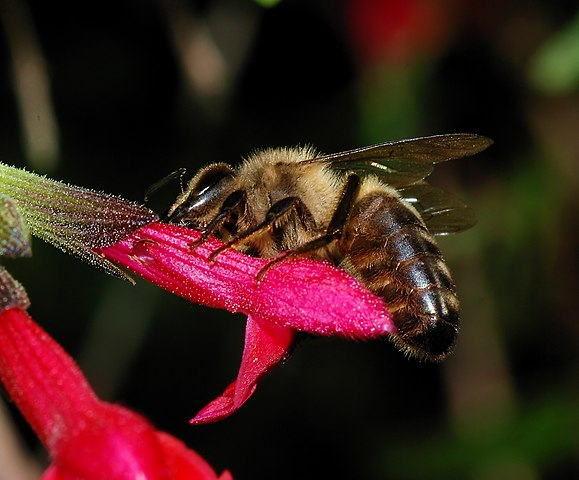
apis mellifera mellifera - northern dark bee - only native honey bee of Ireland
For Ireland, there is only one native honey bee, a sub-species called Apis mellifera mellifera or the Northern dark bee. Photograph by Alvesgaspar.

In The Origins of Money (Philip Grierson.  The Origins of Money. Research in Economic Anthropology, Vol. 1, 1978, pp. 1-35), Grierson, in discussing the origin of monetary values, noted that monetary values pre-existed market economies and that monetary values were well-attested as existing in “customary” and “command” pre-market societies.  He stated that “[i]n such societies [monetary values] provided a scale for evaluating personal injuries in the institution which the Anglo-Saxons termed the wergild, and it is in this institution that the origin of money as a standard of value must, I believe, be sought.  The practice of wergild, that of paying a compensation primarily for the killing of a man but the term by extension covering compensations for injuries to himself or his family and household, is most familiar to us in its Indo-European setting” (p.12).  Grierson proffers various supporting evidence for his thesis, but one linguistic and one quite trivial and ancillary struck my fancy.  

Grierson’s linguistic argument presents concisely and rather convincingly the connection between monetary value and its compensatory use in its opening paragraph (although, I note, that his evidence, linguistic and otherwise, does not, of course, dilute other arguments for the origins of money that are often discussed that are unrelated to markets):

“Our best approach to the problem is through the testimony of language, often the most revealing key to the structure of early societies.  It has naturally not been neglected by writers on early money.  Everyone is familiar with the connection of pecunia and pecus – this was known to the Romans themselves – of fee and O.E. feoh, cow (mod. Germ. Vieh), of the derivation of shilling and rouble (rubl’) from verbs meaning to cut (skilja, rupit’. i.e., pieces of precious metal), of the relationship of talent, lira, and pound with the process of weighing metal.  What we are concerned with, however, are not particular units but the notion of money in general and how it was first used.  Much of our own vocabulary is borrowed from Latin by way of French and is not relevant to Germanic antiquities, though one may note in passing that pay comes through Fr. Payer from Lat. pacare “to pacify” ‘to make peace with,” and that behind the idea of appeasing your creditor lies the more revealing pacere, to come to terms with the injured party. Si membrum rupsit, ni cum eo pacit, talio esto, “If a limb is injured, unless peace is made with him (i.e., with the injured party, by paying compensation), there shall be retaliation,” was the Roman doctrine, as set out in the Law of the Twelve Tables” (footnotes redacted, pp. 15-16).

After exploring his linguistic argument, Grierson noted that it might be difficult to generalize from the available “compensatory law codes” for the pre-market Germanic, Celtic and Russian societies to other early pre-market Indo-European societies but he noted that the available codes provide an extraordinary wealth of detail.  In this regard, he noted that the compilers of the codes “sometimes seem to be trying to provide for every contingency, of however improbable a nature.”  “The other is their occasional frivolity, for some of their provisions, especially in the Celtic codes, must have been inserted more or less in fun.  How else can one explain … the responsa of Cormac Mac Art and Cennfaeladh in the Book of Aicill providing compensations for bee stings – Irish bees were apparently of unexampled ferocity – but allowing a deduction of the value of a bee from the compensation if the bee was killed by the injured party?  Clearly such provisions were not meant to be taken seriously” (p 17).

The unexampled ferocity of Irish bees had me immediately scampering to find out more about the Book of Aicill, its authors, and precisely what it said about Irish bees and how their attacks were to be compensated.  Having examined the Book of Aicill, I would disagree that frivolity was intended.  Either the section was intended in earnest or was intended as an example of how an arbiter should reason through similar, but perhaps more likely and just as serious, injuries.  For here is what the pages dedicated to the ferocious Irish bees said in the book:   

Injuries in the case of bees. That is, a hive is the fine for the blinding, and two hives for the killing of a person; and a book mentions the hive for the blinding, and it does not mention two hives for the killing; but as there is twice the ‘eric’-fine due from a person for killing a person that there is for blinding him, it is right from this, that it is twice the ‘eric’-fine which is due from a bee for blinding him that should be due for killing him. A man’s full meal of honey is the fine for drawing blood; a fifth of the full meal for an injury which leaves a lump, three-fourths of it for a white blow which leaves a sinew in pain, or green, or swollen, or red; if it be one or two of these injuries that are present, it (the penalty) is one-fifth with half one-fifth; one-fifth only for his natural white wound. A hive is the fine for the death-maim necessitating the removal of a limb, but if there be no removal of a limb, it (the fine) is a hive, less one-seventh; two-thirds of it for a ‘cumhal’-maim; one-third of it for a tent-wound of six ‘seds’; one-sixth or one-seventh part is to be added to it for the tent-wound of seven ‘seds.’

From the owners of the bees these fines are due for the persons. What shall be due from the persons for the bees? If the person has killed the bee while blinding him or inflicting a wound on him until it reaches bleeding, a proportion of the full meal of honey equal to the ‘eric’-fine for the wound shall be remitted in the case; the remainder is to be paid by the owner of the bee to the person injured. If the person killed the bee while inflicting a white wound upon him, they (the fines) shall be set off against each other. If the person killed the bee while inflicting a lump-wound on him, four-fifths of the fine shall be remitted, and one-fifth paid. If it was while inflicting a white wound which left a sinew under pain, or green, or swollen, or red, he killed the bee, three-fifths of the fine are to be remitted, and two-fifths paid. If it was while inflicting one or two of them (the wounds) he killed the bee, half one-fifth is to be remitted, and one-fifth paid. From the owners of the bees these fines are due for the persons, and from the persons for the bees. What shall be due from the owners of the bees for the animals injured, and from the owners of the animals for the bees? If the bee has blinded or killed the animal, what shall be the fine for it? The proportion which the hive that is due from the owners of the bees bears to the fine for their blinding the person, or which the two hives that are due for their killing him bear to the natural body-fine of the person, is the proportion which the full natural dire-fine of the animal shall bear to that fine which shall be due from the bee for blinding or killing it (the animal). One-half of what is due for killing it is due for blinding it, or inflicting a death maim which necessitates the removal of a limb; if there be no removal of a limb, it (the fine) is one-half, less half one fifth, if it be a quadruple animal; or one-half, less the half of one-half, if it be an animal of double. Two-thirds of this are due for a ‘cumhal’-maim; one-third for a tent wound of six ‘seds’; and an equivalent of a sixth or seventh part is to be added to it for a tent- wound of seven ‘seds,’ over and above what shall be due for the tent-wound of six ‘seds.’

What shall be due from a bee for making the animal bleed? The proportion which the full meal of honey that is due from a bee for making a person bleed bears to the hive that is due from it for killing him, is the proportion which the ‘eric’-fine for blinding or killing the animal bears to that which will be due from a bee for making it bleed, i.e. four-fifths is the proportion for its lump-wound, three-fifths for its white wound which leaves a sinew in pain, or green, or swollen, or red. If it be one or two of them that are inflicted, it (the fine) is two-fifths and half one-fifth. Two-fifths is the proportion for a natural white wound. From the owners of the bees these fines are due for the animals. What shall be due from the owners of animals for the bees? If the animal killed the bee while in the act of blinding it, or killing it, or inflicting a wound upon it until it reaches bleeding, a proportion of the ‘eric’-fine for the wound equal to a full meal of honey shall be remitted, and the remainder shall be paid by the owner of the bee to the owner of the animal. If it was while in the act of causing the animal to bleed it (the animal) killed the bee, they i.e. the bleeding of the animal and the killing of the bee, shall be set off against each other; or else, indeed, according to others, the difference which is between causing a person to bleed and causing an animal to bleed is the difference that shall be paid by the owner of the animal to the owner of the bee. If it was while inflicting a lump-wound on it the bee was killed, four-fifths shall be remitted, and one-fifth, the difference, paid. If it was while inflicting a white wound which left a sinew in pain, or green, or swollen, or red, the bee was killed, three fifths shall be remitted, and two-fifths, for the difference, paid. If the bee was killed while inflicting one or two of them (the wounds), two-fifths and a half shall be remitted, and two-fifths and a half, for the difference, paid. If the bee was killed while inflicting a natural white wound on it (the animal), one fifth shall be remitted, and four-fifths, for the difference, paid.

If there were many gardens, or if there were many bees, lots are to be cast to discover from which garden the injury was done; and when it shall have been discovered, if there were many possessions in that garden, lots are to be cast on them till the particular possession be discovered from which the injury was done; and when it shall have been discovered, if there were many hives’ in that possession, lots are to be cast upon them until the particular hive from which the injury was done shall have been discovered. And the reason why this is done is, that a bad hive may not be given in place of a good hive, or that a good hive may not be given in place of a bad hive; but that the very hive from which the injury was done may go for the injury. If it was intentionally or inadvertently in unlawful anger the person killed the bee, a man’s full meal of honey shall be given as compensation, and four full meals as dire-fine. If it was inadvertently in lawful anger he killed the bee, a man’s full meal of honey is given as compensation, and two full meals as dire-fine. If it was through unnecessary profit he killed the bee, only a full meal of honey is given as compensation. This is due from the bees of a native freeman for a person; the half thereof from the bees of a stranger; a fourth of it from the bees of a foreigner; there is nothing due from the bees of a daer-person, until it reaches sick maintenance or compensation, or, according to others, even when it does. From the bees of a native freeman this is due for a person; four-sevenths thereof from the bees of a stranger; two-sevenths and one-fourteenth from the bees of a foreigner; there is nothing due from the bees of a daer-person, until it reaches sick maintenance or compensation, or, according to others, even when it does. From the bees of a native freeman this is due for a cow; the half thereof from the bees of a stranger; a fourth of it from the bees of a foreigner; and there is nothing from the bees of a daer-person until it reaches sick maintenance or compensation, or, according to others, even when it does. From the bees of a native freeman this is due for a horse; half thereof from the bees of a stranger; a fourth of it from the bees of a foreigner; and there is nothing due from the bees of a daer-person until it reaches sick maintenance or compensation, or, according to others, even when it does. From the bees of a native freeman this is due; a fourth thereof from the bees of a stranger; a half and a seventh from the bees of a foreigner; an exact half from the bees of a daer person.

Ancient Laws of Ireland, Vol. III, Dublin, 1873, pp. 433-441.

The sophistication of the compensatory structure regarding damages for injuries from bees discussed in the Book of Aicill does not strike me as being as frivolous as Grierson suggested when one considers that the temperature of a cup of coffee from a fast food franchise which spills onto an elderly woman, an incident deemed by many frivolous, can justifiably make a successful $2.9 million tort claim in the American legal system (Andrea Gerlin. A Matter of Degree: How a Jury Decided That a Coffee Spill Is Worth $2.9. Wall Street Journal. September 1, 1994). So perhaps the sagacity and foresightedness of authors of the Book of Aicill were greater than Grierson and others perceived.

As to the authors, Laurence Ginnell (Laurence Ginnell. The Brehon Laws: A Legal Handbook. T. Fisher Unwin, London, 1894), provided a colorful, even if antiquated background, for them and the Book of Aicill in his legal handbook well over century ago. I quote liberally from therein:

The whole of the Book of Aicill is composed of the opinions or placita of two eminent men, illustrious in law and in other respects: The first was King Cormac mac Airt, otherwise called Cormac ua Cuinn; the second was Cennfaeladh the Learned. Cormac was one of the most deservedly celebrated of the monarchs of ancient Erinn. He was Ard-Rig from A.D. 227 until 266 (according to others from 218 until 260). He was, as his names signify, the son of Art and the grandson of Conn of the Hundred Battles, both monarchs of Erinn, and he was the father of Cairbre who may be said to have succeeded him, the very short reign of Eochaidh alone intervening. He was also the father of Grainne, celebrated in the Fenian poetry of Oisin and his contemporaries. In youth he was violent enough, perhaps unscrupulous in pursuit of power; but his subsequent life proved that his ambition rose from the solid basis of ability to rule men; and to this extent, as also by the use he made of power when acquired, he justified himself. He was a great reformer of the national institutions of his time, civil and military, including the Feis of Tara; and most of the traces of its former greatness now existing at Tara are attributed to his time. Consistently with his reforming spirit, he was a great patron of literature, art, and industry, the first of whose patronage we have undoubted evidence. He either wrote himself or procured the writing of several works on law, history, and other important subjects. Some of these works on subjects other than law were still extant so late as the seventeenth century, but appear to have been since destroyed or lost. Among the useful things for which the country was indebted to Cormac was the introduction of the water-mill. He had the first mill erected on a small stream on the slope of Tara. He was a man in many respects far in advance of his time. Though living long before Saint Patrick’s arrival, and king of a pagan nation, there is reason for thinking that he was a believer in Christianity before his death. He at all events ceased to believe in the pagan gods. …

According to one Gaelic authority Cormac was the author of the text of the Book of Aicill throughout, and Cennfaeladh afterwards modified and commented on the whole of it, besides adding some of the case law which had grown up in the interval. And I am inclined to think that this view is correct. However, the introduction to the Book of Aicill gives a different account, and naturally it is that usually accepted. It begins thus: “The place of this book is Aicill, close to Tara, and its time is the time of Coirpri Lifechair (Carbre of the Liffey), the son of Cormac, and its author is Cormac, and the cause of its having been composed was the blinding of the eye of Cormac by Aengus Gabhuaidech.” Owing to the loss of his eye, Cormac became incapable under the Irish law of retaining the sovereignty, “because it is a prohibited thing for one with a blemish to be king at Tara.” The sovereignty was transferred to his son, after a temporary usurper had been got rid of, and Cormac retired to Aicill, now called Skreen, near Tara. It is stated that in difficult cases he was consulted by his son the young king. However this may be, a great deal of the Book of Aicill is written as if in answer to questions submitted, and the answer in each case begins with the words, “My son, that thou mayest know.”

It was on account of this injury to his eye that Cormac expelled the Deisi from the district in Meath still from them called Deece, and drove them to Munster where they settled and gave their name to a district there also.

Having told where, when, on what occasion, and by whom, the book was first written, the introduction proceeds: “These were the place and time of it as far as regards Cormac. But as regards Cennfaeladh, its place is Daire Lurain (now Derryloran, in Tyrone), and its time was the time of Domhnall, son of Aedh, son of Ainmire; and its author was Cennfaeladh, son of Oilell, and the cause of its being composed was that part of his brain was taken out of his [Cennfaeladl1’s] head after it had been split in the battle of Magh Rath.” The Domhnall (Donal) in whose reign this occurred was monarch of Ireland and fought the battle of Magh Rath (now Anglicised Moira) in A.D. 634 (? 642) against Congal Claen, king of Uladh.

The foregoing statements are remarkably clear and explicit. They represent the Book of Aicill as the production of two authors, one writing in the third century, the other in the seventh. Notwithstanding this, Sir Henry Maine, the standard authority on ancient law, in his learned discoveries of “village communities” where they never existed, represents Cennfaeladh as assisting Cormac! Worse still, I find an Irish author saying gravely that Cormac was just the man to appreciate Cennfaeladh’s services! Granted that Cormac was highly endowed, still the power of appreciating services rendered more than three hundred years after his own death can hardly be conceded even to Cormac mac Airt; and if he had such power, any express recognition of Cennfaeladh’s services would then have been rather premature.

Laurence Ginnell. The Brehon Laws: A Legal Handbook. T. Fisher Unwin, London, 1894. p. 177.

In future, after considering the above, when confronted with a ferocious Irish bee, you may have occasion to reflect on the Book of Aicill and the ultimate origins of money. And, more importantly, if in future you are injured by said ferocious Irish bee, you will know what compensation you may seek for redress for the injury inflicted from the owner of the hive of the mischievous bee.

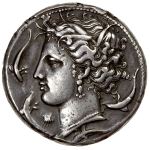
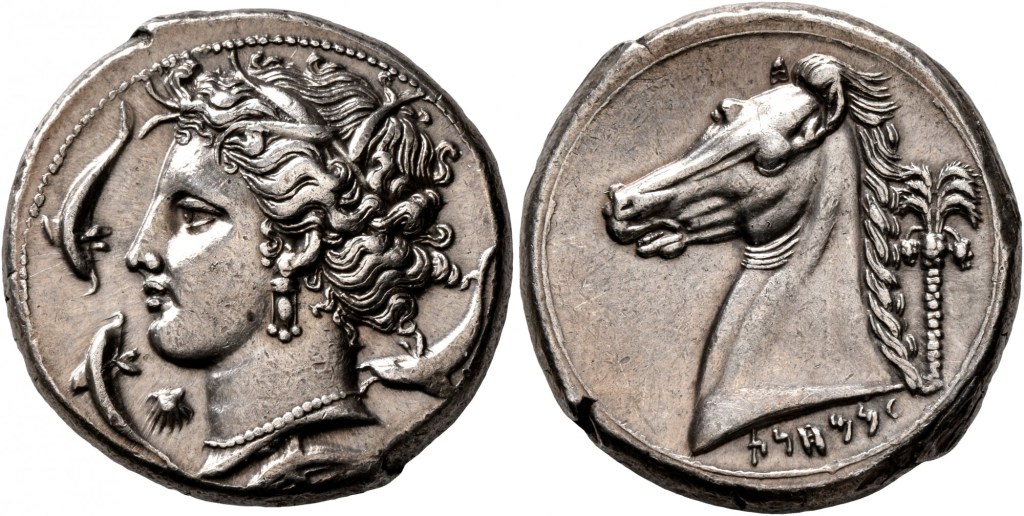
A Stunning SICULO-PUNIC Tetradrachm, circa 320-300 BC

Very few coins are, literally, breathtaking. The above coin is breathtaking. It sold at a Stephen Album Rare Coin auction for well-over its conservative estimate, and deservedly so, on January 20, 2022. It is most reminiscent of the slightly better example of the same type (also Jenkins 161) that sold for slightly less (8500 CHF, approx. $8,485) in Leu Numismatik’s 2019 Auction 4 as Lot 178.

Siculo-Punic AR Tetradrachm, c. 320-300 BC, People of the Camp mint, 17.00g.  Jenkins-161.  Numismatik Leu Auction 4, Lot 178 (2019).   Realized 8500 CHF on 4000 CHF Estimate.
Siculo-Punic AR Tetradrachm, c. 320-300 BC, People of the Camp mint, 17.00g. Jenkins-161. Numismatik Leu Auction 4, Lot 178 (2019). Realized 8500 CHF on 4000 CHF Estimate.

In the final decade of the fifth century BC, the Carthaginians launched a series of invasions of Sicily, conquering much of the western half of the island. The Carthaginian presence lasted for a century and a half, until Rome’s victory in the First Punic War obliged the Carthaginians to withdraw.

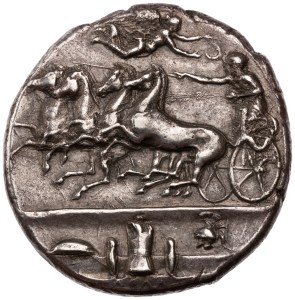
During their occupation of Sicily, the Carthaginians struck an extensive coinage for the purpose of financing their military operations and the maintenance of garrisons. Many of these coins were “military issues” and, surprisingly, labeled as such (i.e., as “camp” issues). The obverse and reverse types of the coins in the military series are mostly influenced by Sicilian prototypes, particularly those of Syracuse. The obverse of the Siculo-Punic Tetradrachm of which I am writing was inspired by the Syracusan AR decadrachm c. 400 BC signed by Euainetos. As noted by N.K. Rutter in Greek Coinages of Southern Italy and Sicily (Spink, London, 1997), it was copied by the Carthaginians because “… the reference to a Syracusan coin-type would have meant something to a Greek mercenary” (p.157).

G. Kenneth Jenkins studied these issues in his Coins of Punic Sicily (Parts I-IV, 1971-1978), and noted that the camp mint, once it was operating in Sicily, was most probably located in Lilybaion (Part III, p.11). This proposed location for the camp mint has been the object of debate for years and other locations have been proposed. For instance, Ian Lee, surveying the literature and reexamining the evidence for the earliest Punic coinage in Sicily, more recently concluded that the camp mint was located at Entella (LEE, IAN. “Entella: The Silver Coinage of the Campanian Mercenaries and the Site of the First Carthaginian Mint 410-409 BC.” The Numismatic Chronicle (1966-), vol. 160, Royal Numismatic Society, 2000, pp. 1–66, http://www.jstor.org/stable/42668259).

Siculo-Punic Tetradrachms, such as the one sold by Stephen Album Rare Coins, were ultimately destined to pay Greek mercenaries. The tetradrachms’ visual familiarity combined with its being struck to the Attic weight standard (c. 17.2 g.) rather than the Phoenician weight standard (c. 14.3 g. to the shekel or tetradrachm) usually used by the Carthaginians would have made it the perfect mechanism for payment to its intended recipients. [See Visonà, Paolo. “CARTHAGINIAN COINAGE IN PERSPECTIVE.” American Journal of Numismatics (1989-), vol. 10, American Numismatic Society, 1998, pp. 1–27, http://www.jstor.org/stable/43580385, p. 4, for discussion regarding adoption of Attic weight standard due to military exigency].

The Creation in Ovid’s Metamorphoses and A Recommended Translation

Antonio Tempesta’s etching “The Creation of the World” is based on Ovid’s ‘Metamorphoses’. Ovid, a canonical Roman poet, is best known for this epic poem, which beautifully recounts classical mythology tales. Charles Martin’s translation of Metamorphoses is recommended for its elegance and brilliance. In the poem, Ovid describes the divine creation of the universe, which Stephen M. Wheeler argues is influenced by the Homeric shield from Homer’s Iliad. Wheeler notes Ovid’s self-consciousness as a poet, suggesting that the universe’s ordering is a metaphor for the creation of the poem itself. This insightful exploration adds depth to Ovid’s captivating tale of creation.

Pūblius Ovidius Nāsō (43 BC – 17/18 AD), known in English as Ovid, is, along with Virgil and Horace, one of the three “canonical poets” of Latin literature.  He is, no doubt, best known today for his epic poem Metamorphoses, which is an extraordinarily beautiful telling of the tales of classical mythology.  I first became intimately acquainted with Metamorphoses in summer 1987 and have revisited it on multiple occasions ever since, never ceasing to be refreshed and delighted by the visit.

Metamorphoses – Ovid: A New Translation by Charles Martin, Introduction by Bernard Knox. W.W. Norton & Co., New York, 2004.

Several years ago, I purchased and read Charle Martin’s translation of Metamorphoses and do not hesitate to recommend this particular translation to you for its elegance, flow, and brilliance as demonstrated in the following excerpt.

The Creation

Before the seas and lands had been created,

before the sky that covers everything,

Nature displayed a single aspect only

throughout the cosmos; Chaos was its name,

a shapeless, unwrought mass of inert bulk

and nothing more, with the discordant seeds

of disconnected elements all heaped

together in anarchic disarray.

The sun as yet did not light up the earth,

nor did the crescent moon renew her horns,

nor was the earth suspended in midair,

balanced by her own weight, nor did the ocean

extend her arms to the margins of the land.

Although the land and sea and air were present,

land was unstable, the sea unfit for swimming,

and air lacked light; shapes shifted constantly,

and all things were at odds with one another,

for in a single mass cold strove with warm,

wet was opposed to dry and soft to hard,

and weightlessness to matter having weight.

Some god (or kinder nature) settled this

dispute by separating earth from heaven,

and then by separating sea from earth

and fluid aether from denser air;

and after these were separated out

and liberated from the primal heap,

he bound the disentangled elements

each in its place and all in harmony.

The fiery and weightless aether leapt

to heaven’s vault and claimed its citadel;

the next in lightness to be placed was air;

the denser earth drew down gross elements

and was compressed by its own gravity;

encircling water lastly found its place,

encompassing the solid earth entire.

Now when that god (whichever one it was)

had given Chaos form, dividing it

in parts which he arranged, he molded earth

into the shape of an enormous globe,

so that it should be uniform throughout.

And afterward he sent the waters streaming

in all directions, ordered waves to swell

under the sweeping winds, and sent the flood

to form new shores on the surrounded earth;

he added springs, great standing swamps and lakes,

as well as sloping rivers fixed between

their narrow banks, whose plunging waters (all

in varied places, each in its own channel)

are partly taken back into the earth

and in part flow until they reach the sea,

when they – received into larger field

of a freer flood – beat against shores, not banks.

He ordered open plains to spread themselves,

valleys to sink, the stony peaks to rise,

and forests to put on their coats of green.

And as the vault of heaven is divided

by two zones on the right and two on the left,

with a central zone, much hotter, in between,

so, by the care of this creator god,

the mass that was enclosed now by the sky

was zoned in the same way, with the same lines

inscribed upon the surface of the earth.

Heat makes the middle zone unlivable,

and the two outer zones are deep in snow;

between these two extremes, he placed two others

of temperate climate, blending cold and warmth.

Air was suspended over all of this,

proportionately heavier than aether,

as earth is heavier than water is.

He ordered mists and clouds into position,

and thunder, to make test of our resolve,

and winds creating thunderbolts and lighting.

Nor did that world-creating god permit

the winds to roam ungoverned through the air;

for even now, with each of them in charge

of his own kingdom, and their blasts controlled,

they scarcely can be kept from shattering

the world, such is the discord between brothers.

Eurus went eastward, to the lands of Dawn,

the kingdoms of Arabia and Persia,

and to the mountain peaks that lie below

the morning’s rays; and Zephyr took his place

on the western shores warmed by the setting sun.

The frozen north and Scythia were seized

by bristling Boreas; the lands opposite,

continually drenched by fog and rain,

are where the south wind, known as Auster, dwells.

Above these winds, he set the weightless aether,

a liquid free of every earthly toxin.

No sooner had he separated all

within defining limits, when the stars,

which formerly had been concealed in darkness,

began to blaze up all throughout the heavens;

and so that every region of the world

should have its own distinctive forms of life,

the constellations and the shapes of gods

occupied the lower part of heaven;

the seas gave shelter to the shining fishes,

earth received beasts, and flighty air, the birds.

An animal more like the gods than these,

more intellectually capable

and able to control the other beasts,

had not as yet appeared: now man was born,

either because the framer of all things,

the fabricator of this better world,

created man out of his own divine

substance – or else because Prometheus

took up a clod (so lately broken off

from lofty aether that it still contained

some elements in common with its kin),

and mixing it with water, molded it

into the shape of gods, who govern all.

And even though all other animals

lean forward and look down toward the ground,

he gave to man a face that is uplifted,

and ordered him to stand erect and look

directly up into the vaulted heavens

and turn his countenance to meet the stars;

the earth, that was lately rude and formless,

was changed by taking on the shapes of men.

Ovid, Metamorphoses, Book I, lines 6-125 (trans. Charles Martin)

Ovid’s tale of creation is both moving and striking, to say the least. And if one is at all like me in intellectual temperament, one cannot help but wonder where Ovid found the inspirational well for his striking poetic imagery and design. Fear not, my friends, Stephen M. Wheeler explored this issue in “Imago Mundi: Another View of the Creation in Ovid’s Metamorphoses” (The American Journal of Philology, vol. 116, no. 1, Johns Hopkins University Press, 1995, pp. 95–121, https://doi.org/10.2307/295504), an article recommended as worth your time to read.

Among other things, Wheeler argues that Ovid uses the Shield of Achilles (the Homeric Shield), from Homer’s Illiad, as “a model for his own version of the divinely created universe.” Wheeler does so by presenting evidence showing Ovid’s “allusive engagement with the Homeric shield” in his account of chaos, showing that Ovid’s description of the universe resembled the ecphrasis [i.e., the use of detailed description of a work of visual art as a literary device] of a work of art in the tradition of the Homeric shield, and that it prefigured other divine works of art in Metamorphoses, and by explaining why Ovid began the Metamorphoses with a reference to the Homeric shield as well as how the work should be read in “light of obvious allusions to Hesiod’s Theogony and the Apollonian song of Orpheus.” 

Greek, c. 470BC. Two-handled ceramic jar (amphora) depicting Hephaistos polishing the Shield of Achilles in the presence of Thetis. In the field, a pair of greaves, a helmet, tongs, hammer and saw. Bartlett Collection. (c) Museum of Fine Art Boston.

Towards the conclusion of his article, Wheeler states the following: “Ovid’s choice to begin Metamorphoses with an epic ecphrasis also highlights his own-self-consciousness as a poet.  It is well-known that the device of ecphrasis offers the poet an opportunity to reflect upon his own art while describing the art of another.  The deus et melior natura may therefore be read as a figure for the poet, and the ordering of the universe as a metaphor for creation of the poem; thus the “real” subject of Ovid’s cosmogony may be the literary creation of Metamorphoses, just as the shield of Achilles is emblematic of the creation of the Iliad” (p. 117).

Giambattista Vico, Metaphorical Language, and the Darmok episode of Star Trek: The Next Generation

Giambattista Vico, an influential figure in the 18th century, has gained recognition for his work on historical imagination. His opus “The New Science,” published in 1744, has contributed significantly to various disciplines, including philosophy, anthropology, literary criticism, and psychology. Vico’s views have influenced notable thinkers and writers, such as Wilhelm Dilthey, Karl Marx, R.G. Collingwood, and James Joyce. Understanding Vico’s perspective on metaphorical language sheds light on the significance of ancient literary and artistic works. This understanding resonates with the “Darmok” episode in Star Trek, where the encounter between two species with different languages reflects Vico’s ideas. The implications of language and culture on human advancement continue to be a subject of debate and analysis.

Giambattista Vico

Of late, the insights and importance of Giambattista Vico, an eighteenth century Neapolitan, especially as they relate to historical imagination, have attracted my attention.  To plumb the depths of the significance of his work, which are far deeper than I initially imagined, I obtained and read a translation of his opus Scienza Nuova seconda (or simply The New Science, the title under which the definitive version published in 1744 is known today).  The translation I obtained was published by Yale University Press in 2020, translated by Jason Taylor and Robert C. Miner, with an introduction by Giuseppe Mazzotta.  It is the third English translation of The New Science and is both well-notated and highly readable.   

Book Cover: The New Science by Giambattista Vico

Giovanni Battista Vico was born in Naples on June 23, 1668.  He received his education at local grammar schools, from Jesuit tutors, and at the University of Naples from which he graduated in 1694 as Doctor of Civil and Canon Law.  Although he never succeeded in obtaining the chair of Jurisprudence at the University of Naples, which he long desired, he did obtain a professorship in Rhetoric at the University, which he held until 1741.  Vico died in Naples in January 1744, at the age of 75. 

In his lifetime Vico’s works were largely unremarked, however, by the nineteenth century his extraordinary insights began to make a significant impression on philosophers, historians, and other intellectuals.  Vico’s ideas reached a wider audience with a German translation of The New Science by W.E. Weber which appeared in 1822, and, more significantly, through a French translation by Jules Michelet in 1824.  Subsequently, Vico’s views influenced the work of Wilhelm Dilthey, Karl Marx, R.G. Collingwood, and James Joyce, who used The New Science to structure Finnegans Wake.  The Stanford Encyclopedia of Philosophy notes that “ … an appreciation of Vico’s thought has spread far beyond philosophy, and his ideas have been taken up by scholars within a range of contemporary disciplines, including anthropology, cultural theory, education, hermeneutics, history, literary criticism, psychology, and sociology. Thus despite obscure beginnings, Vico is now widely regarded as a highly original thinker who anticipated central currents in later philosophy and the human sciences.”

When I was searching for guidance on understanding Vico, I quickly found that some of the greatest intellects of the twentieth century had both lectured and written on him.  For instance, the political philosopher Leo Strauss had lectured on him in Autumn Quarter 1963 at the University of Chicago.  Audio files of the lectures are available at the University’s Leo Strauss Center website; however, the quality of the audio files is uneven and, in many instances, poor.  But not to fear, a comprehensive and helpful written summary of the lectures is available here.  More helpful, and the immediate impetus for this posting, is the second guide I utilized for Vico: the writings by the intellectual historian Isaiah Berlin collected in the work entitled, Three Critics of the Enlightenment – Vico, Hamann, Herder (with a foreword by Jonathan Israel), Second Edition, edited by Henry Hardy, which was published by Princeton University Press in 2013.

Bookcover: Isaiah Berlin's Three Critics of the Enlightenment Vico Haman Herder

From the latter work, Three Critics of the Enlightenment, Berlin wrote a masterful section summarizing Vico’s attitude towards an appropriate historical understanding of humanity’s use of metaphorical language that immediately gave me a greater understanding and appreciation of both Vico’s genius and insight as well as brought to my mind with particular force many different literary and artistic works which I had previously experienced, but in a new and more vivid light.  First, the lengthy extract from Berlin’s essay:

“We normally distinguish between the literal and the metaphorical use of language.  To be literal is to call things by their appropriate names, and describe them in plain, simple terms; to use metaphor is a sophisticated or poetical way of embellishing or heightening such plain usage for the sake of giving pleasure or of creating vivid imaginative effects, or of demonstrating verbal ingenuity; this is usually considered the product of conscious elaboration which could, with enough effort, always be translated back into the plain or literal sense of which it is merely an artificially heightened expression.  Metaphor and simile, even allegory, are not for Vico, deliberate artifices.  They are natural ways of expressing a vision of life different from ours.  Men once thought, according to him, in images rather than concepts, and ‘attributed senses and passions […]to bodies as vast as sky sea and earth’.  What for us a less or more conscious use of rhetorical devices was their sole means of ordering, connecting and conveying what they sensed, observed, remembered, imagined, hoped, feared, worshiped – in short their entire experience.  This is what Vico calls ‘poetic logic’, the pattern of language and thought in the age of heroes.  The metaphorical use precedes – and must precede – the ‘literal’ use of words, as poetry must come before prose, as song is earlier than spoken speech; ‘the source of all poetic locution are two: poverty of language and need to explain and be understood’.  Early man, animist and anthropomorphist, thought in terms of what we now call metaphor as naturally and inevitably as we now think in ‘literal’ phrases.  Hence a great deal of what now passes for literal speech incorporates dead metaphors, the origins of which are so little remembered that they are no longer felt – even faintly – as such.  Since the changing structure of a language ‘tells us the histories of the institutions signified by the words’, we can glean from it something of how their world looked to our ancestors.  Because primitive man cannot abstract, ‘metaphor makes up the great body of the language among all nations’ at that time.  Vico supposed that such men used similes, images and metaphors much as people, to this day, use flags, or uniforms, or Fascist salutes – to convey something directly; this is a use of signs which it would today seem unnatural to call either metaphorical or literal.  Vico maintains that when a primitive man said ‘the blood boils in my heart’, where we should say ‘I am angry’, his ‘metaphorical’ phrase is a uniquely valuable evidence of the way in which such a man though, perceived and felt.  What he felt when he spoke of blood boiling seemed to him – and indeed was – more directly related to his perception of water in a heated cauldron than our sensation of anger would seem to us today.  The marvellous images, the immortal phrases coined by early poets are, according to Vico, due not to conscious flights of fancy but to the fact that the imaginations of such men and their capacity for direct sensations were so much stronger than ours as to be different in kind, while their capacity for precise analogies and scientific observations was far less developed.  Hence, if we are to understand their world, we must try to project ourselves into minds very remote from our own and endowed with these unfamiliar powers.  A world in which men naturally talk of the lip of a cup, the teeth of a rake, the mouth of a river, a neck of land, handfuls of one thing, the heart of another, veins of minerals, bowels of the earth, murmuring waves, whistling winds, smiling skies, groaning tables and weeping willows – such a world must be deeply and systemically different from any in which such phrases are felt, even remotely, to be metaphorical, as contrasted with so-called literal speech.  This is one of Vico’s most revolutionary discoveries.”

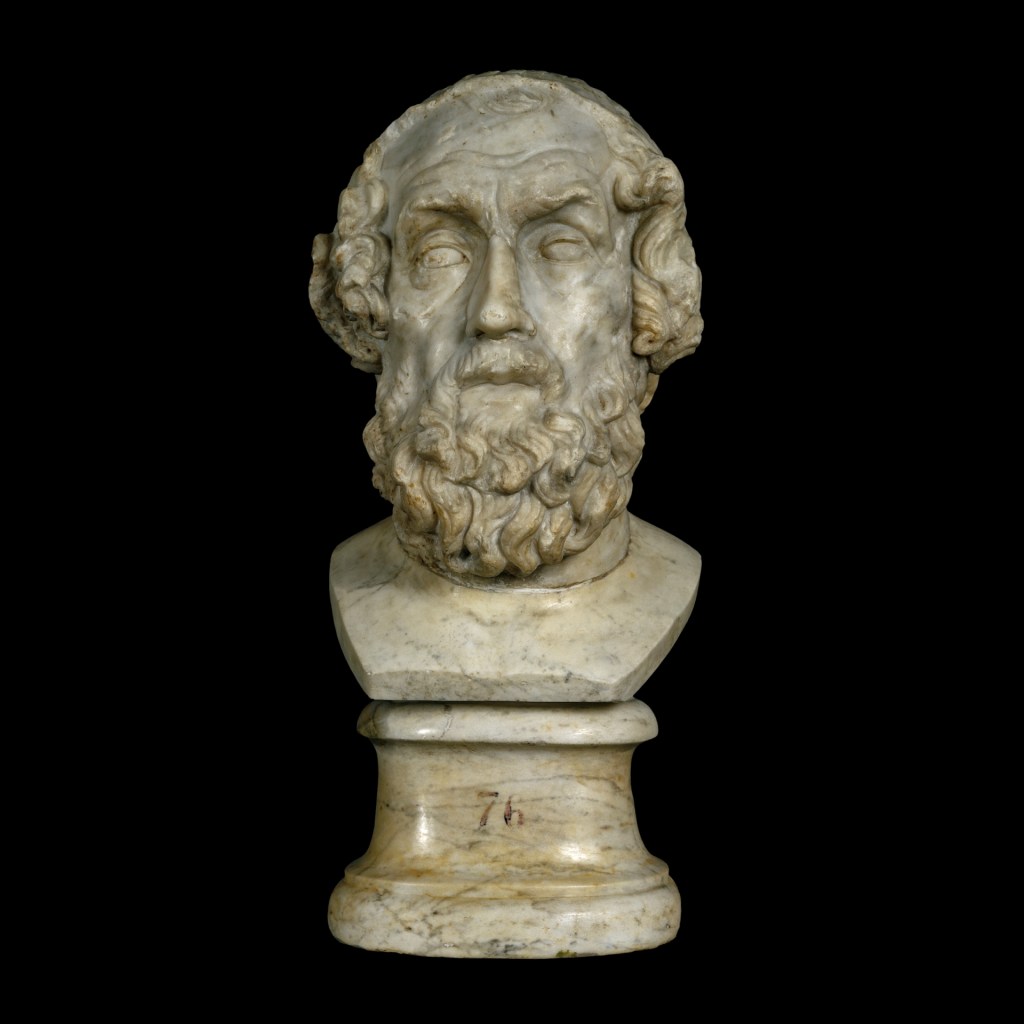
A Roman copy of a Hellenistic image of the poet Homer, author of the Iliad and Odyssey, sculpted in white marble between 150 and 125 BC.  Copyright ©Museo Nacional del Prado

Revolutionary indeed!  Who cannot but grasp even a scintilla of the foregoing and not know that reading the Iliad or Gilgamesh will be even more instinctually meaningful and powerful if read with this understanding of how those works struck the ears and core of our ancestors so many thousands of years ago?  And this, finally, brings me to the Darmok episode, which came to mind quite readily as I read the above on metaphorical speech.

A Trekkie I am not.  However, I do recall being struck by the brilliance of the Darmok episode when I first saw it decades ago.  The episode summary: Starfleet, a species known as speaking a literal language, interacts with a species (Tamarians) that uses a metaphorical language.  As a result of the language disconnect, the two species are initially unable to understand each other with tragic consequences as they engage in an ‘epic’ struggle with a hostile predator.  Ultimately, Picard, using the metaphorical language of Gilgamesh, communicates his understanding, such as it is, with the other species, thereby extending a tenuous bridge between the species … with optimistic portents for future relations. Star Trek often had ‘primitive’ species zipping across the universe with advance technology.  As such, it is not surprising that a species capable only of metaphorical language would be capable of interstellar flight in the Star Trek universe.  In Vico’s universe, however, such a primitive state of humanity (for he could conceive only of humanity) would not be capable of such advanced technological achievements.

An Atlantic article published in 2014 noted that many Trekkies also argued that the Tamarians would be unable to be so advanced given the limitations imposed by their metaphorical language. However, the author of the article, Ian Bogost, countered that the Tamarian language was sufficient, if compared, not to metaphor, but perhaps to allegory or, better yet, was understood as an abstraction, that is, a form of logic, which could be best described as a strategy. His argument is, to my sensibilities, convoluted, complex, and unattractive, but worth reviewing.