The music in the YouTube video below, Forgotten Memory of a Dying Dream, has utterly captivated me. Its delicate piano notes, scattered like raindrops, lull me into a trance, much like the gentle patter of autumn rain. I find myself playing it on repeat, mesmerized by its melancholic beauty. The music is both soothing and evocative, drawing me into a realm of reflection and relaxation. Inspired by this, I felt compelled to offer a poetic response—an embrace, of sorts, to the mood it evokes. But please, I encourage you to listen to the music to fully appreciate the inspiration behind the poem—I have had it on repeat for days.
Autumn’s Forgotten Dream
The keys fall soft, like autumn rain, A whispered sigh in quiet refrain. Each note, a droplet, cool and clear, Tells of dreams that disappear.
The melody drifts, a mournful breeze, Through branches bare of summer’s leaves. It echoes long, then fades away, Like shadows at the edge of day.
In every pause, the silence hums, A memory of what never comes. The piano weeps in gentle streams, For forgotten hopes and dying dreams.
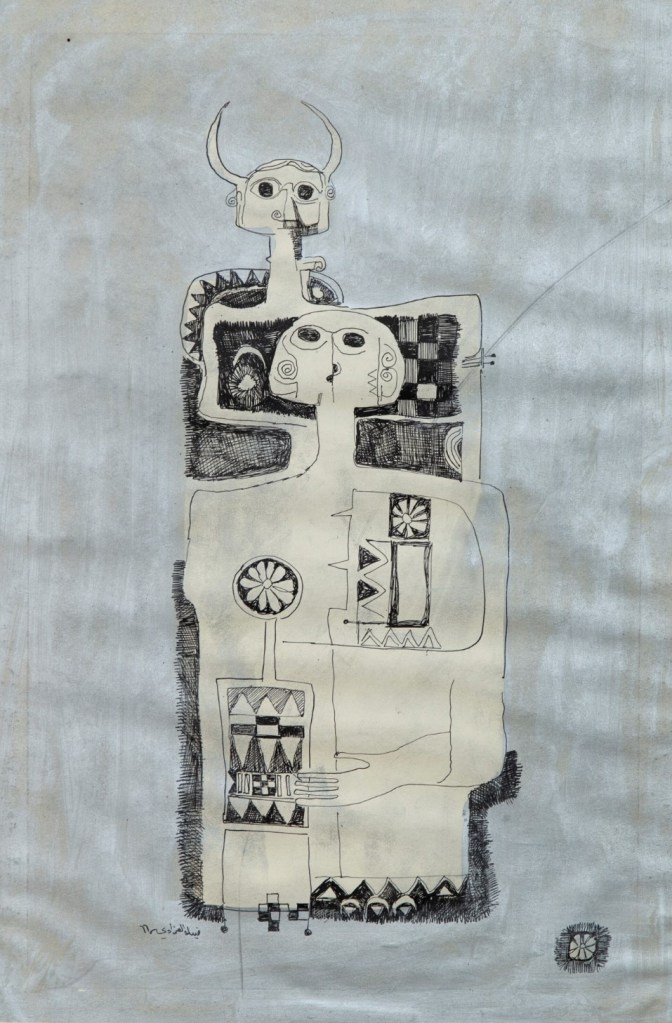
Adam Pendleton If the function of dada, 2017 Galerie Laurent Strouk
Good Lord! First they came for delve, and now they are coming for tapestry. Will constellation be next? I just read an article titled “ChatGPT is changing the way we write. Here’s how – and why it’s a problem,” once again casting aspersions on the use of delve, insinuating that its presence in prose—whether in an essay, school or employment application, or other work—suggests AI involvement. This article also raises suspicions about the word tapestry and other “stylistic” and “scholarly” words.
At this point, I cannot help but take deep offense, as it seems that any vocabulary beyond a third-grade level—essentially, a rich and varied vocabulary—is now suspect. As I have noted before, delve is not uncommon in my writing, and I often employ tapestry and constellation metaphorically. For example, I might refer to “a constellation of factors” when carefully considering a complex issue, or speak of “the tapestry of life,” as I did in a poem where tapestry appeared in both the title and the refrain.
Moreover, I have long used multisyllabic words such as verity, prodigious, exigency, modicum, sundry, and laborious in both my writing and speech, along with Latin and other foreign language phrases—all well before AI ever became a tool available to assist anyone in writing anything. Assuredly, those words would all be marks of suspicion today, if for no other reason than that they are uncommon to those less familiar with an extensive vocabulary—who seem to prefer the vocabulary and style of Hemingway (though this observation is not to disparage Hemingway’s vocabulary or style itself).
The frequency of these articles has become so overwhelming that the suspicions they plant have now ingrained themselves in my mental landscape—so much so that, while recently re-reading a delightful book from 1983, Daniel J. Boorstin’s The Discoverers, I found my equilibrium disturbed upon encountering a form of one of these now-verboten words—delve—used in a quote from Marie Jean Antoine Nicolas de Caritat, Marquis de Condorcet (1743–1794):
“Generally speaking, people have a very erroneous idea of the type of talent proper to the ideal mechanician. He is not a geometrician who, delving into the theory of movement and the categories of phenomena, formulates new mechanical principles or discovers unsuspected laws of nature ….”[1]
I momentarily pondered whether Boorstin or the Marquis had engaged with AI.
I fear that the article’s call to “write clearly” and to eschew all “stylistic language” contributes to the growing pressure to purge one’s writing of any and all suspect words, lest one be accused of literary fraud. This trend will ultimately impoverish poetry, prose, and language as a whole. The insistence on reducing language to its barest bones under the guise of simplicity and her sister clarity threatens to strip away not only the beauty and nuance that more expansive language brings but also the intellectual rigor it offers—more the pity.
Perhaps, if this trend continues, we will soon see an officially approved dictionary—quite slim, of course—purged of all offending words, especially those that are multisyllabic, scholarly, or carry any hint of flourish. Most certainly, this dictionary will exclude anything exceeding two syllables or requiring a moment of deeper thought. The end result? A homogenized language, stripped of depth and elegance, where the richness of expression once celebrated is replaced by a narrow, minimalist vernacular that leaves little room for imagination or creativity. Thus do the times conspire against us.
[1] Boorstin, D. J. (1983). The Discoverers: A History of Man’s Search to Know His World and Himself (p. 67). Random House.
The Sower (oil on canvas, 1888) by Vincent van Gogh (1853-1890). Van Gogh Museum, Amsterdam.
Note on the Origin of This Poem
This poem was inspired by a recent reflection on T.S. Eliot’s Burnt Norton, the first of his Four Quartets (with a nod to Augustine of Hippo’s Confessions, which I have also recently revisited). Eliot’s meditation on time has long intrigued me, particularly his exploration of the eternal present where past, present, and future are interwoven. His lines, “What might have been and what has been / Point to one end, which is always present,” reflect an awareness of unrealized possibilities lingering in memory, resonating with the tension between choice and fate.
While Eliot does not dwell entirely on regret, his imagery—such as “the passage which we did not take / Towards the door we never opened”—evokes a sense of paths unchosen and moments lost, suggesting an undercurrent of melancholy and reflection on missed opportunities.
This contrasts with my own perspective, which views the past not as a source of sorrow or lamentation but as a guide—a map to navigate the future. For me, the past should instruct us, not torment us. I focus not on what might have been but on the lessons that can inform where we must go next. As I recently discussed with one of my sisters, I learned more from my past failures, whether on school exams, work situations, or personal circumstances, than I did from my successes.
In short, regret is the most useless emotion.
Inspired by this distinction, I sought to explore these ideas poetically, offering a reflection on time that emphasizes the instructive value of the past rather than its potential to weigh us down with regret.
The Past Is but a Map
The past is not a chain of sorrow, Not the dust of what we might have been— But a map unfolding, Marked by lines of roads untaken. The tests we failed are etched more deeply Than triumphs where we passed unscarred. The echo of footfalls is not regret’s whisper But instruction pointing forward. The door unopened is not lamented But a path unseen, Waiting to instruct. Hard lessons carve deeper than easy ones; Each misstep, a mark of progress. The teacher we resisted Becomes the guide we heed. There is no torment in yesterday’s shadow, Only the light of what we must now become. Ever forward, we glance back— Not for grief, But for direction, For the past keeps its own counsel As we shape the days to come.
The Epic of Gilgamesh and its related ancient tales have long been a source of inspiration for me, often woven into my prose. Earlier this week, I had the pleasure of reading an essay by Andrew George, written in 2012, which I highly recommend to your attention: The Mayfly on the River: Individual and Collective Destiny in the Epic of Gilgamesh. As with all of George’s works, this essay is masterful, and it resonated with much of my recent work. By coincidence, his reference to the mayfly aligned perfectly with a sub-theme of a monograph I have been developing over the past several weeks.
Inspired by these reflections and my own experience with the loss of close friends, I chose to explore The Epic of Gilgamesh through poetry, marking a departure from my usual prose. Below, I offer a poem that captures a dream in which Gilgamesh contemplates the profound absence of Enkidu, his friend and companion, who met death as punishment for the transgressions he and Gilgamesh committed against the gods. The timeless relationship between Gilgamesh and Enkidu seemed to me a fitting metaphor for the sorrow that accompanies the loss of friends and the enduring nature of their memory.
An Audio Recitation of Donald S. Yarab’s The Dream of Gilgamesh
The Dream of Gilgamesh
In the shadows of my sleep, you came, Enkidu, my brother, carved from the heavens, The rock that fell to earth and struck me whole. But now the earth has claimed you, Silent is the storm of your breath, Felled like the great cedar, your might is no more. I reach for you, yet grasp but dust.
The gods whisper through the winds, Enkidu, you are beyond my reach, Though I call, your name echoes Through the empty halls of Uruk, A soundless shadow, a memory unmade.
In the dream, I see you on the plain, Your laughter rolls like thunder once more, Yet it is distant, swallowed by the sky. I run to you, but the earth swallows my feet, The horizon stretches and bends, And you fade, a shadow of stars, Leaving me to wrestle with the night.
Oh, Enkidu, my companion, my rock from the heavens, In life, you steadied me, made my heart whole. Now the world is too wide, The journey too long. What joy can be found in Uruk’s walls, Without your hand upon my shoulder? You lie beneath the river stones, And I am left to wander the desolate road alone.
Wild flowers in my backyard, Cleveland, Ohio – September 21, 2024.
Our long, hot summer finally comes to an end on Sunday, September 22, at 8:48 a.m. EDT with the autumnal equinox, which marks the beginning of fall here in the Northern Hemisphere.







 Northcoast Antiquarian